Paths after high school
Every path after high school, explained honestly
By Pathfinder Editorial · Published · 15 min read
About: Pathway Trade and apprenticeship Primary and backup path Still deciding

There are eight paths after high school — six of them alternatives to college — and university is one of them, not the default. In October 2024, 62.8% of 2024 high school graduates ages 16 to 24 were enrolled in colleges or universities (BLS, 2025) — so a large share were not.
This is written for a student in grades 9–12, or a parent of one (see my teen doesn't want to go to college), who wants the whole map rather than a verdict. Pathfinder treats every route after high school as equally valid, so nothing below assumes college. The figures are US national data; Pathfinder ships country packs for the US, the UK, the UAE, India and Singapore, so the questions travel even where the numbers do not.
What is a pathway?
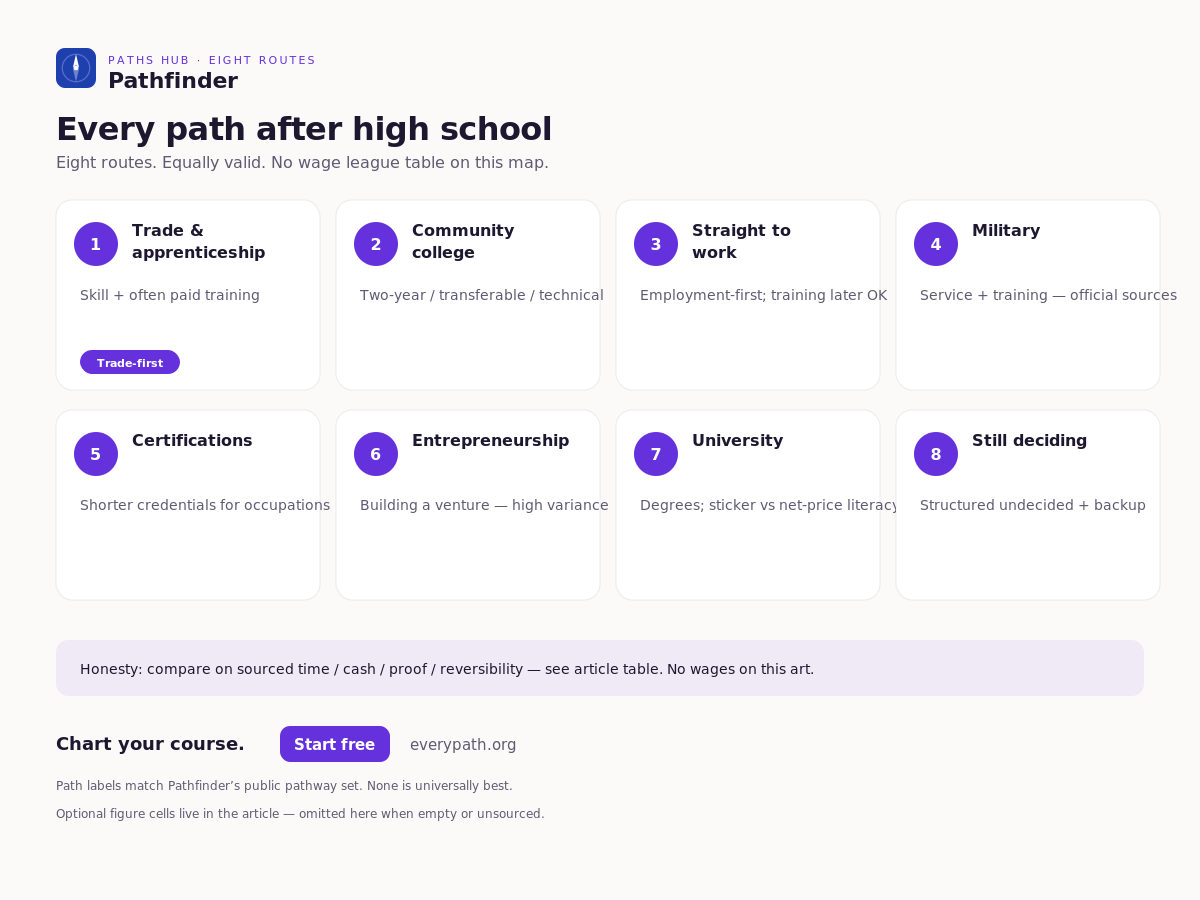
A pathway is one of the eight routes Pathfinder treats as equally valid after high school. University is one option among many, never the default. The eight, in the order the product lists them, are trade and apprenticeship, community college, straight to work, military, certifications, entrepreneurship, university, and still deciding.
Two caveats. The eight are not equally common. And they are not mutually exclusive: people move between them, stack them, and come back to one they left.
For one path compared with university using official pay and cost figures, see apprenticeship vs. college.
Here is each path with one figure attached.
| Path | One figure | What it measures | Source (year) |
|---|---|---|---|
| Trade and apprenticeship | About 940,000 workers | Participants in Registered Apprenticeship Programs, FY2024 | GAO-25-107040 (2025) |
| Community college | $4,150 | Average published in-district tuition and fees, public two-year | College Board (2025-26) |
| Straight to work | $966 | Median usual weekly earnings, high school diploma, ages 25+ | BLS (2025) |
| Military | No figure quoted | Pay is set by grade and years of service; see the limits section | Definitional, not sourced |
| Certifications | $44,470 | Median annual wage, EMTs; typical entry is a postsecondary nondegree award | BLS OOH (May 2025) |
| Entrepreneurship | No figure quoted | No official annual total printed on a primary page we could open | Definitional, not sourced |
| University | $11,950 | Average published in-state tuition and fees, public four-year | College Board (2025-26) |
| Still deciding | No figure quoted | A planning stance, not a measured population | Definitional, not sourced |
Three rows say "no figure quoted". That is deliberate: a path without a clean, dated, primary figure gets an empty cell rather than a borrowed one.
What do recent high school graduates actually do?
Most enrol, and a large minority do not — and the group that does not has a hard labour market. Those are the two facts worth carrying into every section below.
| Measure | Figure | Month / year | Source |
|---|---|---|---|
| 2024 graduates ages 16 to 24 enrolled in colleges or universities | 62.8% | October 2024 | BLS (released April 2025) |
| Unemployment rate, recent graduates not enrolled in college | 20.4% | October 2024 | BLS (released April 2025) |
| 2022 high school completers enrolled in college that October | 62% (1.9 million of 3.0 million) | October 2022 | NCES (2022) |
The BLS and NCES figures are close, but they are separate surveys of separate cohorts two years apart. Read them as two measurements pointing the same way, not as a trend line.
The 20.4% unemployment rate is the number that changes the conversation. Not enrolling is common; doing it without a plan is expensive. Each of the non-college paths below is a plan.
What are the alternatives to college, path by path?
Each path — the six alternatives to college, university itself, and still deciding — gets the same treatment: what it is, one official figure where one exists, what entry looks like, and one honest limit.
Trade and apprenticeship
Trade and apprenticeship routes combine paid work with structured training into a skilled career. The formal version is a registered apprenticeship. The U.S. Department of Labor describes it on apprenticeship.gov as paid work experience with a mentor, progressive wage increases and classroom instruction, ending in a portable, nationally recognised credential.
The scale is real: about 940,000 workers participated in Registered Apprenticeship Programs in fiscal year 2024, across construction, technology, advanced manufacturing, healthcare and energy (GAO, 2025). GAO also reports that completers earned average annual wages of about $80,000 in their first year after exiting. That is a mean, for people who finished — not a wage anyone is offered on day one.
For a specific trade, BLS reports a median annual wage of $63,190 for electricians in May 2025, with a high school diploma or equivalent as the typical entry-level education. Entry is local: sponsors and openings live in your state, not in a national count. The fuller comparison is in apprenticeship vs. college, and in trade school vs. college. For the formal route itself, start with what a registered apprenticeship is, then how to find one.
Community college
Community college is an affordable, flexible route either to transfer into a four-year degree or to enter the workforce directly. Average published in-district tuition and fees at public two-year colleges were $4,150 in 2025-26 (College Board, 2025-26). NCES puts average tuition and fees at public two-year institutions at $4,000 in 2022-23 — a different year and a different series, so do not read the gap as an increase.
The honest limit is completion. Among students who entered two-year programmes in fall 2017, about 34% attained their credential within 150% of the normal time (NCES, 2020 data). Transfer intentions and part-time study make that figure hard to read without its definition attached. The route-by-route comparison is in community college vs. university.
Straight to work
Straight to work means entering the workforce directly after high school with a plan for the skills, experience and roles that get you where you want to go. BLS reports median usual weekly earnings of $966 for workers ages 25 and over whose highest attainment is a high school diploma, with a 4.3% unemployment rate (BLS, 2025).
Specific occupations are easier to plan against than an attainment average. BLS reports a median annual wage of $44,770 for customer service representatives in May 2025, and says they typically need a high school diploma or equivalent to enter the occupation.
The limit: this is a starting line, not a destination. The attainment table describes where people are at 25 and over, not where an 18-year-old starts. How to plan it with a backup is in straight to work after high school.
Military
Military service means serving in the armed forces to earn qualifications and build a career with structure, purpose and funding. Education benefits are part of the offer: the Department of Veterans Affairs describes the Post-9/11 GI Bill as a benefit that helps you pay for school or cover expenses while you are training for a job.
This section quotes no pay figure and no entrance requirement. Basic pay is set by pay grade and years of service on the Department of Defense's annual pay tables, and entry rules are set by each service — both change, so read the current official page rather than a third-party calculator or this article. The side-by-side, using VA, DoD and BLS pages only, is in military vs. college.
Certifications
Certifications are industry credentials — from coding bootcamps to professional certificates — that open doors to specific jobs without a degree. BLS calls the corresponding entry level a "postsecondary nondegree award", and you can see what that buys in a real occupation: EMTs and paramedics both enter that way, with a median annual wage of $44,470 for EMTs and $60,600 for paramedics in May 2025 (BLS, May 2025).
The limit: a certificate only counts where employers ask for it. The value sits in a specific credential for a specific occupation. What each proves, and who issues it, is in certifications vs. a degree.
Entrepreneurship
Entrepreneurship is starting something of your own: developing skills, finding early customers and building a business instead of, or alongside, further study.
This section deliberately carries no statistic. Business formation counts, survival rates and failure rates are all widely quoted, but they measure the fate of businesses, not the prospects of a school-leaver. So no numbers here, and no "most businesses fail" either. What a plan can do is make the first steps concrete — a customer, a price, a way to get paid — while a backup path stays alive. Starting a business instead of college covers the official tools for testing an idea locally.
University
University is the degree route: comparing courses and colleges and understanding what each asks for. Average published in-state tuition and fees at public four-year institutions were $11,950 in 2025-26 (College Board, 2025-26). NCES puts average tuition and fees at public four-year institutions at $9,800 in 2022-23 — again, a different year and series.
Two further figures belong here. Take the fall 2014 cohort of first-time, full-time students seeking a bachelor's degree. Their overall six-year graduation rate was 64% (NCES, 2020 data). Median usual weekly earnings for bachelor's degree holders ages 25 and over were $1,578, with 2.8% unemployment (BLS, 2025). The earnings row describes people who finished; the graduation row is why that condition matters. If you are not starting now, can you go to college later? explains how applying later works.
Still deciding
Still deciding is "not sure yet" treated as a legitimate starting point, with no pressure to commit. Pathfinder makes it a pathway in its own right, because the alternative — picking something so you have an answer ready — is how people end up a year into a route they never chose. Still deciding what to do after high school? walks through that stance.
A gap year is related but different: a deliberate break between high school and what comes next. It is a choice to plan around, not one of the eight. Is a gap year a good idea? covers how to plan one so it does not drift.
How do the eight paths compare side by side?
| Path | Paid while training? | Up-front cost figure? | One entry requirement | One earnings figure (measure) | Source (year) |
|---|---|---|---|---|---|
| Trade and apprenticeship | Yes — progressive wage increases | None; it is a job | HS diploma or equivalent (electricians) | About $80,000 mean annual wage, completers' first year after exit | DOL (undated, opened 2026-09-11); GAO (2025); BLS OOH (May 2025) |
| Community college | No | $4,150 in-district tuition and fees | Varies by college; definitional | None quoted | College Board (2025-26) |
| Straight to work | Yes — it is a job | None | HS diploma or equivalent (customer service reps) | $966 median weekly earnings, HS diploma | BLS (2025); BLS OOH (May 2025) |
| Military | Yes — service is paid | None quoted | None quoted; set by each service | None quoted | VA (updated July 2026) |
| Certifications | Usually no | None quoted | Postsecondary nondegree award (EMTs, paramedics) | $44,470 and $60,600 median annual wages | BLS OOH (May 2025) |
| Entrepreneurship | No | None quoted | None; definitional | None quoted | Definitional, not sourced |
| University | No | $11,950 in-state tuition and fees | The programme's own admission requirements | $1,578 median weekly earnings, bachelor's | College Board (2025-26); BLS (2025) |
| Still deciding | Not applicable | None | None; definitional | None quoted | Definitional, not sourced |
Look at how little of that table lines up. One cell holds a mean for completers, the next a median for an occupation, the next a weekly median across an attainment group. That mismatch is the finding: these routes cannot be ranked, because nobody measures them on one scale.
What can't these numbers tell you?
They cannot tell you what will happen to you. Averages and medians describe populations. You are one person, in one state, in one labour market, at one moment.
- Every path here is measured differently. GAO's about $80,000 is a mean annual wage for apprenticeship completers; the BLS $1,578 is a weekly median across everyone with a bachelor's degree. Neither is a salary offer.
- The years do not match. College Board prices are 2025-26, NCES tuition is 2022-23, NCES graduation rates use fall 2014 and fall 2017 cohorts, and BLS occupational wages are May 2025. Differences across those rows are mostly differences in vintage.
- The BLS attainment table cannot see apprenticeships. BLS states its education categories do not take into account completion of training programs in the form of apprenticeships and other on-the-job training (BLS, 2025). The strongest earn-and-learn route is invisible in the table people quote most.
- The 2025 BLS annual estimates are 11-month averages. BLS notes they exclude October, because data for October 2025 were not collected during the federal government shutdown (BLS, 2025).
- Three paths here carry no figure at all. Military pay, business formation counts and "still deciding" are missing rather than estimated. A gap in a table is more honest than a borrowed number.
- National is not local. Tuition, wages and apprenticeship openings vary by state and metro area, and a national median can sit a long way from what is near you.
This is how Pathfinder labels its own claims. A sourced national figure is grounded for exactly what it says and no further. Anything Pathfinder calculates for you from it is modelled — a reasoned estimate, marked as one. Neither ever becomes a prediction about you: Pathfinder will not state your chances of getting in, in any wording, which is one of the things its AI is built to refuse.
How do you decide?
Turn the national figures into questions about your options after high school:
- Which of the eight would you pick today? Not a commitment — a starting position you can test against the rest of this page.
- Does that path exist near you next year? Apprenticeship sponsors, community college programmes and employers are local facts. A national count says nothing about openings in your county. If you are a senior, the dated gates for this year are in your 12th-grade plan.
- What would it actually cost you, after aid? Published tuition is a sticker figure. What matters is what you would pay at one named institution.
- What does the entry line look like? For several routes BLS names the typical entry-level education outright, and "high school diploma or equivalent" is a very different starting line from a degree requirement.
- What is my backup? Choosing a primary path and an explicit backup path beats one unhedged bet, and most of these routes combine.
- Am I ready to choose at all? "Still deciding" is a legitimate answer and a starting point to plan around.
Pathfinder's what is free and what is not page sets out what a tool costs before you start, and the free plan needs no card.
Guides for each path
- Trade and apprenticeship: apprenticeship vs. college, trade school vs. college, what is a registered apprenticeship?, how to find a registered apprenticeship, apprenticeship requirements after high school, do you get paid during an apprenticeship?, how long does an apprenticeship take?, do apprenticeships count as college credit?
- Community college: community college vs. university
- Straight to work: straight to work after high school
- Military: military vs. college
- Certifications: certifications vs. a degree
- Entrepreneurship: starting a business instead of college
- University: can you go to college later?
- Still deciding: still deciding after high school?, how to choose a path after high school, is a gap year a good idea?, is it okay not to go to college?
- Any path: your 12th-grade plan, what counts as evidence on an application?, how scholarship eligibility is decided
- For parents and the family conversation: my teen doesn't want to go to college, how to help your teenager choose a career, how to tell your parents you don't want to go to college
Want a plan for whichever of these you pick?
Pathfinder builds you a plan for whichever path you pick — or for "still deciding" — and labels every claim in it as grounded, modelled or advisory. It will not invent a deadline, a cost, or your odds of getting in.
Start free — no credit card required.
Frequently asked questions
What are the alternatives to college?
Trade and apprenticeship, community college, straight to work, military, certifications and entrepreneurship are the six routes Pathfinder lists alongside university and still deciding. Seven are measured populations; still deciding is a planning stance.
Which path after high school pays the most?
There is no honest single answer. The published figures measure different things — a mean for apprenticeship completers, medians by occupation, weekly medians by education level — so they cannot be ranked against each other.
Can you combine more than one path?
Yes. Community college transfer, an apprenticeship followed by a degree, or certifications alongside work are all normal. Pathfinder is built around a primary path plus an explicit backup rather than one bet.
What if I do not know what I want to do yet?
Still deciding is a pathway in its own right, not a failure to have an opinion. You can plan around it, and revisit the choice when you know more.
Do these figures apply outside the United States?
No. Every figure here is US federal or US national data. Pathfinder ships country packs for the US, the UK, the UAE, India and Singapore, so the questions travel even where the numbers do not.
Sources
- College Enrollment and Work Activity of 2024 High School Graduates — U.S. Bureau of Labor Statistics (2025), accessed 2026-09-11
- Condition of Education — Immediate College Enrollment Rate — National Center for Education Statistics (2022), accessed 2026-09-11
- Apprenticeship for Career Seekers — U.S. Department of Labor, accessed 2026-09-11
- Apprenticeship: Earn-and-Learn Opportunities Can Benefit Workers and Employers (GAO-25-107040) — U.S. Government Accountability Office (2025), accessed 2026-09-11
- Occupational Outlook Handbook — Electricians — U.S. Bureau of Labor Statistics (2025), accessed 2026-09-11
- Occupational Outlook Handbook — Customer Service Representatives — U.S. Bureau of Labor Statistics (2025), accessed 2026-09-11
- Occupational Outlook Handbook — EMTs and Paramedics — U.S. Bureau of Labor Statistics (2025), accessed 2026-09-11
- Trends in College Pricing and Student Aid 2025 — Highlights — College Board (2025-26), accessed 2026-09-11
- Fast Facts: Tuition costs of colleges and universities — National Center for Education Statistics (2022-23), accessed 2026-09-11
- Fast Facts: Graduation rates — National Center for Education Statistics (2020), accessed 2026-09-11
- Unemployment rates and earnings by educational attainment — U.S. Bureau of Labor Statistics (2025), accessed 2026-09-11
- About the Post-9/11 GI Bill (Chapter 33) — U.S. Department of Veterans Affairs (2026), accessed 2026-09-11
Chart your course
Pathfinder builds you a plan for whichever path you pick — or for “still deciding” — and labels every claim in it as grounded, modelled or advisory. It will not invent a deadline, a cost, or your chances of getting in.
Start free No credit card required.
Related reading
- How to tell your parents you don't want to go to college
A student's guide to the college conversation: build a plan first (what instead, when, money, backup), expect their worries, and follow up after you talk.
- How to choose a path after high school
How to choose a path after high school with a primary and an explicit backup — a sourced decision frame, not tip lists or invented odds.
- Is it okay not to go to college? Sourced answer
Yes — college is one path, not the only valid one. Enrollment data shows a large share of graduates do not enrol immediately. Plan a primary path and a backup.