Evidence and portfolio
What counts as evidence on an application?
By Pathfinder Editorial · Published · 12 min read

Evidence is a document you can attach that proves a claim or a requirement: a transcript, a score report, a certificate, a project. Every route asks for some. The Common App lets you add up to ten activities, in fields capped at 50, 100 and 150 characters (Common App, 2025). This page lists what each route's own pages ask for.
This is written for a student in grades 10–12, or a parent, who has heard that applications want "more than grades" and wants to know what that means in documents. Pathfinder never assumes college, so nothing here does either.
What is evidence, and what isn't?
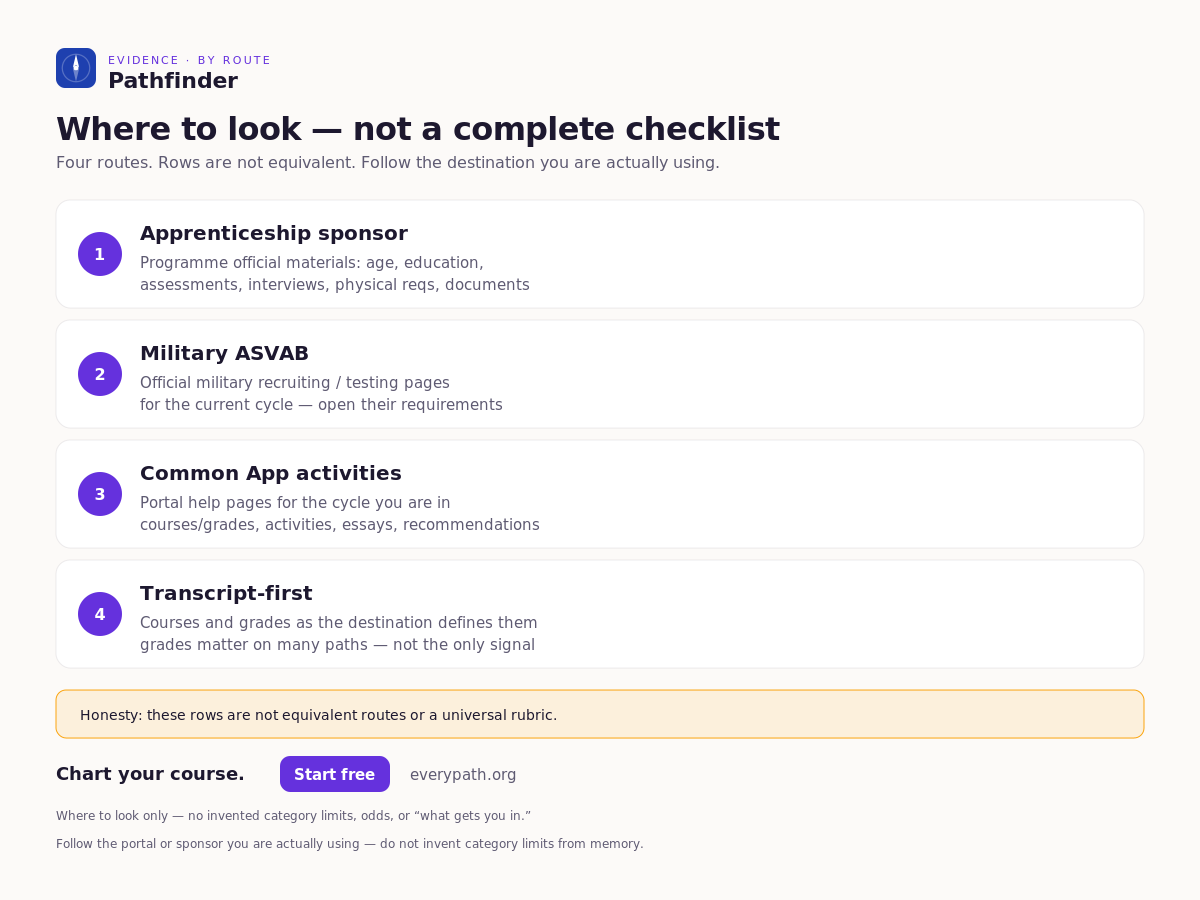
Evidence is documents and artefacts you attach to prove a claim or requirement — a transcript, a score report, a project — kept in your evidence locker. The test is simple: can you attach it? A transcript is evidence. A certificate is evidence. A signed reference is evidence.
For the full map of routes after high school, start with every path after high school.
Two things this does not mean. First, an impression is not evidence. "Interest in engineering" and "a love of helping people" are feelings about you. They become evidence only when they turn into a course grade, a project write-up, a log of hours or someone's signature. Second, evidence is not a personality test. Nobody is grading your soul. They are checking a list.
That list is what a decisive claim is made of: an application deadline, an admission requirement or a course requirement, where being wrong changes the decision itself. Getting a requirement wrong can cost you the application. Getting a vibe wrong costs you nothing.
What do colleges look for besides grades?
Course rigor, and — by the admission offices' own account — not much that outranks it. The National Association for College Admission Counseling publishes a page on factors in the admission decision, drawing on its own State of College Admission report. It says the data there "show students' grades and the academic rigor of their course loads weigh more heavily in decisions to admit than standardized test scores, high school class rank, or demonstrated interest in attending."
Read that sentence carefully. It names four things colleges weigh alongside raw grades — course rigor, test scores, class rank and demonstrated interest — and it says only that the first of them, taken together with grades, outweighs the other three. It does not rank those three against each other, and it attaches no share to any of them.
One honest note. NACAC's page does print two percentages, but it cites an edition of its report rather than a calendar year, and the page itself carries no publication date. The rule this article follows is that a figure with no reference year on its own page is not printed, so those two shares are not quoted here. If a site quotes you a share for grades, essays, recommendations or demonstrated interest, ask which edition it came from and what year that edition was published.
The practical reading is unglamorous. The most heavily weighted item is the record of the classes you took and the grades you got. That is a document, and you already have it.
What does a college application actually ask you to enter?
For the Common App the answer is narrow and specific, which is good news, because narrow lists can be finished. Its own resource, Approaching the Activities section, says: "You can add up to ten activities to your application, but that doesn't mean that you need to enter ten." It then prints the space you get.
| Field | Limit, as printed | Source (year) |
|---|---|---|
| Activities you can add | up to ten | Common App (2025) |
| Position/Leadership description | 50 characters | Common App (2025) |
| Organization name | 100 characters | Common App (2025) |
| Activity details, honors won, and accomplishments | 150 characters | Common App (2025) |
Read those numbers again. One hundred and fifty characters is about two short sentences. The same resource tells students to "abbreviate words and simplify your grammar," and its worked example cuts a 256-character description down to 141.
So the writing job is compression, not invention. And the thing you are compressing has to exist first. The resource also says you report the hours spent per week and the weeks spent per year for each activity. If you cannot answer those two questions, the activity is not yet evidence. It is a memory.
Two things this article does not print, because they were not checked against the official page for this cycle: the Common App personal essay word limit, and the UK UCAS personal statement questions and character limit. Both are widely repeated online. Read them on the official site for your own cycle rather than trusting a number from a blog, including this one.
What does an apprenticeship application ask for?
It asks the sponsor, not the government. The U.S. Department of Labor's career seekers page says: "To become an apprentice, search for an opportunity using our Apprenticeship Job Finder and apply directly with the employer or the program sponsor." There is no single national checklist to collect. The checklist lives with whoever runs the programme.
So look at what one real sponsor prints. The Electrical Training ALLIANCE, a training body for electrical apprenticeships, asks an applicant to "Be at least a high school graduate, or have a GED, or in lieu of a high school diploma or GED, have a two-year Associate Degree or higher," and to "Show evidence of successful completion of one full year of high school algebra with a passing grade, or one post high school algebra course with a passing grade." It asks you to "Provide an official transcript for high school and post high school education and training," with GED records submitted if applicable, and it says that applicants who meet the basic requirements will be scheduled for an aptitude test battery, "if required."
Notice what that list is made of. A diploma. A transcript. One named course, passed. Those are documents, and a student in grade 10 can start collecting them. Notice also what is conditional: the page says some programmes may additionally require drug testing, a physical examination, a security background check, or a valid driver's licence. Some, not all — so read the page of the sponsor you are actually applying to.
If you are weighing this route against a degree, the money and time side of that choice is in apprenticeship vs. college. If the open question is whether to choose a path yet, see still deciding after high school. and trade school vs. college.
What does the military ask for?
It asks for a test result, among other things. The Armed Services Vocational Aptitude Battery is where nearly every discussion of military entry starts. The official ASVAB site describes it as "a multiple-aptitude battery that measures developed abilities and helps predict future academic and occupational success in the military."
That is a definition, not an eligibility rule, and this article stops there deliberately. Minimum scores, age bands and medical standards differ by branch and change over time, and the branch's own recruiting site is the place to read them on the day you need them. What travels across routes is the shape of the thing: a dated, official result you can produce on request.
| Route | What the route's own page asks for | Who asks | Source |
|---|---|---|---|
| Apprenticeship, one electrical sponsor | diploma, GED, or two-year Associate Degree or higher; one full year of high school algebra passed; official transcripts; aptitude test battery, if required | Electrical Training ALLIANCE | Electrical Training ALLIANCE |
| Apprenticeship, generally | no national list; apply directly with the employer or programme sponsor | U.S. Department of Labor | apprenticeship.gov |
| Military | the ASVAB, a multiple-aptitude battery | the military services | Official ASVAB site |
| University, US, via the Common App | up to ten activities in 50, 100 and 150-character fields | Common App | Common App (2025) |
The rows are not equivalent, and lining them up as if they were would mislead you. One is a single sponsor's page. One is a federal signpost that deliberately holds no list. One is a test definition. One is a shared application platform used by many colleges, each of which adds its own requirements on top. The table shows where to look, not a complete set of what to hand over.
What is a portfolio roadmap when you're not an artist?
A portfolio roadmap is a pathway-specific, ordered sequence of experiences, projects and evidence to build — not a generic checklist. The word "portfolio" misleads people into picturing a folder of drawings. It means the pile of attachable things one particular route asks you for, in the order you can realistically get them.
Work backwards from the requirements above and it writes itself:
- Electrical apprenticeship. Algebra, passed, with the grade on the transcript. The official transcript itself, requested from the school office rather than remembered. A record of any hours worked in electrical construction, because the sponsor's page says the minimum requirements can be waived for applicants who meet specific work hour requirements and can provide documentation of that experience.
- Engineering at university. The transcript first, because course grades are the most heavily weighted item on the NACAC page. Then one project you can describe in 150 characters — a build, a repair, a piece of code — with photos and a date on it.
- A science route. A lab log or a write-up with dates on it, kept while you do the work. Reconstructing one a year later is how careful students end up with vague activity entries.
- Any route that needs a reference. A named adult who watched the work and would write about it. Ask early: a reference is evidence somebody else has to create for you.
Ordered matters as much as the list. A certificate that expires before your application cycle is not evidence at the moment you need it. Neither is a transcript you request the week it is due.
What can't these numbers tell you?
They cannot tell you what will happen to you. A share of institutions weighting something heavily is a statement about institutions, not a forecast about your file.
- A complete file is a requirement, not a prediction. Meeting every listed requirement is what makes an application readable. It is not a statement about the outcome, and nobody quoted here claims that it is.
- The NACAC ranking carries an edition, not a year. The page names an edition of its report and prints no calendar date, so treat that ranking of factors as belonging to that edition, and check the current one before quoting it elsewhere.
- The Common App limits are one platform, one cycle. They are printed in a 2025 resource. Colleges that do not use the Common App, and later cycles, can differ.
- One sponsor is not every sponsor. The electrical requirements above are one training body's page. Another trade, another region or another employer will print a different list.
- Some sources are missing on purpose. Essay word limits, UCAS questions, FAFSA document lists and state scholarship requirements are not in this article, because they were not checked against an official page for this cycle. An unchecked number is worse than no number.
This is how Pathfinder labels its own claims. A sourced figure is grounded for exactly what it says and no further. Anything Pathfinder calculates for you from it is modelled — a reasoned estimate, marked as one. Neither ever becomes a prediction about you: Pathfinder will not state your chances of getting in, in any wording, which is one of the things its AI is built to refuse.
How do you decide what to collect first?
Turn the general lists into questions about your own situation:
- What are the decisive claims on my primary path? Write down the deadline, the entry requirement and any named course. Those are the items where being wrong changes the decision.
- What does each route ask for, by name, on its own page? Not "good grades" — the actual words, like "one full year of high school algebra with a passing grade."
- What do I already have as a file? Transcripts, certificates, photos of work, saved write-ups. Most students have more than they think, and can find none of it.
- What expires, or takes time to get? Test results, medicals, and references from an adult who is about to change schools. Order those first.
- What would a counsellor be willing to put their name to? If nobody who watched you work could describe it, the evidence is thin, however the activity felt.
- What is my backup? Choosing a primary path and an explicit backup path means collecting the overlap first. The transcript serves every route on this page.
Pathfinder keeps uploads in the evidence locker on the free plan, and the application command center — deadlines, requirements and evidence reuse across everything you are applying to — is part of the Family plan. If it helps to know that split before you start, what is free and what is not sets it out, and the free plan needs no card.
Want one place to keep the proof, whichever route you take?
Pathfinder builds you a plan for whichever path you pick — or for "still deciding" — and labels every claim in it as grounded, modelled or advisory. It will not invent a deadline, a cost, or your odds of getting in.
Start free — no credit card required.
Frequently asked questions
What do colleges look for besides grades?
NACAC's page on factors in college admission says its State of College Admission report shows students' grades and course rigor weigh more heavily in decisions to admit than test scores, class rank, or demonstrated interest. The page names an edition but no year, so no percentages from it are printed here.
How many activities can you list on the Common App?
Up to ten. The Common App's own activities resource says you can add up to ten activities, but that it does not mean you need to enter ten (Common App, 2025).
Do apprenticeships need a transcript?
It depends on the sponsor. The Electrical Training ALLIANCE asks applicants to provide an official transcript for high school and post high school education and training, and GED records if applicable.
Is a portfolio only for art students?
No. A portfolio roadmap is a pathway-specific, ordered sequence of experiences, projects and evidence to build — a trade certificate or a work reference counts as much as a drawing.
Does Pathfinder write my essay?
No. The Family plan includes essay feedback with an admissions rubric, which comments on what you wrote. It does not write the essay for you, and evidence basics are on the free plan.
Sources
- Factors in College Admission — National Association for College Admission Counseling, accessed 2026-09-11
- Approaching the Activities section — Common App, Inc. (2025), accessed 2026-09-11
- Applying for Apprenticeship — Electrical Training ALLIANCE, accessed 2026-09-11
- Career Seekers — U.S. Department of Labor, accessed 2026-09-11
- Official ASVAB Testing Program — Official ASVAB Testing Program, accessed 2026-09-11
Chart your course
Pathfinder builds you a plan for whichever path you pick — or for “still deciding” — and labels every claim in it as grounded, modelled or advisory. It will not invent a deadline, a cost, or your chances of getting in.
Start free No credit card required.
Related reading
- How to choose a path after high school
How to choose a path after high school with a primary and an explicit backup — a sourced decision frame, not tip lists or invented odds.
- Military vs college after high school? Sourced
Enlisting after high school vs starting college: what each path is for, with VA/DoD/BLS primaries only — no invented odds or prestige rankings.
- Your 12th-grade plan, whichever path you're on
A senior year checklist for whichever path you are on — apprenticeship, trade, work, military, college or still deciding — every deadline sourced and dated.