Scholarships
Scholarship eligibility criteria: the 10 rules providers use
Each provider writes its own scholarship eligibility criteria. Most rules fall into ten areas: citizenship, residence, study country, field of study, pathway, grade level, GPA, demographic, financial need and deadline. Federal Pell Grants usually go only to undergraduates with exceptional financial need. If a provider's page does not state a rule, treat it as unknown, not a yes.
By Pathfinder Editorial · Published · Updated · 12 min read
About: Scholarship Scholarship matching Eligibility dimension Eligibility tri-state

Eligibility is decided by the provider's own written rules, not by how a website feels about your profile. Federal Pell Grants "usually are awarded only to undergraduate students who display exceptional financial need", and the 2026-27 maximum award is $7,395 (Federal Student Aid, 2026-27). Pathfinder checks ten rules in code and reports open, restricted or unknown for each.
This is written for a student or a parent who used a scholarship matching site, got back a long list, and wants to know whether "matched" really means "eligible". Pathfinder treats every path after high school as equally valid, so nothing here assumes university.
Who qualifies for a scholarship, and who sets the rules?
A scholarship is financial aid awarded to a student for further education. Federal Student Aid puts it more bluntly: scholarships are gifts, and "There are thousands of them, offered by schools, employers, individuals, private companies, nonprofits, communities, religious groups, and professional and social organizations" (Federal Student Aid).
That list is the important part. There is no central rule book. Each provider writes its own rules on its own page, and that page is the only thing that decides who qualifies.
| Provider type | Who writes the rules | Where the rules live | Source |
|---|---|---|---|
| Federal | The federal agency running the programme | The programme's own eligibility page | Federal Student Aid |
| State | The state's higher-education agency | The agency's programme pages | Georgia Student Finance Commission |
| Institution | The college or training provider | Its financial aid pages | Federal Student Aid |
| Private | Employers, nonprofits, community and religious groups, professional bodies | The provider's own site | Federal Student Aid |
Two things this does not mean. A matching site does not set eligibility; at best it reads the provider's rules back to you. And you should never pay for that reading: "remember that you don't have to pay to find scholarships or other financial aid" (Federal Student Aid).
What are the common scholarship eligibility criteria?
An eligibility dimension is one of the ten rules every award is scored on: citizenship, residence, study country, field of study, pathway, grade level, GPA, demographic, financial need and deadline window. They are deliberately boring. Almost every rule a real provider writes falls into one of them.
| Dimension | What it checks | An example rule, in a provider's own words | Source (year) |
|---|---|---|---|
| Citizenship | Which citizenships or statuses qualify | "Applicants must be citizens of the United States, Australia, Canada, New Zealand, or United Kingdom at time of application." | SMART Scholarship (page undated) |
| Residence | Where you live, and for how long | "Meet the postsecondary institutions Georgia Residency requirements" | Georgia Student Finance Commission (page undated) |
| Study country | Where the money may be spent | "college or university in Georgia" | Georgia Student Finance Commission (page undated) |
| Field of study | Which subjects count | Neither HOPE eligibility page restricts the subject you go on to study | Georgia Student Finance Commission (page undated) |
| Pathway | Which route after school qualifies | "Be enrolled as a degree-seeking student" | Georgia Student Finance Commission (page undated) |
| Grade level | Which stage of study you are at | "have not earned a bachelor's, graduate, or professional degree" | Federal Student Aid (2026-27) |
| GPA | The academic threshold | "Graduate with a minimum 3.0 calculated HOPE GPA" | Georgia Student Finance Commission (page undated) |
| Demographic | Which group the award is aimed at | "there are scholarships for women or graduate students" | Federal Student Aid (page undated) |
| Financial need | Whether need is assessed at all | "undergraduate students who display exceptional financial need" | Federal Student Aid (2026-27) |
| Deadline window | When you must apply | "Some deadlines are as early as a year before college starts" | Federal Student Aid (page undated) |
Notice what that table already shows. One of the ten rows can only be filled by what a page does not say. That is normal, and it is the whole reason a third answer exists.
What do open, restricted and unknown mean?
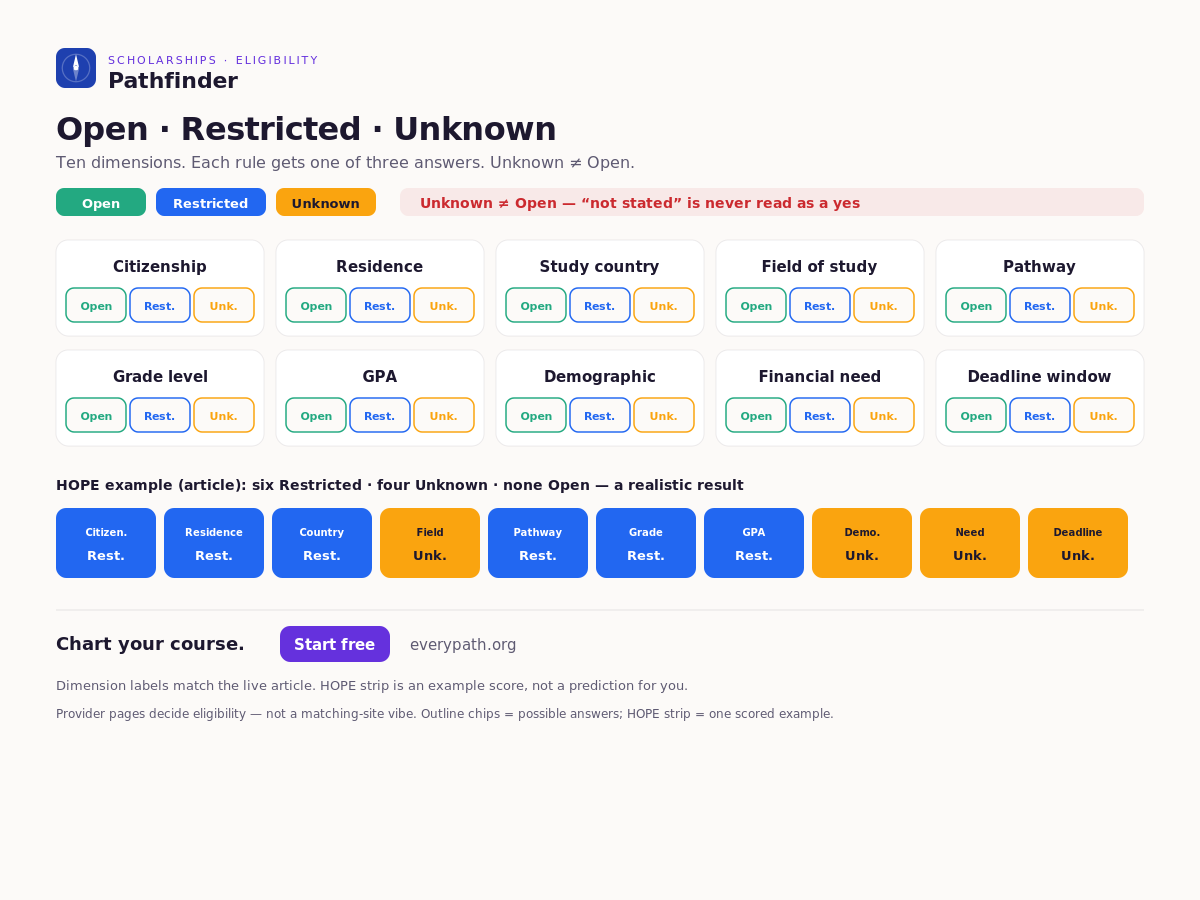
Under the eligibility tri-state, each rule is open to everyone, restricted to certain people, or simply not stated by the provider. "Unknown" is never silently treated as "open" — and it is never treated as "no" either.
- Open. The page addresses the rule and does not narrow it. Everyone clears this one.
- Restricted. The page names a limit you either meet or do not. SMART's citizenship line is the clearest kind: five named countries, no ambiguity.
- Unknown. The page is silent. You cannot score it without asking, so Pathfinder marks it unknown, quotes nothing it did not find, and sends you to the provider's page. When the gap is in your profile instead — the award restricts GPA and you have not entered yours — it names the exact fact to add.
The honest version of "unknown" costs something. It means a shorter list of awards you can act on today, plus a small pile of questions to ask. The dishonest version is cheaper to build and worse to rely on: it reads silence as a yes, and you find out on the form.
How is one real award scored?
Here is Georgia's HOPE Scholarship, a state merit programme, scored on all ten rules using only the wording on its two eligibility pages (Georgia Student Finance Commission). The last column is our reading of what the pages leave out — Pathfinder itself marks these rows unknown and sends you to the page.
| Dimension | What HOPE's pages say | Verdict | What would settle an unknown |
|---|---|---|---|
| Citizenship | "Meet U.S. citizenship or eligible non-citizen requirements" | Restricted | — |
| Residence | "Meet the postsecondary institutions Georgia Residency requirements" | Restricted | — |
| Study country | "college or university in Georgia" | Restricted | — |
| Field of study | Not addressed | Unknown | Whether the eligible-programme list limits subjects |
| Pathway | "Be enrolled as a degree-seeking student" | Restricted | — |
| Grade level | Entry routes listed: eligible high school, home study, an HSE diploma, or eligibility earned in college (initial academic eligibility page) | Restricted | — |
| GPA | "Graduate with a minimum 3.0 calculated HOPE GPA" | Restricted | — |
| Demographic | Not addressed | Unknown | Whether any group-based criterion applies |
| Financial need | Not addressed | Unknown | Whether need is weighed anywhere in the award decision |
| Deadline window | Not stated on these pages | Unknown | The application deadline for your entry term |
Six restricted, four unknown, none open. That is a realistic result, not a bad one. It tells a student in Georgia with a 3.1 GPA that the award is worth an hour of work, and it tells a student in Ohio to stop reading after row two. HOPE also lets some students earn eligibility once in college, so a low high-school GPA is not the end of the story.
One more honest note about that table. HOPE's basic eligibility page also lists other requirements the ten dimensions do not model, among them Selective Service registration, satisfactory academic progress, standing on student loans, compliance with Georgia's drug-free postsecondary law, and award limits. The ten rules are how an award is scored for matching. They are not a replacement for the provider's page.
Why doesn't the AI just decide?
Because a language model is the wrong tool for a rule check. Eligibility is computed in code, rule by rule, against each provider's stated rules. The AI counsellor can explain a verdict and point you at the source, but it cannot overrule the check or invent a rule the page does not contain. Refusing to do that is a design choice, not a limitation, and it is one of the things Pathfinder's AI is built to refuse. The full list of what the counsellor will not say is in what our AI refuses to say.
The practical difference shows up in what comes back. A model asked "am I eligible?" will produce a fluent answer either way. A rule check produces ten verdicts, each with the reason behind it, and honest blanks where the provider said nothing.
How is scholarship matching different from a long list of matches?
A long list answers a different question. It tells you how big a catalogue is. It does not tell you which rules you clear.
The scale of student aid is real. Grant aid received by undergraduate and graduate students came to $173.7 billion in 2024-25, and total federal grant aid was $53.7 billion including $38.6 billion in Pell Grants (College Board, 2024-25). Those are combined undergraduate and graduate totals, not an undergraduate-only split, so do not read them as a figure for school leavers. And none of that money reaches you because a list was long. It reaches you because one provider's rules fit one applicant.
Scale attracts scams too, which is why the free-to-search rule matters. The FTC prints the lines to walk away from in its own words: "You can't get this information anywhere else", "I just need your credit card or bank account number to hold this scholarship", and "We'll do all the work. You just pay a processing fee" (FTC, 2021). Its advice is short: "Never pay to apply for a scholarship." Promises of a refund if you do not win belong on the same list.
Scholarship matching is meant to be the opposite of a long list: checking every approved award against your profile and sorting it into what you qualify for, what rules you out and why, and what cannot be determined yet. Pathfinder's catalogue is curated: every record is reviewed and approved by a person before any student can see it, so it is small by design, and matching with reasons runs on the free plan.
What can't these numbers tell you?
They cannot tell you what will happen to you. The Pell maximum is a ceiling set in Washington, not a payment you are owed, and the College Board totals describe a whole country in a single year.
- Eligible is not awarded. Clearing every stated rule means your application can be considered. The provider still chooses.
- A check is only as current as the page it read. Most of the eligibility pages behind this article carry no visible last-updated date, so the honest thing to print is the date we read them, not a date they never gave.
- Rules change between award years. The Pell maximum is fixed at $7,395 for 2026-27 by a Dear Colleague Letter dated January 2026 (Federal Student Aid, 2026). Next year's figure is a separate document.
- Winning is not the same as keeping all of it. The IRS treats a scholarship as tax-free only when "You're a candidate for a degree at an educational institution" and the money pays "tuition and fees required for enrollment or attendance" (IRS, 2026). Anything else may be taxable, and that is a question for a tax professional rather than for us.
This is how Pathfinder labels its own claims. A sourced figure is grounded for exactly what it says and no further. Anything Pathfinder works out for you from it is modelled — a reasoned estimate, marked as one. Neither ever becomes a prediction about you: Pathfinder will not state your odds of admission, in any wording.
How do you decide which awards to spend time on?
Turn the ten rules into questions you can answer this week:
- Which rules rule me out outright? Citizenship, residence and study country usually settle it fastest. If one of those is restricted against you, stop there and keep the hour.
- Which rules are unknown, and is the answer one email away? A single question to a provider often turns four blanks into four verdicts, for every future applicant as well as for you.
- What is the deadline window? An award you clear on all ten rules is worth nothing if the window shut in March. Sort by deadline before you sort by size.
- Does the award follow my path, or only one route? Some awards are written for degree enrolment only. Others travel with a trade, an apprenticeship, a certificate, or straight-to-work plans. Our apprenticeship and college comparison is a useful sanity check here.
- Does it travel across borders? If you plan to study in another country, check all three geography rules, not just citizenship. Pathfinder's country packs cover five countries.
- Am I ready to choose at all? "Still deciding" is a legitimate answer, and awards that leave pathway unstated are exactly the ones to ask about first.
If it helps to know what a tool costs before you start, Pathfinder's what is free and what is not page sets that out, and scholarship matching with reasons sits on the free side of that line.
Want every award checked against your profile, with reasons?
Pathfinder scores every approved award against all ten rules and shows you the verdict, the reason behind it, and — when the gap is in your profile — the exact fact it needs to finish the check. It will not invent a rule, a deadline or an outcome.
Start free — no credit card required.
Frequently asked questions
Am I eligible for a scholarship if I am still deciding on a path?
Often yes, but it depends on the award. Some awards name a route — Georgia's HOPE asks you to be enrolled as a degree-seeking student — and others say nothing about it, which leaves that rule unknown until you ask.
What does an unknown eligibility rule mean?
It means the provider's page does not say. Pathfinder shows it as unknown rather than guessing and points you to the provider's page; when the missing piece is on your side, it names the fact it needs from you.
Do I have to pay to find scholarships?
No. Federal Student Aid says plainly that you don't have to pay to find scholarships or other financial aid, and the FTC lists upfront fees among the warning signs of a scam (FTC, 2021).
Does Pathfinder decide eligibility with AI?
No. Each of the ten rules is checked in code against the provider's stated wording. The AI counsellor can explain a verdict and point you at the source, but it cannot overrule the rule check.
Does being eligible mean I will get the award?
No. Eligibility is the gate, not the decision. Meeting every stated rule only means your application can be considered; the provider still chooses who receives it.
Do scholarships work outside the United States?
Some do and many do not, which is why three of the ten rules are about geography: citizenship, residence and study country. Pathfinder supports five country packs and checks those rules for each one.
Sources
- Finding and Applying for Scholarships — U.S. Department of Education, Federal Student Aid, accessed 2026-09-11
- Federal Pell Grants — U.S. Department of Education, Federal Student Aid (2026-27), accessed 2026-09-11
- 2026-27 Federal Pell Grant Maximum and Minimum Award Amounts (GEN-26-01) — U.S. Department of Education, Federal Student Aid (2026), accessed 2026-09-11
- How To Avoid Scholarship and Financial Aid Scams — Federal Trade Commission (2021), accessed 2026-09-11
- HOPE Scholarship — Basic Eligibility — Georgia Student Finance Commission, accessed 2026-09-11
- HOPE Scholarship — Initial Academic Eligibility — Georgia Student Finance Commission, accessed 2026-09-11
- Citizenship and Security Clearances for Scholars — SMART Scholarship-for-Service Program, accessed 2026-09-11
- Trends in Student Aid 2025 — Highlights — College Board (2024-25), accessed 2026-09-11
- Topic no. 421, Scholarships, fellowship grants, and other grants — Internal Revenue Service (2026), accessed 2026-09-11
Chart your course
Pathfinder builds you a plan for whichever path you pick — or for “still deciding” — and labels every claim in it as grounded, modelled or advisory. It will not invent a deadline, a cost, or your chances of getting in.
Start free No credit card required.
Related reading
- What our AI refuses to say (and why that helps you)
Pathfinder's AI counsellor will not invent a deadline or a cost, state your odds of admission, or decide scholarship eligibility by opinion. Why, with sources.
- Trade school vs. college: costs, wages and time
Trade school vs. college with sourced US data: what each costs, what the jobs pay, how long each takes, and what the averages cannot tell you.
- Are apprenticeships paid? Yes, from day one if registered
Do you get paid for an apprenticeship? Yes: registered apprentices are employees paid from day one, at least minimum wage, with raises on a written schedule.