Paths after high school
How to tell your parents you don't want to go to college
By Pathfinder Editorial · Published · 14 min read
About: Pathway Primary and backup path Still deciding Advisory

Go in with a plan, not just a no. Before the conversation, write down what you'll do instead, when each step happens, how you'll cover your costs, and your backup. Then pick a calm moment, lead with where you're heading, listen to their worries, and agree on when you'll talk again.
This guide is written for you, the student. If one of your parents wants their own version, there's a guide for parents whose teen is skipping college that covers the same moment from their side, and one on how to help your teenager choose a career without choosing it for you. Not sure yet whether a non-college route is a sound choice at all? Start with why a non-college route can be a legitimate decision. And to see where your idea fits among the other options, the overview of every route after high school lays them out.
The free tools mentioned below are American government resources. Outside the US, look for your country's own careers service; the conversation itself works the same way.
What are you actually asking your parents for?
Get clear on this before anything else, because "I don't want to go to college" can sound like three different requests. You might be asking for permission, for support (money, a place to live, a ride to work), or simply for them to hear it from you before they hear it from someone else. Each needs a slightly different conversation.
It also helps to turn the negative into a positive. "I don't want college" tells your parents what you're leaving. It doesn't tell them where you're going, so they fill in the blank with their worst guess. Try writing your plan as one sentence you could say out loud:
I want to [do this] starting [when], because [the reason it fits me], and if it isn't working by [a checkpoint], I'll [switch to my backup].
If you can't fill in every bracket yet, that's useful information. It tells you what to work on before you talk, or it tells you the honest version is that you're still deciding, which is a real pathway with its own steps.
What should your plan cover before you talk?
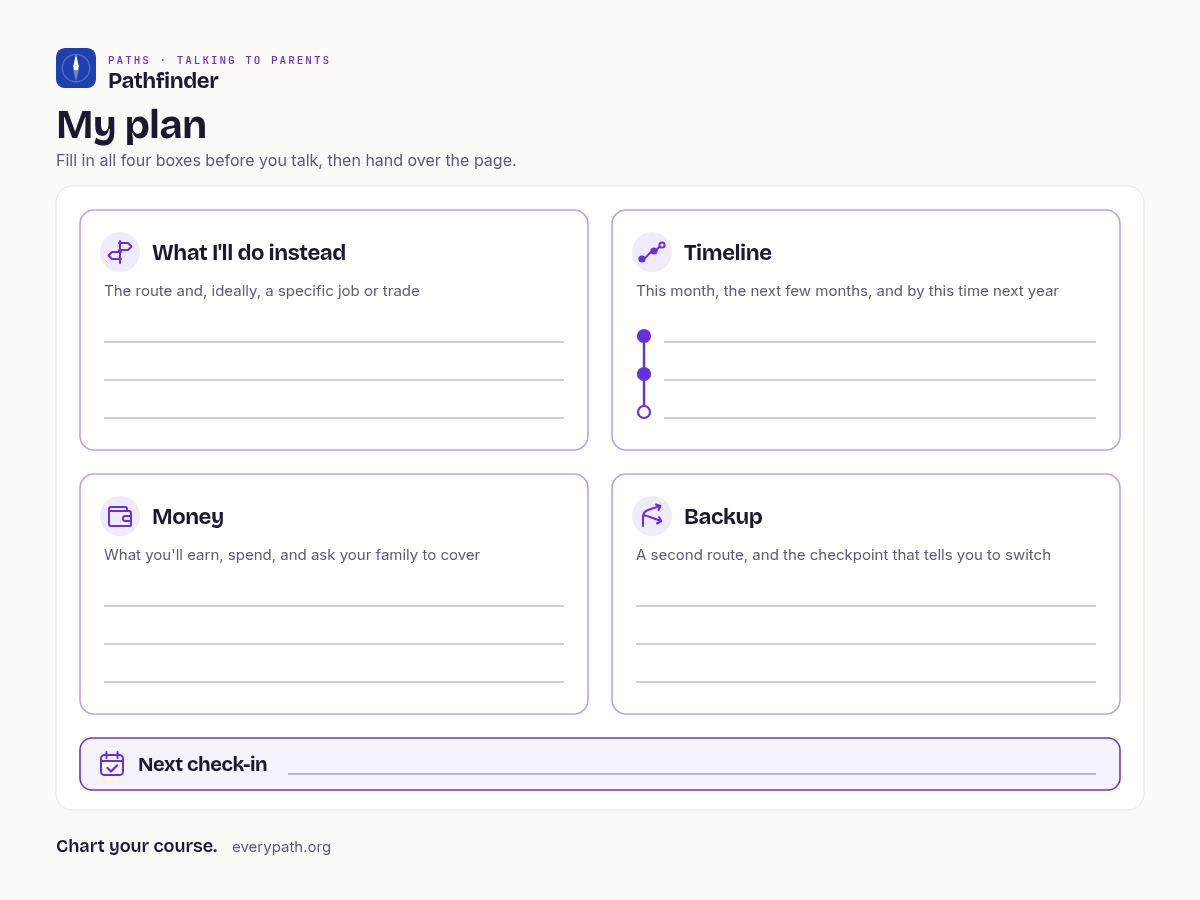
Four things: what you'll do instead, the timeline, the money, and a backup. A vague idea draws more pushback than a different route does, and one written page covering these points answers most first questions before they're asked.
| Part of the plan | What to write down | Where to check it |
|---|---|---|
| What instead | The route and, ideally, a specific job or trade | My Next Move, and the "How to Become One" section of a BLS Occupational Outlook Handbook profile |
| Timeline | What happens this month, over the next few months, and by this time next year | Application windows from the employer, sponsor or program you're targeting |
| Money | What you expect to earn, what you'll spend, and what you're asking your family to cover | Your own spending record, plus local pay data in BLS "State and Area Data" |
| Backup | A second route, and the checkpoint that tells you to switch | Your own list, reviewed with a counselor if you can |
What you'll do instead. Name the route: a trade and apprenticeship path, going straight to work, the military, a gap year with a purpose, or community college part-time alongside a job. Then get more specific. If you're unsure which job fits, the Department of Labor's My Next Move has a quiz for people who say they're not really sure: "Answer questions about the type of work you might enjoy. We'll suggest careers that match a personalized profile of your interests" (My Next Move). Once you have a job title, the Bureau of Labor Statistics (BLS) Occupational Outlook Handbook describes "the education and training typically needed to enter occupations" in each profile's "How to Become One" section (BLS). Print that page. It's more convincing than your summary of it.
The timeline. Break it into near, middle and far. Near is what you'll do before the end of this month. Middle is the next few months, including any application you need to send. Far is where you expect to be a year from now. For apprenticeships, openings don't always sit on a public board. The Apprenticeship Job Finder suggests that if you can't find a match, you use its Partner Finder "to learn more about when they are accepting new apprentice applications" (apprenticeship.gov). Write those windows into your timeline, because a date tells your parents you've done the homework.
The money. This is often the first worry, so answer it directly. Write down what you'll earn, what you'll spend, and what, if anything, you're asking your family for. If you haven't tracked your spending before, the Consumer Financial Protection Bureau has a simple tracker. It says that keeping track of what you earn and spend for a month "lets you see all of your income and expenses in one place" (CFPB). On pay, be careful not to overpromise. BLS points to each profile's "State and Area Data" section for local figures, but it also says plainly that it "does not collect data on starting salaries" (BLS). Say you'll ask the employer or sponsor what a beginner earns, rather than quoting a number you can't back up.
The backup. This is the part that reassures parents most, because it shows you've thought about things going wrong. A primary and backup path means you pick your main route and a second one, plus a checkpoint that tells you when to switch. For help choosing that pair, see how to pick a main route and a fallback. If your parents' fear is that you're shutting a door, point out that it stays open: how going back to college works after time away explains re-entry.
How do you make the plan believable?
Do one real thing before you talk. A plan you've started is far harder to dismiss than a plan you've only described.
Pick a step you can finish in a week or two. Search for openings in the trade you named. Email one employer or program sponsor and ask how their hiring works. Talk to someone who does the job about what an ordinary day is like. Visit an American Job Center, a local office for employment and training help. CareerOneStop's finder says comprehensive centers "serve a range of specialized clients including veterans, youth, laid-off workers, and employers" (CareerOneStop). Walking in with a question counts as a step.
If the job needs a license, look up what your state requires. BLS explains that it doesn't track specific licensing rules "because those requirements often vary by state," and it points readers to CareerOneStop's License Finder instead (BLS).
For an apprenticeship, bring what the official site says about the model. The Department of Labor describes registered apprenticeship as a route where people "obtain paid work experience with a mentor, receive progressive wage increases, classroom instruction, and a portable, nationally-recognized credential" (apprenticeship.gov). If you're aiming for a registered apprenticeship, handing your parents that page helps them see it as a real program rather than an idea you heard about online.
Keep a folder of what you find: printouts, emails, notes. That's your evidence.
What will your parents probably worry about?
Most pushback comes from a handful of fears, and naming them first shows you've thought it through. You won't know every answer, and that's fine. Saying "I don't know yet, but here's how I'll find out" is a strong answer.
| What they may be worried about | What it can sound like | What you can bring |
|---|---|---|
| Money and independence | "How will you support yourself?" | Your money section: income, spending, and exactly what you're asking of them |
| A closed door | "You'll never go back once you stop." | Your backup, and how returning to college later works |
| Drifting | "So you'll just sit at home?" | Your timeline with dated steps, and the one step you've already taken |
| Effort | "You're avoiding hard work." | What the route actually asks of you: training, hours, tests, licensing |
| Their own hopes | "We always pictured you at college." | Patience; this one needs listening more than evidence |
| Safety, for the military | "What if something happens?" | Questions you'll ask a recruiter, and an offer to go through official materials together |
Their own hopes often matter most and get said least. Parents may have sacrificed for your education, or regret not going themselves. You can acknowledge that without agreeing to change your plan: "I know this isn't what you imagined, and I get why that's hard."
For the military row, BLS notes that "Each military service publishes its own pamphlets, handbooks, and fact sheets," available at recruiting stations, schools and libraries (BLS). Suggest reading them together, so the information comes from the service itself rather than from you or a recruiter alone.
When and how should you bring it up?
Choose the moment on purpose. Avoid the middle of an argument, a rushed morning, a family gathering, or the night before a college deadline they're counting on. Ask for the conversation in advance, something like "Can we talk this weekend? There's something about next year I want to go over with you." That gives everyone time to arrive calm.
Open with where you're headed, then share the plan. A structure that tends to work:
- Start with appreciation. "I know you want the best for me, and I've been thinking seriously about what comes after high school."
- Say your one-sentence plan. The route, the start, the reason, the checkpoint and the backup.
- Hand over the page. Let them read it. Silence while they read is fine.
- Ask for their concerns and listen fully. Don't interrupt to argue each point. Write their questions down.
- Answer what you can, and note what you can't. Promise to come back with answers by a specific day.
- Agree on a next step together. A follow-up conversation, a visit, a call with a counselor.
Stay calm even if they don't; raised voices turn the talk into a fight about tone. If things heat up, it's okay to pause: "I want to keep talking about this, but maybe tomorrow."
A school counselor or another trusted adult can help, either to rehearse with beforehand or to join a later conversation. Some parents hear things differently from a professional than from their own child. That isn't a failure on your part; it's using the people around you.
What if it doesn't go well?
It may not, at least the first time, and one hard conversation isn't the final word. Parents often need time to move from surprise to curiosity. What you do next usually matters more than how the first talk went.
If they say no outright, ask what would change their mind. Maybe it's a specific amount of savings, proof of an offer, or a plan to keep one college option open. Consider whether any of those are fair asks you could meet. If you live at home and rely on your family, you're negotiating, and a reasonable compromise can be worth more than winning the argument.
A trial period can work well: "Let me do this through spring. If I haven't got an apprenticeship offer or steady work by then, I'll go to community college in the fall." It gives your parents a safety net and you a real chance.
If a disagreement ever turns into something that feels unsafe, talk to a school counselor or another trusted adult right away.
What should you do after the conversation?
Follow through, visibly. Trust gets built after the talk, not during it.
Send a short summary the same day or the next: what you agreed, what you're doing next, and when you'll check in. Then keep those check-ins even when there's little news. Share wins, like an interview, a callback, or a first paycheck, and share setbacks honestly too. Parents worry less when they aren't guessing.
Update the plan as you learn. If the first route doesn't pan out, switching to your backup at the checkpoint you named is proof the plan worked, not proof it failed. Keep your evidence folder going, because it helps with the next conversation and with applications.
Finally, give them room to come around. Some parents go from worried to proud once they see you working toward something.
What if I don't have a plan yet, just a feeling that college isn't right?
Say that honestly, and say what you'll do to find out. Still deciding is a legitimate place to start. Offer a short list of routes you'll look into, one concrete step for each, and a date when you'll report back.
What if my parents insist that I go to college?
Don't try to settle it in one talk. Ask what would need to be true for them to feel okay, show them the parts of your plan that answer those concerns, and propose a check-in date. A trial period with a clear review often lands better than a flat refusal.
Should I still apply to a college as a backup?
It can be a reasonable compromise if it doesn't cost you much and your family would feel safer. Be clear that it's your backup, not your plan. Remember that college also stays available later, so skipping it now doesn't close the door.
Should I tell both parents at the same time?
Usually, if they're both involved in the decision, because it stops anyone from hearing a secondhand version. If one parent is easier to talk to, you can practice with them first, but don't ask them to keep it from the other.
What if I change my mind later?
Then you change the plan. That's what the check-in dates are for. Telling your parents now is about the next step, not a lifetime promise, and saying so can make the conversation easier for everyone.
Sources
- OOH FAQs — U.S. Bureau of Labor Statistics, accessed 2026-09-28
- My Next Move — U.S. Department of Labor, Employment and Training Administration (O*NET), accessed 2026-09-28
- Career Seekers: Jump Start Your Career Through Apprenticeship — U.S. Department of Labor, accessed 2026-09-28
- Apprenticeship Job Finder — U.S. Department of Labor, accessed 2026-09-28
- American Job Center Finder — CareerOneStop, sponsored by the U.S. Department of Labor, accessed 2026-09-28
- Your Money, Your Goals: Spending tracker — Consumer Financial Protection Bureau, accessed 2026-09-28
Chart your course
The conversation goes better with a plan on paper. Pathfinder helps you build one for whatever route you choose, or for still deciding, with a main path, a backup and dated next steps. Every claim is marked as sourced, estimated or advisory, and when you're ready, you can invite a parent to follow along.
Start free — no credit card required.
Frequently asked questions
What if I don't have a plan yet, just a feeling that college isn't right?
Say that honestly, and say what you'll do to find out. Still deciding is a legitimate place to start. Offer a short list of routes you'll look into, one concrete step for each, and a date when you'll report back.
What if my parents insist that I go to college?
Don't try to settle it in one talk. Ask what would need to be true for them to feel okay, show them the parts of your plan that answer those concerns, and propose a check-in date. A trial period with a clear review often lands better than a flat refusal.
Should I still apply to a college as a backup?
It can be a reasonable compromise if it doesn't cost you much and your family would feel safer. Be clear that it's your backup, not your plan. Remember that college also stays available later, so skipping it now doesn't close the door.
Should I tell both parents at the same time?
Usually, if they're both involved in the decision, because it stops anyone from hearing a secondhand version. If one parent is easier to talk to, you can practice with them first, but don't ask them to keep it from the other.
What if I change my mind later?
Then you change the plan. That's what the check-in dates are for. Telling your parents now is about the next step, not a lifetime promise, and saying so can make the conversation easier for everyone.
Sources
- OOH FAQs — U.S. Bureau of Labor Statistics, accessed 2026-09-28
- My Next Move — U.S. Department of Labor, Employment and Training Administration (O*NET), accessed 2026-09-28
- Career Seekers: Jump Start Your Career Through Apprenticeship — U.S. Department of Labor, accessed 2026-09-28
- Apprenticeship Job Finder — U.S. Department of Labor, accessed 2026-09-28
- American Job Center Finder — CareerOneStop, sponsored by the U.S. Department of Labor, accessed 2026-09-28
- Your Money, Your Goals: Spending tracker — Consumer Financial Protection Bureau (2018), accessed 2026-09-28
Chart your course
Pathfinder builds you a plan for whichever path you pick — or for “still deciding” — and labels every claim in it as grounded, modelled or advisory. It will not invent a deadline, a cost, or your chances of getting in.
Start free No credit card required.
Related reading
- How to choose a path after high school
How to choose a path after high school with a primary and an explicit backup — a sourced decision frame, not tip lists or invented odds.
- Is it okay not to go to college? Sourced answer
Yes — college is one path, not the only valid one. Enrollment data shows a large share of graduates do not enrol immediately. Plan a primary path and a backup.
- Every path after high school, explained honestly
Every path after high school — apprenticeship, community college, work, military, certifications, business, university, still deciding — one sourced page.