Paths after high school
How long does an apprenticeship take? Trades compared
Usually one to six years. A registered apprenticeship needs at least 2,000 on-the-job hours; construction trades such as electrician and carpenter list 7,328 to 8,000 hours, and BLS describes electrician apprenticeships as 4 or 5 years. The program's written standards state your exact term.
By Pathfinder Editorial · Published · Updated · 15 min read
About: Registered apprenticeship Trade and apprenticeship Pathway Grounded

Usually several years, but it depends on how the program measures progress. A registered apprenticeship is time-based (a minimum of 2,000 on-the-job learning hours), competency-based (you finish when you prove the skills) or a hybrid of both. Oregon's apprenticeship agency says time-based programs run one to six years. The program's written standards state your term.
This guide is about the clock. In one line, registration means a government Registration Agency has approved the program's training and pay rules; what makes an apprenticeship registered explains the rest. Pay rises in steps as you progress, and how apprentice pay works covers that in detail. For how the years compare with other schooling, read apprenticeship vs. college or trade school vs. college costs and timelines, and the overview of all eight routes after high school puts them side by side.
Everything below uses US rules and one Oregon program. Outside the US, the terms and approval bodies differ, so treat it as a list of things to check.
What sets the length of an apprenticeship?
Three things: the occupation, the program's approach, and your progress. Start with the floor. To qualify as apprenticeable at all, an occupation must, by industry standard, require the completion of "at least 2,000 hours" of learning on the job (29 CFR §29.4). Beyond that, the Department of Labor (DOL) says length "can vary depending on the employer, complexity of the occupation, industry, and the type of program" (apprenticeship.gov).
"Type of program" means the approach. Federal rules let a sponsor measure the term in hours, in demonstrated competency, or in a mix, and the sponsor picks, "subject to approval by the Registration Agency" (29 CFR §29.5(b)(2)). So two programs in the same trade can run different terms and both be legitimate.
Then there's you. Your agreement must state "the beginning date and term (duration) of apprenticeship" (29 CFR §29.7(d)), but your finish date depends on your pace and any credit you bring.
Time-based, competency-based or hybrid: what changes for you?
The approach decides what moves you forward and what counts as done.
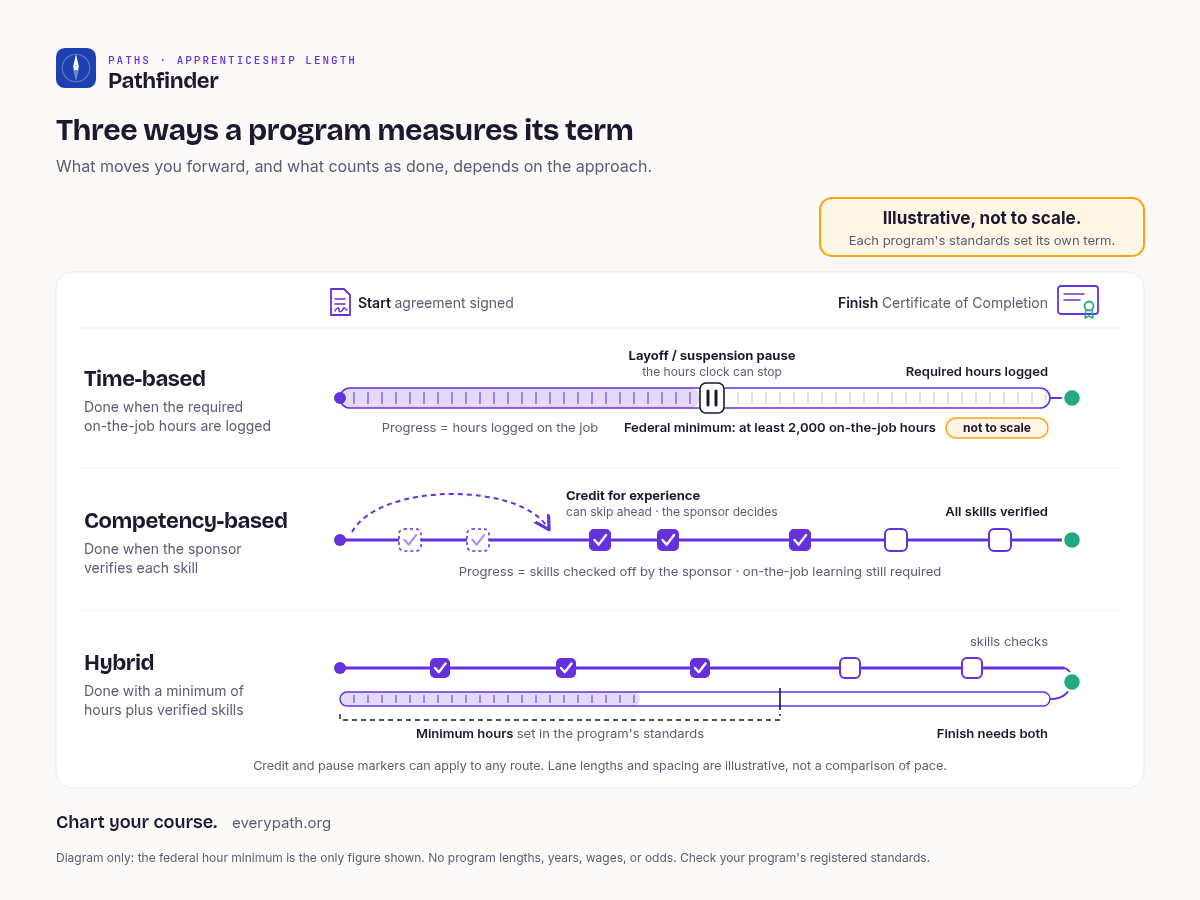
| Approach | What the federal rule measures | What the Oregon guide adds | What it means for your timeline |
|---|---|---|---|
| Time-based | Hours of on-the-job learning against a work process schedule, 2,000 at minimum (§29.5(b)(2)(i)) | Progress uses "time as the primary indicator"; these programs "vary in length from one to six years" | Your finish date tracks the hours you actually get. Slow seasons or short weeks push it out. |
| Competency-based | Skills and knowledge "as verified by the program sponsor", with on-the-job learning still required | "Once an apprentice is deemed fully 'competent' by their employer, they can complete their program" | You can move faster if you show skills early, but the sponsor's assessments set the pace. |
| Hybrid | A set minimum of hours plus demonstrated competency | "The apprentice must attain a set of competencies within a range of hours to complete" | There's a floor you can't go under, and skills still have to be signed off. |
What about "2,000 hours a year"? The federal rule uses 2,000 hours as a program-wide minimum, not an annual rate. The Bureau of Labor Statistics (BLS) does frame one trade that way: electrician apprentices "typically receive 2,000 hours" of training on the job for each year, inside what it calls "a 4- or 5-year apprenticeship program" (BLS). That's a trade description, not a rule.
How long does a construction trade apprenticeship take?
DOL publishes a spreadsheet of approved occupations with a minimum and maximum term for each version and approach (Approved Occupations). It prints the figures without a unit; they line up with the hour counts in the regulation, and the smallest entries are 2,000, the federal floor. A selection, as listed on the day we checked:
| Occupation (DOL list title) | Time-based minimum | Competency-based | Hybrid minimum to maximum |
|---|---|---|---|
| Electrician | 8,000 | not listed | 7,200 to 8,000 |
| Carpenter | 8,000 (version 1); 7,328 (version 2) | not listed | 5,200 to 8,000 |
| Elevator Constructor | 8,000 (version 1); 6,800 (version 2) | not listed | 6,800 to 8,500 |
| Wind Turbine Technician | 4,000 | 2,000 to 4,000 | 4,000 to 6,000 |
| Medical Assistant | 4,000 | 4,000 | 4,000 to 5,000 |
| IT Generalist | 2,880 | 2,000 | 2,880 to 3,600 |
| Dental Assistant | 2,000 | 2,000 | 2,000 to 2,500 |
In this selection, construction trades sit near the top and several health and IT roles near the floor. One occupation can also carry several versions: Plumber appears at 7,328, 8,000 and 8,500 time-based hours. (Some Electrician and Elevator Constructor rows sit under alternate titles.)
Construction trades, in short. Depending on the version, the time-based minimums in that list are 8,000 hours for Electrician, 7,328 or 8,000 for Carpenter, 6,800 or 8,000 for Elevator Constructor, and 7,328 to 8,500 for Plumber. BLS describes the same trades in years: 4 or 5 for electrician apprentices, as quoted above, and typically 4 for elevator installers. How many calendar years the hours take depends on how steadily you work.
In words, BLS agrees. Elevator installation "typically begins with a 4-year apprenticeship program sponsored by a union, industry association, or employer" (BLS). For carpenters, "Apprenticeship program requirements differ based on the type of program and by region" (BLS). Oregon's agency puts a wider frame around it: "Most apprenticeship programs require between 4,000-8,000 on-the-job training hours and take between two and four years to complete" (Oregon BOLI). These are grounded for what each source describes, not promises about a program near you.
Finishing a registered program earns a Certificate of Completion of Apprenticeship (apprenticeship.gov). A trade license or an industry certification is a separate credential with its own rules; in the Oregon plumbing standards in the next section, apprentices must complete the minimum hours before they are referred to the license exam. Certifications vs. a degree explains how certifications, school certificates and licenses differ.
How do you read the term in a real program's standards?
Every registered program files written standards, and the term is in there. Here's one: the Klamath Basin Plumbers JATC standards, registered with Oregon's Bureau of Labor and Industries (MA# 5025, last revised July 1, 2021). It's one program with a clear public document, not a norm for plumbing or Oregon (standards PDF).
| What to find | What this document says | What it tells you |
|---|---|---|
| Approach and term | "This is a time-based apprenticeship standard. The term of this standard of apprenticeship shall be 7,700 hours of employment." | Hours on the job, not calendar years, end the program. |
| Probation | "the first 1,000 OJT hours of employment, or one year after the current registration to this standard, whichever is shorter" | The trial period is measured in the same on-the-job hours. |
| Progress periods | Seven periods of 1,000 hours and a final period of 700 | Checkpoints you pass on the way to 7,700. |
| Work processes | Approximate hours per area, e.g. DWV 2,400, water 2,200, fixtures 1,350, sewerage 750 | Targets, not quotas: the committee adds instruction where an apprentice falls short in an area. |
| Licensing | "In licensed occupations apprentices must complete the minimum required total hours prior to being referred to the license examination." | You can't sit the license exam early by skipping hours. |
| Review | Progress reviewed every six months, with action to advance you or hold you "at the same level for a reasonable period" | A hold can lengthen your time at one step. |
Notice what the document doesn't say: a number of years. Its own rules require a time-based term to be "stated in hours unless otherwise required by a collective bargaining agreement, civil service or other governing regulation." How many years 7,700 hours takes depends on how steadily you work.
How much classroom time comes on top?
Related instruction is the classroom side, and it's separate from on-the-job hours. Federal rules have the agreement state the hours of related instruction, "which is recommended to be not less than 144 hours per year" (29 CFR §29.7(e)(2)). It's a recommendation, so yours may differ.
Scheduling varies too. Oregon's guide describes three delivery models: "Traditional" (classes alongside work), "Front-Loaded", where "All (or most) Related Training occurs up front", and "Segmented", where "apprentices alternate between working full-time (OJT) and attending classes full-time (RT)" (Oregon BOLI).
The Klamath Basin document lists courses totalling 576 hours, but its yearly minimum reads "A minimum of [Number] hours of related training shall be required during each year", a blank left unfilled in the posted copy. Ask for the current figure.
Can you finish an apprenticeship faster?
Sometimes, through credit.
Advanced standing for experience or training. Registered standards must provide for "the granting of advanced standing or credit for demonstrated competency, acquired experience, training, or skills for all applicants equally" (29 CFR §29.5(b)(12)). DOL says prior coursework counts if it lines up with the program's curriculum and "your sponsor approves this coursework as relevant"; otherwise it's decided "on a case-by-case basis." Even with credit, DOL expects you to spend at least six months, or 1,000 hours, in the program itself (apprenticeship.gov).
Military service and technical school. For veterans, DOL says advanced standing lets you "advance their progress in the apprenticeship program by showing evidence of prior experience" (apprenticeship.gov). BLS says electricians with military or construction experience "may qualify for a shortened apprenticeship based on their experience and testing," and technical-school graduates "usually receive credit toward their apprenticeship."
Licensed trades are stricter. In the Oregon plumbing standards, "previous credit must be documented legal experience." Informal work may not count.
Pre-apprenticeship. DOL describes these as short programs, running weeks to months, that prepare you to apply (apprenticeship.gov). In the Oregon plumbing program, an approved pre-apprenticeship such as Job Corps helps with getting in; nothing says it cuts hours.
Starting in high school. Youth apprenticeship lets students start earlier: DOL says these programs "combine academic and technical classroom instruction with work experience through a Registered Apprenticeship Program (RAP)" (apprenticeship.gov). The term may not change; the clock just starts sooner.
College credit runs the other way. DOL says "Often apprenticeship sponsors work directly with community colleges that do provide college credit for apprenticeship experience" (apprenticeship.gov). That's credit your apprenticeship earns toward a degree at a community college, not a shortcut through the apprenticeship.
What happens if you switch employers, get laid off or pause?
Your hours can travel, if the move goes through the program.
Federal rules define a transfer as "a shift of apprenticeship registration from one program to another or from one employer within a program to another employer within that same program" (29 CFR §29.2). It must be agreed, you receive "a transcript of related instruction and on-the-job learning", "Transfer must be to the same occupation", and "A new apprenticeship agreement must be executed when the transfer occurs between program sponsors" (29 CFR §29.5(b)(13)). Leaving outside that process puts your credit at the new sponsor's discretion.
Layoffs happen, and the Oregon standards plan for them. The committee "may arrange to transfer an apprentice from one training agent to another" when it can't provide "reasonably continuous employment", and "If, for any reason, a layoff of an apprentice occurs, the Apprenticeship Agreement will remain in effect unless canceled by the committee." Its record categories include "Suspension, military service, or other", "Reinstatement" and "Holds". In that program, a layoff pauses your hours; it doesn't reset them.
Coming back can work too. The same program lets apprentices with at least 1,000 documented hours and 72 hours of related training, within the previous five years, "pick up their training where they left off instead of re-entering as a beginning apprentice."
After probation, a sponsor can also suspend the agreement "for good cause, with due notice" (29 CFR §29.7(h)). If you might need time off, ask how it's recorded.
What are interim credentials, and do they change the timeline?
They're certificates for finished pieces of an occupation along the way. Federal rules define an interim credential as one "issued by the Registration Agency, upon request of the appropriate sponsor, as certification of competency attainment by an apprentice" (29 CFR §29.2), and they "must only be issued for recognized components of an apprenticeable occupation" (§29.5(b)(16)).
DOL's fact sheet says they "provide portable recognition of an apprentice's accomplishments", but "Interim credentials do not document the completion of an apprenticeship program" and "Apprenticeship programs are not required to offer interim credentials." DOL expects them mostly in competency-based or hybrid programs (DOL).
They don't shorten the term. They change what you hold if plans change: proof of finished skills, instead of waiting for the final Certificate of Completion of Apprenticeship (apprenticeship.gov).
What should you ask about the timeline before you sign?
Ask to see the registered standards, not a flyer, and bring these.
| Ask | Why it matters |
|---|---|
| Is this time-based, competency-based or hybrid, and what's the term? | Sets what "done" means. |
| How many hours a week do apprentices usually get, year-round? | Converts an hour count into your real calendar. |
| How long did your last few completers take? | Shows the gap between the paper term and reality. |
| How many related-instruction hours a year, and when are classes? | Tells you your full weekly load. |
| What credit can I get for school, work, military or pre-apprenticeship, and can I have that in writing? | Credit is case by case. |
| What happens to my hours if I'm laid off, move, or need a break? | Transfer and reinstatement rules protect your progress. |
| For licensed trades, when can I sit the license exam? | Hours may have to be complete first. |
If the calendar looks too long for now, keep a primary and backup path alongside this one.
Can an apprenticeship take less than a year?
Not usually. A registered occupation must call for a minimum of 2,000 on-the-job learning hours, and Oregon's apprenticeship agency says that typically means at least a year. Credit can cut the rest, but DOL still requires at least six months, or 1,000 hours, in the program.
Is a competency-based apprenticeship faster?
It can be, if you show the skills quickly, since completion depends on verified skills, not a fixed hour count. On-the-job learning is still required, and no federal source publishes a typical saving, so ask how long past apprentices took.
Do classroom hours count toward the term?
Check your agreement. Federal rules have it list on-the-job hours and related-instruction hours as separate items. In one Oregon plumbing standard, the 7,700-hour term counts hours of employment, and the classes sit alongside it.
What happens to my hours if I change employers?
A registered transfer carries them. Federal rules say you get a transcript of your classes and on-the-job learning, the move must be to the same occupation, and a new agreement is signed if the sponsor changes. Ask before you quit.
Does a pre-apprenticeship shorten the apprenticeship itself?
Not automatically. It prepares you to get in; whether any of it counts toward your term is the sponsor's case-by-case call. Get the answer in writing.
Sources
- How long are apprenticeship programs? — U.S. Department of Labor, accessed 2026-09-25
- 29 CFR 29.2 — Definitions — U.S. Department of Labor (Electronic Code of Federal Regulations), accessed 2026-09-25
- 29 CFR 29.4 — Criteria for apprenticeable occupations — U.S. Department of Labor (Electronic Code of Federal Regulations), accessed 2026-09-25
- 29 CFR 29.5 — Standards of apprenticeship — U.S. Department of Labor (Electronic Code of Federal Regulations), accessed 2026-09-25
- 29 CFR 29.7 — Apprenticeship agreement — U.S. Department of Labor (Electronic Code of Federal Regulations), accessed 2026-09-25
- Registered Apprenticeship Approved Occupations (spreadsheet) — U.S. Department of Labor, accessed 2026-09-25
- Start an Apprenticeship Program in Oregon — Oregon Bureau of Labor and Industries, accessed 2026-09-25
- Klamath Basin Plumbers JATC — Plumber Apprenticeship Standards (MA# 5025) — Oregon Bureau of Labor and Industries, Apprenticeship and Training Division, accessed 2026-09-25
- Electricians: How to Become One — U.S. Bureau of Labor Statistics, accessed 2026-09-25
- Elevator and Escalator Installers and Repairers: How to Become One — U.S. Bureau of Labor Statistics, accessed 2026-09-25
- Carpenters: How to Become One — U.S. Bureau of Labor Statistics, accessed 2026-09-25
- Can previous work or classroom experience be used towards completion of an apprenticeship program? — U.S. Department of Labor, accessed 2026-09-25
- What is advanced standing for military experience? — U.S. Department of Labor, accessed 2026-09-25
- What is pre-apprenticeship? — U.S. Department of Labor, accessed 2026-09-25
- What is youth apprenticeship? — U.S. Department of Labor, accessed 2026-09-25
- Do you earn college credit while participating in apprenticeship programs? — U.S. Department of Labor, accessed 2026-09-25
- At-a-Glance: Interim Credentials — U.S. Department of Labor, Employment and Training Administration, accessed 2026-09-25
- What will I receive after I complete a Registered Apprenticeship Program? — U.S. Department of Labor, accessed 2026-09-25
Chart your course
An apprenticeship's clock is only one piece of a plan. Pathfinder lays out the route you pick, whether that's an apprenticeship, one of the other seven paths, or still deciding, and tags each claim so you know what's sourced, what's estimated and what's advisory. It won't make up a finish date for you.
Start free — no credit card required.
Frequently asked questions
Can an apprenticeship take less than a year?
Not usually. A registered occupation must call for a minimum of 2,000 on-the-job learning hours, and Oregon's apprenticeship agency says that typically means at least a year. Credit can cut the rest, but DOL still requires at least six months, or 1,000 hours, in the program.
Is a competency-based apprenticeship faster?
It can be, if you show the skills quickly, since completion depends on verified skills, not a fixed hour count. On-the-job learning is still required, and no federal source publishes a typical saving, so ask how long past apprentices took.
Do classroom hours count toward the term?
Check your agreement. Federal rules have it list on-the-job hours and related-instruction hours as separate items. In one Oregon plumbing standard, the 7,700-hour term counts hours of employment, and the classes sit alongside it.
What happens to my hours if I change employers?
A registered transfer carries them. Federal rules say you get a transcript of your classes and on-the-job learning, the move must be to the same occupation, and a new agreement is signed if the sponsor changes. Ask before you quit.
Does a pre-apprenticeship shorten the apprenticeship itself?
Not automatically. It prepares you to get in; whether any of it counts toward your term is the sponsor's case-by-case call. Get the answer in writing.
Sources
- How long are apprenticeship programs? — U.S. Department of Labor, accessed 2026-09-25
- 29 CFR 29.2 — Definitions — U.S. Department of Labor (Electronic Code of Federal Regulations), accessed 2026-09-25
- 29 CFR 29.4 — Criteria for apprenticeable occupations — U.S. Department of Labor (Electronic Code of Federal Regulations), accessed 2026-09-25
- 29 CFR 29.5 — Standards of apprenticeship — U.S. Department of Labor (Electronic Code of Federal Regulations), accessed 2026-09-25
- 29 CFR 29.7 — Apprenticeship agreement — U.S. Department of Labor (Electronic Code of Federal Regulations), accessed 2026-09-25
- Registered Apprenticeship Approved Occupations (spreadsheet) — U.S. Department of Labor, accessed 2026-09-25
- Start an Apprenticeship Program in Oregon — Oregon Bureau of Labor and Industries (2020), accessed 2026-09-25
- Klamath Basin Plumbers JATC — Plumber Apprenticeship Standards (MA# 5025) — Oregon Bureau of Labor and Industries, Apprenticeship and Training Division (2021), accessed 2026-09-25
- Electricians: How to Become One — U.S. Bureau of Labor Statistics, accessed 2026-09-25
- Elevator and Escalator Installers and Repairers: How to Become One — U.S. Bureau of Labor Statistics, accessed 2026-09-25
- Carpenters: How to Become One — U.S. Bureau of Labor Statistics, accessed 2026-09-25
- Can previous work or classroom experience be used towards completion of an apprenticeship program? — U.S. Department of Labor, accessed 2026-09-25
- What is advanced standing for military experience? — U.S. Department of Labor, accessed 2026-09-25
- What is pre-apprenticeship? — U.S. Department of Labor, accessed 2026-09-25
- What is youth apprenticeship? — U.S. Department of Labor, accessed 2026-09-25
- Do you earn college credit while participating in apprenticeship programs? — U.S. Department of Labor, accessed 2026-09-25
- At-a-Glance: Interim Credentials — U.S. Department of Labor, Employment and Training Administration, accessed 2026-09-25
- What will I receive after I complete a Registered Apprenticeship Program? — U.S. Department of Labor, accessed 2026-09-25
Chart your course
Pathfinder builds you a plan for whichever path you pick — or for “still deciding” — and labels every claim in it as grounded, modelled or advisory. It will not invent a deadline, a cost, or your chances of getting in.
Start free No credit card required.
Related reading
- Registered apprenticeship vs trade school explained
A registered apprenticeship is a validated paid job. Trade school can teach the class and still not be the program. Check who sponsors it.
- Are apprenticeships paid? Yes, from day one if registered
Do you get paid for an apprenticeship? Yes: registered apprentices are employees paid from day one, at least minimum wage, with raises on a written schedule.
- What is a registered apprenticeship? Sourced definition
DOL-registered apprenticeships: paid work + training, with standards. How they differ from informal “apprentice” jobs.