Paths after high school
Do apprenticeships count as college credit? When and how
By Pathfinder Editorial · Published · 14 min read
About: Registered apprenticeship Trade and apprenticeship Community college Grounded

Sometimes, but never automatically. A registered apprenticeship isn't a degree program, yet its classes and on-the-job learning can turn into college credit when a college agrees: because the college teaches the classes, because the American Council on Education reviewed the program, or because a state deal like Michigan's says so. The receiving college decides.
This guide is about the transcript. For what the word "registered" guarantees, start with how registered apprenticeships are approved and run. The paycheck side is covered in how apprentice wages rise as you progress, and the calendar in what sets an apprenticeship's term. To see how this pathway compares with the other seven, open the side-by-side guide to every route after high school.
Every rule below is American, and each college or state example is named. Credit systems in other countries use different labels and gatekeepers, so carry the questions with you and check the answers locally.
Is an apprenticeship the same as going to college?
No, although the two overlap more than most people expect. A registered apprenticeship is a job with structured training, run under written standards a government Registration Agency has approved. Those standards must provide for "organized, related instruction in technical subjects related to the occupation," and when you finish, the agency itself issues your completion certificate (29 CFR §29.5). That certificate is a labor-market credential. It isn't a degree, and it doesn't appear on any college transcript by itself.
College credit is a separate record kept by a college. It reflects that school's judgment that what you learned matches the courses it teaches. So the real question is whether a college will put your apprenticeship learning on its books, and on what terms.
The overlap starts with the classroom part. Federal rules describe related instruction as "an organized and systematic form of instruction" covering the theory behind your trade, and allow it in a classroom, through courses, online, or by other approved self-study (29 CFR §29.2). The Department of Labor (DOL) says that instruction is often delivered by "apprenticeship training centers, technical schools, community colleges, and four-year colleges and universities, sometimes through distance learning" (apprenticeship.gov). When the provider is a college, some of your apprenticeship classes may already be college classes.
Where does apprenticeship college credit come from?
From one of three places, and a single program can use more than one.
| Route | How the credit is created | Who decides | Named example |
|---|---|---|---|
| A college teaches your related instruction | You enroll in the college's credit courses as part of your training | The college that teaches them | Oregon community colleges deliver apprenticeship training under state rules |
| An outside review | Faculty reviewers compare the program with college courses and recommend credit | Each college you send the recommendation to | American Council on Education (ACE) Apprenticeship Pathways |
| A state or college agreement | A completed apprenticeship or journey card can earn a block of credit, sometimes capped at a stated maximum | Each participating college, under the state program or its own policy | Michigan College Credit for Apprenticeships Program |
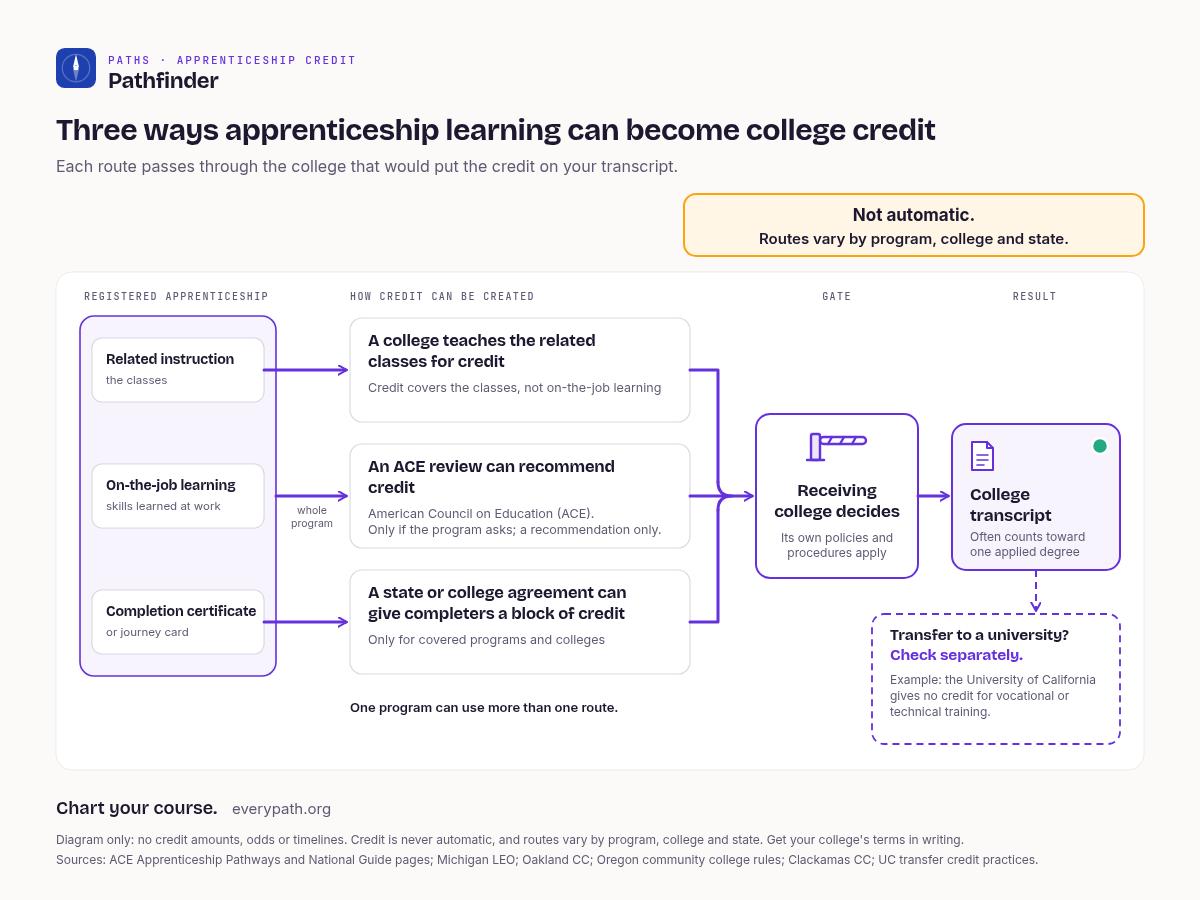
The first route has become easier to spot. DOL's March 2026 guidance says sponsors may count related instruction "utilizing clock hours, credit hours, contact hours, or alternative, commonly recognized measures of time" (DOL Circular 2026-01). If your program's standards list credit hours, that's a sign a college may be involved. If they list only clock hours, the classes can still be solid training; just ask whether they appear on any transcript.
Colleges can also play bigger roles. A DOL fact sheet names three: training provider, intermediary and program sponsor. Its examples include the University of New Hampshire as a training provider and Harper College, which "became one of the first community colleges to sponsor a program in 2016." It adds that "there are hundreds of educational institutions serving as Registered Apprenticeship Program sponsors" (DOL fact sheet). A college that sponsors or teaches your program is the most likely place for credit to land, because the classes are already its own.
How does an ACE review turn an apprenticeship into credit?
The American Council on Education, through its Learning Evaluations program, reviews training that happens outside college classrooms and recommends how much college credit it's worth. Its Apprenticeship Pathways page says "Apprenticeship programs are now included among the educational experiences eligible for ACE's rigorous review process." Faculty consultants "determine college-level equivalencies and workplace competencies," and, if appropriate, the team "recommends college credit equivalencies that apprentices may be eligible to transfer to degree and certification programs at postsecondary institutions" (ACE).
Two details matter for you. First, a program has to ask. Registered programs "are automatically considered eligible and may proceed with a request for a review," which means eligible to apply, not already credited. Programs also have to show "continued compliance every five years." Second, results are published on the ACE National Guide and come with digital badges and transcripts through Credly.
A recommendation spells out credit in college terms. ACE says its academic recommendations "include a number of semester hours, level, and subject area" (ACE). That's useful when you talk to an advisor, because it reads like a course list rather than a job description.
It still isn't a guarantee. ACE's page for learners puts it plainly: "each college or university makes its own decisions about whether to grant credit," and it tells you to contact the colleges you're considering about where to send the transcript and which prior learning policies apply (ACE).
To check a program yourself, search the ACE National Guide, which has an Apprenticeship filter. If the sponsor isn't listed, that only means ACE hasn't published a review. The program might still earn credit through the other two routes.
What does a state credit agreement look like?
Two states show how different these deals can be. Treat both as grounded examples of what exists, not a promise that your state works the same way.
Michigan. The state's Department of Labor and Economic Opportunity runs a program that "awards college credit for rigorous on-the-job learning that occurs in Michigan's Skilled Building Trade registered apprenticeship programs." Workers who have completed registered apprenticeships through a participating building trades union "can use this program to transfer credits to a participating community college," and "In many cases, eligible Union Trade workers will only need to take a semester of community college courses to obtain an associate's degree." Participating unions include the electrical workers (IBEW), carpenters and millwrights, laborers, iron workers, painters and sheet metal workers, and 22 community colleges are listed, from Bay de Noc Community College to Washtenaw Community College. The state says the list "will grow" as more agreements are finalized, and it points students to the Michigan Transfer Network to see how credits move (Michigan LEO).
One participating college, Oakland Community College, spells out its terms (OCC):
| OCC term | What the page says |
|---|---|
| Degree | You must enroll in the "Associate in Applied Science – Technological Sciences" |
| Credit available | Apprentices "can earn up to 45 credits toward a certificate or degree" |
| Coursework at OCC | "Completion of at least 15 OCC Credits, with a cumulative GPA of a 2.0 or higher" before the degree is issued |
| Proof | A "Journeyperson card or US Department of Labor Office of Apprenticeship Certificate" |
| Rules | "Normal college requirements and policies apply including admission and grading" |
Notice the timing. The Michigan program credits a completed apprenticeship, so this credit arrives at the end, when you hold the journey card, not in year one.
Oregon. Oregon writes its approach into state rules for community colleges. Apprentices and journey workers get "the same opportunities for being awarded academic credit for prior learning or prior certification" as other community college students. Related training courses "transcripted at one Oregon community college will be evaluated" toward certificates and associate degrees at another. Journey workers "may be awarded academic credit toward an associate degree based on local community college procedures." There's a ceiling too: no more than 25 percent of a certificate or associate degree can come from credit for prior experiential learning (OAR 589-007-0150). The same chapter says colleges should offer apprentices a route to an associate degree, such as an Associate of Applied Science in an apprenticeable trade (OAR 589-007-0140).
Here's how that plays out at one school. Clackamas Community College's Electrician Apprenticeship Technologies AAS totals 90 credits, and students who obtain an Oregon journey-level card or state Certificate of Completion "will earn 22 Credits." It's a limited-entry program that requires an apprenticeship card, and the college warns, "These degrees do not guarantee licensure" (Clackamas Community College).
Will apprenticeship credit transfer to a four-year university?
Sometimes, but plan for friction. At both Oakland and Clackamas, the credit feeds an Associate of Applied Science, a degree built around the trade, and a community college accepting your apprenticeship doesn't mean a university will.
Clackamas notes that its electrician degree "is articulated with Oregon Institute of Technology (OIT), which requires a higher-level math course than is required for the program." That's a real bridge to a bachelor's degree, with an extra requirement attached. At the other end, the University of California lists "vocational or technical training" among things it gives no credit for (UC). Credit a community college grants for your trade could count toward its own associate degree and still not move to a UC campus.
If a bachelor's degree is part of your plan, ask the university early which of your courses it would take. The mechanics of applying after time away are in how returning to college works after a break, and the bigger trade-off is in our comparison of apprenticeship and college routes.
Does college credit shorten an apprenticeship?
That's the reverse direction, and it runs on different rules. Credit that shortens an apprenticeship is called advanced standing, and DOL says it "can be applied to both the related instruction and the on-the-job learning components" of a program (DOL Circular 2026-01). The sponsor decides, under its approved standards, and our guide to apprenticeship length explains how that credit is granted.
Oregon's rule shows how separate the two records are: "The community college does not grant apprenticeship credit toward BOLI apprenticeship program requirements," and that credit "is acknowledged and accepted by the local joint committee" (OAR 589-007-0150). One office decides your college credit; a different body decides your apprenticeship progress. Expect to ask each one on its own.
What should you ask before you sign?
Ask the sponsor and the college, and get answers in writing.
| Ask | Why it matters |
|---|---|
| Who teaches the related instruction, and are the classes college credit courses? | Credit courses can build a transcript as you go. |
| Do the standards count classes in credit hours or clock hours? | Credit hours usually mean a college is involved. |
| Is this program listed in the ACE National Guide? | A published review gives colleges a recommendation to work from. |
| Does a state or college agreement cover this trade? | Agreements set a block of credit for completers. |
| Which degree does the credit apply to, and what's left to finish it? | Credit often fits one applied degree, with general education still to go. |
| Would a university accept that degree or those courses later? | Applied credit doesn't always transfer to a bachelor's program. |
| What proof will I need, and when? | Journey cards and completion certificates are common requirements. |
If a degree matters to you, keep a primary and backup path in view, so the apprenticeship and the college option can both stay open. Choose the trade and apprenticeship route for the work itself, and treat college credit as a bonus to confirm before you count on it.
Is an apprenticeship completion certificate the same as a degree?
No. The certificate comes from the Registration Agency and shows you finished a registered program in an occupation. A degree comes from a college. Some colleges turn a finished apprenticeship into a block of credit toward an associate degree, but you still enroll and meet their requirements.
Do I earn college credit while I'm still an apprentice?
It depends on who teaches your classes. When a college delivers the related instruction as credit courses, they can land on its transcript as you go. Michigan's statewide program credits completed apprenticeships, so under deals like that the credit arrives at the end.
How many credits is an apprenticeship worth?
There's no national figure. Oakland Community College in Michigan says apprentices can earn up to 45 credits, and Clackamas Community College in Oregon grants 22 credits for a journey-level card toward a 90-credit degree. Get your own college's number in writing.
Can apprenticeship credit count toward a bachelor's degree?
Sometimes, through a specific agreement. Clackamas Community College's electrician degree is articulated with Oregon Institute of Technology, which asks for more math. The University of California lists vocational and technical training among things it gives no credit for, so check the university first.
What does an ACE credit recommendation mean for an apprentice?
It means faculty reviewers from accredited colleges have matched a program to college-level learning and suggested credit. Registered programs can request that review, but it isn't automatic. The recommendation advises colleges; each one decides whether to accept it.
Sources
- Do you earn college credit while participating in apprenticeship programs? — U.S. Department of Labor, accessed 2026-09-26
- Circular 2026-01 — Registered Apprenticeship Training Approaches — U.S. Department of Labor, Office of Apprenticeship, accessed 2026-09-26
- 29 CFR 29.2 — Definitions — U.S. Department of Labor (Electronic Code of Federal Regulations), accessed 2026-09-26
- 29 CFR 29.5 — Standards of apprenticeship — U.S. Department of Labor (Electronic Code of Federal Regulations), accessed 2026-09-26
- Colleges and Universities as Partners in Registered Apprenticeship (fact sheet) — U.S. Department of Labor, accessed 2026-09-26
- Apprenticeship Pathways — American Council on Education, accessed 2026-09-26
- ACE National Guide — American Council on Education, accessed 2026-09-26
- Learners: Seeking Credit With the National Guide — American Council on Education, accessed 2026-09-26
- Colleges & Universities: Granting Credit With the National Guide — American Council on Education, accessed 2026-09-26
- Michigan College Credit for Apprenticeships Program — Michigan Department of Labor and Economic Opportunity, accessed 2026-09-26
- Apprenticeship — Oakland Community College, accessed 2026-09-26
- Oregon Administrative Rules Compilation, Chapter 589 (Higher Education Coordinating Commission), OAR 589-007-0110 to 589-007-0150 — Oregon Secretary of State, accessed 2026-09-26
- Electrician Apprenticeship Technologies, AAS — Clackamas Community College, accessed 2026-09-26
- Transfer credit practices — University of California, accessed 2026-09-26
Chart your course
Credit is one strand of a bigger decision. Pathfinder maps an apprenticeship next to college and the other routes, or keeps them all open while you're still deciding, and it labels each claim as sourced, estimated or advisory so you can see where the evidence ends and the judgment begins.
Start free — no credit card required.
Frequently asked questions
Is an apprenticeship completion certificate the same as a degree?
No. The certificate comes from the Registration Agency and shows you finished a registered program in an occupation. A degree comes from a college. Some colleges turn a finished apprenticeship into a block of credit toward an associate degree, but you still enroll and meet their requirements.
Do I earn college credit while I'm still an apprentice?
It depends on who teaches your classes. When a college delivers the related instruction as credit courses, they can land on its transcript as you go. Michigan's statewide program credits completed apprenticeships, so under deals like that the credit arrives at the end.
How many credits is an apprenticeship worth?
There's no national figure. Oakland Community College in Michigan says apprentices can earn up to 45 credits, and Clackamas Community College in Oregon grants 22 credits for a journey-level card toward a 90-credit degree. Get your own college's number in writing.
Can apprenticeship credit count toward a bachelor's degree?
Sometimes, through a specific agreement. Clackamas Community College's electrician degree is articulated with Oregon Institute of Technology, which asks for more math. The University of California lists vocational and technical training among things it gives no credit for, so check the university first.
What does an ACE credit recommendation mean for an apprentice?
It means faculty reviewers from accredited colleges have matched a program to college-level learning and suggested credit. Registered programs can request that review, but it isn't automatic. The recommendation advises colleges; each one decides whether to accept it.
Sources
- Do you earn college credit while participating in apprenticeship programs? — U.S. Department of Labor, accessed 2026-09-26
- Circular 2026-01 — Registered Apprenticeship Training Approaches — U.S. Department of Labor, Office of Apprenticeship (2026), accessed 2026-09-26
- 29 CFR 29.2 — Definitions — U.S. Department of Labor (Electronic Code of Federal Regulations), accessed 2026-09-26
- 29 CFR 29.5 — Standards of apprenticeship — U.S. Department of Labor (Electronic Code of Federal Regulations), accessed 2026-09-26
- Colleges and Universities as Partners in Registered Apprenticeship (fact sheet) — U.S. Department of Labor (2025), accessed 2026-09-26
- Apprenticeship Pathways — American Council on Education, accessed 2026-09-26
- ACE National Guide — American Council on Education, accessed 2026-09-26
- Learners: Seeking Credit With the National Guide — American Council on Education, accessed 2026-09-26
- Colleges & Universities: Granting Credit With the National Guide — American Council on Education, accessed 2026-09-26
- Michigan College Credit for Apprenticeships Program — Michigan Department of Labor and Economic Opportunity, accessed 2026-09-26
- Apprenticeship — Oakland Community College, accessed 2026-09-26
- Oregon Administrative Rules Compilation, Chapter 589 (Higher Education Coordinating Commission), OAR 589-007-0110 to 589-007-0150 — Oregon Secretary of State (2026), accessed 2026-09-26
- Electrician Apprenticeship Technologies, AAS — Clackamas Community College, accessed 2026-09-26
- Transfer credit practices — University of California, accessed 2026-09-26
Chart your course
Pathfinder builds you a plan for whichever path you pick — or for “still deciding” — and labels every claim in it as grounded, modelled or advisory. It will not invent a deadline, a cost, or your chances of getting in.
Start free No credit card required.
Related reading
- What is a registered apprenticeship? Sourced definition
DOL-registered apprenticeships: paid work + training, with standards. How they differ from informal “apprentice” jobs.
- Registered apprenticeship vs trade school explained
A registered apprenticeship is a validated paid job. Trade school can teach the class and still not be the program. Check who sponsors it.
- How community college differs from trade school
Community college is usually a public sub-baccalaureate pattern. Trade school is not an official category. Match the credential before any price.