Paths after high school
How to find a registered apprenticeship after high school
By Pathfinder Editorial · Published · 15 min read
About: Registered apprenticeship Trade and apprenticeship Pathway Grounded

Start on apprenticeship.gov with two tools: the Apprenticeship Job Finder for open postings and the Partner Finder for sponsors. Then check your state's apprenticeship agency, because some states register their own programs. Ask sponsors when they take applications, confirm which agency registered the program, and expect an application, testing or an interview, and a ranked list.
This is the how-to for landing a registered apprenticeship. For what separates a registered program from any job with "apprentice" in the title, start with what a program needs before it counts as registered. The wage side is covered in how apprentice pay steps up over the term, and what decides the length of a program explains the calendar. If you're still weighing this pathway against others, compare them on the guide to all the options after graduation.
What follows is the US system, with three states named where the rules or tools differ. Other countries run apprenticeships through their own agencies, so use the steps as a guide to what to look for.
Who keeps the list of registered programs where you live?
It depends on your state. The Department of Labor (DOL) describes an apprenticeship system with "two types of entities responsible for registering and overseeing Registered Apprenticeship Programs": its own Office of Apprenticeship (OA) and "recognized State Apprenticeship Agencies (SAA)" (apprenticeship.gov).
The difference matters for your search:
- In OA states, federal staff register and oversee programs "through state field offices." Texas and Georgia are listed among them.
- In SAA states, a state agency is "Recognized by OA to act on behalf of the federal U.S. DOL." Oregon, Washington and New York are listed among them. These agencies "may use a separate system unique to that state" instead of the federal database.
- The overlap: "In some circumstances, OA may register a program in a state with an SAA."
Federal rules back this up. A State Apprenticeship Agency is defined as "an agency of a State government that has responsibility and accountability for apprenticeship within the State" (29 CFR §29.2), and DOL recognition gives it "non-exclusive authority" to decide whether a program meets the federal standards (29 CFR §29.13).
So before you search, check which kind of state you're in on DOL's state offices page. If it's an SAA state, plan to use both the national tools and the state's own.
How do you search the Apprenticeship Job Finder?
The Job Finder is DOL's search for open apprenticeship jobs. Its help page walks through it: search "using keywords and/or location," then filter results "by location, program type, date posted, and skills," and sort by "most relevant" or "nearest to you." When you find one you like, the apply button "will take you to the job listing website where you can complete the application process" (apprenticeship.gov). You apply with the employer, not with DOL.
Pay attention to the tags on each result, because they don't mean the same thing (Apprenticeship Job Finder):
| Tag | What DOL says it means | What it tells you |
|---|---|---|
| Registered Partner | "the organization or company associated with an apprenticeship posting is registered with the Office of Apprenticeship" | The employer or sponsor is known to OA. Still ask which program you'd join |
| Registered Occupation | "the occupation specified in an apprenticeship opportunity corresponds to an occupation title or code registered with the Office of Apprenticeship" | The job type can be apprenticed. It doesn't show that this employer runs a registered program |
The Job Finder also "pulls data from multiple data sources," so treat a listing as a lead, not proof. A Registered Occupation tag on a posting from an unfamiliar company is the one to question hardest.
If you don't know which job to search for yet, DOL's page for people new to the workforce suggests starting with My Next Move "to discover career profiles, career videos, and research industries," then returning to the Job Finder "to find real-time opportunities" (apprenticeship.gov).
What if nothing is posted near you?
Search for sponsors instead of postings. Many programs recruit on their own schedule, and a sponsor with no open listing today may open applications later. The Job Finder itself points you there when a search comes up empty, as a way to find out when sponsors will next take applicants.
The Partner Finder lets you search "by need, organization name, and by state/county." To see sponsors, DOL says to use the search-by-need tab and check the box labeled "I want to learn from sponsors" (apprenticeship.gov).
Then pick up the phone. Oregon's apprenticeship agency tells applicants to call or visit a program and ask two questions: "Are you taking applications? What are the steps to apply?" (Oregon BOLI). Write down the answer, including any date when the next window opens. A missed window can mean waiting for the next recruitment.
What do state apprenticeship agencies add?
Often the most complete local list, plus application dates. Here's what three SAA states offer on their own sites. Each row is grounded in that agency's own page, not a rule for other states:
| State | Where programs are listed | What the page tells applicants |
|---|---|---|
| Oregon (Bureau of Labor and Industries) | A search of programs "by type of job, county, and opening," with "contact information, requirements for the program, as well as opening notices for application" | Unless a program lists otherwise, minimum qualifications are "18 years of age and holding a High School Diploma or GED" |
| New York (State Department of Labor) | Recruitment announcements by region, each showing "how & when you can obtain an application" and the requirements | The NYS Job Bank also carries apprenticeship listings from "New York State registered programs and other non-registered programs" |
| Washington (Department of Labor & Industries) | The Apprenticeship Registration Tracking System (ARTS), which "lists all registered apprenticeship programs available in Washington" | The agency "cannot recommend which program or occupation a potential apprentice should pursue" |
Sources: Oregon BOLI, New York DOL, Washington L&I.
Two lessons stand out. First, application windows are real and dated. New York's announcements list an opening date and a closing date for each recruitment, so check them regularly. Second, not every apprenticeship listing is registered, even on a government job board. New York says so plainly about its own job bank.
In an OA state like Texas or Georgia, there may be no separate state registration database, and the apprenticeship.gov tools become your main search. apprenticeship.gov's state and regional office pages are the way to reach the federal staff who register programs there.
How do you confirm a program is actually registered?
Ask, then check. The word "apprentice" in a job title doesn't settle it. Registration does. Under federal rules, a program must "apply for registration and be registered with the Office of Apprenticeship or with a State Apprenticeship Agency recognized by the Office of Apprenticeship" (29 CFR §29.3).
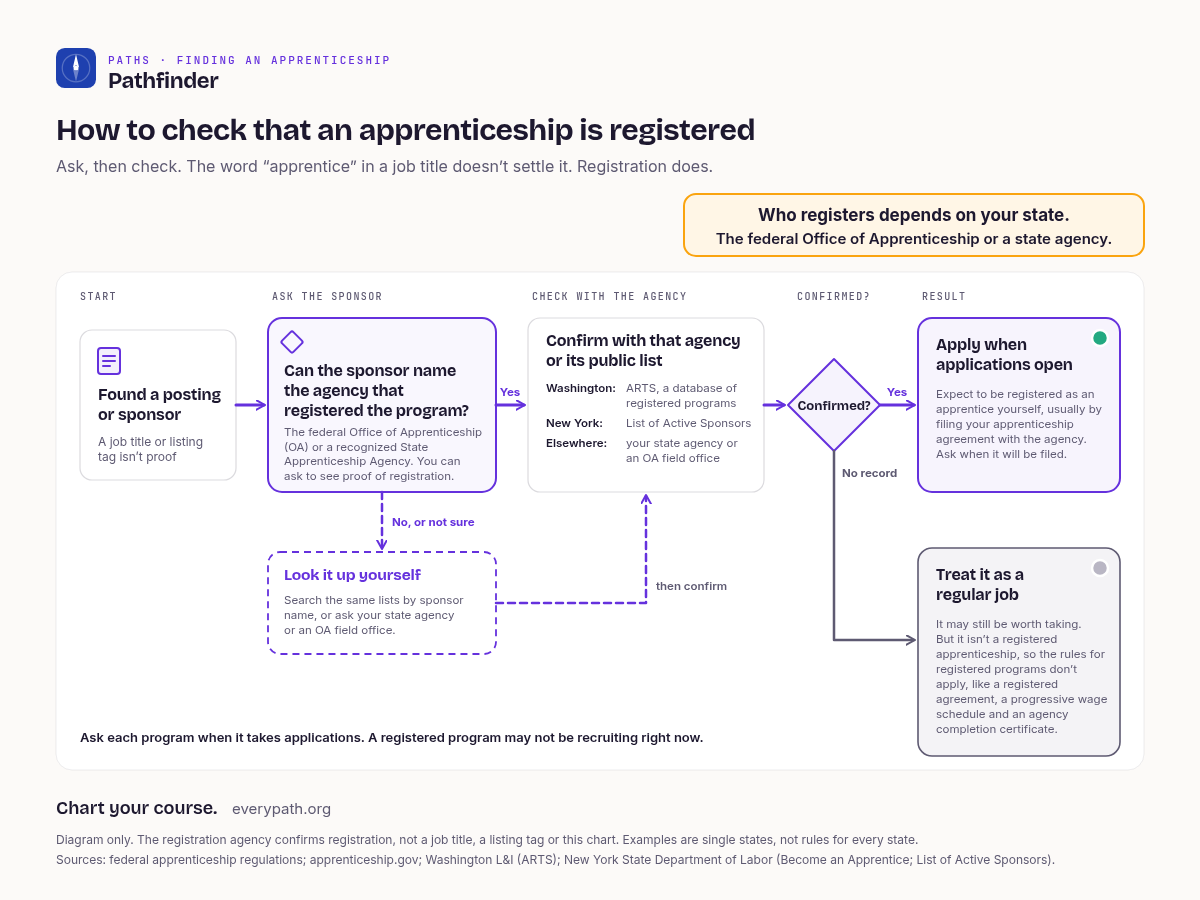
Here's how to check:
- Ask the sponsor which agency registered the program. The answer should be a recognized state agency or the Office of Apprenticeship. Under federal rules, OA-approved programs get a Certificate of Registration, and state-approved ones get "a similar certificate or other written indicia." That paperwork is the program's proof of registration, and it's fair to ask to see it.
- Confirm with that agency. In Washington, look the program up in ARTS. The employer you'd work for may train apprentices under another sponsor's program, so if its name doesn't match a sponsor, try the separate "Training agent/Employer lookup" there. In New York, search the state DOL's List of Active Sponsors by sponsor name or trade, and check the Status column, because the list also includes sponsors on Probation or Inactive status. Elsewhere, contact your state agency or OA field office.
- Expect your own registration. Apprentices "must be individually registered under a registered program," usually by filing your apprenticeship agreement with the agency. If you start on probation before that happens, your name must reach the agency "within 45 days of employment" (29 CFR §29.3). Ask when your agreement will be filed.
New York describes that step from the state side: the written contract between apprentice and sponsor "is approved and registered by the Department," and each program is monitored by a state Apprenticeship Training Representative.
One tool you won't need yet: Verify My Apprenticeship. It's for people who have "completed an apprenticeship program" registered with DOL, a State Apprenticeship Agency or the military's program, to download their record (apprenticeship.gov). Keep it in mind for later.
If a sponsor can't name an agency and none has a record, the job may still be worth taking. It just isn't a registered apprenticeship, so the rules for registered programs (29 CFR §29.5(b)(5), (11) and (15)) don't apply: a registered apprenticeship agreement, a progressive wage schedule, and a completion certificate from the registration agency. Log it under straight to work and keep searching if registration matters to you.
What does applying usually involve?
More like a job application than a school application, with a few extra steps. Washington describes it in four: choose a program, apply, interview and testing, where "you will likely have an interview and potentially an aptitude test," then selection (Washington L&I).
Qualifications. Each program sets its own, within limits. Federal standards require "The minimum qualifications required by a sponsor for persons entering the apprenticeship program, with an eligible starting age not less than 16 years" (29 CFR §29.5). States and programs usually set more. New York says apprentices must be "18 years old, or 16-17 years old, with parental approval" (New York DOL), and Washington asks applicants to "Provide proof of age, high school diploma or equivalent, and other required documents." Gather those papers before you apply. What counts as evidence on an application lists the documents each route's own pages ask for.
Selection rules. How a sponsor picks apprentices isn't a secret process. Its selection procedures "must be included in the written plan for Standards of Apprenticeship" approved by the Registration Agency, and they "must be uniformly and consistently applied to all applicants" (29 CFR §30.10). Registered sponsors also may not discriminate against an "applicant for apprenticeship" on protected grounds, including in "Recruitment, outreach, and selection procedures" (29 CFR §30.3). You can ask how applicants are scored.
Waiting lists. Passing the interview doesn't always mean starting work the next day. In Oregon, "many programs will give you a score which places you in a specific order on a list called the Pool of Eligibles (not yet apprentices)." From there you may move onto a list of out-of-work apprentices before being sent to a job, and "depending on the trade, you may either find work or be referred to work by the apprenticeship program" (Oregon BOLI). Ask any program how its list works, so you can plan around the wait.
What if you aren't ready, or don't get in this round?
You have options, and state agencies name them.
- Preparation programs. Washington points applicants who aren't quite ready to a Recognized Apprenticeship Preparation Program, which provides "a structured pathway toward a Registered Apprenticeship." New York offers "Direct Entry" programs that help you build the skills to meet a registered program's minimum requirements.
- Starting in high school. If you're still a student, DOL suggests asking your school counselor whether your school offers a youth apprenticeship "or other work-based learning options" (apprenticeship.gov).
- The next window. Recruitments reopen. Note the next opening date and what you could strengthen before then, such as a math class, a work reference or a driver's license if the trade needs one.
- A second choice. Apply to more than one trade or sponsor if you qualify, and keep a primary and backup path so a closed window doesn't stall you.
If you're still unsure the trade and apprenticeship route is right for you, still deciding is a fair place to be. For the bigger trade-off, see how apprenticeships compare with college. And if you'd like help explaining your plan at home, there's a student's guide to telling your parents.
Is every listing on the Apprenticeship Job Finder a registered apprenticeship?
Not necessarily. A Registered Partner tag means the organization behind the posting is registered with the Office of Apprenticeship. A Registered Occupation tag only means the job title matches a registered occupation. Ask the employer which agency registered its program.
How old do I have to be to apply?
Federal rules let sponsors set their own minimum qualifications, with a starting age of at least 16. States and programs often ask for more. Oregon lists 18 and a diploma or GED unless a program says otherwise, and New York accepts 16- and 17-year-olds with parental approval.
My state has its own apprenticeship agency. Do I still use apprenticeship.gov?
Yes, and the state tools too. States with a recognized agency may track programs in their own system, so a program might show up more clearly on the state site. Searching both gives you the fullest list.
What happens after I apply and interview?
It depends on the program. In Oregon, many programs score applicants and place them in ranked order on a list, and you move toward work as that list moves. Ask each program how its list works and how long placements usually take.
Can I check a program's registration before I accept an offer?
Yes. Ask the sponsor which agency registered the program, then confirm with that agency or its public list. Washington publishes a database of every registered program in the state, and New York publishes a list of active sponsors. That list also includes sponsors on Probation or Inactive status, so check the Status column.
Sources
- Apprenticeship Job Finder — U.S. Department of Labor, accessed 2026-09-28
- How do I find open apprenticeship job opportunities? — U.S. Department of Labor, accessed 2026-09-28
- Where can I find a list of apprenticeship program sponsors? — U.S. Department of Labor, accessed 2026-09-28
- Apprenticeship System (State Offices) — U.S. Department of Labor, accessed 2026-09-28
- New to the Workforce — U.S. Department of Labor, accessed 2026-09-28
- Verify My Apprenticeship — U.S. Department of Labor, accessed 2026-09-28
- 29 CFR 29.2 — Definitions — U.S. Department of Labor (Electronic Code of Federal Regulations), accessed 2026-09-28
- 29 CFR 29.3 — Eligibility and procedure for registration of an apprenticeship program — U.S. Department of Labor (Electronic Code of Federal Regulations), accessed 2026-09-28
- 29 CFR 29.5 — Standards of apprenticeship — U.S. Department of Labor (Electronic Code of Federal Regulations), accessed 2026-09-28
- 29 CFR 29.13 — Recognition of State Apprenticeship Agencies — U.S. Department of Labor (Electronic Code of Federal Regulations), accessed 2026-09-28
- 29 CFR 30.3 — Equal opportunity standards applicable to all sponsors — U.S. Department of Labor (Electronic Code of Federal Regulations), accessed 2026-09-28
- 29 CFR 30.10 — Selection of apprentices — U.S. Department of Labor (Electronic Code of Federal Regulations), accessed 2026-09-28
- Apprenticeship Opportunities — Oregon Bureau of Labor and Industries, accessed 2026-09-28
- Become an Apprentice — Oregon Bureau of Labor and Industries, accessed 2026-09-28
- Become an Apprentice — New York State Department of Labor, accessed 2026-09-28
- Apprenticeship Announcements — New York State Department of Labor, accessed 2026-09-28
- List of Active Sponsors — New York State Department of Labor, accessed 2026-09-28
- Become an Apprentice — Washington State Department of Labor & Industries, accessed 2026-09-28
- Apprenticeship Program Public (ARTS) — Washington State Department of Labor & Industries, accessed 2026-09-28
Chart your course
Finding a program is one step in a longer plan. Pathfinder builds that plan around the route you choose, whether an apprenticeship, another path or still deciding, with a backup and dated next steps, and it flags every claim as sourced, estimated or advisory so you know what rests on evidence.
Start free — no credit card required.
Frequently asked questions
Is every listing on the Apprenticeship Job Finder a registered apprenticeship?
Not necessarily. A Registered Partner tag means the organization behind the posting is registered with the Office of Apprenticeship. A Registered Occupation tag only means the job title matches a registered occupation. Ask the employer which agency registered its program.
How old do I have to be to apply?
Federal rules let sponsors set their own minimum qualifications, with a starting age of at least 16. States and programs often ask for more. Oregon lists 18 and a diploma or GED unless a program says otherwise, and New York accepts 16- and 17-year-olds with parental approval.
My state has its own apprenticeship agency. Do I still use apprenticeship.gov?
Yes, and the state tools too. States with a recognized agency may track programs in their own system, so a program might show up more clearly on the state site. Searching both gives you the fullest list.
What happens after I apply and interview?
It depends on the program. In Oregon, many programs score applicants and place them in ranked order on a list, and you move toward work as that list moves. Ask each program how its list works and how long placements usually take.
Can I check a program's registration before I accept an offer?
Yes. Ask the sponsor which agency registered the program, then confirm with that agency or its public list. Washington publishes a database of every registered program in the state, and New York publishes a list of active sponsors. That list also includes sponsors on Probation or Inactive status, so check the Status column.
Sources
- Apprenticeship Job Finder — U.S. Department of Labor, accessed 2026-09-28
- How do I find open apprenticeship job opportunities? — U.S. Department of Labor, accessed 2026-09-28
- Where can I find a list of apprenticeship program sponsors? — U.S. Department of Labor, accessed 2026-09-28
- Apprenticeship System (State Offices) — U.S. Department of Labor, accessed 2026-09-28
- New to the Workforce — U.S. Department of Labor, accessed 2026-09-28
- Verify My Apprenticeship — U.S. Department of Labor, accessed 2026-09-28
- 29 CFR 29.2 — Definitions — U.S. Department of Labor (Electronic Code of Federal Regulations), accessed 2026-09-28
- 29 CFR 29.3 — Eligibility and procedure for registration of an apprenticeship program — U.S. Department of Labor (Electronic Code of Federal Regulations), accessed 2026-09-28
- 29 CFR 29.5 — Standards of apprenticeship — U.S. Department of Labor (Electronic Code of Federal Regulations), accessed 2026-09-28
- 29 CFR 29.13 — Recognition of State Apprenticeship Agencies — U.S. Department of Labor (Electronic Code of Federal Regulations), accessed 2026-09-28
- 29 CFR 30.3 — Equal opportunity standards applicable to all sponsors — U.S. Department of Labor (Electronic Code of Federal Regulations), accessed 2026-09-28
- 29 CFR 30.10 — Selection of apprentices — U.S. Department of Labor (Electronic Code of Federal Regulations), accessed 2026-09-28
- Apprenticeship Opportunities — Oregon Bureau of Labor and Industries, accessed 2026-09-28
- Become an Apprentice — Oregon Bureau of Labor and Industries, accessed 2026-09-28
- Become an Apprentice — New York State Department of Labor, accessed 2026-09-28
- Apprenticeship Announcements — New York State Department of Labor, accessed 2026-09-28
- List of Active Sponsors — New York State Department of Labor, accessed 2026-09-28
- Become an Apprentice — Washington State Department of Labor & Industries, accessed 2026-09-28
- Apprenticeship Program Public (ARTS) — Washington State Department of Labor & Industries, accessed 2026-09-28
Chart your course
Pathfinder builds you a plan for whichever path you pick — or for “still deciding” — and labels every claim in it as grounded, modelled or advisory. It will not invent a deadline, a cost, or your chances of getting in.
Start free No credit card required.
Related reading
- Apprenticeship requirements after high school: age 16+
Apprenticeship requirements: be at least 16 (higher if a law says so). A diploma is not a national rule; each sponsor sets its own grade and skill rules.
- What is a registered apprenticeship? Sourced definition
DOL-registered apprenticeships: paid work + training, with standards. How they differ from informal “apprentice” jobs.
- What is a youth apprenticeship, and can you start at 16?
A youth apprenticeship lets a high school student start a registered apprenticeship at 16, with school, an employer, and a parent signing on.