Paths after high school
Community college vs university after high school?
By Pathfinder Editorial · Published · 12 min read

Community college then transfer and starting at a university are different entry points after high school — not a prestige contest. College Board published tuition for public two-year in-district students is far below public four-year in-state; national transfer data show many students move on, but “2+2” is not guaranteed. Choose by credential need and name a backup.
This is the community college vs university guide inside Pathfinder’s map of every path after high school. If you are not ready to lock a route yet, start with still deciding after high school. For a sourced earn-and-learn comparison against a degree path, use apprenticeship vs. college — this page will not reprint those pay tables.
These are U.S. pricing, enrollment-outcome, and occupation figures. Pathfinder ships country packs for the US, the UK, the UAE, India and Singapore, so the planning questions travel — the College Board / NCES / BLS snapshot does not automatically.
What is community college for after high school?
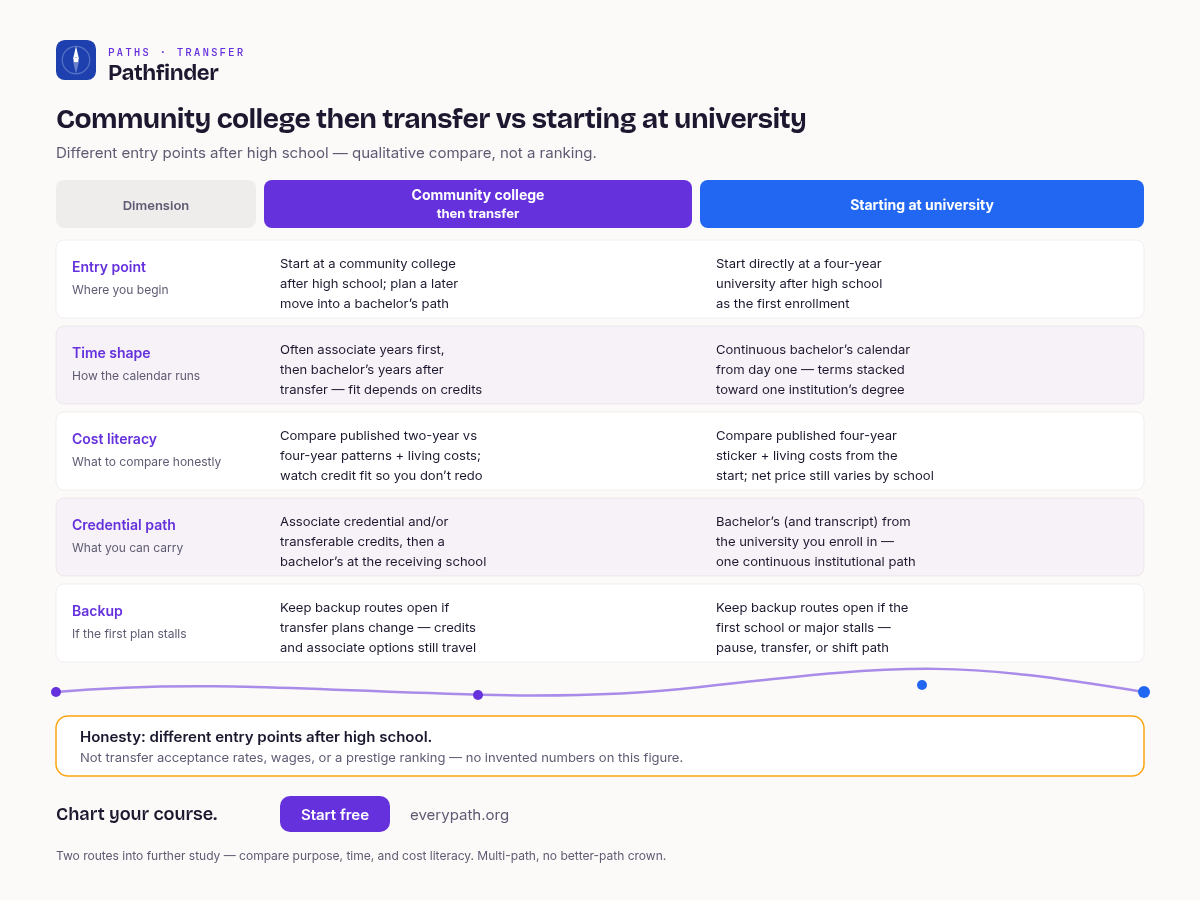
In Pathfinder’s taxonomy, community college is a named pathway after high school — often a public two-year (or short-cycle) institution where students pursue an associate’s degree, a school-issued certificate, workforce training, or coursework with transfer intent. It is not a consolation prize for skipping a four-year campus, and it is not the same label as “trade school” or “industry certification.”
What community college can be for, when the language stays grounded:
- An associate’s credential as the primary goal. In the Occupational Outlook Handbook glossary, an associate’s degree is typically awarded for at least two years of full-time academic study beyond high school (OOH Glossary).
- A lower published-price entry into postsecondary study, with the option to transfer later — not a promise that every credit will apply at every university.
- A local, often part-time-friendly campus for students who need to work, stay near family, or test a field before committing to a bachelor’s timeline.
What it does not prove on this page: that your local district college has open transfer seats at your dream university, that “everyone who wants a bachelor’s gets one through 2+2,” or that community college is “always cheaper after living costs and time.”
What is starting at a university for?
Starting at a university (or other four-year college) usually means treating a bachelor’s program as the primary academic path from the first term. The OOH glossary defines a bachelor’s degree as typically awarded for at least four years of full-time academic study beyond high school (OOH Glossary).
That entry point is for students whose near-term plan is built around four-year program structure, campus resources, and (often) living arrangements tied to that campus. It is one equally valid route on the hub map — not the default against which every other path is measured.
Two honesty constraints matter immediately:
- Typical entry education is not your personal hiring guarantee. BLS assigns each detailed occupation a typical education needed for entry; multiple paths to entry are not captured by that classification system, and alternate routes live in the OOH profile’s “How to Become One” narrative when relevant (Measures of Education and Training).
- Starting at a four-year campus does not invent your graduation odds. This page will not invent acceptance rates, prestige rankings, or a national “finish in four years” percentage for your major.
How do published prices compare (sticker, not your bill)?
College Board’s Trends in College Pricing highlights for 2025–26 report average published (sticker) tuition and fees for full-time undergraduates as (Trends highlights):
| Sector (2025–26 published tuition & fees) | Average sticker |
|---|---|
| Public two-year, in-district | $4,150 |
| Public four-year, in-state | $11,950 |
| Public four-year, out-of-state | $31,880 |
| Private nonprofit four-year | $45,000 |
NCES Digest Table 330.10 (IPEDS-based average charges) shows the same direction for an earlier year: in 2022–23, average tuition and required fees at public institutions were about $3,598 at two-year campuses and $9,750 at four-year campuses (Digest 330.10). Use College Board for the current sticker snapshot; use NCES as supporting IPEDS context — not as a second conflicting “truth.”
Net-price honesty from the same College Board highlights: on average, first-time full-time students at public two-year colleges have been receiving enough grant aid to cover their tuition and fees since 2009–10. That is a national average pattern about tuition/fees after grants — not a claim that room, board, transport, or forgone wages are free, and not your personal award letter. Scholarships add their own written rules on top; scholarship eligibility criteria shows how to read them.
Sticker is research context. Your bill is financial-aid reality. Pathfinder will not invent your Expected Family Contribution or a campus-specific net price here.
How common is transferring from community college to a four-year school?
Transfer is a real national pathway — and it is not automatic.
The National Student Clearinghouse Research Center’s Tracking Transfer update (fall 2018 entering community-college cohort) reports (Tracking Transfer):
- Fewer than a third of first-time-ever-in-college students who began at a community college transferred to a four-year institution within six years (31.6%).
- Of those who did transfer, slightly less than half completed a bachelor’s degree within six years of starting (48.7%).
Those are cohort outcome rates. They are not transfer acceptance rates at a named university, not your odds in your state system, and not a Pathfinder promise about articulation.
NCES Digest Table 326.25 adds a shorter, narrower IPEDS Graduation Rates window for first-time, full-time students at public two-year institutions. For the 2019 entry cohort, three years after entry: 30.2% had completed a program at the first institution, and 13.9% were reported as transferred out (Digest 326.25). Important footnote from that table: transfer-out data are required only from institutions for which preparation for transfers is a substantial part of the institutional mission — so IPEDS GR transfer-out figures can undercount real movement. Prefer Tracking Transfer for the six-year national transfer-pathway picture; cite IPEDS GR carefully as a limited three-year institutional report.
Does “2+2” always work?
No. “Two years at a community college, then two years at a university” is a planning shape, not a federal guarantee.
What can break the cartoon version of 2+2:
- Credits that do not apply to the major you eventually declare
- Capacity limits, GPA or course prerequisites at the receiving campus
- Changing majors midstream
- Stopping out for work or family without a re-entry plan
- Confusing “accepted somewhere” with “finished a bachelor’s on a four-year clock”
Pathfinder will not invent articulation odds, “guaranteed junior standing,” or a national acceptance rate for community-college transfers. If your state publishes a transfer guarantee program, read that primary — this page stays at national outcome framing.
How do associate’s and bachelor’s show up in BLS occupation data?
Degrees show up in BLS’s typical education needed for entry assignments — classifications, not placement promises.
Career Outlook’s education-level openings article (2024–34 projections) reports that BLS classifies (Career Outlook — Education level and projected openings, 2024–34):
- 48 occupations as typically requiring an associate’s degree to enter
- 178 occupations as typically requiring a bachelor’s degree to enter
- (For neighboring context only: 51 typically require a postsecondary nondegree award such as a school-issued certificate)
Across all occupations, BLS projects about 19 million openings each year, on average, from 2024 to 2034 — mostly from replacement needs, not only from newly created jobs. Those figures are projections and classifications. They do not invent your hiring odds in your county.
You can browse occupations by typical entry education in the OOH Occupation Finder. That is a research process — not a placement promise.
How do you choose without invented transfer odds?
Name a primary academic route and an explicit backup — the same primary and backup path rule Pathfinder uses across the map.
A practical sequence that stays honest:
- Name the credential you actually need in the next 2–4 years (associate’s as destination; bachelor’s as destination; or associate’s-with-transfer-intent as a staged plan). If you cannot name it yet, you may still be in still deciding.
- Read the OOH “How to Become One” section for the occupation family you are aiming at (or a close match). Note typical entry-level education — and whether alternate routes are described.
- Separate sticker from net price before you treat College Board averages as your bill. Ask the campus for a net-price estimate and aid deadlines; do not invent them from a national table.
- If transfer is part of the plan, treat it as a project — articulation guides, advising appointments, and written course applicability — not as folklore that “2+2 always works.”
- Write the backup out loud. Example shapes (illustrative, not odds): primary bachelor’s start with a backup associate’s program nearby; primary community-college workforce certificate with a backup transfer track; primary university start with a backup community-college term if aid or readiness shifts — whatever matches your research.
What “choose” does not mean here: picking the campus with the loudest prestige story, inventing a national ROI, or treating a cousin’s transfer anecdote as a grounded claim about your receiving institution.
How does this relate to still deciding, apprenticeships, and other paths?
Keep the neighbors in their lanes:
- Still deciding after high school owns the undecided planning stance. Community college can be a low-sticker place to explore — it is not automatically “still deciding,” and still deciding is not automatically community college.
- Apprenticeship vs. college owns sourced pay and cost side-by-sides for registered apprenticeship vs a degree path. This page will not reprint those tables.
- Trade school vs. college owns trade/vocational vs degree framing. A community college may host career-technical programs; that does not collapse trade school and community college into one label.
- Certifications vs a degree owns the issuer split (industry cert vs school certificate vs license vs degree). A community-college certificate is usually a school-issued award — not automatically an industry certification.
- Straight to work after high school owns employment as primary. Some people work full-time and take community-college classes part-time; that hybrid does not rewrite either path’s definition.
Community college and university sit on the hub map as their own routes for a reason: they are different entry points with different sticker contexts and different transfer realities.
What this page will not tell you
- Invented transfer acceptance rates, “guaranteed 2+2,” or campus prestige rankings
- Invented wages, ROI percentages, or “community college grads earn X% more/less” horse races
- Which single campus is “best” after high school in the abstract
- Your personal odds of transferring into a named major at a named university
- Full apprenticeship vs college pay/cost tables (sibling owns)
- Full trade-school cost tables (sibling owns)
- A deep reprint of certification vs license issuer rules (certifications vs. degree owns)
If a claim needs a primary URL and we did not open one on write day, it stays off the page.
Is community college then transfer the same as starting at a university?
No. Community college is often an associate’s or transfer-intent entry point; starting at a university is usually a bachelor’s path from day one. They can both lead to a bachelor’s for some students, but transfer is an outcome pattern — not a guarantee.
Is community college cheaper than a university?
Published (sticker) tuition and fees are lower on average at public two-year colleges than at public four-year in-state campuses — College Board’s 2025–26 averages are $4,150 vs $11,950. Your net price after grants can differ. Sticker is not your personal bill.
What share of community college students transfer to a four-year school?
National Student Clearinghouse Tracking Transfer finds that 31.6% of first-time community college starters in fall 2018 transferred to a four-year institution within six years. That is a cohort outcome rate, not your acceptance odds at a named university.
Does “2+2” always work?
No. Articulation agreements, course applicability, and capacity vary by state and campus. Pathfinder will not invent a guarantee that two years at a community college plus two years at a university automatically produces a bachelor’s on schedule.
Which path should I pick if I’m still unsure?
Name a primary and an explicit backup. If you cannot name either yet, use still deciding after high school as a planning stance — undecided is a path, not a failure.
Sources
- Trends in College Pricing: Highlights — College Board (2025), accessed 2026-09-22
- Digest Table 330.10 — National Center for Education Statistics (2023), accessed 2026-09-22
- Digest Table 326.25 — National Center for Education Statistics (2023), accessed 2026-09-22
- Tracking Transfer — National Student Clearinghouse Research Center (updated 2026), accessed 2026-09-22
- OOH Glossary — U.S. Bureau of Labor Statistics, accessed 2026-09-22
- Measures of Education and Training — U.S. Bureau of Labor Statistics, accessed 2026-09-22
- Education level and projected openings, 2024–34 — U.S. Bureau of Labor Statistics (2025), accessed 2026-09-22
- Occupation Finder — U.S. Bureau of Labor Statistics, accessed 2026-09-22
Chart your course
Pathfinder builds you a plan for whichever path you pick — community college, university, apprenticeship, trade, certifications, straight to work, or “still deciding” — and labels every claim as grounded, modelled or advisory. It will not invent a deadline, a wage, a transfer acceptance rate, or your chances of getting hired.
Start free — no credit card required. See pricing if you want the paid tiers later.
Frequently asked questions
Is community college then transfer the same as starting at a university?
No. Community college is often an associate’s or transfer-intent entry point; starting at a university is usually a bachelor’s path from day one. They can both lead to a bachelor’s for some students, but transfer is an outcome pattern — not a guarantee.
Is community college cheaper than a university?
Published (sticker) tuition and fees are lower on average at public two-year colleges than at public four-year in-state campuses — College Board’s 2025–26 averages are $4,150 vs $11,950. Your net price after grants can differ. Sticker is not your personal bill.
What share of community college students transfer to a four-year school?
National Student Clearinghouse Tracking Transfer finds that 31.6% of first-time community college starters in fall 2018 transferred to a four-year institution within six years. That is a cohort outcome rate, not your acceptance odds at a named university.
Does “2+2” always work?
No. Articulation agreements, course applicability, and capacity vary by state and campus. Pathfinder will not invent a guarantee that two years at a community college plus two years at a university automatically produces a bachelor’s on schedule.
Which path should I pick if I’m still unsure?
Name a primary and an explicit backup. If you cannot name either yet, use still deciding after high school as a planning stance — undecided is a path, not a failure.
Sources
- Trends in College Pricing: Highlights — College Board (2025), accessed 2026-09-22
- Digest Table 330.10 — Average undergraduate tuition, fees, room, and board — National Center for Education Statistics (2023), accessed 2026-09-22
- Digest Table 326.25 — Outcomes at 2-year institutions 3 years after entry — National Center for Education Statistics (2023), accessed 2026-09-22
- Tracking Transfer — National Student Clearinghouse Research Center (2026), accessed 2026-09-22
- Occupational Outlook Handbook — Glossary — U.S. Bureau of Labor Statistics, accessed 2026-09-22
- Measures of Education and Training — U.S. Bureau of Labor Statistics, accessed 2026-09-22
- Education level and projected openings, 2024–34 — U.S. Bureau of Labor Statistics (2025), accessed 2026-09-22
- Occupation Finder — U.S. Bureau of Labor Statistics, accessed 2026-09-22
Chart your course
Pathfinder builds you a plan for whichever path you pick — or for “still deciding” — and labels every claim in it as grounded, modelled or advisory. It will not invent a deadline, a cost, or your chances of getting in.
Start free No credit card required.
Related reading
- Can you go to college later? How re-entry works
Yes. Skipping or delaying college doesn't close the door. How applying later works, first-year vs transfer status, credit for what you did, and what to keep.
- Certifications vs a degree after high school?
Industry certifications vs a college degree after high school: what each proves, who issues them, and how to choose without invented odds.
- Military vs college after high school? Sourced
Enlisting after high school vs starting college: what each path is for, with VA/DoD/BLS primaries only — no invented odds or prestige rankings.