Paths after high school
What is a registered apprenticeship? Sourced definition
By Pathfinder Editorial · Published · 12 min read
About: Pathway Registered apprenticeship Trade and apprenticeship Grounded

A registered apprenticeship is a paid job with structured on-the-job learning, related classroom instruction, progressive wage increases, and a portable credential — validated by the U.S. Department of Labor or a State Apprenticeship Agency. Job titles that say “apprentice” without that registration are not the same thing. This page defines registration; pay and cost comparisons live elsewhere.
This is the definition spoke inside Pathfinder’s map of every path after high school. For sourced pay and cost figures against a degree, use apprenticeship vs. college. For how trade or vocational school differs from a degree path, use trade school vs. college.
These are U.S. federal definitions and counts. Pathfinder ships country packs for the US, the UK, the UAE, India and Singapore, so the planning questions travel — the DOL registration model does not automatically.
What does “registered” mean for an apprenticeship?
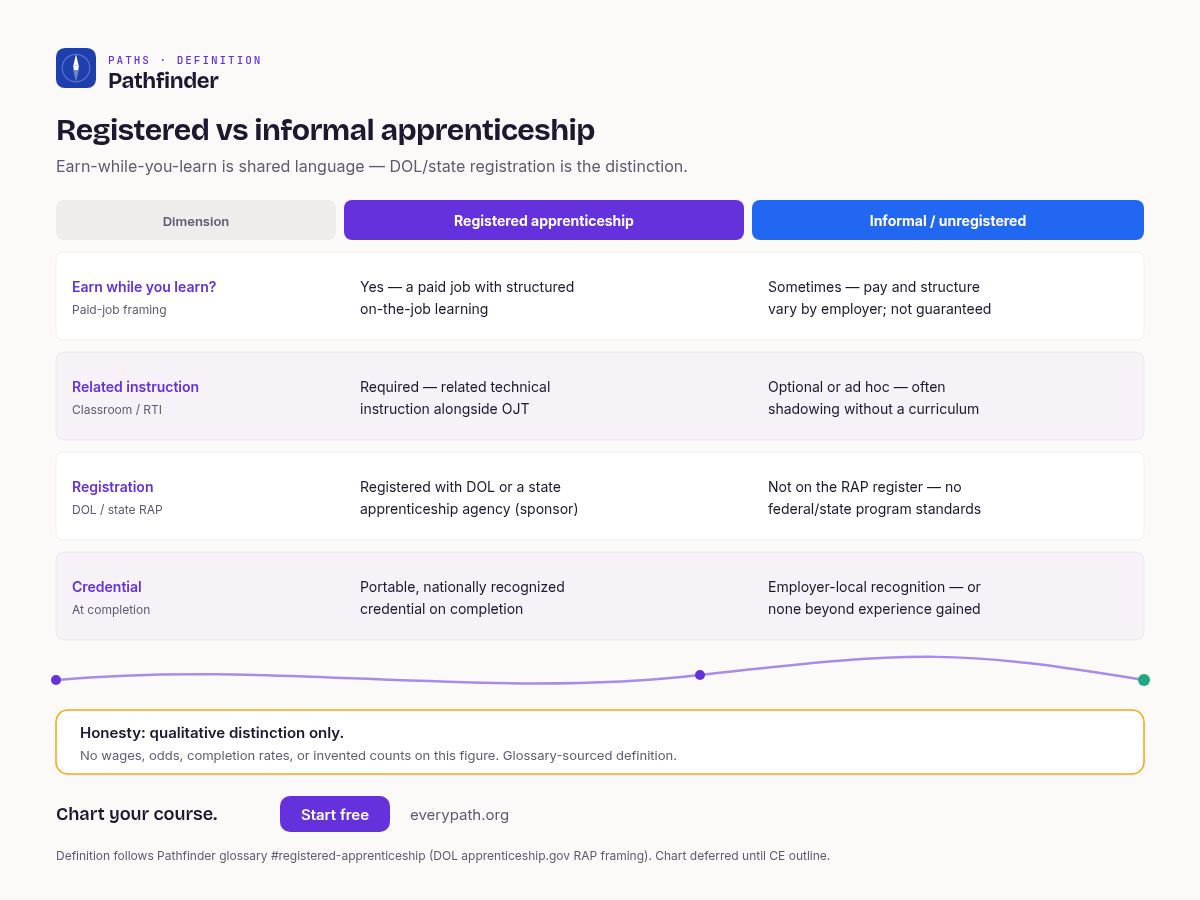
On apprenticeship.gov, a Registered Apprenticeship Program (RAP) is a model of apprenticeship that has been validated by the Department of Labor or a State Apprenticeship Agency. The employer-facing page repeats the same idea in plain language: Registered Apprenticeships are industry-vetted and approved and validated by the U.S. Department of Labor or a State Apprenticeship Agency (apprenticeship.gov).
The federal regulation puts registration in legal terms. Under 29 CFR Part 29, registration of an apprenticeship program means the Office of Apprenticeship — or a recognized State Apprenticeship Agency — accepts and records the program as meeting the Department’s basic standards for federal purposes. Approval is evidenced by a Certificate of Registration or other written indicia.
So “registered” is not a marketing adjective. It is a standards check with a named registration agency. That is what Pathfinder means by a registered apprenticeship when it sits under the trade and apprenticeship pathway.
Two things this does not mean:
- It does not mean every skilled trade job is a RAP. People enter trades other ways.
- It does not mean the word “apprentice” on a hiring post is enough. Titles are cheap; registration is not.
Who registers apprenticeship programs?
Two kinds of registration agency appear throughout the rules and the DOL site:
- The Office of Apprenticeship (OA) inside the U.S. Department of Labor’s Employment and Training Administration.
- A recognized State Apprenticeship Agency (SAA) — a state government agency that the Office of Apprenticeship has recognized to register and oversee programs for federal purposes in that state.
Sponsors — employers, associations, committees, or other organizations that operate the program — apply to register. DOL’s register-your-program page says registration with the Department of Labor or a State Apprenticeship Agency unlocks federal resources, state tax credits where available, technical assistance, and a nationally recognized credential pathway. The Standards Builder is the electronic tool sponsors use to assemble the registration package for DOL submission.
Apprentices themselves do not “register the program.” They are individually registered under an already-registered program (or certified for probationary employment under one), under the procedures in 29 CFR §29.3. For a student or graduate, the practical question is: is this opportunity attached to a program that a registration agency has accepted?
What are the required parts of a registered apprenticeship?
DOL’s public summary lists five key elements of every Registered Apprenticeship Program (apprenticeship.gov):
| Element | What DOL says it means |
|---|---|
| Industry led | Programs are industry-vetted and approved so training aligns with industry standards for skilled, in-demand occupations |
| Paid job | Apprenticeships are jobs; apprentices earn progressive wages as skills and productivity increase |
| Structured on-the-job learning / mentorship | Supervised, structured on-the-job training with an experienced mentor |
| Supplemental education | Related classroom or technical instruction keyed to the employer’s training needs |
| Credentials | A portable, nationally recognized credential in the industry |
Those five bullets are the plain-language map. The regulation fills in the standards a program must contain to be eligible for registration (29 CFR §29.5), including — among others — a written plan for an apprenticeable occupation; a term measured by time, competency, or a hybrid of both (how long an apprenticeship takes); an outline of work processes; organized related instruction; a progressively increasing schedule of wages; a written apprenticeship agreement; and recognition of successful completion by an appropriate certificate issued by the Registration Agency.
An apprenticeable occupation, under 29 CFR §29.4, must involve skills customarily learned through structured on-the-job supervised learning, be commonly recognized in an industry, require progressive attainment of skills that industry standards treat as needing at least 2,000 hours of on-the-job learning, and require related instruction to supplement that learning.
BLS’s Occupational Outlook Handbook glossary describes apprenticeship in compatible terms: a formal relationship combining on-the-job training and related occupation-specific instruction, usually providing at least 144 hours of technical instruction and 2,000 hours of on-the-job training per year over a 3- to 5-year period (BLS OOH Glossary). Treat BLS as a statistical glossary definition, not as a substitute for the DOL registration standards.
How is earn-while-you-learn supposed to work?
“Earn while you learn” is the everyday phrase. The official pieces are more precise.
It is a job. Career-seeker materials on apprenticeship.gov say apprentices earn a competitive wage from day one, with wage increases as they develop new skills (career seekers). The employer page is blunt: “Apprenticeships are jobs!”
Wages step up. Program standards must include a progressively increasing wage schedule consistent with skill acquired. The entry wage must not be less than the applicable Fair Labor Standards Act minimum wage unless a higher wage is required by other law or a collective bargaining agreement (29 CFR §29.5(b)(5)). Are apprenticeships paid? walks through a real wage schedule.
On-the-job learning is measured. Sponsors choose a time-based approach (at least 2,000 hours of on-the-job learning), a competency-based approach (demonstration of skills, still with an on-the-job learning component), or a hybrid approach (29 CFR §29.5(b)(2)). Related instruction in technical subjects is required; 144 hours for each year of apprenticeship is recommended, not invented as a universal hard floor in every sentence of the regulation.
Completion brings a credential. Successful completion is recognized by a certificate issued by the Registration Agency. BLS Career Outlook notes that at the end of a registered program, apprentices get a nationally recognized certificate of completion as proof of their skills, and that formal programs usually last about four years — though some finish in less than a year and others take as long as six, depending on the occupation (BLS Career Outlook, 2022).
What this page will not do is invent the wage you will earn in your trade, in your state, next year. Those averages and medians — and the college-cost figures people stack against them — live on apprenticeship vs. college. A sourced national figure is grounded for exactly what it says. Anything Pathfinder calculates for your situation is modelled. Neither becomes your personal odds.
How is a registered apprenticeship different from an informal “apprentice” job?
| Question | Registered Apprenticeship Program | Informal “apprentice” title |
|---|---|---|
| Who validated the program? | DOL Office of Apprenticeship or a recognized State Apprenticeship Agency | No registration agency acceptance required for the title |
| Written standards? | Required written program standards under 29 CFR Part 29 | Employer may or may not have a structured plan |
| Progressive wage schedule? | Required in registered standards | Not guaranteed by federal RAP rules |
| Related instruction? | Required to supplement on-the-job learning | Optional unless the employer chooses it |
| Completion credential? | Certificate issued by the Registration Agency | No RAP completion certificate by definition |
| Portable national recognition? | Designed as a portable, nationally recognized credential | Depends entirely on the employer’s local practice |
An employer can call a trainee an “apprentice.” That word alone does not create a RAP. Registration is the difference. If you are evaluating an opportunity after high school, ask for the program’s registration status and the registration agency — not only the job title on the posting.
How is it different from trade school?
They answer different structural questions.
A registered apprenticeship is employment plus structured learning under registered standards: you are paid, you have a mentor and work processes, and you complete related instruction alongside the job.
Trade school (vocational or career-technical training) is typically an education enrollment: you take courses or a certificate program, often paying tuition or using aid, and you may or may not have a paid job attached. Some people later enter a RAP; some employers partner with schools for the related-instruction piece of a RAP. The pathways can connect. They are not synonyms.
Pathfinder keeps the deep trade-school-versus-degree comparison on trade school vs. college. This page only needs the clean distinction: school enrollment ≠ registered employment-based apprenticeship, even when both prepare people for skilled work.
How many people are in registered apprenticeships?
Scale is not the definition — but it answers “is this a real path or a niche slogan?”
Congressional Research Service Table 1 (CRS R45171, February 2025 update), sourced to DOL’s Apprentices by State dashboard, reports:
| Fiscal year | Active apprentices | Completers | Source |
|---|---|---|---|
| FY2015 | 359,788 | 48,024 | CRS R45171, Table 1 (2025) |
| FY2024 | 679,960 | 111,767 | CRS R45171, Table 1 (2025) |
CRS warns readers not to turn that table into an annual completion percentage: most programs run several years, so completers in a year are mostly not the same cohort that started in it. National totals in that table include programs registered by DOL, State Apprenticeship Agencies, and the U.S. Military Apprenticeship Program.
BLS Career Outlook separately reported that the Office of Apprenticeship counted almost 600,000 active apprentices in nearly 27,000 registered programs in 2022 — a different year and framing from the CRS FY2024 active count. Report them as separate measurements, not a one-line trend.
Openings near you are still local. A national active-apprentice count cannot tell you what a sponsor is hiring in your county next month.
How do you find a registered program after high school?
Process only — not a promise of a seat:
- Search on apprenticeship.gov. Career-seeker guidance says to use the Apprenticeship Job Finder and apply directly with the employer or program sponsor (career seekers).
- Ask whether the program is registered with the Office of Apprenticeship or a State Apprenticeship Agency, and ask for the occupation and expected length.
- Use an American Job Center if you need help navigating options; DOL points career seekers there for local workforce help.
- Name a primary and a backup. A primary and backup path beats one unhedged bet. If you are not ready to pick, still deciding is a planning stance — not a blank month.
- Keep the map open. University, community college, straight to work, certifications, and the other routes on every path after high school remain equally valid. A RAP is one pathway, not the default.
What this page will not tell you
- What you will earn. Wage and cost side-by-sides belong on apprenticeship vs. college.
- Your odds of getting into a specific program. Pathfinder will not invent them.
- A completion rate computed from CRS active and completer columns. CRS says not to.
- That every “apprentice” posting is a RAP. Registration is the test.
- That trade school and RAP are the same. They are not; see trade school vs. college.
- Which path is “best.” Best for whom, on which measure, in which year?
Want a plan that can include a registered apprenticeship?
Pathfinder builds you a plan for whichever path you pick — including a registered apprenticeship, including university, and including “still deciding” — and labels every claim as grounded, modelled or advisory. It will not invent a deadline, a cost, or your chances of getting in.
Start free — no credit card required. See pricing if you want the paid tiers later.
What is a registered apprenticeship?
A Registered Apprenticeship Program is a paid earn-and-learn pathway validated by the U.S. Department of Labor or a State Apprenticeship Agency. It combines structured on-the-job learning, related instruction, progressive wages, and a portable credential.
Who registers apprenticeship programs?
Programs are registered with the Department of Labor’s Office of Apprenticeship or with a recognized State Apprenticeship Agency. Registration means the program meets published standards for federal purposes.
Are all jobs titled “apprentice” registered apprenticeships?
No. Registration is a formal acceptance of program standards. An informal job title that says “apprentice” is not the same thing as a Registered Apprenticeship Program.
How does a registered apprenticeship differ from trade school?
A registered apprenticeship is a paid job with standards-backed on-the-job learning plus related instruction. Trade school is typically classroom or vocational training you enroll in. See trade school vs. college for that comparison.
Where do pay and cost numbers live?
On apprenticeship vs. college. This page owns the definition of registration, not the full earnings and tuition tables.
Sources
- What is a Registered Apprenticeship Program? — U.S. Department of Labor, accessed 2026-09-22
- Registered Apprenticeship Program (employers) — U.S. Department of Labor, accessed 2026-09-22
- Career Seekers — U.S. Department of Labor, accessed 2026-09-22
- Register your program — U.S. Department of Labor, accessed 2026-09-22
- 29 CFR Part 29 — eCFR, accessed 2026-09-22
- OOH Glossary — Apprenticeship — U.S. Bureau of Labor Statistics, accessed 2026-09-22
- Beyond construction trades: Apprenticeships in a variety of careers — U.S. Bureau of Labor Statistics (2022), accessed 2026-09-22
- Registered Apprenticeship: Federal Role and Recent Federal Efforts (R45171) — Congressional Research Service (2025), accessed 2026-09-22
Chart your course
Pathfinder builds you a plan for whichever path you pick — or for “still deciding” — and labels every claim in it as grounded, modelled or advisory. It will not invent a deadline, a cost, or your chances of getting in.
Frequently asked questions
What is a registered apprenticeship?
A Registered Apprenticeship Program is a paid earn-and-learn pathway validated by the U.S. Department of Labor or a State Apprenticeship Agency. It combines structured on-the-job learning, related instruction, progressive wages, and a portable credential.
Who registers apprenticeship programs?
Programs are registered with the Department of Labor’s Office of Apprenticeship or with a recognized State Apprenticeship Agency. Registration means the program meets published standards for federal purposes.
Are all jobs titled “apprentice” registered apprenticeships?
No. Registration is a formal acceptance of program standards. An informal job title that says “apprentice” is not the same thing as a Registered Apprenticeship Program.
How does a registered apprenticeship differ from trade school?
A registered apprenticeship is a paid job with standards-backed on-the-job learning plus related instruction. Trade school is typically classroom or vocational training you enroll in. See trade school vs. college for that comparison.
Where do pay and cost numbers live?
On apprenticeship vs. college. This page owns the definition of registration, not the full earnings and tuition tables.
Sources
- What is a Registered Apprenticeship Program? — U.S. Department of Labor, accessed 2026-09-22
- Registered Apprenticeship Program (employers) — U.S. Department of Labor, accessed 2026-09-22
- Career Seekers — U.S. Department of Labor, accessed 2026-09-22
- Register your program — U.S. Department of Labor, accessed 2026-09-22
- 29 CFR Part 29 — Labor Standards for the Registration of Apprenticeship Programs — U.S. Government Publishing Office (eCFR), accessed 2026-09-22
- Occupational Outlook Handbook — Glossary (Apprenticeship) — U.S. Bureau of Labor Statistics (2025), accessed 2026-09-22
- Beyond construction trades: Apprenticeships in a variety of careers — U.S. Bureau of Labor Statistics (2022), accessed 2026-09-22
- Registered Apprenticeship: Federal Role and Recent Federal Efforts (R45171) — Congressional Research Service (2025), accessed 2026-09-22
Chart your course
Pathfinder builds you a plan for whichever path you pick — or for “still deciding” — and labels every claim in it as grounded, modelled or advisory. It will not invent a deadline, a cost, or your chances of getting in.
Start free No credit card required.
Related reading
- Are apprenticeships paid? How apprentice pay works
Yes: registered apprentices are paid from day one. How the wage schedule steps up, whether you pay for classes or fees, and what to check before you sign.
- Registered apprenticeship vs trade school explained
A registered apprenticeship is a validated paid job. Trade school can teach the class and still not be the program. Check who sponsors it.
- What is a pre-apprenticeship, and who is it for?
A pre-apprenticeship prepares you for a registered program. It is not registered itself. It fits people who do not yet meet a sponsor's entry rules.