Paths after high school
Is a gap year a good idea if you’re undecided?
By Pathfinder Editorial · Published · 13 min read
About: Pathway Still deciding Gap year Grounded

A planned gap year is a deliberate break with goals, deadlines, and a backup — not the same as drifting. NCES measures immediate college enrollment and delayed enrollment; those are not “gap year improves admissions” odds. If you take a year, name a primary plan and an explicit backup before you start.
A gap year is not one of the routes on Pathfinder’s map of every path after high school; it is a way of timing them. If you are not ready to commit to a year off — or anything else — still deciding after high school is the place to start. If you are still in senior year and need dated actions for any route, use the 12th grade plan — this page doesn’t repeat that checklist.
The enrollment numbers here are U.S. federal data from NCES, and the service examples are American programs such as AmeriCorps. Pathfinder has country packs for the UK, the UAE, India and Singapore too; the logic of planning a year transfers, but these specific numbers and programs do not.
What is a gap year after high school?
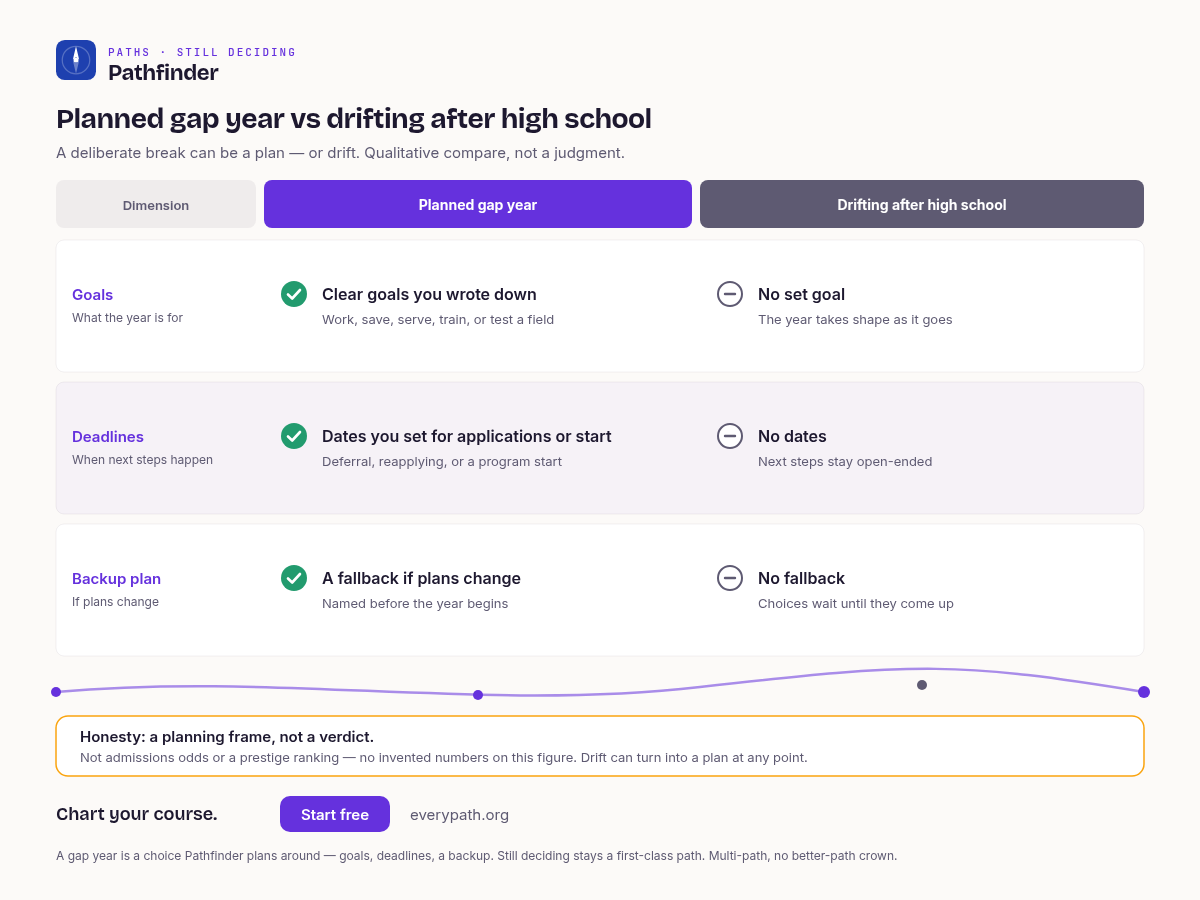
In Pathfinder’s glossary, a gap year is a deliberate break between high school and what comes next. It is not itself one of the eight named pathways on the hub. It is a choice Pathfinder can plan around — work, service, training, travel with goals, language study, family responsibilities — when you treat the interval as work, not as waiting with a nicer label.
A planned year can serve these purposes, in grounded terms:
- A time-boxed interval (often about one academic year) with written goals you can check in three months, not a vague “I’ll figure it out.”
- A bridge toward a named next step — university, community college, straight to work, military, a registered apprenticeship search, certifications — with an explicit primary and backup path.
- A structured fill (job, service term, training) that produces evidence you can show later — hours, projects, references — without assuming admissions offices will reward you with better odds.
What a planned year does not show: that every unpaid trip is “character building” in a measurable way, that a gap year raises acceptance rates, that delayed college enrollment in federal data is the same thing as your planned year, or that skipping a plan is still “a gap year.”
How is a planned gap year different from drifting?
The calendar can look identical. The difference is anchors.
| Planned gap year | Drift | |
|---|---|---|
| Intent | Written goals for the interval | “Something will come up” |
| Time box | Start and review dates | Open-ended pause |
| Evidence | Hours, projects, references, applications | Vague activity claims |
| Money | Budget and income plan named | Hope as a budget |
| Exit | Primary next step + backup if it fails | Rebranding delay as destiny |
| Honesty label | Grounded plan you can defend | Story without checkpoints |
Drifting is not a moral failure — but renaming drift as a gap year does not create a plan. If you cannot name goals, a review date, and a backup, you are closer to an unnamed pause than to Pathfinder’s gap year definition.
How is a gap year different from “still deciding”?
Still deciding is a first-class pathway on the hub: structured exploration with weekly actions, official pages opened, and a primary-plus-backup pair — without pretending you already locked a forever career.
A gap year is different in two ways:
- It is an interval design, not the pathway label itself. You can be still deciding inside a planned year (research continues). You can also take a planned year with a locked primary (for example deferred college start + service) — that is not “still deciding” anymore.
- It assumes you are using the year for something named. Still deciding without a gap year can live inside senior spring or a community-college term. A gap year without a plan is usually just delay.
If the honest sentence is “I do not know yet,” stay in still deciding after high school until you can write what the year is for. Do not buy a plane ticket to escape the decision.
What do NCES immediate and delayed enrollment figures actually measure?
Federal education statistics are useful — and easy to misuse as gap-year folklore.
Immediate college enrollment is a defined NCES measure: the percentage of recent high school completers (ages 16–24 who finished high school earlier that calendar year) who are enrolled in a 2- or 4-year college in the October after completion (Immediate College Enrollment Rate).
In Digest Table 302.10, for 2023, 61.4% of recent completers were enrolled by October — 15.6% at 2-year colleges and 45.9% at 4-year colleges (Table 302.10). The Condition of Education’s related write-up reports about 62% immediate enrollment for the 2022 completer cohort (COE CPA).
Honest reading:
- A large share of completers enroll right away — and a large share do not.
- “Not enrolled by October” is not a national count of planned gap years. It mixes work, family, military, delayed starts, and many other situations.
- So that remainder can’t be read as a federal “gap year participation rate.”
Delayed postsecondary enrollment is a different NCES construct: students who wait a year or more after high school before first enrolling. In Waiting to Attend College (NCES 2005–152), among students who first enrolled in 1995–96, about one third had waited a year or more. Within six years, 40% of delayed entrants had earned some postsecondary credential versus 58% of immediate entrants — and the report stresses that delayed entrants are not a homogeneous group and often differ on preparation, income, and program type before they enroll (NCES 2005–152; IES abstract).
Honest reading of that older report:
- It is evidence that delay categories in federal data are mixed and that simple “delay = gap year = success story” marketing is false.
- It is not permission to claim “your planned gap year will lower your degree odds by 18 points.” The groups differ; the report itself warns against treating them as interchangeable.
- It is also not a current national census of intentional gap years.
If a blog or influencer converts either measure into “gap years help you get in,” that claim is not grounded on these primaries.
What can fill a planned year (work, service, training) without overpromising outcomes?
A plan needs a fill — something you actually do. Examples that stay honest:
Paid work. A job with hours, a supervisor, and skills you can describe later is a classic fill. It can fund living costs and produce references. It does not come with a guaranteed wage ladder or prestige story. If employment itself is your primary next step rather than a one-year bridge, use straight to work after high school instead of forcing the gap-year label.
Structured national service. AmeriCorps NCCC is a team-based national service program for young adults ages 18–24 (Team Leaders 18+ with no upper age limit on the page), typically about 10 months, with housing/travel support, a modest living allowance, and eligibility for a Segal AmeriCorps Education Award upon successful completion — described on the program page as over $7,300 (AmeriCorps NCCC). AmeriCorps’s Fit Finder helps browse fits by age and time commitment (Fit Finder). AmeriCorps sets the Segal Education Award amount each year (Segal Education Award).
Selection isn’t guaranteed, what you take home from the living allowance depends on your situation, and service doesn’t guarantee a later college admission.
Training / earn-and-learn search. Exploring a registered apprenticeship through Apprenticeship.gov can be a planned fill — applications, visits, prerequisite courses. Deep RAP vs degree comparisons live on what is a registered apprenticeship and apprenticeship vs college, not here.
College research without pretending you enrolled. If university or community college is on your backup list, use College Scorecard for institution-reported fields as Scorecard defines them — not as a personal prediction of your net price or graduation.
Travel / language / projects. Fine when goals and budget are written. Not fine as a substitute for a plan.
How do college deferred-enrollment / gap-year policies actually work?
There is no single national deferred-enrollment rule. Schools set their own policies. Common pattern among schools that allow it: apply as a first-year student, get admitted, confirm enrollment (often with a deposit), then request a deferral with a written plan — usually for one year. Details on credits, other-college enrollment, scholarships, and deadlines vary widely.
Example (process only — not a Pathfinder ranking): Harvard College publishes a “Considering a Gap Year” page for admitted students, encourages one-year deferrals for travel, projects, work, or other meaningful uses, and states you should not take time off simply to gain admission to a particular college (Considering a Gap Year). Other institutions publish different rules, deadlines, and restrictions.
Honest constraints:
- Deferral is usually for people already admitted — it is not a side door into admission.
- Policies expire and differ — read your school’s current page; do not copy a friend’s rumor.
- Financial aid and scholarships may not roll automatically — confirm in writing.
- Don’t count on an admissions edge — no official source shows a gap year raising your chance at a selective school.
If you have not applied anywhere yet and you are undecided, a gap year is not a deferred-enrollment plan — it is either still deciding or a stand-alone interval that needs its own primary and backup.
How do you plan a gap year with a primary and a backup?
Use the same primary and backup path rule Pathfinder uses across the map.
Six steps, in order:
- Write one sentence for what the year is for. Example shapes (not odds): “Earn and build references while I confirm an apprenticeship application,” or “Complete an AmeriCorps term, then start the deferred college offer,” or “Work full time for nine months, then start community college in the fall if the RAP interview fails.”
- Name the primary exit after the interval — the path you are aiming to enter when the year ends.
- Name the backup out loud — the path you take if the primary collapses (funding, rejection, health, family).
- Attach three checkpoints (for example month 1 / month 4 / month 8) with one official page or application action each.
- Separate research from folklore. Open NCES definitions for enrollment context, AmeriCorps or employer pages for service/work fills, and your school’s deferral page if college is involved — dated notes, not screenshots of influencers.
- Keep senior-year logistics current if you are still in grade 12 — deposits, tests, transcripts, and deadlines live on the 12th grade plan.
What “plan” does not mean: buying a program because of prestige marketing, assuming admissions will thank you, or treating military enlistment as a casual gap year with a uniform — that commitment belongs on military vs college.
Which related guides should you read next?
Each of these covers something this page only touches:
- Still deciding after high school — undecided as a pathway. Use it when you cannot yet defend a year plan.
- 12th grade plan — dated senior-year checklist for any path, including if a gap year is on the table.
- Is it okay not to go to college? — legitimacy / social pressure; gap year is related but different.
- Straight to work after high school — employment as primary, not necessarily a one-year bridge.
- Military vs college — service commitment vs academic start; not a casual interval.
- What is a registered apprenticeship? / apprenticeship vs college — earn-and-learn depth if that is your fill or exit.
What this gap-year guide won’t claim
- Invented “gap years improve admissions” odds, acceptance-rate boosts, or school prestige rankings
- That NCES delayed enrollment equals your planned gap year without the report’s own caveats
- A viral private survey as if it were a federal gap-year census
- Your personal AmeriCorps selection chance, Segal Award tax result, or living-allowance budget
- Full senior-year deadline tables (see the 12th grade plan)
- The full still-deciding guide (see still deciding after high school)
- Full apprenticeship, military, or wage comparisons (each has its own guide)
Claims we could not match to an official source opened while writing were cut.
Is a gap year the same as still deciding?
No. Still deciding is a named Pathfinder pathway with structured research. A gap year is a deliberate break between high school and what comes next — related, but not one of the eight pathways by itself, and not the same as an unnamed pause.
Do gap years improve college admissions odds?
No official source shows a gap year raising your admission chances. NCES publishes immediate and delayed enrollment measures, not a national “gap year improves admissions” percentage. Some schools publish deferred-enrollment rules for students they have already admitted; those rules vary, so read your school’s own page.
What’s the difference between a planned gap year and drifting?
A planned year has goals, a time box, official pages you actually open, and an explicit backup. Drifting is time without those anchors. The calendar can look the same; the plan is not.
Can I fill a gap year with work or service?
Yes — paid work, structured national service (for example AmeriCorps NCCC for eligible ages), training, or a registered apprenticeship search can all be a plan. None of those are automatic outcome guarantees.
Should I take a gap year if I’m undecided?
Only if you can name what the year is for and what happens if that plan fails. If you cannot, stay in still deciding with weekly research actions — or use the senior-year checklist — rather than renaming drift as a gap year.
Sources
- Digest Table 302.10 — National Center for Education Statistics (2024), accessed 2026-09-22
- Immediate College Enrollment Rate — NCES Condition of Education, accessed 2026-09-22
- Waiting to Attend College (NCES 2005–152) — National Center for Education Statistics (2005), accessed 2026-09-22
- Waiting to Attend College — IES resource page — IES / NCES, accessed 2026-09-22
- AmeriCorps NCCC — AmeriCorps, accessed 2026-09-22
- AmeriCorps Fit Finder — AmeriCorps, accessed 2026-09-22
- Segal AmeriCorps Education Award — AmeriCorps, accessed 2026-09-22
- Registered Apprenticeship Program (employers) — U.S. Department of Labor / Apprenticeship.gov, accessed 2026-09-22
- College Scorecard — U.S. Department of Education, accessed 2026-09-22
- Considering a Gap Year — Harvard College Admissions, accessed 2026-09-22
Chart your course
Pathfinder builds you a plan for whichever path you pick — still deciding, university, straight to work, apprenticeship, military, community college, certifications, or a planned gap year around those routes — and labels every claim as grounded, modelled or advisory. It doesn’t guess at admissions odds, a school’s deferral policy, or your chances of getting selected for a service program.
Start free — no credit card required. See pricing if you want the paid tiers later.
Frequently asked questions
Is a gap year the same as still deciding?
No. Still deciding is a named Pathfinder pathway with structured research. A gap year is a deliberate break between high school and what comes next — related, but not one of the eight pathways by itself, and not the same as an unnamed pause.
Do gap years improve college admissions odds?
No official source shows a gap year raising your admission chances. NCES publishes immediate and delayed enrollment measures, not a national “gap year improves admissions” percentage. Some schools publish deferred-enrollment rules for students they have already admitted; those rules vary, so read your school’s own page.
What’s the difference between a planned gap year and drifting?
A planned year has goals, a time box, official pages you actually open, and an explicit backup. Drifting is time without those anchors. The calendar can look the same; the plan is not.
Can I fill a gap year with work or service?
Yes — paid work, structured national service (for example AmeriCorps NCCC for eligible ages), training, or a registered apprenticeship search can all be part of a plan. None of those are automatic outcome guarantees.
Should I take a gap year if I’m undecided?
Only if you can name what the year is for and what happens if that plan fails. If you cannot, stay in still deciding with weekly research actions — or use the senior-year checklist — rather than renaming drift as a gap year.
Sources
- Digest of Education Statistics — Table 302.10 — National Center for Education Statistics (2024), accessed 2026-09-22
- Immediate College Enrollment Rate — National Center for Education Statistics (Condition of Education), accessed 2026-09-22
- Waiting to Attend College: Undergraduates Who Delay Their Postsecondary Enrollment (NCES 2005–152) — National Center for Education Statistics (2005), accessed 2026-09-22
- Waiting to Attend College — IES resource page — Institute of Education Sciences / NCES, accessed 2026-09-22
- AmeriCorps NCCC — AmeriCorps, accessed 2026-09-22
- Find Your Best Fit — AmeriCorps Fit Finder — AmeriCorps, accessed 2026-09-22
- Segal AmeriCorps Education Award — AmeriCorps, accessed 2026-09-22
- Registered Apprenticeship Program (employers) — U.S. Department of Labor / Apprenticeship.gov, accessed 2026-09-22
- College Scorecard — U.S. Department of Education, accessed 2026-09-22
- Considering a Gap Year — Harvard College Admissions, accessed 2026-09-22
Chart your course
Pathfinder builds you a plan for whichever path you pick — or for “still deciding” — and labels every claim in it as grounded, modelled or advisory. It will not invent a deadline, a cost, or your chances of getting in.
Start free No credit card required.
Related reading
- How to choose a path after high school
How to choose a path after high school with a primary and an explicit backup — a sourced decision frame, not tip lists or invented odds.
- Is it okay not to go to college? Sourced answer
Yes — college is one path, not the only valid one. Enrollment data shows a large share of graduates do not enrol immediately. Plan a primary path and a backup.
- Should you apply to college if you might not go yet
Should you apply to college if you might not go? Applying is not enrolling. Early decision can bind you. Then check Cal State LA's deposit rule.