Paths after high school
Is it okay not to go to college? Sourced answer
By Pathfinder Editorial · Published · 11 min read
About: Pathway Still deciding Primary and backup path Grounded

Yes. Skipping college is common enough to be normal, and Pathfinder treats every path after high school as equally valid. In October 2024, 62.8% of recent U.S. high school graduates ages 16–24 were enrolled in college (BLS) — which means a large share were not. “Okay” still means a plan: a primary path and an explicit backup, not drifting.
This page answers the legitimacy question — is it okay not to go? — not the full map of routes. The map lives on every path after high school. If you already know you need a plan for “not sure yet,” start with still deciding after high school. If you want pay and cost figures for one non-college route against a degree, that comparison is in apprenticeship vs. college.
These are U.S. national enrollment figures. Pathfinder ships country packs for the US, the UK, the UAE, India and Singapore, so the questions travel even where the numbers do not.
Is it actually common to skip college after high school?
Yes — common enough that “everyone goes” is a social story, not a population fact.
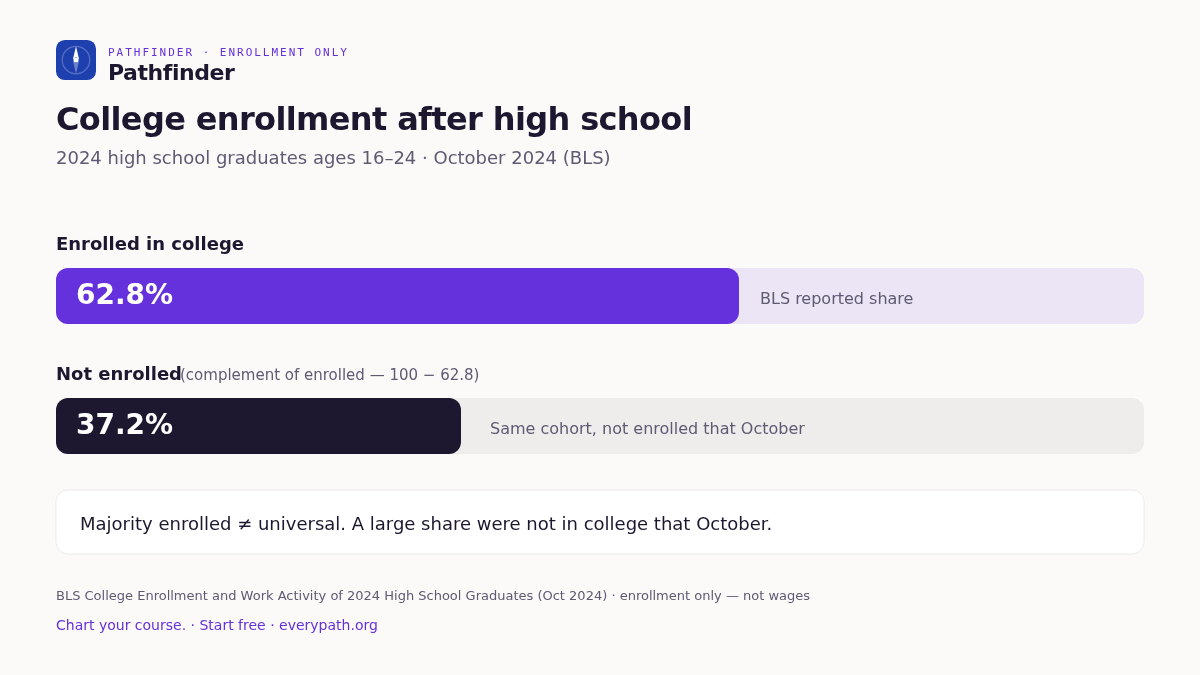
The U.S. Bureau of Labor Statistics reports that in October 2024, 62.8% of 2024 high school graduates ages 16 to 24 were enrolled in colleges or universities. Of about 3.2 million graduates in that age band who finished between January and October 2024, about 2.0 million were enrolled that October (BLS, released April 2025). The rate was little different from October 2023.
Read the complement out loud: more than a third of that graduating cohort was not enrolled in college in the October after graduation. That is not a fringe edge case. It is a large minority in the same official release people use when they say “most kids go.”
A second, older measurement points the same way. The National Center for Education Statistics defines the immediate college enrollment rate as the share of high school completers ages 16–24 who are enrolled in a 2- or 4-year institution in the October right after they finish. For completers who finished in the first nine months of 2022, that rate was 62% — about 1.9 million of 3.0 million (NCES Condition of Education, 2022 data). NCES also notes that the 2022 overall rate was not measurably different from a decade earlier in 2012, or from 2021.
| Measure | Figure | Window | Source |
|---|---|---|---|
| Recent graduates ages 16–24 enrolled in college | 62.8% (~2.0M of ~3.2M) | October 2024 | BLS HSGEC (2025) |
| Immediate college enrollment rate | 62% (~1.9M of ~3.0M) | October 2022 | NCES COE (2022) |
| Immediate enrollment, 4-year institutions | 45% | 2022 | NCES COE (2022) |
| Immediate enrollment, 2-year institutions | 17% | 2022 | NCES COE (2022) |
BLS and NCES are separate surveys of separate cohorts. Treat them as two measurements pointing the same direction, not as a one-point trend line.
Two splits from those same pages matter for the “everyone” myth:
- Sex (BLS, October 2024): among 2024 graduates ages 16–24, 69.5% of young women and 55.4% of young men were enrolled in college.
- Sex (NCES, 2022): immediate enrollment was 66% for female completers and 57% for male completers, driven mainly by 4-year enrollment (51% vs 38%).
So “is it okay?” is not Pathfinder inventing a soft answer. A large share of graduates already take a non-college October. The harder question is whether your non-college October is a pathway or a blank month.
Does “okay” mean doing nothing?
No.
Permission to skip college is not permission to skip a plan. Pathfinder’s equal-validity rule says university is one pathway among eight — trade and apprenticeship, community college, straight to work, military, certifications, entrepreneurship, university, and still deciding — never the default. Equal validity does not mean equal outcomes if you choose none of them.
The enrollment releases themselves hint at why a plan matters. BLS reports that among recent graduates not enrolled in college, labor-force participation was 66.4% in October 2024 — higher than among those enrolled — while recent high school dropouts in the same age band participated at a lower rate (40.0%). Those are participation figures, not success scores. They still underline a plain point: “not in college” describes many different Octobers. Some people are working or looking. Some are not in the labor force. The label alone does not tell you which.
If your honest answer today is “I don’t know what to pick,” that is already a named stance. Still deciding after high school is the spoke for turning “not sure yet” into steps — not an apology for lacking a branded destination.
If your honest answer is “I know I don’t want a bachelor’s degree right now,” you still owe yourself a primary route and a backup. “Not college” is a refusal. It is not yet a plan.
What counts as a real non-college plan?
A real plan names a route you could actually take next, plus what you would do if that route stalls.
Pathfinder’s full taxonomy — and one sourced figure per path where a clean primary figure exists — sits on every path after high school. This page will not reprint that table. What it will say is the test we use when someone asks whether skipping college is “okay”:
- Can you name the path in one sentence? “Community college then transfer,” “registered apprenticeship in my state,” “full-time work with a certification target,” “military service,” and “still deciding with weekly exploration steps” are plans. “I’ll figure it out” is not.
- Is there a next action that exists near you? Sponsors, openings, applications and employers are local. A national enrollment rate cannot tell you what is open in your county next month.
- Do you have an explicit backup? A primary and backup path beats one unhedged bet. Backups can be another non-college route, or college later — the order is yours.
- Are you refusing college, or refusing structure? The first can be wise. The second is how people inherit the hardest labor-market Octobers without meaning to.
For one non-college route compared with a degree using official pay and cost figures, use apprenticeship vs. college. That article owns the side-by-side numbers. This one owns the permission question those numbers sit inside.
A gap year is related but different: a deliberate break between high school and what comes next. It can be part of a plan. It is not automatically the same as still deciding, and it is not one of the eight pathways by itself.
What about earnings and “you’ll regret it”?
Pressure speeches usually jump from “most people enrol” to “you will be worse off financially” without showing a source, a year, or a definition. Pathfinder will not finish that speech for them.
Two limits on this page:
- This spoke is enrollment-first. The Strategist brief for day 2 allows BLS/NCES enrollment figures as the statistical spine. We are not reprinting weekly-earnings cells here, and we will not invent a wage gap to win an argument.
- The famous education-and-earnings table is the wrong tool for ranking paths. BLS publishes unemployment rates and earnings by educational attainment, and it states that those education categories reflect highest attainment only — they do not take into account completion of training programs such as apprenticeships and other on-the-job training (BLS Employment Projections table notes). So the table people quote to scold a trade path cannot even see a completed apprenticeship. That is a definition gap, not a small footnote.
What we can say without inventing cells:
- Immediate non-enrollment is common in the enrollment releases above.
- Averages about groups are not predictions about you. Pathfinder labels sourced national figures as grounded for exactly what they say. Anything calculated for your situation is modelled. Neither becomes your personal odds.
- Pathfinder will not state your chances of getting into a school, in any wording. That refusal is product policy, not a rhetorical flourish.
If someone insists “the money says you must go,” ask which publication, which year, which population, and whether the series can see the route you are actually considering. If they cannot answer, you are hearing social pressure with a spreadsheet costume.
How do you choose without treating college as the default?
Start from the map, not from guilt.
- Open the eight routes. Use every path after high school as the menu. University is on the list. It is not the header.
- Pick a temporary primary. Not a tattoo — a working answer you can test for a month. If you cannot pick one, your primary is still deciding, and you follow the steps on that spoke.
- Name a backup out loud. Write it down. A backup you have never looked up is a wish.
- Turn national facts into local questions. Does this apprenticeship exist near me? What does this community college actually require? What would tuition be for me after aid? National enrollment rates cannot answer those.
- Keep college available without making it mandatory. Many people stack routes: work then college, apprenticeship then degree, community college then transfer. “Not now” is not always “not ever.”
- Watch for prestige language. “Real path,” “safety school for people who failed,” and “just a trade” are status talk. They are not enrollment data.
Equal validity is the brand rule — Chart your course — and it is also the honest reading of the enrollment numbers: the October after graduation already contains more than one common outcome.
What this page will not tell you
- Your odds of admission, hire, or completion. Pathfinder will not invent them.
- Which path is “best.” Best for whom, on which measure, in which year?
- A wage you should expect if you skip college. That would require inventing a number this brief does not authorize.
- That skipping college is always wise. It is okay when it is a plan. It is costly when it is avoidance with no next step.
- A full catalog of every alternative. The hub owns the catalog. The apprenticeship spoke owns one deep comparison.
Want a plan that does not assume college?
Pathfinder builds you a plan for whichever path you pick — including university, including a non-college primary, and including “still deciding” — and labels every claim as grounded, modelled or advisory. It will not invent a deadline, a cost, or your chances of getting in.
Start free — no credit card required. See pricing if you want the paid tiers later.
Is it okay not to go to college?
Yes. Pathfinder treats every path after high school as equally valid. Immediate college enrollment is the majority outcome in recent U.S. data, not a universal one — so skipping college is common enough to be normal. Okay still means a plan: a primary path and a backup.
What percentage of high school graduates go to college right away?
In October 2024, 62.8% of 2024 high school graduates ages 16 to 24 were enrolled in college (BLS). NCES reports a 62% immediate enrollment rate for 2022 completers. The two figures are separate surveys of separate cohorts.
Does skipping college mean I should do nothing?
No. Permission without a plan is just delay. If you do not know which route to pick, still deciding after high school is a planning stance with steps — not an empty box labelled undecided.
Where do I compare apprenticeship and college with real numbers?
See apprenticeship vs. college for sourced pay and cost figures. This page answers the legitimacy question only; it does not reprint those tables.
Will Pathfinder tell me I made the wrong choice?
No. Pathfinder will not invent your odds of getting in, a deadline, or a cost. It labels claims as grounded, modelled, or advisory, and it treats college as one option among eight — never the default.
Sources
- College Enrollment and Work Activity of 2024 High School Graduates — U.S. Bureau of Labor Statistics (2025), accessed 2026-09-18
- Archived HSGEC release (22 Apr 2025) — U.S. Bureau of Labor Statistics (2025), accessed 2026-09-18
- Condition of Education — Immediate College Enrollment Rate — National Center for Education Statistics (2022), accessed 2026-09-18
- Unemployment rates and earnings by educational attainment — U.S. Bureau of Labor Statistics (2025), accessed 2026-09-18 (definitional limit only; no earnings cells quoted on this page)
Chart your course
Pathfinder builds you a plan for whichever path you pick — or for “still deciding” — and labels every claim in it as grounded, modelled or advisory. It will not invent a deadline, a cost, or your chances of getting in.
Frequently asked questions
Is it okay not to go to college?
Yes. Pathfinder treats every path after high school as equally valid. Immediate college enrollment is the majority outcome in recent U.S. data, not a universal one — so skipping college is common enough to be normal. Okay still means a plan: a primary path and a backup.
What percentage of high school graduates go to college right away?
In October 2024, 62.8% of 2024 high school graduates ages 16 to 24 were enrolled in college (BLS). NCES reports a 62% immediate enrollment rate for 2022 completers. The two figures are separate surveys of separate cohorts.
Does skipping college mean I should do nothing?
No. Permission without a plan is just delay. If you do not know which route to pick, still deciding after high school is a planning stance with steps — not an empty box labelled undecided.
Where do I compare apprenticeship and college with real numbers?
See apprenticeship vs. college for sourced pay and cost figures. This page answers the legitimacy question only; it does not reprint those tables.
Will Pathfinder tell me I made the wrong choice?
No. Pathfinder will not invent your odds of getting in, a deadline, or a cost. It labels claims as grounded, modelled, or advisory, and it treats college as one option among eight — never the default.
Sources
- College Enrollment and Work Activity of 2024 High School Graduates — U.S. Bureau of Labor Statistics (2025), accessed 2026-09-18
- College Enrollment and Work Activity of High School Graduates (archived release, 22 Apr 2025) — U.S. Bureau of Labor Statistics (2025), accessed 2026-09-18
- Condition of Education — Immediate College Enrollment Rate — National Center for Education Statistics (2022), accessed 2026-09-18
- Unemployment rates and earnings by educational attainment — U.S. Bureau of Labor Statistics (2025), accessed 2026-09-18
Chart your course
Pathfinder builds you a plan for whichever path you pick — or for “still deciding” — and labels every claim in it as grounded, modelled or advisory. It will not invent a deadline, a cost, or your chances of getting in.
Start free No credit card required.
Related reading
- How to choose a path after high school
How to choose a path after high school with a primary and an explicit backup — a sourced decision frame, not tip lists or invented odds.
- Is a gap year a good idea if you’re undecided?
A gap year after high school when you're still deciding: what it is, how it differs from drifting, and how to plan primary + backup.
- Straight to work after high school? Sourced guide
Going straight to work after high school: what it means, how it differs from college and apprenticeships, and how to plan a primary + backup.