Paths after high school
Trade school vs. college: costs, wages and time
By Pathfinder Editorial · Published · 13 min read
About: Trade and apprenticeship Certifications University Community college

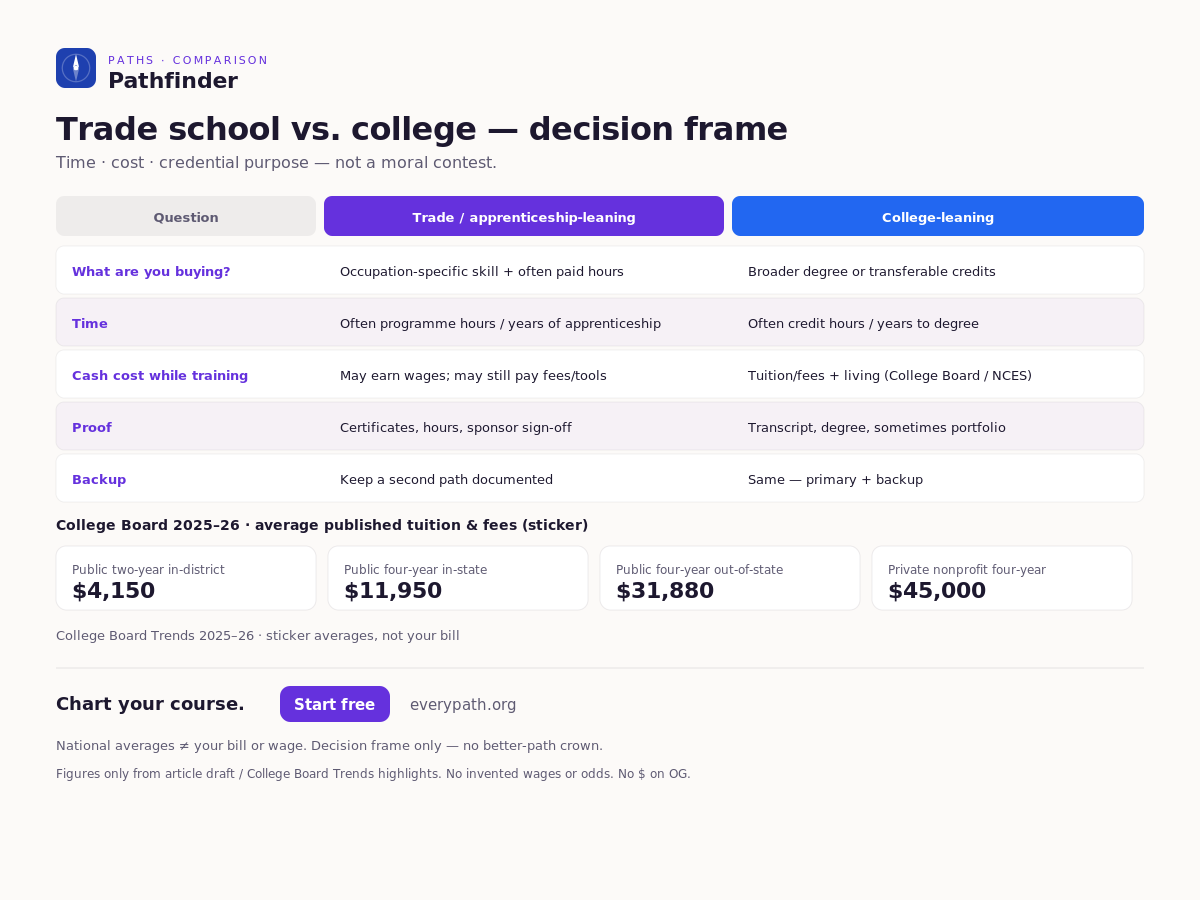
Trade school and college are different purchases: a shorter, job-specific credential against a longer, broader degree. Published tuition and fees for 2025-26 averaged $4,150 at public two-year colleges in-district and $11,950 at public four-year colleges in-state (College Board, 2025-26). Wages, length and completion differ too. Every figure below is dated.
This is written for a student or parent weighing a one- or two-year credential against a degree, using US national data. Pathfinder treats every path after high school as equally valid, so nothing here assumes college — trade school sits alongside apprenticeship, work, the military and a gap year on the wider map of paths after high school.
What is trade school, and what credential does it give you?
"Trade school" is not a statistical category. It is an everyday word for programmes that sit in the certifications and trade and apprenticeship pathways: industry credentials and hands-on routes into skilled careers, often faster and more affordable than a traditional degree. Some are run by private technical schools, some by a community college, some by a public vocational centre.
For the full map of routes after high school, start with every path after high school.
Because the label is loose, use the official vocabulary instead. The Bureau of Labor Statistics assigns every occupation a "typical entry-level education" from a fixed list, and its glossary defines the one that matters here. A postsecondary nondegree award is "usually a certificate or other award that is not a degree and is issued by an educational institution", and BLS adds that such "programs may last only a few weeks to 2 years" (BLS, 2026). The rungs above it are an associate's degree and a bachelor's degree.
That gives you three clean comparison points: a certificate, a two-year degree, and a four-year degree from a university.
Two things this does not mean. A certificate is not a professional certification — BLS says credentials "issued by professional organizations or certifying bodies are not included in this category" (BLS, 2026). And trade school is not an apprenticeship. In trade school you pay; in a registered apprenticeship you are paid. The Government Accountability Office reports that between April 2022 and March 2023, registered apprenticeship completers "earned average annual wages of about $80,000 their first year after exiting their program", higher than average annual wages of associate's degree holders in BLS data (GAO, 2025). That is a different route with different economics, covered in apprenticeship vs. college. If the real question is still which route at all, start with still deciding after high school.
What do the jobs pay?
It depends on the job, not on the credential. Here are six occupations across the three entry categories, with BLS median annual wages for May 2025 and projected growth for 2025–35.
| Occupation | Median annual wage (May 2025) | Typical entry-level education | Projected growth 2025–35 | Source |
|---|---|---|---|---|
| Dental hygienists | $98,100 | Associate's degree | 8% | BLS OOH |
| Licensed practical and licensed vocational nurses | $64,400 | Postsecondary nondegree award | 3% | BLS OOH |
| Electricians | $63,190 | High school diploma or equivalent | 9% | BLS OOH |
| Heating, air conditioning and refrigeration mechanics and installers | $61,010 | Postsecondary nondegree award | 11% | BLS OOH |
| Welders, cutters, solderers and brazers | $53,750 | High school diploma or equivalent | 2% | BLS OOH |
| Automotive service technicians and mechanics | $50,620 | Postsecondary nondegree award | 5% | BLS OOH |
Read the middle column as carefully as the wage column. The highest-paying row here is the one that asks for a degree, and two of the six ask for no postsecondary credential at all, and BLS does not name a certificate as the typical entry point for either. The growth column is a projection over ten years, and 2% and 11% describe very different labour markets.
A second BLS table measures something else entirely: median usual weekly earnings by the worker's highest level of education, across all jobs.
| Education level | Median usual weekly earnings | Unemployment rate | Source (year) |
|---|---|---|---|
| High school diploma | $966 | 4.3% | BLS (2025) |
| Some college, no degree | $1,062 | 3.8% | BLS (2025) |
| Associate's degree | $1,135 | 3.0% | BLS (2025) |
| Bachelor's degree | $1,578 | 2.8% | BLS (2025) |
Two cautions come from BLS itself. The 2025 annual estimates "are 11-month averages that exclude October", because data for that month were not collected during the federal government shutdown, so they "are not strictly comparable with annual averages for other years" (BLS, 2025). And these are weekly figures; multiplying by 52 would misstate what the series measures.
Do not set the two tables against each other. One is a wage for a named occupation, the other a wage for a level of schooling across every occupation. "Trades pay more than degrees" is not a claim either table supports.
What does each route cost?
There is no single national price for trade school. There are good national figures for the sectors around it, and two different measures that are easy to confuse.
Published tuition and fees is the sticker price of instruction. Total cost of attendance adds housing, food and other costs. They come from different publishers and different years.
| Measure | Sector | Amount | Year | Source |
|---|---|---|---|---|
| Average published tuition and fees | Public two-year, in-district | $4,150 (+$110, 2.7%) | 2025-26 | College Board |
| Average published tuition and fees | Public four-year, in-state | $11,950 (+$340, 2.9%) | 2025-26 | College Board |
| Average published tuition and fees | Public four-year, out-of-state | $31,880 (+$1,060, 3.4%) | 2025-26 | College Board |
| Average published tuition and fees | Private nonprofit four-year | $45,000 (+$1,750, 4.0%) | 2025-26 | College Board |
| Average total cost of attendance, on campus | Public four-year | $27,100 | 2022–23 | NCES |
| Average total cost of attendance, on campus | Private nonprofit four-year | $58,600 | 2022–23 | NCES |
| Average total cost of attendance, on campus | Private for-profit four-year | $33,600 | 2022–23 | NCES |
Notice what is missing. NCES publishes total cost of attendance only for four-year institutions on that page; there is no two-year sector figure there, and no "trade school" sector figure anywhere in these tables. The closest national anchor is College Board's public two-year in-district tuition of $4,150 (College Board, 2025-26) — and a private technical school is not a public two-year college, so that figure does not price it.
For a specific programme, then, the price is a fact you look up, not one you estimate. NCES runs College Navigator, a free federal lookup tool for institution-level figures.
How long does each take, and how many finish?
Length is stated per programme; completion is measured per institution. Both belong in the comparison, because a short, cheap programme you do not finish is not cheap.
| Route | Stated length | Completion measure | Figure | Source (year) |
|---|---|---|---|---|
| Postsecondary nondegree award, generally | "A few weeks to 2 years" | Not measured as a category | — | BLS glossary (2026) |
| HVAC programme | "6 months to 2 years", leading to a certificate or an associate's degree | Not measured per programme | — | BLS OOH (May 2025) |
| Licensed practical nurse programme | "About 1 year" | Not measured per programme | — | BLS OOH (May 2025) |
| Dental hygiene programme | "Usually take 3 years to complete" | Not measured per programme | — | BLS OOH (May 2025) |
| Two-year institutions | Certificate or associate's degree | Completion within 150% of normal time, fall 2017 cohort | 34% | NCES (2020) |
| Four-year institutions | Bachelor's degree | Six-year graduation rate, fall 2014 cohort | 64% | NCES (2020) |
NCES reports that among first-time, full-time students who began seeking a certificate or associate's degree at two-year institutions in fall 2017, about 34% attained their credential within 150% of the normal time (NCES, 2020). For four-year institutions, the overall six-year graduation rate for the fall 2014 cohort was 64% — 63% at public institutions, 68% at private nonprofits and 29% at private for-profits (NCES, 2020).
Those two rates are not a fair race: different cohorts, different credentials, different time windows. What they jointly say is that neither route finishes everyone who starts, and that the four-year figure varies enormously by the kind of institution you attend.
For electricians, BLS says most learn the trade in a 4- or 5-year apprenticeship, with about 2,000 hours of paid on-the-job training each year plus technical instruction (BLS, 2025). That is longer than most trade-school programmes, and you are paid for it.
Can you use financial aid at a trade school?
That is a question about one school, not about the category. Whether a given career, technical or trade school takes part in federal student aid is a fact that school can state, and one to confirm yourself on the US Department of Education's Federal Student Aid site before you enrol or sign anything.
Three things to ask, in this order:
- Does this school take part in federal student aid, and what is its federal school code?
- What is the net price, not the published price? Published tuition sits before any grant aid. Net price is the figure that reaches your household.
- What outside money exists for this programme? Pathfinder's scholarship matching checks every approved award in its curated, human-approved catalogue against your profile and sorts it into what you qualify for, what rules you out and why, and what cannot be determined yet. It never treats "not stated" as "yes"; how scholarship eligibility is decided walks through each rule.
Trade school vs. college, side by side
| Dimension | Trade or technical programme | Four-year degree | Source (year) |
|---|---|---|---|
| Credential | Postsecondary nondegree award, or an associate's degree | Bachelor's degree | BLS glossary (2026); definitional |
| Stated length | A few weeks to 2 years for a nondegree award; 3 years for dental hygiene | Bachelor's degree at a 4-year institution; NCES measures completion at six years | BLS glossary (2026); BLS OOH (May 2025); NCES (2020) |
| Published price, nearest national anchor | $4,150, public two-year in-district tuition and fees | $11,950 in-state to $45,000 private nonprofit | College Board (2025-26) |
| Total cost of attendance | No national figure published for this sector | $27,100 public to $58,600 private nonprofit, on campus | NCES (2022–23); the left cell is a negative finding, not a figure |
| Completion | 34% within 150% of normal time, two-year institutions, fall 2017 | 64% within six years, fall 2014 | NCES (2020) |
| Wage evidence available | Occupation medians: $50,620 to $98,100 across the six jobs above | Education median: $1,578 usual weekly earnings, bachelor's holders | BLS OOH (May 2025); BLS (2025) |
Every cell is a figure from a named publication with a year attached. Look at how few of them line up: an occupation median against an education median, a 2025-26 sticker price against a 2022–23 cost of attendance, a fall 2017 cohort against a fall 2014 one. That mismatch is the honest finding, and it is why a single "which is better" number does not exist.
What can't these numbers tell you?
They cannot tell you what will happen to you. Averages and medians describe populations. You are one person, in one place, at one moment.
- Occupation medians are not starting pay. The median is the middle of everyone working in that job, including people twenty years in. A first-year worker normally sits below it.
- There is no national trade-school price. The $4,150 figure is public two-year in-district tuition, not a price for private technical schools (College Board, 2025-26). Anyone quoting a national trade-school average is quoting something that is not published.
- Completion is per institution. The 34% and 64% rates are national averages across institutions that vary widely — the four-year figure alone spans 29% to 68% by sector (NCES, 2020).
- Sticker is not net. Published tuition sits before grant aid; total cost of attendance is an average for a particular group of students. Neither is a bill anyone actually receives.
- The education table cannot see apprenticeships. BLS states that its education categories "reflect only the highest level of educational attainment" and "do not take into account completion of training programs in the form of apprenticeships and other on-the-job training" (BLS, 2025).
This is how Pathfinder labels its own claims. A sourced national figure is grounded for exactly what it says and no further. Anything Pathfinder calculates for you from it is modelled — a reasoned estimate, marked as one. Neither ever becomes a prediction about you: Pathfinder will not state your chances of getting in, in any wording, which is one of the things its AI is built to refuse.
How do you decide?
Turn the national figures into questions about one real programme:
- Which specific programme, at which specific school? Every number that matters — price, length, completion, transfer — belongs to a named institution, not to "trade school".
- What does it publish, and what does NCES's College Navigator hold for it? Ask the school for its published tuition, its net price and its completion figures, and write all three down before you compare anything.
- Does this trade use apprenticeships instead? If the job you want is normally entered through a paid apprenticeship, paying tuition for the same skills is a choice worth making deliberately.
- Does the credential stack toward a degree? Ask the receiving college, in writing, which credits transfer. A programme's own marketing is not the authority on that.
- What is my backup? Choosing a primary path and an explicit backup path beats one unhedged bet, and these routes are not mutually exclusive.
- Am I ready to choose at all? "Still deciding" is a legitimate answer and a starting point to plan around.
If it helps to know what a tool costs before you start, Pathfinder's what is free and what is not page sets that out, and the free plan needs no card.
Want these figures applied to the school you're looking at?
Pathfinder builds you a plan for whichever path you pick — or for "still deciding" — and labels every claim in it as grounded, modelled or advisory. It will not invent a deadline, a cost, or your odds of getting in.
Start free — no credit card required.
Frequently asked questions
Is trade school worth it?
No route is worth it in the abstract. The answer is a comparison for one specific programme: its price, its length, the completion rate of the institution, and the BLS median wage for the job it leads to.
How much does trade school cost?
There is no single national price for trade school as a category. College Board puts average published tuition and fees at public two-year colleges at $4,150 in-district for 2025-26 (College Board, 2025-26); a private technical school sets its own price.
Do you get paid in trade school?
No — you pay tuition. A registered apprenticeship is the route where you are paid: BLS says most electricians learn in a 4- or 5-year apprenticeship with about 2,000 hours of paid on-the-job training a year (BLS, 2025).
Can I get financial aid for trade school?
That depends on the school, not on the category. Ask the programme directly whether it takes part in federal student aid, and confirm the answer on the US Department of Education's Federal Student Aid site before you enrol.
Can trade school credits count toward a degree?
Sometimes, and it is an institution-by-institution fact. Get the transfer answer in writing from the receiving college before you enrol, not from the programme selling you the credential.
Which trades pay the most?
Of the jobs in this article, dental hygienists had the highest median annual wage at $98,100, ahead of licensed practical nurses at $64,400 and electricians at $63,190 (BLS, May 2025). These are national medians, not starting pay.
Sources
- Occupational Outlook Handbook — Glossary — U.S. Bureau of Labor Statistics (2026), accessed 2026-09-11
- Occupational Outlook Handbook — Heating, Air Conditioning, and Refrigeration Mechanics and Installers — U.S. Bureau of Labor Statistics (2025), accessed 2026-09-11
- Occupational Outlook Handbook — Welders, Cutters, Solderers, and Brazers — U.S. Bureau of Labor Statistics (2025), accessed 2026-09-11
- Occupational Outlook Handbook — Dental Hygienists — U.S. Bureau of Labor Statistics (2025), accessed 2026-09-11
- Occupational Outlook Handbook — Licensed Practical and Licensed Vocational Nurses — U.S. Bureau of Labor Statistics (2025), accessed 2026-09-11
- Occupational Outlook Handbook — Automotive Service Technicians and Mechanics — U.S. Bureau of Labor Statistics (2025), accessed 2026-09-11
- Occupational Outlook Handbook — Electricians — U.S. Bureau of Labor Statistics (2025), accessed 2026-09-11
- Unemployment rates and earnings by educational attainment — U.S. Bureau of Labor Statistics (2025), accessed 2026-09-11
- Trends in College Pricing and Student Aid 2025 — Highlights — College Board (2025-26), accessed 2026-09-11
- Fast Facts: Tuition costs of colleges and universities — National Center for Education Statistics (2022-23), accessed 2026-09-11
- Fast Facts: Graduation rates — National Center for Education Statistics (2020), accessed 2026-09-11
- Apprenticeship: Earn-and-Learn Opportunities Can Benefit Workers and Employers (GAO-25-107040) — U.S. Government Accountability Office (2025), accessed 2026-09-11
Chart your course
Pathfinder builds you a plan for whichever path you pick — or for “still deciding” — and labels every claim in it as grounded, modelled or advisory. It will not invent a deadline, a cost, or your chances of getting in.
Start free No credit card required.
Related reading
- Community college vs university after high school?
Community college then transfer vs starting at a university: what each path is for, with sourced US figures where available — no invented transfer odds.
- Certifications vs a degree after high school?
Industry certifications vs a college degree after high school: what each proves, who issues them, and how to choose without invented odds.
- Apprenticeship vs college: paid work or tuition
Compare apprenticeship vs college on pay during training, published tuition, and completion. See which official US figures apply to you.