For parents
How to help your teenager choose a career
By Pathfinder Editorial · Published · 12 min read
About: Pathway Primary and backup path Guardian consent Parent progress view

To help your teenager choose a career, ask better questions and hand over better tools, not pick the answer. The US Department of Labor publishes free occupation profiles and a free interest profiler. Electricians, for example, had a median annual wage of $63,190 in May 2025 (BLS). Nothing below predicts your teenager's future.
This is written for a parent of a 14- to 18-year-old who wants to help without taking over. Pathfinder treats every route after high school as equally valid, so nothing here assumes college. The figures are US national data.
What does choosing a career actually mean at 15, 16 or 17?
It means picking a direction and a first step, not a job title for life. In Pathfinder's words, a pathway is one of the eight routes treated as equally valid after high school. University is one option among many, never the default. The others are trade and apprenticeship, community college, straight to work, the military, certifications, entrepreneurship, and still deciding.
For the full map of routes after high school, start with every path after high school.
It helps to know how much movement a working life can contain. BLS has followed one group since 1979 and reports that people born in the latter years of the baby boom, 1957-64, held an average of 12.9 jobs from ages 18 to 58 (BLS, 2025). That is one specific cohort, born more than sixty years ago. It is not a forecast for a sixteen-year-old today. But it does make one thing plain: a first choice at seventeen was rarely a final one, even a generation ago.
So the goal of the conversation is not a decision. It is a direction your teenager can explain in their own words, plus one thing they can do this month.
Which questions help, and which shut the conversation down?
Open questions get you information. Closed ones get you a shrug. This table is practice, not psychology. It is advisory, and you know your own child better than any article does.
| Ask this | Instead of this | What it surfaces |
|---|---|---|
| What part of the week do you look forward to? | What do you want to be? | Real interests, before job titles narrow them |
| Whose job looks interesting to you? | Have you thought about medicine? | A concrete example you can both go and research |
| Would you rather work with people, things or ideas? | You are good at maths, so... | The kind of work, not the label |
| What would you try if nobody was watching? | Be realistic. | Options they have already ruled out for you |
| What is the first step to find out? | You need to decide soon. | A next action instead of a verdict |
| What would make you change your mind later? | Are you sure? | How firm the choice actually is |
| What do you want me to do, and not do? | Silence, then a plan you made alone | Your real role in this |
One line is worth holding on to: you can be interested without being in charge. If the conversation turns into a negotiation, stop and come back to it another day.
Which free official tools should you sit down with together?
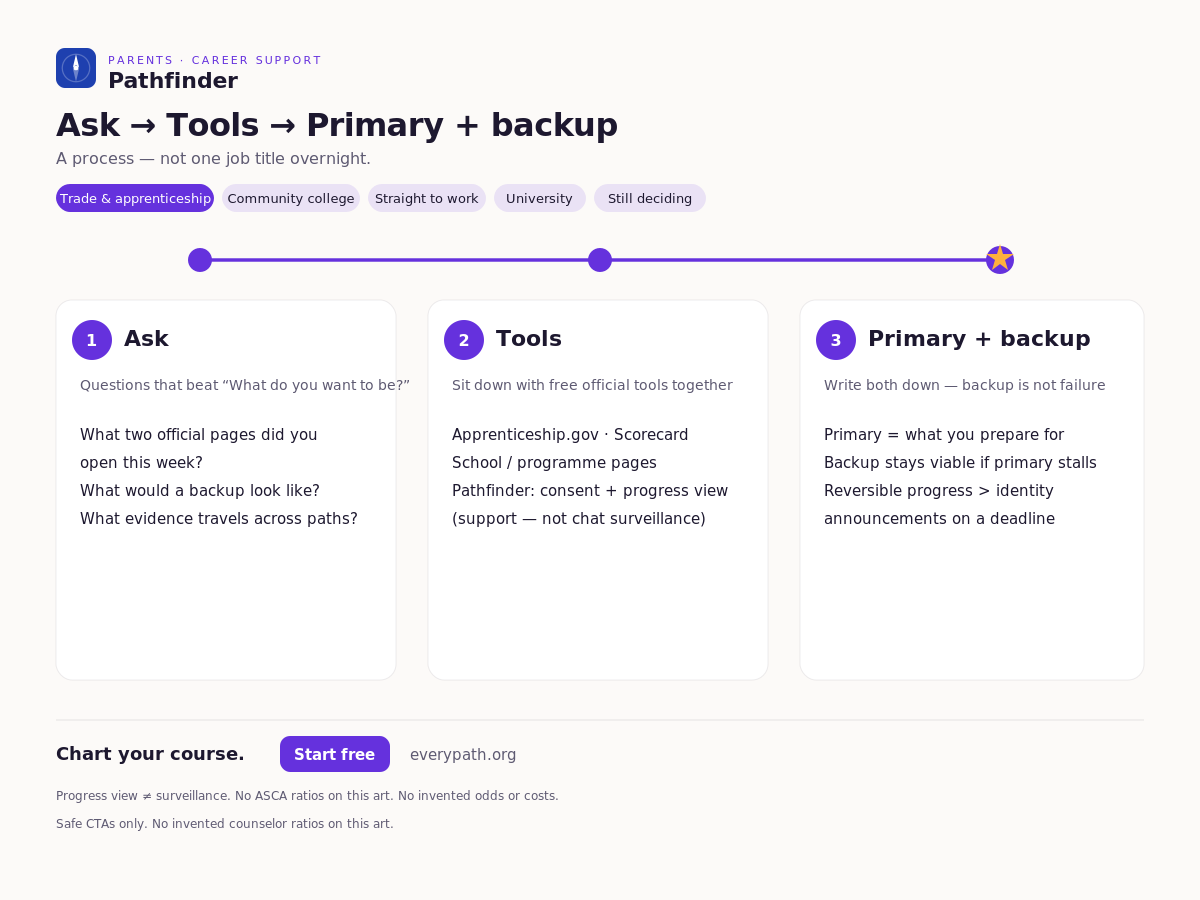
Three, all published by the US government, none of which lists a price. Do them side by side at the kitchen table rather than sending links and hoping.
| Tool | Publisher | What it gives you | Cost | Source |
|---|---|---|---|---|
| Occupational Outlook Handbook | U.S. Bureau of Labor Statistics | Occupation profiles you can filter by "2025 Median Pay", "Entry-Level Education", "On-the-Job Training" and "Number of New Jobs (Projected)" | No price listed | BLS OOH (2025) |
| O*NET Interest Profiler | U.S. Department of Labor, Employment and Training Administration | A self-assessment of the work activities someone would enjoy: 30 questions in the Mini-IP, 60 in the Short Form, roughly 10-20 minutes | Free of charge, in the publisher's own words | O*NET Resource Center (accessed 2026-09-11) |
| Apprenticeship Job Finder | U.S. Department of Labor, Office of Apprenticeship | "Search open apprenticeship job opportunities from employers across the country and directly apply with the employer" | No price listed | apprenticeship.gov (accessed 2026-09-11) |
Use them in that order. The interest profiler gives your teenager words for the work they would enjoy. The Handbook turns those words into real occupations with a pay figure and a stated entry-level education. The Job Finder shows whether a paid route into one of them is open near you right now.
The profiler is a self-report about preferences. It does not measure ability, and it does not tell anyone what they will be good at. Treat its output as a list of things to go and look at, never as an answer.
What does one sourced fact per route look like?
Here is one official figure per route, so that no path gets argued for on feeling alone.
| Route | One sourced fact | Source (year) |
|---|---|---|
| Trade and apprenticeship | Electricians: median annual wage $63,190; typical entry-level education a high school diploma or equivalent | BLS OOH (May 2025) |
| Community college | Average tuition and fees at public two-year institutions: $4,000 | NCES Fast Facts (2022-23) |
| Straight to work | Median usual weekly earnings with a high school diploma: $966; unemployment rate 4.3% | BLS (2025) |
| University | Median usual weekly earnings with a bachelor's degree: $1,578; unemployment rate 2.8% | BLS (2025) |
| University, finishing it | 64 percent six-year graduation rate for first-time, full-time students who began seeking a bachelor's degree at four-year institutions in fall 2014 | NCES Fast Facts (fall 2014 cohort) |
| Still deciding | No figure applies. It is a starting point, not an outcome | Definitional, not sourced |
Read those as separate facts, not as a league table. The BLS earnings rows are weekly medians for a broad population; the NCES tuition row is average tuition and fees for one academic year, as published, not what any one family pays after aid; the electrician row is an annual wage for one occupation. They are different measures and they do not subtract from each other. BLS also notes that its 2025 annual estimates are 11-month averages that exclude October, because October 2025 data were not collected during the federal government shutdown (BLS, 2025).
The degree earnings row carries a condition, too: it describes people who finished. The graduation-rate row is the other half of that same sentence, and it is the question worth asking about one specific institution and one specific course.
What if your teenager is still deciding?
Then they are in a common position, and an honest plan should say so rather than paper over it. Still deciding is "not sure yet" as a legitimate starting point: exploring options honestly with no pressure to commit. Pathfinder treats it as a pathway in its own right.
The practical alternative to a premature decision is not drift. It is a primary and backup path, the compare-and-commit step where your teenager chooses a primary pathway and an explicit backup rather than a single unhedged choice. Two named routes beat one forced answer, and they beat a blank page.
You can also set a review date. A path chosen in October is allowed to change in March, and saying that out loud lowers the stakes enough for a real conversation to happen.
What if they want a trade, work or the military instead of university?
Take it seriously, and check it against the same sources you would use for a degree. The entry point is often the surprise. BLS lists the typical entry-level education for electricians as a high school diploma or equivalent, alongside a median annual wage of $63,190 in May 2025 (BLS). That is a real occupation, with a published wage, and no degree named as the way in.
If a trade route is new territory for you, the Apprenticeship Job Finder belongs in the list above for one reason: it shows current openings from real employers rather than a national argument about whether trades are a good idea. For a fuller side-by-side of the two routes, with the costs, the wages and the places where the numbers do not line up, read apprenticeship vs. college. For a senior-year calendar, use your 12th-grade plan. If they are not ready to pick yet, still deciding after high school keeps that open without treating it as failure. And if your teenager has already told you college is not the plan, my teen doesn't want to go to college covers the routes open instead and how to talk about it.
For the military, this guide prints no figures on purpose. Age, education and testing requirements are set by each service and belong on its own recruiting site, so read them there rather than from a summary.
What can you see if your teenager uses Pathfinder?
Only what they choose to turn on, and only after they turn it on. Guardian consent is the explicit, student-initiated, token-based step that turns on a parent's read access. Parent access never exists without it. You cannot sign up on your own and add your child. Your teenager creates the account and sends you an invite by email. You record your consent through that invite link and claim it with an account of your own, and only then does the link exist.
Once invited, the parent progress view shows the week's focus, tasks finished in the last seven days, what is due in the next fourteen, evidence the student chose to share, and whether a counsellor endorsed the plan. Never counsellor conversations, and never unshared drafts. The depth of that view depends on the student's plan: on the free plan a linked parent sees plan status and counsellor endorsement only, while the full week view, plus a summary emailed to you each Sunday, belongs to the Family plan. That summary is weekly and it goes out on Sundays. There are no live notifications, by design.
What can't these numbers tell you?
They cannot tell you what will happen to your teenager. Medians and rates describe populations. Your child is one person, in one town, in one year of one labour market.
- These are national US figures. A trade wage or a tuition bill in your state can sit a long way from the national number in either direction.
- They are different measures. A weekly median, an annual median, a published tuition price and a six-year cohort rate cannot be added, subtracted or averaged together.
- A published price is not a bill. The NCES figure is average tuition and fees for 2022-23, as published. It is not a net price after aid.
- An interest profiler is a self-report. It records what someone says they would enjoy today. It measures neither aptitude nor future pay.
- The jobs-held figure is one old cohort. An average of 12.9 jobs describes people born in 1957-64 across forty years of their working lives, not a teenager starting now.
This is how Pathfinder labels its own claims, and we would rather say it plainly than sound more certain than the evidence allows. A sourced figure is grounded for exactly what it says and no further. Anything Pathfinder works out for you from it is modelled, a reasoned estimate marked as one. Neither ever becomes a prediction about your child: Pathfinder will not state anyone's chances of getting in, in any wording, which is one of the things its AI is built to refuse, along with inventing a deadline or a cost.
How do you decide what to do this month?
Turn all of that into four weeks of small, concrete steps:
- Book one twenty-minute conversation, not a summit. Use two questions from the first table, and stop while it is still going well.
- Do the interest profiler together, once. The Mini-IP is 30 questions and takes roughly 10 to 20 minutes (O*NET Resource Center). Compare what each of you expected to see.
- Open three Handbook profiles. Read the pay, the entry-level education and the projected new jobs for each, and write down what surprised you.
- Search the Apprenticeship Job Finder for your state. Even if nobody applies this year, seeing real openings makes a route concrete.
- Name a primary path and a backup path. Two named routes, written down, beat one forced decision.
- Agree what your role is. Ask what they want you to do, and what they want you to leave alone. Then do that, and put a date in the calendar to revisit it.
If it helps to know what a tool costs before your teenager starts, Pathfinder's what is free and what is not page sets that out, and the free plan needs no card.
Want a plan you can see without taking it over?
Your teenager starts free, builds a plan for whichever route they choose, or for still deciding, and can invite you to see how the plan is going. Every claim in that plan is labelled grounded, modelled or advisory, and it will not invent a deadline, a cost, or anyone's odds of getting in.
Start free — no credit card required.
Frequently asked questions
Should I take a career quiz with my teenager?
Use an official interest profiler rather than a personality quiz. The O*NET Interest Profiler is free from the U.S. Department of Labor, and it is a self-report about what work you would enjoy, not a prediction of what you will be good at.
What if my teenager has no idea what they want?
Still deciding is a legitimate starting point, not a failure. The practical move is to explore two routes honestly and plan a primary path with an explicit backup rather than one unhedged bet.
Can I sign up for Pathfinder myself and add my child?
No. You cannot sign up and add a child. Your teenager creates the account and sends you an invite, and your read access only exists after that explicit, student-initiated consent step.
What will I actually be able to see?
The week's focus, tasks finished in the last seven days, what is due in the next fourteen, evidence your teenager chose to share, and whether a counsellor endorsed the plan. Never counsellor conversations or unshared drafts. On the free plan you see plan status and counsellor endorsement only; the full week view is part of the Family plan.
How many jobs will my teenager have?
Nobody can say. BLS reports that people born in 1957-64 held an average of 12.9 jobs from ages 18 to 58 (BLS, 2025). That describes one older cohort, not today's teenagers.
Sources
- Occupational Outlook Handbook — Electricians — U.S. Bureau of Labor Statistics (2025), accessed 2026-09-11
- Occupational Outlook Handbook — home — U.S. Bureau of Labor Statistics (2025), accessed 2026-09-11
- O*NET Interest Profiler — O*NET Resource Center — U.S. Department of Labor, Employment and Training Administration, accessed 2026-09-11
- Apprenticeship Job Finder — U.S. Department of Labor, Office of Apprenticeship, accessed 2026-09-11
- Unemployment rates and earnings by educational attainment — U.S. Bureau of Labor Statistics (2025), accessed 2026-09-11
- Fast Facts: Tuition costs of colleges and universities — National Center for Education Statistics (2022-23), accessed 2026-09-11
- Fast Facts: Graduation rates — National Center for Education Statistics (2014), accessed 2026-09-11
- Number of Jobs, Labor Market Experience, Marital Status, and Health (NLSY79) — U.S. Bureau of Labor Statistics (2025), accessed 2026-09-11
Chart your course
Pathfinder builds you a plan for whichever path you pick — or for “still deciding” — and labels every claim in it as grounded, modelled or advisory. It will not invent a deadline, a cost, or your chances of getting in.
Start free No credit card required.
Related reading
- Still deciding what to do after high school?
Still deciding what to do after high school? What the data says about changing course, why 'undecided' is a legitimate plan, and how to build one.
- How to choose a path after high school
How to choose a path after high school with a primary and an explicit backup — a sourced decision frame, not tip lists or invented odds.
- Straight to work after high school? Sourced guide
Going straight to work after high school: what it means, how it differs from college and apprenticeships, and how to plan a primary + backup.