Paths after high school
Are apprenticeships paid? How apprentice pay works
Yes, if it is a registered apprenticeship. You are hired as an employee and paid from your first day, never below the applicable minimum wage, and your pay rises on a written schedule as you log hours or prove skills. Pre-apprenticeships and internships are different: they may be unpaid.
By Pathfinder Editorial · Published · Updated · 16 min read
About: Registered apprenticeship Trade and apprenticeship Pathway Grounded

That yes has fine print: whether class time is paid, and whether you cover books or fees, depends on the program. This guide is about the fine print: where the wage schedule lives, how the steps work, what the rules say about classroom hours, and what to ask before you sign. For the definition of registration itself, read what a registered apprenticeship is. For national earnings and costs against a degree, see apprenticeship vs. college. And if apprenticeship is one of several routes on your list, the map of every path after high school sets it beside the other seven.
What follows is US federal rules plus one state example. Other countries run apprenticeships under their own laws, so the questions carry over; the rules do not.
Are apprentices employees or students?
Employees. Federal rules define an apprentice as "a worker at least 16 years of age … who is employed to learn an apprenticeable occupation" under registered standards (29 CFR §29.2). The Department of Labor's FAQ is blunter: "Apprenticeships are jobs! Apprentices earn wages from their employers during training" (apprenticeship.gov).
That one fact explains most of the money. You do not enrol and pay to be trained; an employer or sponsor hires you, and the training happens inside the job. DOL's career-seeker page lists "a competitive wage from day one" and "a guaranteed wage increase as you develop new skills" (Career Seekers).
Are all apprenticeships paid?
Registered ones are. Their standards must include a progressively increasing wage schedule (29 CFR §29.5(b)(5)), and your agreement must state it (29 CFR §29.7(g)). Not everything that sounds like an apprenticeship carries that rule:
- Pre-apprenticeships "may or may not include wages or stipend," according to DOL (apprenticeship.gov). They prepare you to apply; what a pre-apprenticeship is explains how they work, and their pay is covered further down.
- Internships are a different arrangement: DOL says "Internships are often unpaid and may not lead to a full-time job" (apprenticeship.gov).
- Employer-run trainee jobs are usually paid jobs, but BLS notes some electrical contractors run their own training programs, "which are not recognized apprenticeship programs," so no registered wage schedule binds them.
So the line between a paid apprenticeship and unpaid training is registration. Before you trust the word "apprenticeship" in a job ad, confirm the program is registered: how to find a registered apprenticeship walks through the official search tools and how to check which agency registered a program.
What is the least an apprentice can be paid?
The entry wage in registered standards must not be "less than the minimum wage prescribed by the Fair Labor Standards Act, where applicable, unless a higher wage is required by other applicable Federal law, State law, respective regulations, or by collective bargaining agreement" (29 CFR §29.5(b)(5)). So the highest of three floors applies:
- Federal: $7.25 per hour, effective July 24, 2009, according to DOL's Wage and Hour Division (DOL).
- State: DOL notes many states have their own minimum wage laws, and employers must comply with both.
- Union contract: a collective bargaining agreement can require more.
The floor matters less than where your program starts above it.
How does a progressive wage schedule work?
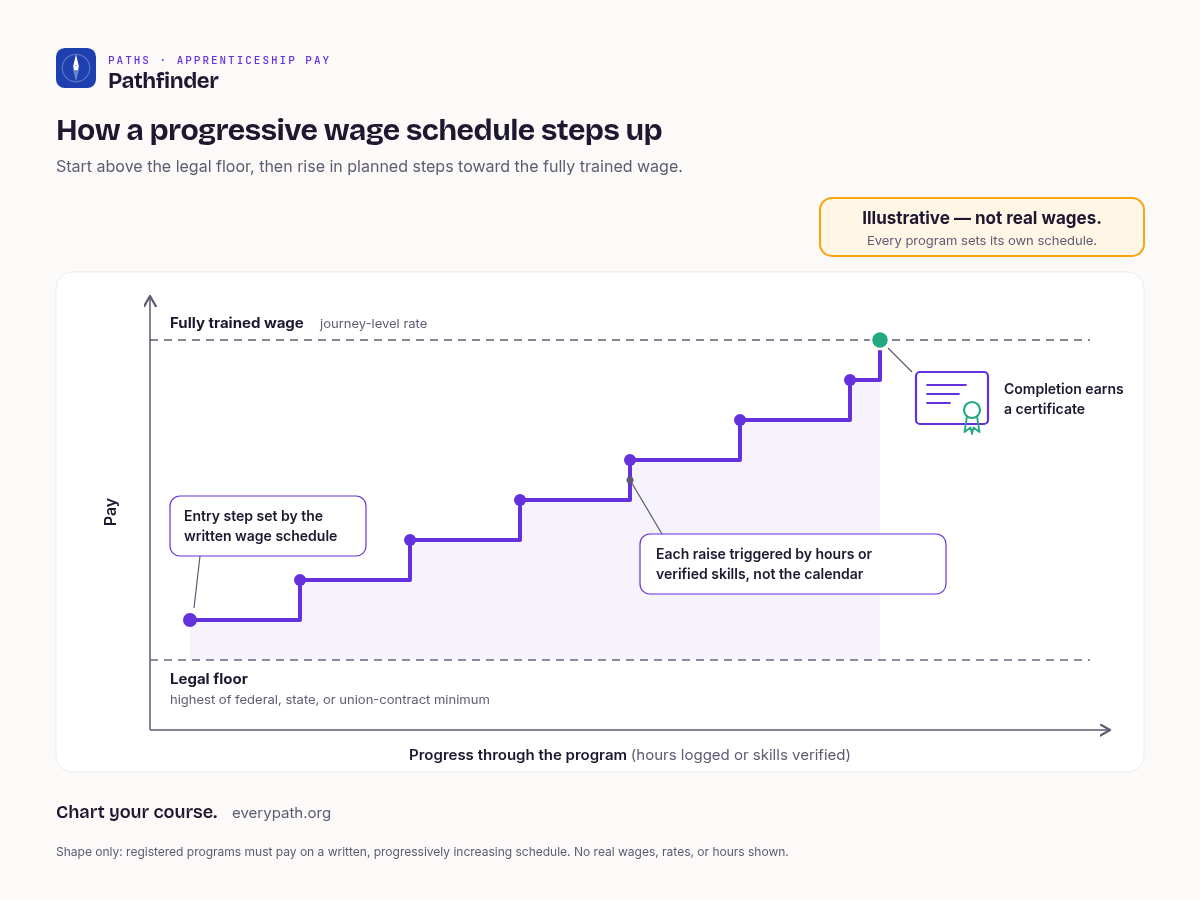
Every registered program must set out "a progressively increasing schedule of wages to be paid to the apprentice consistent with the skill acquired" (29 CFR §29.5(b)(5)). You start below a fully trained worker's rate and rise in planned steps. BLS says the same of electricians: "Apprentices receive less pay than fully trained electricians, but their pay increases as they learn to do more" (BLS OOH).
What triggers each raise depends on how the program measures progress (29 CFR §29.5(b)(2)):
| Approach | What moves you up a pay step |
|---|---|
| Time-based | Logged on-the-job hours; the term is at least 2,000 hours |
| Competency-based | Skills verified by the sponsor; on-the-job learning still required |
| Hybrid | A minimum of hours plus demonstrated competencies |
Many schedules express each step against a journeyworker's pay: a worker "recognized within an industry as having mastered the skills and competencies required for the occupation" (29 CFR §29.2). And if you arrive with relevant coursework or experience, advanced standing must come "with commensurate wages for any progression step so granted" (29 CFR §29.5(b)(12)), though DOL says every apprentice must still complete "at least 6 months (equivalent to 1,000 hours)" to earn the credential (apprenticeship.gov).
Are apprentices paid weekly or on a schedule?
Two different schedules get mixed up here. The one the rules require is for your rate: registered standards must set out "a progressively increasing schedule of wages" (29 CFR §29.5(b)(5)), and in the Washington program below, "Wage increases are based on hours worked or competencies attained." That schedule says when your pay goes up, step by step.
How often a paycheck arrives, whether weekly, every two weeks or otherwise, is not set by the federal apprenticeship rules or the program standards cited in this guide. Ask the employer, at the same time as you ask for the entry wage.
What does a real wage schedule look like?
Washington's Department of Labor & Industries, which registers apprenticeship programs in that state, publishes their standards online. Here is the wage section from one: the Performance Electrical Apprenticeship Committee's standards for inside electricians, an 8,000-hour term, last amended July 17, 2025 (WSATC 2224).
| Step | Hours worked | West: % of journey-level wage | East: % of journey-level wage |
|---|---|---|---|
| 1 | 0–1,000 | 40% | 50% |
| 2 | 1,001–2,000 | 45% | 54% |
| 3 | 2,001–3,000 | 50% | 58% |
| 4 | 3,001–4,000 | 55% | 60% |
| 5 | 4,001–5,000 | 65% | 65% |
| 6 | 5,001–6,000 | 75% | 75% |
| 7 | 6,001–7,000 | 80% | 80% |
| 8 | 7,001–8,000 | 85% | 85% |
Source: Washington program standards WSATC 2224, section VII.C, amended 2025-07-17.
Four things to look for in any schedule, all visible here:
- Percentages, not dollars. The base is the journey-level wage, which the sponsor reports to the state "at least annually or whenever changed." Apprentices are told to "contact the sponsor or the Department for the most recent Journey-level wage rate."
- Location matters. The two tables reflect "the different journeyman wages between the East and West side, as dictated by the comparative costs of living for each area."
- It is a floor. Apprentices "shall not be paid less than the progressive scale … regardless the scope of work being performed."
- Raises follow progress. "Wage increases are based on hours worked or competencies attained," and the sponsor determines them.
This is one program in one state, not a national norm. Its value is showing you what a real schedule contains.
Are apprentices paid for classroom time?
Sometimes. Registered programs must include related technical instruction, with at least 144 hours a year recommended (29 CFR §29.5(b)(4)). Whether it is paid is part of your agreement, which must state "the graduated scale of wages to be paid to the apprentice and whether or not the required related instruction is compensated" (29 CFR §29.7(g)).
The Washington standards take one position: "Time spent in RSI shall not be considered as hours of work and the apprentice is not required to be paid." (RSI is their term for related instruction.) Other programs pay for some or all class time. BLS draws the same line for electricians, who typically get "2,000 hours of paid on-the-job training as well as some technical instruction" a year.
So "paid from day one" describes your working hours. If class is unpaid and on your own time, your real hourly income across the week is lower than the wage rate suggests. That is a reason to ask, not a reason to walk away.
Do you have to pay for an apprenticeship?
Usually not much, but not always nothing. In a registered program you are hired, not enrolled, so there is no national tuition bill, and DOL puts the cost of running the program on the sponsor. Some costs can still land on you, such as books and lab fees in the Washington electrical program above.
Who pays for the classes? Mostly the sponsor. DOL says administering a program "is the responsibility of the sponsor," with costs depending on whether instruction is in-house or through, for example, a local community college. Workforce Innovation and Opportunity Act funds may help with "instructional training and tuition costs," decided at state and local level (apprenticeship.gov).
Mostly is not entirely. Washington's agency says "Apprenticeship costs depend on the program" (Washington L&I). In the electrical standards above, the committee "pays for a large majority of the RSI," but apprentices pay for books and "RSI lab fees," and "These amounts can be provided prior to acceptance into the program at the request of the applicant." Ask for them.
DOL also notes that "some apprenticeship programs will lead to a debt-free college degree." Some, not all. The federal rules quoted here do not cover every document an employer might hand you, so if any paperwork mentions repaying training costs if you leave, get it explained in writing first.
You are not locked in. Probation "cannot exceed 25 percent of the length of the program, or 1 year, whichever is shorter," and either side can cancel during it without stated cause (29 CFR §29.5(b)(8), (b)(20)). After probation, the agreement may be "Cancelled at the request of the apprentice" (29 CFR §29.7(h)).
Does a pre-apprenticeship pay the same way?
No. A pre-apprenticeship prepares you for an apprenticeship. DOL says they "may last from a few weeks to a few months and may or may not include wages or stipend" (apprenticeship.gov). The federal definition covers people who do not yet meet a sponsor's selection criteria, with "at least one documented partnership with a Registered Apprenticeship program" (29 CFR §30.2), and DOL's Office of Apprenticeship "does not directly oversee or regulate pre-apprenticeship programs" (TEN 23-23). Informal trainee jobs are a third category: BLS notes some electrical contractors run their own training programs, "which are not recognized apprenticeship programs."
| Pay question | Registered apprenticeship | Pre-apprenticeship | Informal trainee job |
|---|---|---|---|
| Are you paid? | Yes, employed from day one | "May or may not include wages or stipend" | Yes; raises are up to the employer |
| Written raise schedule required? | Yes, 29 CFR §29.5(b)(5) | No federal requirement | No federal requirement |
| Class-time pay stated in writing? | Yes, 29 CFR §29.7(g) | Varies | Varies |
| Who oversees it? | DOL or a State Apprenticeship Agency | Not directly regulated by DOL's Office of Apprenticeship | Ordinary employment law |
A pre-apprenticeship can be a smart first step if you don't yet meet entry requirements, especially one with "Agreements with RAP sponsors that allow program participants to enter directly into a RAP" (Explore Pre-Apprenticeship). Budget for it as training, not a paycheck, unless told otherwise in writing.
Does union vs. non-union change your pay?
Both exist and both can be registered. Washington's agency says: "There are both union and non-union Registered Apprenticeship programs. Union affiliation is your choice." Federally, a joint committee includes "employees represented by a bona fide collective bargaining agent"; a non-joint committee has employer representatives but no bargaining agent (29 CFR §29.2). For electricians, BLS says "unions and contractor associations" both sponsor programs.
The difference is structural. In a union program, the bargaining agreement can require a higher entry wage than the legal minimum (29 CFR §29.5(b)(5)); in a non-union program, the standards and your agreement set the schedule. None of the official sources behind this guide compares the two nationally, so we don't. Compare the actual schedules you are offered, and ask what comes out of pay for dues or fees.
How do you check the wage schedule before you accept?
- Confirm registration, and with which agency. Only registered programs are bound by the rules above. Search the Job Finder or Partner Finder on apprenticeship.gov.
- Get the program standards and turn to the wage section. In Washington, each program listed in the state's registration database links "to the program standards." Elsewhere, ask the sponsor or your state apprenticeship agency.
- Get the current journey-level wage. Percentages without the base are half a number.
- Read the apprenticeship agreement before signing. It must state the wage scale, whether instruction is paid, the hours, the term and the probation period (29 CFR §29.7). Under 18? A parent or guardian signs too.
- Ask for help if you want it. DOL points career seekers to American Job Centers (Career Seekers).
Then take these questions to the employer:
| Ask this | Why it matters |
|---|---|
| What is the entry wage, and what percentage of the journey-level rate is it? | The schedule and the base are separate numbers |
| What triggers each raise: hours, skills or both? | Tells you how fast pay can move |
| Is classroom time paid? | The agreement must say either way |
| What will I pay for books, fees or dues? | Costs "depend on the program" |
| How often is payday: weekly, every two weeks? | The rules cited here set the raise schedule, not the pay frequency |
| When is class: work hours, evenings or weekends? | Unpaid evening class changes your real week |
| Can I get credit for what I already know? | Advanced standing comes with the matching wage |
| Would I owe anything if I leave? | Get the answer in writing |
If the answers don't work this year, that is what a primary and backup path is for: another program, another start date, or another route.
What can a national pay figure tell you?
Apprenticeship.gov's home page lists "$86K*" as "Average Starting Salary," defined as the "Average starting salary after an apprentice completes an apprenticeship program." Its footnote: "Based on information available through Kansas Department of Commerce Common Reporting Information System (CRIS) and the Registered Apprenticeship Partners Information Database System (RAPIDS). Retrieved on 12/31/2025" (apprenticeship.gov).
That describes people after completing a program, averaged across occupations, not pay during training. It is grounded for exactly that, and it cannot tell you step one of the schedule in front of you. If Pathfinder estimates something from your own offer, such as weekly income across paid and unpaid hours, that is modelled and labelled as one.
Are apprentices paid for classroom hours?
It depends on the program. Federal rules require your apprenticeship agreement to state whether related instruction is paid. Some programs pay for class time; others, like one Washington electrical program, state that apprentices are not required to be paid for it.
Is apprentice pay lower than a fully trained worker's pay?
At the start, yes. Registered programs pay on a progressively increasing schedule, so apprentices begin below the fully trained, journey-level rate and move up in steps as they log hours or show skills.
Can a 17-year-old be a paid registered apprentice?
Federal rules set the minimum age at 16 unless another law sets a higher one. If you are under 18, a parent or guardian also signs the apprenticeship agreement, and state work rules for minors may apply.
Does a pre-apprenticeship pay?
Not necessarily. The Department of Labor says pre-apprenticeships may last from a few weeks to a few months and may or may not include wages or a stipend. They prepare you for a registered apprenticeship; they are not one.
Do I have to join a union to be a paid apprentice?
No. Union and non-union registered programs both exist. In a union program, a collective bargaining agreement can require a higher entry wage; in a non-union program, the registered standards and your agreement set the schedule.
Sources
- Career Seekers — U.S. Department of Labor, accessed 2026-09-25
- How is apprenticeship different from other types of work-based training models? — U.S. Department of Labor, accessed 2026-09-25
- What is the difference between an apprenticeship and an internship? — U.S. Department of Labor, accessed 2026-09-25
- What are the costs associated with sponsoring a Registered Apprenticeship Program? — U.S. Department of Labor, accessed 2026-09-25
- Can previous work or classroom experience be used towards completion of an apprenticeship program? — U.S. Department of Labor, accessed 2026-09-25
- What is Pre-Apprenticeship? — U.S. Department of Labor, accessed 2026-09-25
- Explore Pre-Apprenticeship — U.S. Department of Labor, accessed 2026-09-25
- Where can I find a list of apprenticeship program sponsors? — U.S. Department of Labor, accessed 2026-09-25
- Apprenticeship.gov home page — Did You Know? — U.S. Department of Labor, accessed 2026-09-25
- TEN 23-23: Quality Pre-Apprenticeship Programs — U.S. Department of Labor (2024), accessed 2026-09-25
- Minimum Wage — U.S. Department of Labor, Wage and Hour Division, accessed 2026-09-25
- 29 CFR §29.2 — Definitions — eCFR, accessed 2026-09-25
- 29 CFR §29.5 — Standards of apprenticeship — eCFR, accessed 2026-09-25
- 29 CFR §29.7 — Apprenticeship agreement — eCFR, accessed 2026-09-25
- 29 CFR §30.2 — Definitions — eCFR, accessed 2026-09-25
- Occupational Outlook Handbook — Electricians — U.S. Bureau of Labor Statistics (2025), accessed 2026-09-25
- Become an Apprentice — Washington State Department of Labor & Industries, accessed 2026-09-25
- Apprenticeship Program Standards, WSATC 2224 — Washington State Apprenticeship and Training Council (amended 2025-07-17), accessed 2026-09-25
Chart your course
Pathfinder builds a plan around the path you choose, whether that is a registered apprenticeship, one of the other seven routes, or still deciding. It marks every claim as grounded, modelled or advisory, so you can tell a sourced fact from an estimate. It won't guess your wage, your odds or your deadlines.
Start free — no credit card required.
Frequently asked questions
Are apprentices paid for classroom hours?
It depends on the program. Federal rules require your apprenticeship agreement to state whether related instruction is paid. Some programs pay for class time; others, like one Washington electrical program, state that apprentices are not required to be paid for it.
Is apprentice pay lower than a fully trained worker's pay?
At the start, yes. Registered programs pay on a progressively increasing schedule, so apprentices begin below the fully trained, journey-level rate and move up in steps as they log hours or show skills.
Can a 17-year-old be a paid registered apprentice?
Federal rules set the minimum age at 16 unless another law sets a higher one. If you are under 18, a parent or guardian also signs the apprenticeship agreement, and state work rules for minors may apply.
Does a pre-apprenticeship pay?
Not necessarily. The Department of Labor says pre-apprenticeships may last from a few weeks to a few months and may or may not include wages or a stipend. They prepare you for a registered apprenticeship; they are not one.
Do I have to join a union to be a paid apprentice?
No. Union and non-union registered programs both exist. In a union program, a collective bargaining agreement can require a higher entry wage; in a non-union program, the registered standards and your agreement set the schedule.
Sources
- Career Seekers — U.S. Department of Labor, accessed 2026-09-25
- How is apprenticeship different from other types of work-based training models? — U.S. Department of Labor, accessed 2026-09-25
- What is the difference between an apprenticeship and an internship? — U.S. Department of Labor, accessed 2026-09-25
- What are the costs associated with sponsoring a Registered Apprenticeship Program? — U.S. Department of Labor, accessed 2026-09-25
- Can previous work or classroom experience be used towards completion of an apprenticeship program? — U.S. Department of Labor, accessed 2026-09-25
- What is Pre-Apprenticeship? — U.S. Department of Labor, accessed 2026-09-25
- Explore Pre-Apprenticeship — U.S. Department of Labor, accessed 2026-09-25
- Where can I find a list of apprenticeship program sponsors? — U.S. Department of Labor, accessed 2026-09-25
- Apprenticeship.gov home page — Did You Know? — U.S. Department of Labor, accessed 2026-09-25
- Training and Employment Notice 23-23: Quality Pre-Apprenticeship Programs — U.S. Department of Labor, Employment and Training Administration (2024), accessed 2026-09-25
- Minimum Wage — U.S. Department of Labor, Wage and Hour Division, accessed 2026-09-25
- 29 CFR 29.2 — Definitions — U.S. Government Publishing Office (eCFR), accessed 2026-09-25
- 29 CFR 29.5 — Standards of apprenticeship — U.S. Government Publishing Office (eCFR), accessed 2026-09-25
- 29 CFR 29.7 — Apprenticeship agreement — U.S. Government Publishing Office (eCFR), accessed 2026-09-25
- 29 CFR 30.2 — Definitions (pre-apprenticeship program) — U.S. Government Publishing Office (eCFR), accessed 2026-09-25
- Occupational Outlook Handbook — Electricians — U.S. Bureau of Labor Statistics (2025), accessed 2026-09-25
- Become an Apprentice — Washington State Department of Labor & Industries, accessed 2026-09-25
- Apprenticeship Program Standards — Performance Electrical Apprenticeship Committee (WSATC 2224) — Washington State Apprenticeship and Training Council / Department of Labor & Industries (2025), accessed 2026-09-25
Chart your course
Pathfinder builds you a plan for whichever path you pick — or for “still deciding” — and labels every claim in it as grounded, modelled or advisory. It will not invent a deadline, a cost, or your chances of getting in.
Start free No credit card required.
Related reading
- What is a registered apprenticeship? Sourced definition
DOL-registered apprenticeships: paid work + training, with standards. How they differ from informal “apprentice” jobs.
- Registered apprenticeship vs trade school explained
A registered apprenticeship is a validated paid job. Trade school can teach the class and still not be the program. Check who sponsors it.
- How long does an apprenticeship take? Trades compared
Usually one to six years. Construction trades like electrician and carpenter list 7,328 to 8,000 hours. What sets the term and how to check yours.