Paths after high school
Straight to work after high school? Sourced guide
By Pathfinder Editorial · Published · 13 min read
About: Pathway Straight to work Primary and backup path Grounded

Going straight to work after high school means treating employment as your primary path — not a consolation prize. BLS shows many recent graduates not enrolled in college are already in the labor force, and OOH lists hundreds of occupations that typically need a high school diploma to enter. Name a primary job route and an explicit backup.
This is the straight-to-work spoke inside Pathfinder’s map of every path after high school. If you are not ready to pick a route yet, start with still deciding after high school. For sourced pay and cost figures on one earn-and-learn route against a degree, use apprenticeship vs. college — this page will not reprint those tables.
These are U.S. national labor-force and occupational figures. Pathfinder ships country packs for the US, the UK, the UAE, India and Singapore, so the planning questions travel — the BLS snapshot does not automatically.
What does “straight to work” mean after high school?
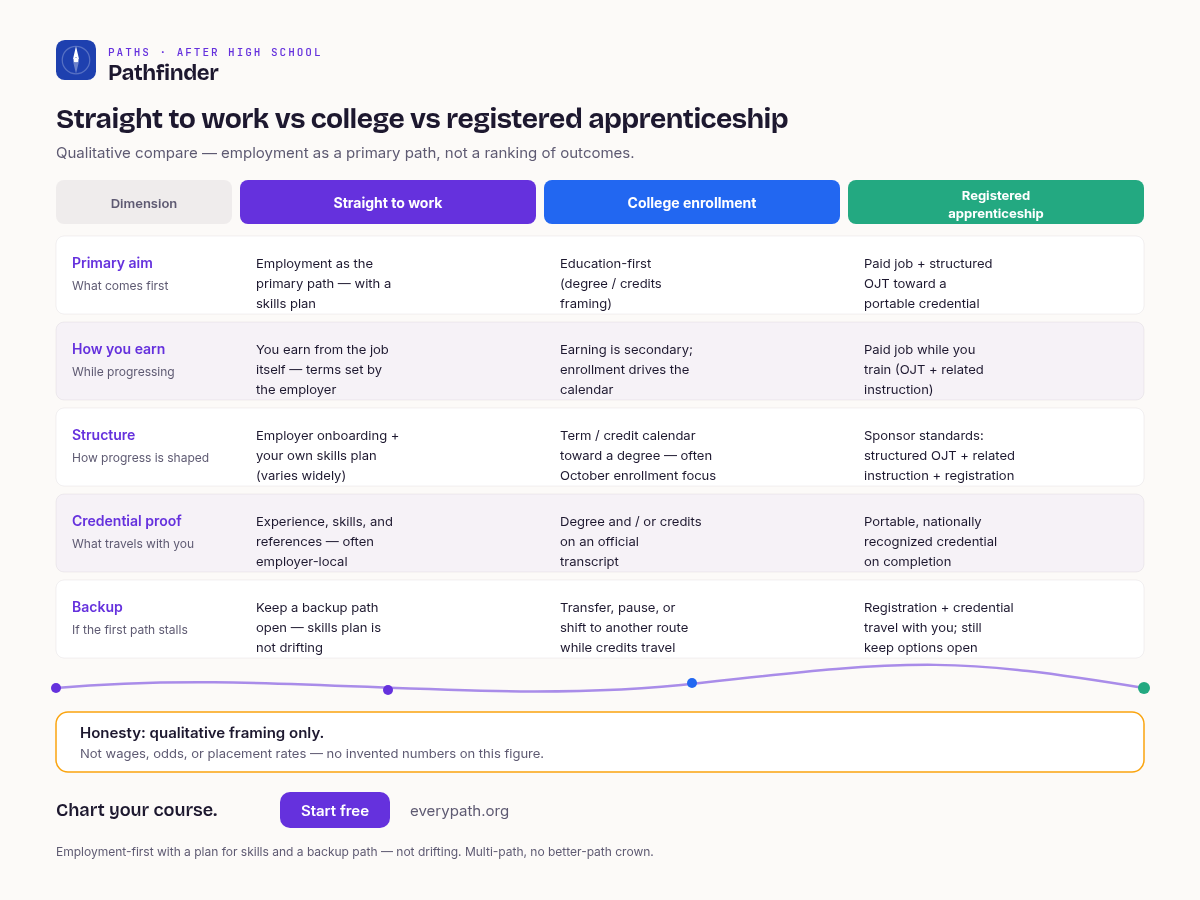
In Pathfinder’s taxonomy, straight to work is a named pathway: you treat a job (or a short sequence of jobs with a skill target) as the primary next step after high school, not as leftover time while a college application story catches up.
Three clarifications keep the label honest:
- It is employment-first, not “anti-learning.” Many jobs include on-the-job training. BLS’s Occupational Outlook Handbook (OOH) often pairs a typical entry-level education with a typical on-the-job training category — short-term, moderate-term, long-term, apprenticeship, or none (Measures of Education and Training). Training on the job does not automatically turn the role into a registered apprenticeship.
- It is not the same as “still deciding.” Still deciding is a planning stance with exploration steps. Straight to work is a destination you can name in one sentence: the kind of work you are aiming at, and how you will look for it.
- It is not a consolation prize for skipping college. Pathfinder’s equal-validity rule treats university as one option among eight — never the default. Straight to work is on that map for the same reason trade, military, certifications, community college, and entrepreneurship are.
What “straight to work” does not mean here: a promise that any particular employer will hire you next month, a national placement rate, or a wage Pathfinder invented for your zip code.
How common is working instead of enrolling right away?
Common enough that “everyone goes to college in October” is a social story, not a complete population fact — and common enough that “not enrolled” still covers very different Octobers.
The U.S. Bureau of Labor Statistics reports that in October 2024, 62.8% of 2024 high school graduates ages 16 to 24 were enrolled in colleges or universities — about 2.0 million of roughly 3.2 million graduates who finished between January and October 2024 (BLS HSGEC summary, released April 2025).
The same release’s Table 1 isolates graduates who were not enrolled in college that October:
| Status (recent HS grads not enrolled, ages 16–24, Oct 2024) | Number (thousands) | Rate | Source |
|---|---|---|---|
| Total not enrolled in college | 1,199 | — | BLS HSGEC Table 1 |
| In the labor force (working or looking) | 795 | 66.4% of population | BLS HSGEC Table 1 |
| Employed | 633 | 52.8% of population | BLS HSGEC Table 1 |
| Unemployed | 162 | 20.4% of labor force | BLS HSGEC Table 1 |
| Not in the labor force | 403 | — | BLS HSGEC Table 1 |
Read the table carefully. Labor-force participation (66.4%) is higher than the employment-population rate (52.8%) because some people were looking and not yet working. The unemployment rate (20.4%) is the share of that labor force who were unemployed — not “20% of all not-enrolled graduates.” Pathfinder will not turn those cells into your personal odds of getting hired in your county.
BLS also notes that recent graduates not enrolled were more likely to be in the labor force than graduates who were enrolled (66.4% versus 41.2%). That is a participation contrast, not a ranking of which path is “better.” Enrolled students may work part-time; not-enrolled graduates may be full-time job seekers; some people in either group are not looking at all.
A grounded claim from this release looks like: “In October 2024, among recent U.S. high school graduates not enrolled in college, about half were employed and about two-thirds were in the labor force.” A claim this page refuses: “Most employers prefer…” or “You have an X% chance of a job by December.”
Which jobs typically need a high school diploma to enter?
BLS does not publish a single “jobs after high school” shortlist with placement odds. What it does publish is a classification: for each occupation in its projections system, a typical education needed for entry — “the typical education level most workers need to enter an occupation” (Measures of Education and Training; OOH occupational information).
In the OOH glossary, high school diploma or equivalent means completion of high school or the equivalent, resulting in a high school diploma or equivalent credential such as a GED (OOH Glossary). Adjacent categories matter for honesty:
- No formal educational credential — a formal credential is not typically needed for entry.
- Postsecondary nondegree award — usually a certificate from an educational institution (not the same as every industry certification badge).
- Apprenticeship appears under on-the-job training, not as a substitute for the education category.
BLS Career Outlook (September 2025) reports that 326 occupations typically require a high school diploma or the equivalent — nearly twice as many occupations as at any other single education level in that article’s framing (Education level and projected openings, 2024–34). Across all occupations, BLS projects about 19 million openings each year, on average, from 2024 to 2034; most openings come from replacing workers who leave, not only from brand-new growth.
The same article notes that the median annual wage for all occupations was $49,500 in 2024, and that almost half of occupations at the high-school entry level had wages higher than that all-occupations median. That is a distribution statement about occupation medians — not your starting wage, and not a promise that “high school jobs pay the median.”
Career Outlook’s Chart 2 highlights high-school-entry occupations projected to have large average annual openings over 2024–34 (for example, home health and personal care aides; customer service representatives; office clerks). Those lines are projection averages, not hiring guarantees for a senior graduating this year. Use them to discover categories worth researching locally — then open the OOH profile and your state labor-market tools — rather than as a ranked “best jobs” list invented by Pathfinder.
Practical process only:
- Filter the OOH Occupation Finder by entry-level education.
- Read typical on-the-job training and any license notes on the profile.
- Check local openings and employers — national openings cannot tell you what is hiring on your block.
- Keep a backup path if the first target stalls.
How is straight-to-work different from college and from a registered apprenticeship?
They answer different structural questions. Mixing the labels is how people get surprised by unpaid expectations or missing credentials.
| Question | Straight to work | College / university enrollment | Registered apprenticeship |
|---|---|---|---|
| Primary activity | Paid employment (or job search aiming at employment) | Education enrollment | Paid employment plus standards-backed related instruction |
| Who “validates” the path? | The employer’s hiring decision (and any license your state requires) | The school’s admission and program rules | DOL Office of Apprenticeship or a State Apprenticeship Agency for a Registered Apprenticeship Program |
| Typical BLS framing | Many OOH occupations list HS diploma (or none) as typical entry education, often with OJT | Bachelor’s / associate’s / other postsecondary as typical entry for other occupations | Apprenticeship often appears as the OJT category; RAP registration is a DOL/state standards check |
| Where Pathfinder keeps the deep page | This spoke | Hub + university / community-college spokes | What is a registered apprenticeship? |
Versus college. Enrolling means your primary next step is school. You may also work while enrolled — BLS reports labor-force participation among recent graduates who are enrolled — but the pathway label is still education-first. Straight to work flips that: the job is the plan, and school is optional later, part-time, or not at all.
Versus a registered apprenticeship. An informal job can still teach you a skill. A registered apprenticeship is different because registration with the Department of Labor or a State Apprenticeship Agency means published standards: structured on-the-job learning, related instruction, progressive wages, and a completion credential pathway. Pathfinder keeps that definition on what is a registered apprenticeship. Pay and tuition side-by-sides against a degree live on apprenticeship vs. college. This page only needs the clean split: employment ≠ RAP, even when both pay you to learn.
Trade school is another neighbour: typically an education enrollment (tuition or aid), not automatically a paid registered program. Pointer only — the deep trade-versus-degree comparison is not this spoke’s job.
How do you plan a primary job path and a backup?
Permission to work after high school is not a plan. A primary and backup path is.
Use this test — process only, no odds:
- Name the primary in one sentence. “Full-time work in X kind of role while I build Y skill,” “apply to Z local employers in this occupation group,” or “start in customer-facing work while I save for a certificate program” are plans. “I’ll get a job somehow” is not.
- Attach a next action that exists near you. Applications, interviews, American Job Center visits, and employer portals are local. A national employment-population rate cannot complete an application for you.
- Read the OOH line items that matter. Typical entry education, typical on-the-job training, and any license or certification notes — then verify state rules for licensed work.
- Write the backup before you need it. Backup can be another occupation group, a registered apprenticeship search, community college later, or college later. The order is yours. Backups are not failures; they are hedges.
- If you cannot name a primary yet, switch labels. Use still deciding after high school as the planning stance — weekly exploration steps — instead of calling drift “straight to work.”
- Keep the map open. Straight to work sits beside the other routes on every path after high school. Changing primary later is allowed; inventing that one path is “best for everyone” is not.
Anything Pathfinder calculates for your situation is modelled. Planning tips without a primary URL are advisory. Neither becomes a placement percentage.
What this page will not tell you
- What you will earn in your first job. Occupation medians in Career Outlook are national snapshots for workers already in those roles — not starting-salary promises. Pathfinder will not invent yours.
- Your odds of getting hired. The 20.4% unemployment rate among not-enrolled recent graduates in the labor force (BLS, Oct 2024) is a national CPS measure, not a personal probability.
- That “most employers” prefer X. No primary opened on write day supports a blanket employer-preference claim here.
- Full apprenticeship-versus-college pay tables. Those live on apprenticeship vs. college.
- A deep definition of RAP registration, 29 CFR standards, or completer counts. Those live on what is a registered apprenticeship.
- Which path is “best.” Best for whom, on which measure, in which labor market year?
- FAFSA, parent playbooks, counselor ratios, or AI-career-advice pillars. Those are out of this Subject 1 spoke.
Want a plan that can include straight to work?
Pathfinder builds you a plan for whichever path you pick — including straight to work, including university, and including “still deciding” — and labels every claim as grounded, modelled or advisory. It will not invent a deadline, a wage, or your chances of getting hired.
Start free — no credit card required. See pricing if you want the paid tiers later.
What does straight to work after high school mean?
It means treating employment as your primary path after graduation — not as a temporary pause while you wait for a college plan. Pathfinder lists it as one equally valid pathway among eight.
How many recent high school graduates work instead of enrolling?
In October 2024, among 2024 graduates ages 16–24 who were not enrolled in college, 52.8% were employed and 66.4% were in the labor force (BLS Table 1). Those are national snapshot rates, not your local odds.
Are there jobs that typically need only a high school diploma?
Yes. BLS classifies 326 occupations as typically requiring a high school diploma or equivalent to enter, and publishes projected openings for them in Career Outlook. Typical entry education is not a personal hiring guarantee.
How is a regular job different from a registered apprenticeship?
A straight-to-work job is employment without assuming DOL or state registration standards. A registered apprenticeship is a paid earn-and-learn pathway with validated standards. See what is a registered apprenticeship for the definition; pay tables live on apprenticeship vs. college.
What should I do if I am not sure yet?
Use still deciding after high school as a planning stance with steps. Permission to skip college is not permission to skip a primary path and a backup.
Sources
- College Enrollment and Work Activity of Recent High School and College Graduates Summary — 2024 — U.S. Bureau of Labor Statistics, accessed 2026-09-22
- Table 1. Labor force status of 2024 high school graduates… October 2024 — U.S. Bureau of Labor Statistics, accessed 2026-09-22
- Education level and projected openings, 2024–34 — U.S. Bureau of Labor Statistics (2025), accessed 2026-09-22
- OOH Glossary — U.S. Bureau of Labor Statistics, accessed 2026-09-22
- Measures of Education and Training — U.S. Bureau of Labor Statistics, accessed 2026-09-22
- Occupational Information Included in the OOH — U.S. Bureau of Labor Statistics, accessed 2026-09-22
- Occupation Finder — U.S. Bureau of Labor Statistics, accessed 2026-09-22
Chart your course
Pathfinder builds you a plan for whichever path you pick — or for “still deciding” — and labels every claim in it as grounded, modelled or advisory. It will not invent a deadline, a wage, or your chances of getting hired.
Frequently asked questions
What does straight to work after high school mean?
It means treating employment as your primary path after graduation — not as a temporary pause while you wait for a college plan. Pathfinder lists it as one equally valid pathway among eight.
How many recent high school graduates work instead of enrolling?
In October 2024, among 2024 graduates ages 16–24 who were not enrolled in college, 52.8% were employed and 66.4% were in the labor force (BLS Table 1). Those are national snapshot rates, not your local odds.
Are there jobs that typically need only a high school diploma?
Yes. BLS classifies 326 occupations as typically requiring a high school diploma or equivalent to enter, and publishes projected openings for them in Career Outlook. Typical entry education is not a personal hiring guarantee.
How is a regular job different from a registered apprenticeship?
A straight-to-work job is employment without assuming DOL or state registration standards. A registered apprenticeship is a paid earn-and-learn pathway with validated standards. See what is a registered apprenticeship for the definition; pay tables live on apprenticeship vs. college.
What should I do if I am not sure yet?
Use still deciding after high school as a planning stance with steps. Permission to skip college is not permission to skip a primary path and a backup.
Sources
- College Enrollment and Work Activity of Recent High School and College Graduates Summary — 2024 — U.S. Bureau of Labor Statistics (2025), accessed 2026-09-22
- Table 1. Labor force status of 2024 high school graduates… October 2024 — U.S. Bureau of Labor Statistics (2025), accessed 2026-09-22
- Education level and projected openings, 2024–34 — U.S. Bureau of Labor Statistics (2025), accessed 2026-09-22
- Occupational Outlook Handbook — Glossary — U.S. Bureau of Labor Statistics, accessed 2026-09-22
- Measures of Education and Training — U.S. Bureau of Labor Statistics, accessed 2026-09-22
- Occupational Information Included in the OOH — U.S. Bureau of Labor Statistics, accessed 2026-09-22
- Occupation Finder — U.S. Bureau of Labor Statistics, accessed 2026-09-22
Chart your course
Pathfinder builds you a plan for whichever path you pick — or for “still deciding” — and labels every claim in it as grounded, modelled or advisory. It will not invent a deadline, a cost, or your chances of getting in.
Start free No credit card required.
Related reading
- How to choose a path after high school
How to choose a path after high school with a primary and an explicit backup — a sourced decision frame, not tip lists or invented odds.
- Is it okay not to go to college? Sourced answer
Yes — college is one path, not the only valid one. Enrollment data shows a large share of graduates do not enrol immediately. Plan a primary path and a backup.
- Starting a business instead of college
Starting a business instead of college: one valid pathway, primary + backup plan, and official tools to test locally — no invented survival rates.