Paths after high school
Apprenticeship requirements after high school: age 16+
By Pathfinder Editorial · Published · 13 min read
About: Registered apprenticeship Trade and apprenticeship Pathway Grounded

After high school, a registered apprenticeship has a federal age floor of 16 unless another law sets a higher age for that work. A high school diploma is not a national entry rule. Each sponsor writes its own minimum qualifications, and those can cover grades, tests, or skills, as long as they are written into the program standards.
This page is only about who can start. It does not define the program, explain pay, set the length, or walk through a job search. For the definition, read what registration actually requires. To look up openings, use finding a registered program near you. For wages, use how pay works during an apprenticeship. If you are still comparing routes, start from the map of paths after graduation.
The rules below are the United States federal system. A state can register programs through its own recognized agency, and a state or local law can raise the age or add a licensing rule. Nothing here is a rule for apprenticeships outside the United States.
What age does federal law set, and when is it higher?
Start with the definition, not with a trade rumor. In the Labor Department's apprenticeship regulations, an apprentice is defined as someone employed to learn an apprenticeable occupation under the standards in that part. The age in that definition is 16 at minimum. A higher minimum applies where the law itself fixes one (29 CFR 29.2).
The standards section makes the same age point a paperwork duty. A program that wants registration has to state the qualifications a sponsor sets for entrants, and the eligible starting age in those qualifications cannot be under 16 (29 CFR 29.5). The sponsor writes the qualifications. The regulation writes the floor.
The Office of Apprenticeship's sponsor reference guide puts the same rule in plainer language: "An apprentice must be at least 16 years old unless applicable law requires a higher age." It then says sponsors "may note additional minimum qualifications" in the standards "where appropriate," and that sponsors "are prohibited from using discriminatory minimum qualifications" (Requirements for Apprenticeship Sponsors Reference Guide).
So 16 is a floor, not a promise that every program takes 16-year-olds. A higher age can come from two different places, and you should not mix them up.
- A statute or regulation can fix a higher minimum age for the work. The regulation points at that case directly. This page does not have a trade-by-trade list of those laws, because the federal sources cited here do not provide one. Ask the sponsor which age law applies to the occupation, and ask your state apprenticeship office if the answer is vague.
- The sponsor can also choose a higher age as one of its additional minimum qualifications, even when no separate law demands it. That is a program rule. It is allowed only if it is not a discriminatory qualification, and it should appear in the standards so you can read it.
Is a high school diploma a national requirement?
No national diploma rule appears in the federal standards cited here. Part 29 tells the sponsor to state minimum qualifications and to respect the age floor. It does not say "high school diploma" or "GED."
What the department does collect is an education level on the individual agreement. ETA Form 671, Section II, the apprentice agreement and registration form posted on apprenticeship.gov, asks for "Education Level" and lists choices that include "Not High School graduate" and "High School graduate (including equivalency)," along with college options from some college or an associate degree through a doctorate (ETA Form 671, Section II). A form that lets a sponsor record "Not High School graduate" is not a form that treats a diploma as a condition of federal registration.
Read that carefully. The form records an education level. It does not say every sponsor must accept every education level. A sponsor may still write "high school graduate" or "high school graduate, including equivalency" into its own standards. The reference guide allows additional minimum qualifications. If that line is in the standards, it is a real rule for that program. If it is not in the standards, you should not assume a diploma is required just because many people expect one.
The words on the form are "including equivalency." The posted form does not use the letters GED. This page will not relabel that checkbox as a GED rule. If a sponsor's standards say "GED," that word is the sponsor's, and you can ask the sponsor whether an equivalency record satisfies it.
One limit on the form itself: the copy downloaded 2 October 2026 still shows OMB No. 1205-0223 and an expiration line of 06/30/2024. Treat the education choices as what that posted file collects. Do not treat the printed expiration date as proof that the approval is current. If you are filling out a live agreement, use the copy the sponsor or the registration agency gives you.
Where do grade, test, and skill rules actually come from?
They come from the sponsor's standards and from the selection procedure inside those standards. They do not come from a single federal grade-point cutoff.
Section 29.5 requires the program to state the minimum qualifications. The reference guide tells sponsors they may note additional ones and may not use discriminatory ones. That is the whole federal instruction on grades and skills: write them down, keep them lawful, and do not invent a national algebra score that the regulation never stated.
Selection is a separate paragraph, and it is where tests usually live. Selection procedures have to live in the written standards the registration agency approves. Sponsors may combine methods, but four conditions apply (29 CFR 30.10):
- It must comply with the Uniform Guidelines on Employee Selection Procedures, including the duty to look at impact by race, sex, and ethnicity and to show job-relatedness and business necessity when a procedure has an adverse impact.
- Within a given procedure, every applicant and every apprentice is supposed to face it the same way.
- It must comply with the disability rules the section cites, and it must not screen people out because of disability unless the standard is job-related and consistent with business necessity.
- It "must be facially neutral" with respect to race, color, religion, national origin, sex, sexual orientation, age (40 or older), genetic information, and disability.
This page will not guess which trades want algebra, a driver license, or a color-vision check. Those show up, when they show up, as sponsor qualifications. If a posting lists one and the standards do not, ask the sponsor to show you the standards line. The reference guide also says registration does not excuse the sponsor or the apprentice from occupational licensing laws. A license you need later is not the same document as the entry qualification you need now. Ask which one the program is talking about.
How do you check a program's qualifications before you apply?
Use one sequence for every program. Do not collect rumors from a group chat and call that a requirement.
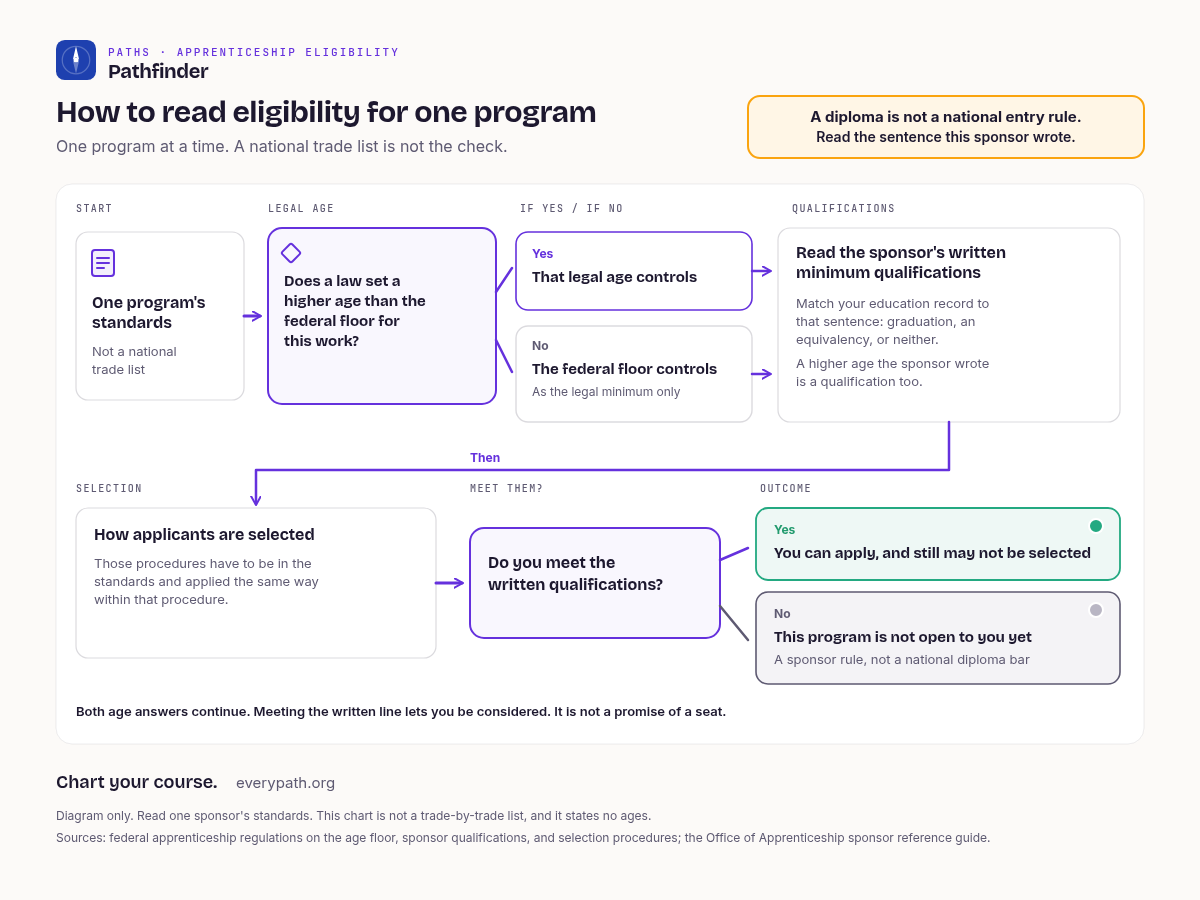
- Name the program, not the occupation. Two sponsors can train the same occupation and write different qualifications. The check is sponsor by sponsor.
- Ask the age question in two parts. Does any law set a higher age for this work? If yes, that age controls. If no, the federal floor of not less than 16 controls, and you still read whatever higher age the sponsor wrote for itself.
- Read the minimum-qualifications section. Match your education record to the sentence you see. If the sentence is silent on school, do not insert a diploma. If the sentence requires graduation or an equivalency, the form's "Not High School graduate" box will not override that sponsor.
- Ask for the selection procedure. Tests, interviews, and ranked lists belong in the standards. Ask how the procedure is applied, and ask whether every applicant under that procedure faces it. The regulation requires uniform application. It does not require the sponsor to skip the test for you.
- Separate "eligible to be considered" from "selected." Meeting the written qualifications means you can be considered under the procedure. It does not mean the sponsor has an open seat this month. How applications are filed, and how you confirm the program is registered, is covered in finding a registered program near you. This page stops at the eligibility read.
Here is a labeled example, not a national rule. Suppose one sponsor's standards require age 18, graduation or an equivalency, and a math screen in the selection procedure. An 18-year-old with a diploma still has the screen ahead. An 18-year-old with neither a diploma nor an equivalency fails that sponsor's education line, even though the federal form can record "Not High School graduate" for a different program. A second sponsor might omit the education line. Check that second set of standards instead of treating the first sentence as the rule for the occupation.
What if you clear the age floor and still miss a sponsor rule?
Then you are not eligible for that program yet. You may still be eligible for a different sponsor, or you may need time to meet the written line.
Sort the miss before you change your whole plan.
| What you missed | What it usually means | What to do next |
|---|---|---|
| Below 16 | You are under the federal floor. A program cannot set the eligible starting age lower. | Wait. Do not ask a sponsor to ignore the regulation. |
| 16 or older, but under a higher legal age for the work | A law, not the sponsor's taste, is the block. | Ask which law, and when you will cross that age. |
| Sponsor's own higher age, education line, grade, or skill | Additional minimum qualifications the sponsor was allowed to write. | Meet that line, or look at a sponsor whose standards you already meet. |
| You meet the written qualifications and still are not chosen | Selection, not eligibility. Procedures can rank or test people who already qualify. | Ask when the procedure runs again. Keep a second sponsor in view. |
If no sponsor's standards fit what you can document today, you have an eligibility gap, not a character verdict. The useful move is to name the missing item in the sponsor's own words, then decide whether to earn it or to switch sponsors. Switching is a real option because qualifications are sponsor-written. It is a bad option if the missing item is the federal age floor or a legal age for the occupation, since those travel with you.
A job that never gets registered can still be straight to work. It does not satisfy a qualifications section you have not met. Wages inside a registered program are a different question, covered in how pay works during an apprenticeship.
If you are between sponsors, still deciding can be the status you name out loud. Keep a primary and backup path: one sponsor whose standards you meet by a date you can name, and a second route if that window closes. Set that second route on the map of paths after graduation.
Leave with a yes or no for a named program: age, the education sentence that sponsor wrote, and the selection procedure in its standards. Do not leave with a national diploma rule or a trade list this page does not cover.
Is 16 the age every sponsor has to use?
No. Federal rules set an eligible starting age of not less than 16, and they also say a higher age applies where the law fixes one. A sponsor may add further minimum qualifications on top of that floor. Ask which age this occupation and this sponsor actually use.
Does the federal registration form require a diploma?
The posted apprentice agreement lists education as a choice, including Not High School graduate and High School graduate (including equivalency). That form does not make a diploma a condition of registration. A sponsor can still require graduation or an equivalency in its own standards.
Who is allowed to add grade, test, or skill rules?
The sponsor. Federal standards tell the sponsor to state the minimum qualifications for people entering the program. Selection procedures also have to sit in the written standards and be applied the same way to applicants under that procedure.
Will this page list electrician, plumber, or other trade entry rules?
No. This page will not turn one national rule into a per-trade checklist. Occupations differ, and each sponsor writes the extra qualifications. Read that sponsor's standards rather than a generic trade list.
If I meet the age floor, must a sponsor accept me?
No. Clearing the federal age floor only gets you past that one rule. You still have to meet the qualifications that sponsor wrote, and you still go through its selection procedure. Another sponsor in the same occupation may write a different set.
Sources
- 29 CFR 29.2 — Definitions — U.S. Department of Labor (Electronic Code of Federal Regulations), accessed 2026-10-02
- 29 CFR 29.5 — Standards of apprenticeship — U.S. Department of Labor (Electronic Code of Federal Regulations), accessed 2026-10-02
- 29 CFR 30.10 — Selection of apprentices — U.S. Department of Labor (Electronic Code of Federal Regulations), accessed 2026-10-02
- Requirements for Apprenticeship Sponsors Reference Guide — U.S. Department of Labor, Office of Apprenticeship, accessed 2026-10-02
- ETA Form 671, Section II — Apprentice Agreement and Registration — U.S. Department of Labor, Employment and Training Administration, accessed 2026-10-02
Chart your course
Eligibility is a gate, not the whole route. Pathfinder can hold the program you are checking next to a backup, with dates you choose, and it marks each claim as sourced, estimated, or advisory.
Frequently asked questions
Is 16 the age every sponsor has to use?
No. Federal rules set an eligible starting age of not less than 16, and they also say a higher age applies where the law fixes one. A sponsor may add further minimum qualifications on top of that floor. Ask which age this occupation and this sponsor actually use.
Does the federal registration form require a diploma?
The posted apprentice agreement lists education as a choice, including Not High School graduate and High School graduate (including equivalency). That form does not make a diploma a condition of registration. A sponsor can still require graduation or an equivalency in its own standards.
Who is allowed to add grade, test, or skill rules?
The sponsor. Federal standards tell the sponsor to state the minimum qualifications for people entering the program. Selection procedures also have to sit in the written standards and be applied the same way to applicants under that procedure.
Will this page list electrician, plumber, or other trade entry rules?
No. This page will not turn one national rule into a per-trade checklist. Occupations differ, and each sponsor writes the extra qualifications. Read that sponsor's standards rather than a generic trade list.
If I meet the age floor, must a sponsor accept me?
No. Clearing the federal age floor only gets you past that one rule. You still have to meet the qualifications that sponsor wrote, and you still go through its selection procedure. Another sponsor in the same occupation may write a different set.
Sources
- 29 CFR 29.2 — Definitions — U.S. Department of Labor (Electronic Code of Federal Regulations), accessed 2026-10-02
- 29 CFR 29.5 — Standards of apprenticeship — U.S. Department of Labor (Electronic Code of Federal Regulations), accessed 2026-10-02
- 29 CFR 30.10 — Selection of apprentices — U.S. Department of Labor (Electronic Code of Federal Regulations), accessed 2026-10-02
- Requirements for Apprenticeship Sponsors Reference Guide — U.S. Department of Labor, Office of Apprenticeship, accessed 2026-10-02
- ETA Form 671, Section II — Apprentice Agreement and Registration — U.S. Department of Labor, Employment and Training Administration, accessed 2026-10-02
Chart your course
Pathfinder builds you a plan for whichever path you pick — or for “still deciding” — and labels every claim in it as grounded, modelled or advisory. It will not invent a deadline, a cost, or your chances of getting in.
Start free No credit card required.
Related reading
- How to find a registered apprenticeship after high school
Search apprenticeship.gov's Job Finder and Partner Finder, check your state's agency, confirm a program is registered, and know what applying involves.
- What is a registered apprenticeship? Sourced definition
DOL-registered apprenticeships: paid work + training, with standards. How they differ from informal “apprentice” jobs.
- What is a youth apprenticeship, and can you start at 16?
A youth apprenticeship lets a high school student start a registered apprenticeship at 16, with school, an employer, and a parent signing on.