Paths after high school
Certifications vs a degree after high school?
By Pathfinder Editorial · Published · 12 min read
About: Pathway Certifications University Grounded

After high school, industry certifications and a college degree prove different things. BLS classifies degrees (and school-issued certificates) as typical entry-level education for occupations, while certifications are competency credentials from nongovernmental bodies — separate from state licenses. Choose by issuer and what the job typically needs, not by invented pass rates or “best cert” lists.
This is the certifications spoke inside Pathfinder’s map of every path after high school. If employment itself is your primary next step, start with straight to work after high school. For how trade or vocational school differs from a degree path, use trade school vs. college — this page will not reprint those cost tables.
These are U.S. federal definitions and occupation classifications. Pathfinder ships country packs for the US, the UK, the UAE, India and Singapore, so the planning questions travel — the BLS credential model does not automatically.
What does an industry certification prove after high school?
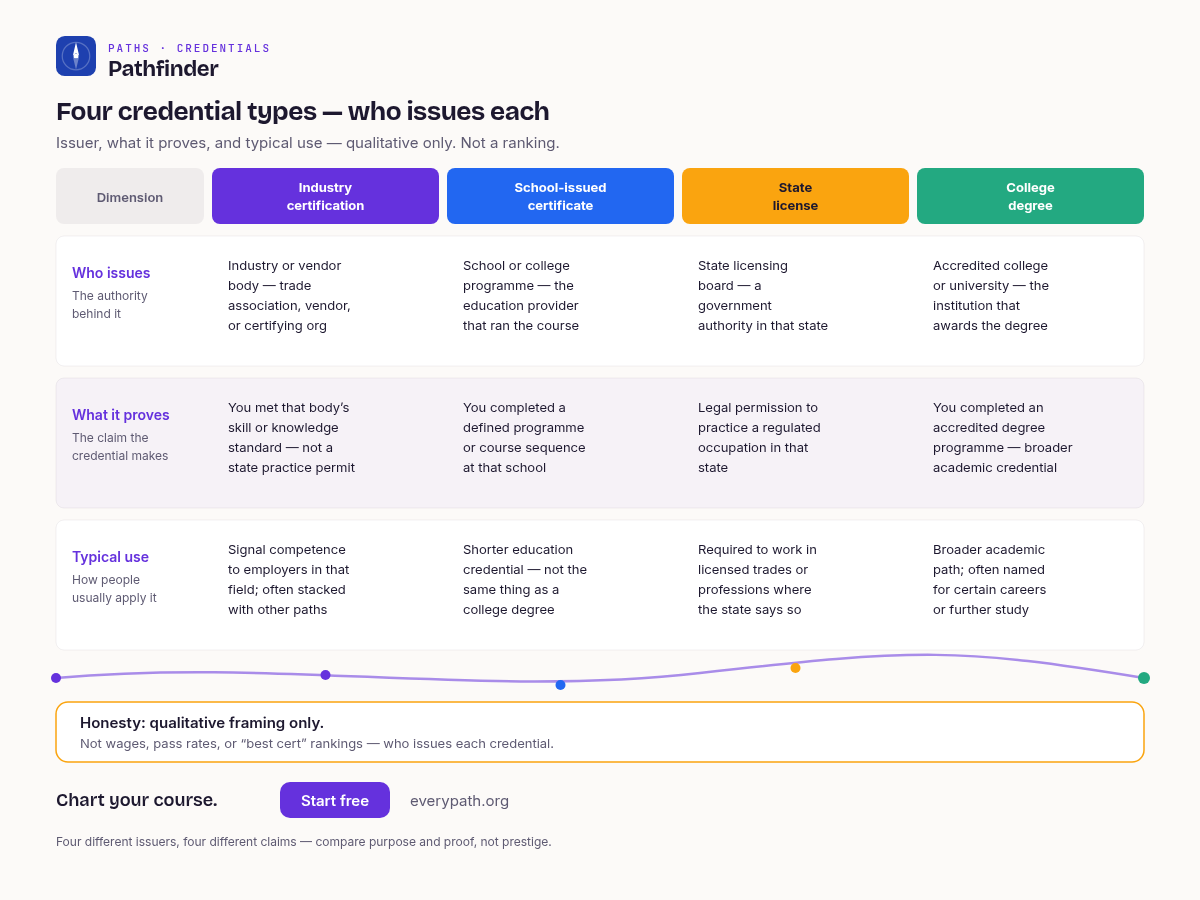
In Pathfinder’s taxonomy, certifications are a named pathway option after high school — not a consolation prize for skipping university, and not a synonym for “any short course.”
The Occupational Outlook Handbook glossary defines a certification as an award for demonstrating competency in a skill or a set of skills, typically through work experience, training, and the passage of an examination, or some combination of those (OOH Glossary). Some certification programs also require a certain level of education before you are even eligible to sit for the exam.
BLS’s Current Population Survey (CPS) uses the same family of ideas in survey language: certifications and licenses are credentials that demonstrate a level of skill or knowledge needed to perform a specific type of job. Certifications are issued by a non-governmental body; licenses are awarded by a government agency and convey a legal authority to work in an occupation (CPS certifications and licenses; CPS FAQs).
What a certification proves, when the language is grounded: that a named issuer accepted your demonstration of competency under its rules. What it does not prove on this page: that every employer in your zip code requires it, that you will pass on the first try, or that it is “better than” a degree in the abstract.
What does a college degree prove for entering an occupation?
A college degree is an educational credential awarded by a college or university after you complete a program of study. In the OOH glossary, a bachelor’s degree is typically awarded for at least four years of full-time academic study beyond high school; an associate’s degree typically for at least two years but not more than four (OOH Glossary).
BLS’s Employment Projections system assigns each detailed occupation a typical education needed for entry — “the typical education level most workers need to enter an occupation” (Measures of Education and Training). Bachelor’s degree is one of those eight entry categories. So is associate’s degree. So are postsecondary nondegree award, high school diploma or equivalent, and several others.
Two honesty constraints matter immediately:
- Typical entry education is not your personal hiring guarantee. BLS economists assign the typical path. Multiple paths to entry are not captured by the classification system; when occupations have alternate routes, the OOH profile’s “How to Become One” narrative is where those alternatives live (Measures of Education and Training).
- Educational attainment of people already in a job can differ from the entry assignment. Workers already employed may hold more (or less) formal schooling than the typical entry category. Attainment data describe the recent workforce; they do not rewrite the entry assignment into a promise about you.
A degree proves program completion under an institution’s academic rules. It does not, by itself, prove the same thing a certification proves — and Pathfinder will not invent a prestige ranking between them.
How is a certification different from a school-issued certificate?
This is the mix-up that breaks a lot of “cert vs degree” advice.
BLS’s postsecondary nondegree award category is usually a certificate or other award that is not a degree and is issued by an educational institution after formal postsecondary schooling. Programs may last only a few weeks to about two years. Critically: certifications issued by professional organizations or certifying bodies are not included in this category (OOH Glossary).
The OOH’s “How to Become One” guidance repeats the same split in plain language: certification should not be confused with certificates from an educational institution; a certificate awarded by a postsecondary educational institution is a postsecondary nondegree award and belongs in the education discussion, not in the certifications discussion (Occupational Information Included in the OOH).
CPS FAQs make the same exclusion for survey measurement: educational certificates awarded by a community college, a four-year college or university, or a trade school based on completing a program of study are not counted as certifications or licenses in the CPS measure. Those educational certificates are also not time-limited the way CPS treats certifications and licenses (CPS FAQs).
| Credential | Who typically issues it | What it mainly proves (BLS language) |
|---|---|---|
| Industry certification | Nongovernmental professional / industry body | Demonstrated competency (often exam + experience/training) |
| School-issued certificate (postsecondary nondegree award) | Educational institution | Completion of a formal postsecondary program that is not a degree |
| Associate’s or bachelor’s degree | College or university | Completion of a degree program of study |
| Occupational license | Government agency | Legal authority to practice (rules vary by state) |
If someone says “get a cert,” ask which row they mean. The issuer changes the claim.
How is a certification different from a license?
Licenses, in OOH language, are permissions granted by government agencies (or other accrediting bodies in the glossary’s broader wording) that allow someone to work in a particular occupation or perform certain duties (OOH Glossary). States issue licenses when workers have met specific legal requirements; eligibility often includes exams plus education, experience, training, internship, residency, or apprenticeship rules that vary by state even for the same occupation (Occupational Information Included in the OOH).
Certifications, by contrast, are described in the same OOH section as typically voluntary demonstrations of competency — commonly an exam and/or specified experience or training. Some employers or jobs may still require a certification in practice; “typically voluntary” is the OOH’s general framing, not a claim that no hiring manager ever asks for one.
CPS draws the line by issuer: certification = nongovernmental body, does not convey legal authority by itself; license = governmental licensing agency, does convey legal authority (CPS FAQs). People may hold more than one credential; people with a license may also have a certification (CPS certifications and licenses).
Process tools (not Pathfinder endorsement lists): CareerOneStop Certification Finder and CareerOneStop License Finder. License requirements vary by state — look up the state board, not a national rumor.
How do certifications and degrees show up in BLS occupation data?
Degrees and school-issued certificates show up in the typical entry-level education assignment. Industry certifications and licenses show up in OOH profiles under Licenses, Certifications, and Registrations when relevant — they are not a substitute row in the eight-level education ladder.
Career Outlook’s education-level openings article (2024–34 projections) is useful for scale without turning into a “best jobs” listicle:
- BLS classifies 178 occupations as typically requiring a bachelor’s degree to enter.
- Across postsecondary education below a bachelor’s, 51 occupations typically require a postsecondary nondegree award (such as a school-issued certificate), 48 typically require an associate’s degree, and 7 typically require some college, no degree.
- Across all occupations, BLS projects about 19 million openings each year, on average, from 2024 to 2034 — mostly from replacement needs, not only from newly created jobs.
- For comparison context only, the median annual wage for all occupations was $49,500 in 2024 (Career Outlook — Education level and projected openings, 2024–34).
Those occupation counts are classifications, not your odds of getting hired. Projected openings are projections. Pathfinder will not invent a pass rate for CompTIA, a nursing board, or any vendor exam, and will not publish a “top 10 certifications after high school” ranking without a primary that actually supports that framing.
You can browse occupations by typical entry education in the OOH Occupation Finder. That is a research process — not a placement promise.
How do you choose without invented pass rates?
Name a primary credential route and an explicit backup — the same primary and backup path rule Pathfinder uses across the map.
A practical sequence that stays honest:
- Name the occupation family you are aiming at (or the kind of work), in one sentence. If you cannot name it yet, you may still be in still deciding — that is a path, not a failure.
- Read the OOH “How to Become One” section for that occupation (or a close match). Note the typical entry-level education and whether licenses or certifications are discussed.
- Separate the four issuers before you spend money: school/university (degree or school certificate), certifying body (industry certification), state board (license), employer (job-specific training).
- Check state rules when the occupation is licensed where you live — License Finder and the state board beat social media.
- Write the backup out loud. Example shapes (illustrative, not odds): primary bachelor’s path with a backup school certificate in a related field; primary industry certification with a backup associate’s program; primary straight-to-work job with a certification prep plan on evenings — whatever matches your occupation research, not a national tip list.
What “choose” does not mean here: picking the credential with the loudest marketing, inventing a national ROI, or treating a friend’s anecdote as a grounded claim about your county.
How do certifications relate to trade school, apprenticeships, and straight to work?
Keep the neighbors in their lanes:
- Trade school vs. college owns the trade/vocational vs degree comparison. A trade-school program may award a school-issued certificate (postsecondary nondegree award) — that is still not automatically an industry certification.
- What is a registered apprenticeship owns the DOL/SAA registration definition. A registered apprenticeship can include related instruction and ends with a portable completion credential under registration standards — do not collapse that into “a cert.”
- Apprenticeship vs. college owns sourced pay and cost side-by-sides. This page will not reprint those tables.
- Straight to work after high school owns employment as primary. Some straight-to-work routes later add a certification; some never do. Training on the job does not automatically equal either a RAP or an industry certification.
Certifications sit on the hub map as their own route for a reason: they are issuer-backed competency credentials, not a nickname for “anything that isn’t a bachelor’s.”
What this page will not tell you
- Invented exam pass rates, “easiest certs,” or vendor ranking lists
- Invented wages, ROI percentages, or “cert holders earn X% more than degree holders” horse races
- Which single credential is “best” after high school in the abstract
- Your personal odds of being hired in your county
- Full tuition vs earnings tables (see trade-school and apprenticeship siblings)
- A reprint of registered-apprenticeship regulation deep-dives
- Subject 2 invent: FAFSA walkthroughs, parents pillars, counselor-ratio takes, or AI-career-advice spin-offs
If a claim needs a primary URL and we did not open one on write day, it stays off the page.
What is the difference between a certification and a college degree?
A college degree is an educational credential awarded by a college or university after a program of study. An industry certification is a competency credential usually issued by a nongovernmental professional or industry body, often after an exam and sometimes after experience or training. They prove different things.
Is a school certificate the same as a certification?
No. BLS treats a postsecondary nondegree award (a certificate from an educational institution) as an education category for entry into some occupations. Industry certifications from professional organizations are a separate kind of credential and are not counted in that education category.
How is a certification different from a license?
In BLS Current Population Survey language, certifications are issued by nongovernmental bodies and do not by themselves convey legal authority to work. Licenses are issued by a government agency and convey legal authority to practice. Some people hold both.
Which is better after high school — a certification or a degree?
Pathfinder will not invent a single winner. BLS assigns typical entry-level education by occupation — for example, 178 occupations typically need a bachelor’s degree to enter, and 51 typically need a postsecondary nondegree award. Match the credential to the occupation and name a backup.
Where should I look up certifications or licenses?
CareerOneStop’s Certification Finder and License Finder are process tools for browsing issuers and state requirements. They are not Pathfinder endorsement lists, and they do not invent your pass rate or hiring odds.
Sources
- OOH Glossary — U.S. Bureau of Labor Statistics, accessed 2026-09-22
- Occupational Information Included in the OOH — U.S. Bureau of Labor Statistics, accessed 2026-09-22
- Measures of Education and Training — U.S. Bureau of Labor Statistics, accessed 2026-09-22
- Education level and projected openings, 2024–34 — U.S. Bureau of Labor Statistics (2025), accessed 2026-09-22
- Data on certifications and licenses (CPS) — U.S. Bureau of Labor Statistics, accessed 2026-09-22
- FAQs about data on certifications and licenses (CPS) — U.S. Bureau of Labor Statistics, accessed 2026-09-22
- Certification Finder — CareerOneStop (U.S. Department of Labor), accessed 2026-09-22
- License Finder — CareerOneStop (U.S. Department of Labor), accessed 2026-09-22
- Occupation Finder — U.S. Bureau of Labor Statistics, accessed 2026-09-22
Chart your course
Pathfinder builds you a plan for whichever path you pick — certifications, university, straight to work, trade, apprenticeship, or “still deciding” — and labels every claim as grounded, modelled or advisory. It will not invent a deadline, a wage, a pass rate, or your chances of getting hired.
Start free — no credit card required. See pricing if you want the paid tiers later.
Frequently asked questions
What is the difference between a certification and a college degree?
A college degree is an educational credential awarded by a college or university after a program of study. An industry certification is a competency credential usually issued by a nongovernmental professional or industry body, often after an exam and sometimes after experience or training. They prove different things.
Is a school certificate the same as a certification?
No. BLS treats a postsecondary nondegree award (a certificate from an educational institution) as an education category for entry into some occupations. Industry certifications from professional organizations are a separate kind of credential and are not counted in that education category.
How is a certification different from a license?
In BLS Current Population Survey language, certifications are issued by nongovernmental bodies and do not by themselves convey legal authority to work. Licenses are issued by a government agency and convey legal authority to practice. Some people hold both.
Which is better after high school — a certification or a degree?
Pathfinder will not invent a single winner. BLS assigns typical entry-level education by occupation — for example, 178 occupations typically need a bachelor’s degree to enter, and 51 typically need a postsecondary nondegree award. Match the credential to the occupation and name a backup.
Where should I look up certifications or licenses?
CareerOneStop’s Certification Finder and License Finder are process tools for browsing issuers and state requirements. They are not Pathfinder endorsement lists, and they do not invent your pass rate or hiring odds.
Sources
- Occupational Outlook Handbook — Glossary — U.S. Bureau of Labor Statistics, accessed 2026-09-22
- Occupational Information Included in the OOH — U.S. Bureau of Labor Statistics, accessed 2026-09-22
- Measures of Education and Training — U.S. Bureau of Labor Statistics, accessed 2026-09-22
- Education level and projected openings, 2024–34 — U.S. Bureau of Labor Statistics (2025), accessed 2026-09-22
- Data on certifications and licenses (CPS) — U.S. Bureau of Labor Statistics, accessed 2026-09-22
- FAQs about data on certifications and licenses (CPS) — U.S. Bureau of Labor Statistics, accessed 2026-09-22
- Certification Finder — CareerOneStop (U.S. Department of Labor), accessed 2026-09-22
- License Finder — CareerOneStop (U.S. Department of Labor), accessed 2026-09-22
- Occupation Finder — U.S. Bureau of Labor Statistics, accessed 2026-09-22
Chart your course
Pathfinder builds you a plan for whichever path you pick — or for “still deciding” — and labels every claim in it as grounded, modelled or advisory. It will not invent a deadline, a cost, or your chances of getting in.
Start free No credit card required.
Related reading
- Community college vs university after high school?
Community college then transfer vs starting at a university: what each path is for, with sourced US figures where available — no invented transfer odds.
- Military vs college after high school? Sourced
Enlisting after high school vs starting college: what each path is for, with VA/DoD/BLS primaries only — no invented odds or prestige rankings.
- Can you go to college later? How re-entry works
Yes. Skipping or delaying college doesn't close the door. How applying later works, first-year vs transfer status, credit for what you did, and what to keep.