Paths after high school
Can you go to college later? How re-entry works
By Pathfinder Editorial · Published · 13 min read

Yes. Skipping or delaying college doesn't lock you out. In the University of California system, for example, you apply as a first-year if you haven't enrolled in a regular college term since high school, and as a transfer once you have. Military training, work credentials and exams like CLEP may earn credit, depending on the college.
If you're still asking whether skipping college is a reasonable choice at all, read why skipping college can be a sound decision first. This guide assumes you've made that call, or might, and want to know how coming back works. The full list of routes after high school shows where college sits among the others.
The rules quoted here are American, mostly from California's public systems and national testing and credit programs. Other states and countries write their own, so use this as a checklist rather than a rulebook.
Does skipping college now close the door later?
Not in the systems we checked. For community college, California law says a district "shall admit to the community college any California resident, and may admit any nonresident, possessing a high school diploma or the equivalent thereof." It adds that districts may admit "any other person who is over 18 years of age" who can benefit from instruction (Cal. Educ. Code §76000). Nothing in that section sets an expiry date on your diploma.
Many four-year university programs are selective, so "open" means something different there: you can apply, not that you'll be admitted. But the application itself doesn't care when you graduated. What changes over time is which kind of applicant you are, what credit you can bring, and which records you need to dig up.
Will you apply as a first-year or a transfer student?
This is the part most people get wrong, and it's set by each college. The University of California is one clear, public example, not a national rule.
UC says: "You're a first-year (or freshman) applicant if you're currently in high school, OR you've graduated from high school, but haven't yet enrolled in a regular session (fall, winter, spring) at a college or university." Summer classes don't count against you: "If you've completed college courses during high school, through the summer after graduation, you're still considered a first-year applicant" (UC first-year requirements).
Once you enroll in a regular term, the label flips. "You can apply to UC as a transfer if you've enrolled and earned credit during a regular session (fall, winter or spring) at a college or university after high school graduation" (UC transfer requirements).
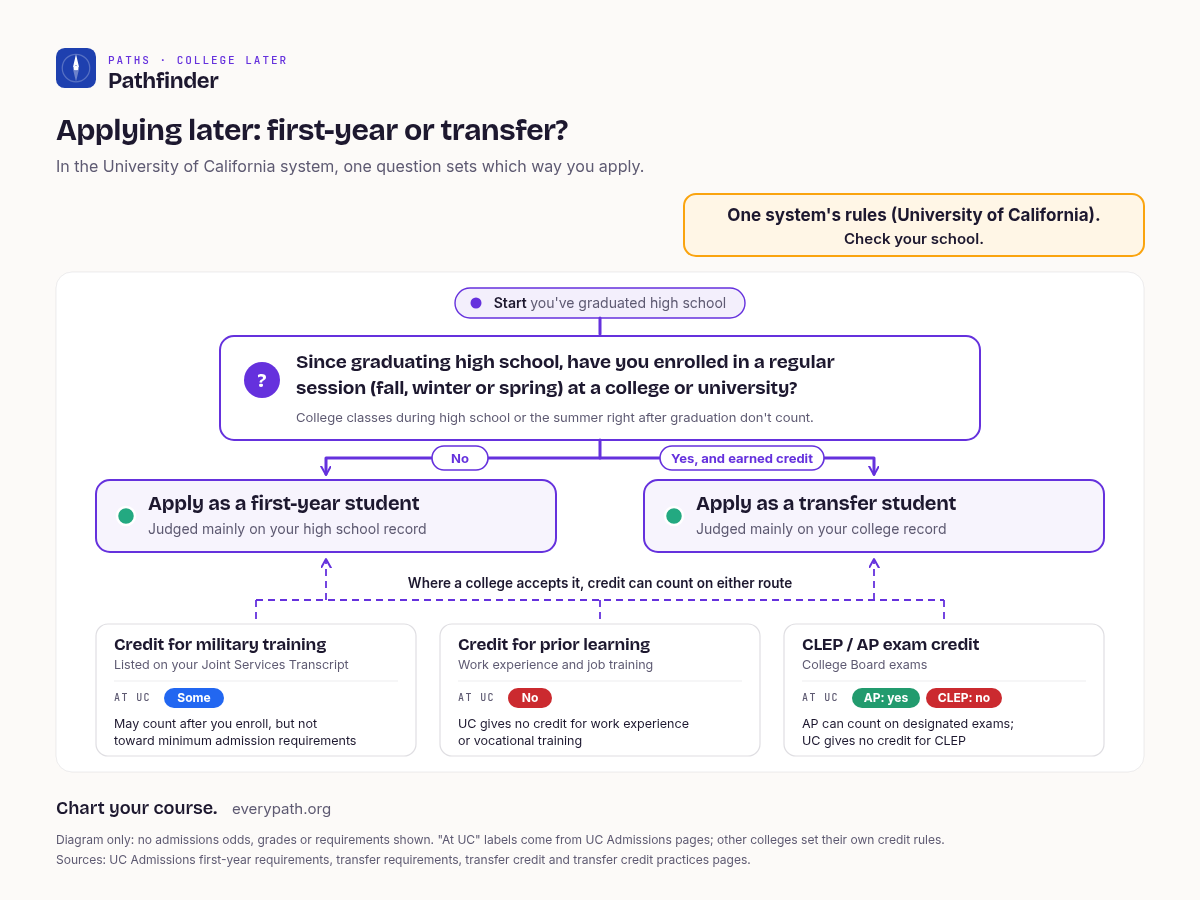
Why it matters: the two routes judge you on different records.
| First-year applicant (UC) | Junior-level transfer applicant (UC) | |
|---|---|---|
| Who | Graduated, no regular-session college enrollment yet | Enrolled and earned credit in a regular college term after graduating |
| Main record | High school courses and grades | College coursework |
| Headline minimums | 15 A-G courses with a GPA of "3.0 or better (3.4 if you're a nonresident)" | "at least 60 semester (90 quarter) units of UC-transferable credit" and "at least a 2.4 GPA in UC-transferable courses (2.8 if you're a nonresident)" |
| Also required | Course and grade rules in the A-G pattern | A 7-course pattern (English, math, and four courses across two subject areas), plus major preparation |
Source: UC first-year requirements, UC basic transfer requirements.
The practical upshot: if your high school record is strong, taking one fall class "just to stay busy" could move you onto the transfer track, which is built around a larger block of college credit. If your high school grades were weak, a stretch of solid college work can give you a fresh record to be judged on. Neither is wrong. Know which one you're choosing before you register.
Where do community college and deferral fit?
Two related routes, covered elsewhere. Community college is the open-admission on-ramp described above, and community college vs. university weighs that route against starting at a four-year school. And if you've already been admitted somewhere, asking to defer is a different move from reapplying later; whether a gap year is a good idea explains how deferral policies work before you take a gap year.
Can what you did in the gap count as college credit?
Sometimes. The umbrella term is credit for prior learning. California's community college system defines it as "credit awarded when a student demonstrates sufficient mastery of the outcomes of a catalog course through an approved faculty assessment of prior learning." It lists four ways colleges assess it: credit by examination or portfolio review, "Joint Service Transcripts (JST) evaluation" for military training, industry certification evaluation, and standardized exams (CCC Chancellor's Office).
The same page is frank about limits: offers "are subject to review and may be affected by many variables such as: Academic standing, residency requirements, educational goals, transfer plans, financial aid, veteran benefit eligibility, and college requirements."
Military service. The American Council on Education (ACE) reviews military courses and occupations and publishes college credit recommendations in its Military Guide (ACE Military Guide). Your record of those recommendations is the Joint Services Transcript, which serves Army, Marine Corps, Navy, Air Force, Space Force and Coast Guard members, active, reserve and veteran. Air Force and Space Force members who took only their own service's courses are pointed to the Community College of the Air Force instead (JST). Whether to serve at all is a separate decision; the military route is laid out on the hub.
Work and training. ACE says learners may receive credit recommendations for "Military service", "Workplace training" and other learning outside a classroom, and that "Many colleges award academic credit for knowledge gained outside of traditional college classes" (ACE). Some registered apprenticeships carry college credit too, and whether a registered apprenticeship counts as college credit is decided by the college, not by the completion certificate.
The key caveat, in ACE's words: "Each college or university has established transfer credit policies," and "Learners are responsible for understanding the college or university transfer policy about CPL." A recommendation is not a guarantee.
UC, the example system on this page, shows how far policies can differ: it "does not award credit for: work or volunteer experience, vocational or technical training," lists "No credit for CLEP or DANTES exams," and says "credit for military courses is determined after matriculation at UC" (UC transfer credit practices).
Can exams like CLEP and AP earn credit?
Yes, if the college accepts them. The College-Level Examination Program (CLEP) "offers 34 exams that cover introductory level college course material," and College Board says it is "accepted at over 3,000 colleges." Exams cost "$97 plus your test center's administration fee" (CLEP). For service members, CLEP says "the U.S. government fully funds CLEP exams and administration fees" through DANTES (CLEP Military Benefits).
Read the fine print for timing. "Some colleges won't grant credit for a CLEP exam if you've already attempted a college-level course closely aligned with that exam" (CLEP policies). If you plan to test out of a subject, do it before you take the class.
AP scores you earned in high school can still count later. UC, for example, lets transfer applicants use "AP exam scores of 3, 4, or 5" in appropriate subject areas (UC basic transfer requirements).
What about paying for college later?
Two facts, then this guide stops, because aid rules deserve their own page. Some employers help: the IRS says an employer "can exclude up to $5,250 of educational assistance you provide to an employee under an educational assistance program from the employee's wages each year" (IRS Publication 15-B). And age affects federal aid forms: on the 2027–28 FAFSA, being "born after the year 2003" is one condition of dependent status, and if any condition isn't true, "the student is considered to be independent, and parent information should not be provided" (FAFSA form).
How do you keep your options open during the gap?
Gather your paperwork while it's easy to find. At 18, your records become yours to request: federal privacy law says "When a student turns 18 years old, or enters a postsecondary institution at any age, the rights under FERPA transfer from the parents to the student" (FERPA FAQ).
What College Board says happens to old scores, grounded in its own help pages:
| Record | What happens over time |
|---|---|
| SAT | "Once you've left high school and haven't tested for a year, College Board archives your SAT test scores." You can request them, but "Scores older than 2005 are no longer accessible," and scores sent "five or more years after a test date may be less valid predictors" (SAT archived scores) |
| AP | If your last AP Exam was before 2018, scores "have been archived and can only be sent to a college, university or scholarship program through a request made via mail or fax" (AP archived scores) |
| CLEP | Scores from exams taken on or after July 1, 2022, "are available for 10 years from the test date" (CLEP scores) |
A short keep-list for the gap:
- An official or unofficial copy of your high school transcript, and a note of how your school handles requests.
- Your College Board account login and any SAT, AP or CLEP score reports.
- Certificates, licenses and training records from jobs, with dates and hours.
- Your Joint Services Transcript, if you serve.
- Course syllabi from any class you take, since colleges may ask for them when judging credit.
None of this commits you to anything. It keeps a primary and backup path cheap to switch between.
What should you ask an admissions office?
Call or email the colleges you might apply to, and get answers in writing where possible.
| Question | Why it matters |
|---|---|
| If I take classes this fall, do I become a transfer applicant? | The UC example shows a single term can change your track. |
| How many transferable units do you require, and which courses? | Transfer minimums and required patterns differ by college. |
| Do you accept ACE credit recommendations or my Joint Services Transcript? | Recommendations aren't binding. |
| Do you award credit for prior learning, and what evidence do you need? | Portfolios, certifications and exams each need different proof. |
| What's your CLEP and AP policy, including score minimums? | Policies vary, and some block credit after a related course. |
| How old can my test scores be? | College Board itself flags SAT scores five or more years old as weaker predictors. |
| Is there anything different about applying a year or more after high school? | Forms, deadlines and required records may differ, and asking avoids a wrong application. |
If you're thinking about college mainly as a future option while working, that's a straight to work plan with a door left open, which is a perfectly good plan.
Is there an age limit for going to college?
Not in the rules checked here. California law tells community colleges to admit any state resident with a high school diploma or equivalent, with no age cap, and UC's first-year definition covers graduates who haven't enrolled yet. Individual programs can have their own entry rules, so check the one you want.
If I take a community college class during my gap year, am I still a first-year applicant?
It depends on the college and the term. At UC, summer classes right after graduation don't change your status, but enrolling and earning credit in a fall, winter or spring term makes you a transfer applicant. Ask each college before you register.
Will colleges accept SAT or AP scores from years ago?
Often you can still send them. College Board archives SAT scores once you've left high school and haven't tested for a year, and sends archived scores on request; scores older than 2005 are no longer accessible. AP scores from before 2018 are sent by mail or fax request.
Does military training count as college credit?
It can. The American Council on Education reviews military courses and occupations and publishes credit recommendations, and your Joint Services Transcript lists them. Each college decides how much of that credit it accepts and where it applies.
Can work experience or certifications count toward a degree?
At some colleges, yes, through credit for prior learning. California's community colleges list portfolio review, credit by exam, industry certification review and standardized exams as ways to assess it. The college's faculty decide, so ask what documentation they need.
Sources
- First-year requirements — University of California, accessed 2026-09-26
- Transfer requirements — University of California, accessed 2026-09-26
- Basic requirements (transfer) — University of California, accessed 2026-09-26
- Transfer credit practices — University of California, accessed 2026-09-26
- California Education Code §76000 — California Legislature, accessed 2026-09-26
- Credit for Prior Learning — California Community Colleges Chancellor's Office, accessed 2026-09-26
- College Credit for Students and Learners — American Council on Education, accessed 2026-09-26
- The Military Guide — American Council on Education, accessed 2026-09-26
- Joint Services Transcript — U.S. Department of Defense, accessed 2026-09-26
- CLEP Benefits for Everyone — College Board, accessed 2026-09-26
- Understanding Colleges' CLEP Policies — College Board, accessed 2026-09-26
- CLEP Military Benefits — College Board, accessed 2026-09-26
- CLEP Scores — College Board, accessed 2026-09-26
- Sending Archived SAT Scores — College Board, accessed 2026-09-26
- AP Scores: Archived Scores — College Board, accessed 2026-09-26
- Publication 15-B (2026), Employer's Tax Guide to Fringe Benefits — Internal Revenue Service, accessed 2026-09-26
- 2027–28 FAFSA Form — U.S. Department of Education, Federal Student Aid, accessed 2026-09-26
- What is FERPA? — U.S. Department of Education, Student Privacy Policy Office, accessed 2026-09-26
Chart your course
College now, college later, or college as one option among several: Pathfinder keeps it on the same map as every other route, including still deciding. Each claim is tagged as sourced, estimated or advisory, and it won't tell you a door has shut when it hasn't.
Start free — no credit card required.
Frequently asked questions
Is there an age limit for going to college?
Not in the rules checked here. California law tells community colleges to admit any state resident with a high school diploma or equivalent, with no age cap, and UC's first-year definition covers graduates who haven't enrolled yet. Individual programs can have their own entry rules, so check the one you want.
If I take a community college class during my gap year, am I still a first-year applicant?
It depends on the college and the term. At UC, summer classes right after graduation don't change your status, but enrolling and earning credit in a fall, winter or spring term makes you a transfer applicant. Ask each college before you register.
Will colleges accept SAT or AP scores from years ago?
Often you can still send them. College Board archives SAT scores once you've left high school and haven't tested for a year, and sends archived scores on request; scores older than 2005 are no longer accessible. AP scores from before 2018 are sent by mail or fax request.
Does military training count as college credit?
It can. The American Council on Education reviews military courses and occupations and publishes credit recommendations, and your Joint Services Transcript lists them. Each college decides how much of that credit it accepts and where it applies.
Can work experience or certifications count toward a degree?
At some colleges, yes, through credit for prior learning. California's community colleges list portfolio review, credit by exam, industry certification review and standardized exams as ways to assess it. The college's faculty decide, so ask what documentation they need.
Sources
- First-year requirements — University of California, accessed 2026-09-26
- Transfer requirements — University of California, accessed 2026-09-26
- Basic requirements (transfer) — University of California, accessed 2026-09-26
- Transfer credit practices — University of California, accessed 2026-09-26
- California Education Code §76000 — California Legislature, accessed 2026-09-26
- Credit for Prior Learning — California Community Colleges Chancellor's Office, accessed 2026-09-26
- College Credit for Students and Learners — American Council on Education, accessed 2026-09-26
- The Military Guide — American Council on Education, accessed 2026-09-26
- Joint Services Transcript — U.S. Department of Defense, accessed 2026-09-26
- CLEP Benefits for Everyone — College Board, accessed 2026-09-26
- Understanding Colleges' CLEP Policies — College Board, accessed 2026-09-26
- CLEP Military Benefits — College Board, accessed 2026-09-26
- CLEP Scores — College Board, accessed 2026-09-26
- Sending Archived SAT Scores — College Board, accessed 2026-09-26
- AP Scores: Archived Scores — College Board, accessed 2026-09-26
- Publication 15-B (2026), Employer's Tax Guide to Fringe Benefits — Internal Revenue Service (2026), accessed 2026-09-26
- 2027–28 FAFSA Form — U.S. Department of Education, Federal Student Aid, accessed 2026-09-26
- What is FERPA? — U.S. Department of Education, Student Privacy Policy Office, accessed 2026-09-26
Chart your course
Pathfinder builds you a plan for whichever path you pick — or for “still deciding” — and labels every claim in it as grounded, modelled or advisory. It will not invent a deadline, a cost, or your chances of getting in.
Start free No credit card required.
Related reading
- Community college vs university after high school?
Community college then transfer vs starting at a university: what each path is for, with sourced US figures where available — no invented transfer odds.
- Military vs college after high school? Sourced
Enlisting after high school vs starting college: what each path is for, with VA/DoD/BLS primaries only — no invented odds or prestige rankings.
- Certifications vs a degree after high school?
Industry certifications vs a college degree after high school: what each proves, who issues them, and how to choose without invented odds.