Paths after high school
Military vs college after high school? Sourced
By Pathfinder Editorial · Published · 13 min read
About: Pathway Military University Grounded

Enlisting after high school and starting college are different pathways — not a prestige contest. VA Post-9/11 GI Bill eligibility and benefit tiers depend on qualifying active-duty service; BLS frames enlisted entry with ASVAB aptitudes and officers typically needing a bachelor’s. Choose by service commitment and credential need, and name a backup — not by invented bonuses or “best branch.”
Enlisting and enrolling sit side by side on Pathfinder’s map of every path after high school; this guide puts military service next to a university start. Still weighing everything? Still deciding after high school is the better first stop. If civilian employment itself is your primary next step, use straight to work after high school — this page will not reprint that labor-force snapshot.
Everything below is U.S.-specific: VA benefit rules, DoD enlistment testing, and BLS military-career data. Pathfinder also has country packs for the UK, the UAE, India and Singapore; the questions about commitment and credentials carry over, but the GI Bill and the ASVAB do not.
What does enlisting after high school commit you to?
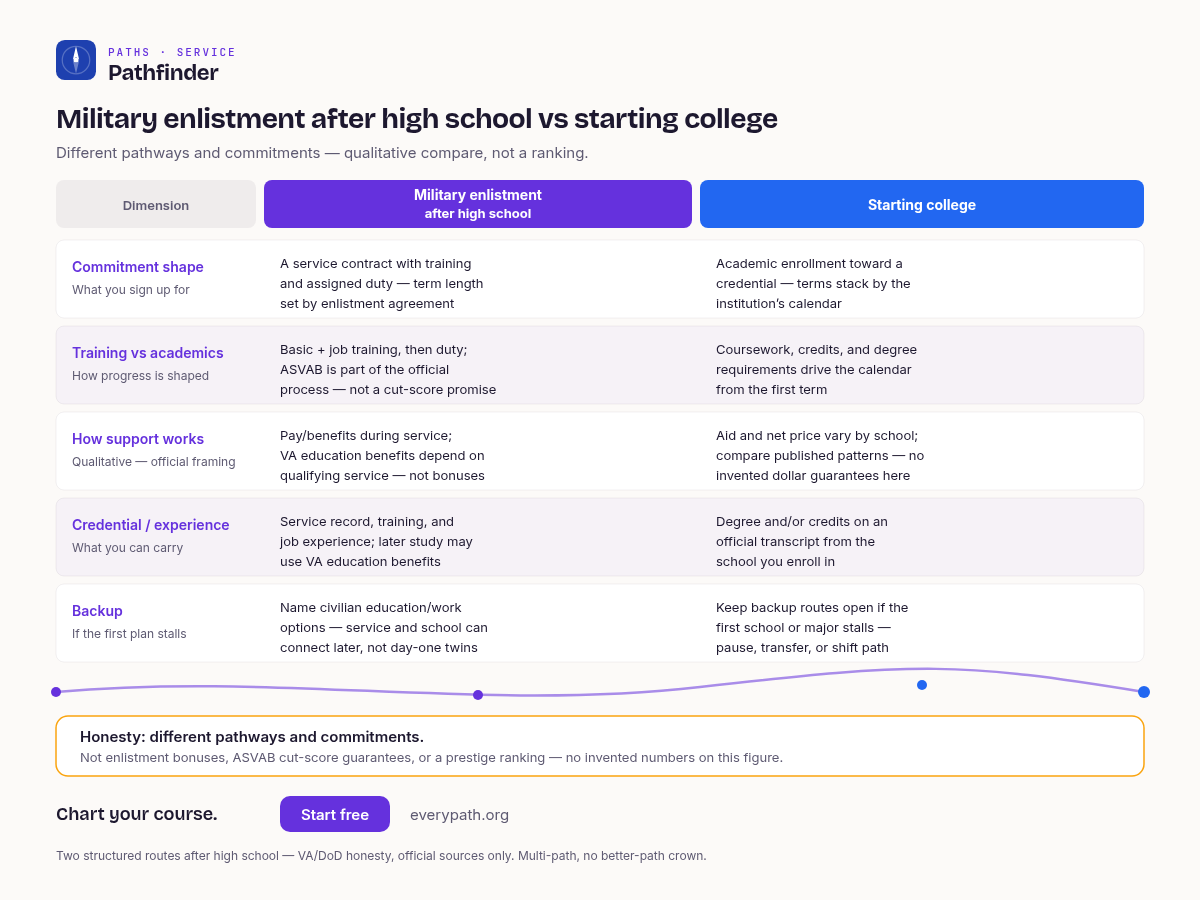
Pathfinder treats military service as a pathway in its own right — not a fallback for people who skip university, and not a synonym for “a free degree later.”
The Occupational Outlook Handbook’s Military Careers profile describes U.S. service members across the Army, Navy, Air Force, Space Force, Marine Corps, Coast Guard, and related Reserve and National Guard components. The military distinguishes enlisted careers (most of the force; carry out and support operations) from officer careers (lead and manage operations and personnel) (Military Careers).
Reasons enlisting can make sense, stated in grounded terms:
- A structured service commitment with training, duty, and specialty work — not a casual gap year with a uniform.
- An entry path that typically starts from a high school diploma (or equivalent) plus aptitude, medical, and character screens — details vary by branch (Military Careers).
- A possible later bridge to education benefits for people who meet VA rules after qualifying service — possible, not an automatic tuition blank check on signing day.
None of that means every recruiter promise is a federal guarantee, that your ASVAB score locks a dream job, that combat risk is zero, or that enlistment is “better than college” in the abstract.
What does starting college right after high school involve?
For most people, starting college means making a program of study — often a bachelor’s — the main plan for the next few years. BLS’s OOH glossary describes a bachelor’s degree as usually awarded for at least four years of full-time academic study beyond high school (OOH Glossary).
It suits students who want the next few years organized around coursework, program rules, and a real financing plan — grants, savings, work, loans, or family support (who qualifies for a scholarship). On Pathfinder’s map it is one equally valid route, not the yardstick for scoring enlistment.
Two distinctions matter when you set college beside the military:
- Enrolling is not the same as finishing. No national average predicts whether you, in your major, will graduate on schedule — and this page does not offer one.
- Officer commissioning is not “just going to college.” BLS notes officer candidates typically need at least a bachelor’s, U.S. citizenship, and other screens — via service academies, ROTC, or OCS/OTS-style programs (Military Careers). Civilian student and officer-pipeline overlap in classrooms; they are not identical commitments.
How does the enlistment process actually work (recruiter, ASVAB, MEPS)?
Process language beats folklore.
Official ASVAB materials say: contact a recruiter; when otherwise qualified, they schedule the ASVAB at a Military Entrance Processing Station (MEPS) or affiliated Military Entrance Test (MET) site. Official ASVAB points applicants to Today's Military request information (Where to Take the ASVAB).
The Fact Sheet is blunt: ASVAB scores determine whether you are qualified to enlist and help assign you to a job (ASVAB Fact Sheet). Most testing is at MEPS (computer); many MET sites use paper-and-pencil.
BLS’s Military Careers “How to Become One” section lists common qualifications across branches (exact rules still vary): minimum age 17 (consent if 17), U.S. citizenship or permanent resident status, high school diploma or equivalent, no felony conviction, and medical plus other physical/character standards. Enlistees take the ASVAB; officer candidates typically do not. Initial-entry training lasts about 7 to 13 weeks, then technical training. Most active-duty first terms are 4 years (some 2, 3, or 6); delayed entry can postpone shipping up to a year in many cases (Military Careers).
| Step (typical enlisted path) | What official sources say it is for | What it is not on this page |
|---|---|---|
| Talk with a recruiter | Eligibility screening + scheduling tests | A binding job offer by itself |
| Take the ASVAB (MEPS/MET) | Enlistment qualification + job-assignment input | A guaranteed MOS/AFSC at a viral cut score |
| MEPS medical / other screens | Fitness for service under service standards | Proof you will love the lifestyle |
| Enlistment contract + oath | A real service commitment with options in the contract | “Free college” on day one |
Pathfinder will not invent branch-by-branch ASVAB cut scores, signing bonuses, or “guaranteed job” language — those belong to current official recruiting materials, not a blog table. For how evidence differs by route in general, see what counts as evidence (ASVAB is not a personality verdict).
How can military service relate to later education benefits (Post-9/11 GI Bill)?
If your interest in military service is partly about school later, read VA primary pages, not social-media summaries.
The Post-9/11 GI Bill (Chapter 33) helps eligible Veterans, service members, and some dependents pay for school or job training. VA says you may be eligible if at least one of these is true (Post-9/11 GI Bill):
- You served at least 90 days on active duty (continuous or with breaks) on or after September 11, 2001, or
- You received a Purple Heart on or after September 11, 2001, and were honorably discharged after any amount of service, or
- You served at least 30 continuous days on or after September 11, 2001, and were honorably discharged with a service-connected disability, or
- You are a dependent child using benefits transferred by a qualifying Veteran or service member
VA also lists non-qualifying periods that do not count toward Post-9/11 eligibility — including some civilian-school assignments, service-academy cadet/midshipman time, certain Guard/Reserve training call-ups, and periods that already counted toward specified DoD programs (Loan Repayment, ROTC Scholarship, Service Academy Graduation) (Post-9/11 GI Bill). VA decides from your service record — do not guess whether your orders qualify.
Benefit categories include tuition and fees, housing money if you are in school more than half time, books and supplies, and several training/test-related payments. Amounts depend on the school, qualifying active-duty service since September 10, 2001, and your rate of pursuit (Post-9/11 GI Bill).
Percentage of the full benefit (eligibility tier). VA bases your award on length of active-duty service and certain other factors (How we determine your percentage):
- 100% if you served at least 1,095 days (36 months) total, or you received a Purple Heart on or after September 11, 2001, or you served at least 30 continuous days and were discharged for a service-connected disability
- 90% for 910–1,094 days (30–35 months)
- 80% for 730–909 days (24–29 months)
- 70% for 545–729 days (18–23 months)
- 60% for 180–544 days (6–17 months)
- 50% for 90–179 days (90 days–5 months)
Those tiers are VA’s published structure — not Pathfinder’s guess about your DD-214.
Rates (maxima, not your personal bill). For August 1, 2026–July 31, 2027, at the full (100%) benefit, VA pays net in-state tuition and mandatory fees at public schools; caps private/foreign (and several non-college-degree) programs at up to $30,908.34; pays up to $1,000/year for books and supplies; and bases monthly housing allowance on DoD BAH for an E-5 with dependents at the school’s ZIP — with online-only, foreign-school, active-duty, and half-time exclusions (Post-9/11 GI Bill rates). If your tier is below 100%, multiply published full rates by your percentage. Yellow Ribbon may help at some schools above the private/out-of-state cap — only where the school participates.
Expiration and entitlement. If service ended before January 1, 2013, Post-9/11 benefits generally expire 15 years after last separation; if service ended on or after that date, VA says benefits do not expire under the Forever GI Bill (Post-9/11 GI Bill). Common single-benefit cases often top out around 36 months of entitlement — confirm with VA’s Statement of Benefits, not a blog ceiling (Eligibility).
Honest one-liner: military service can fund later education for people who qualify under VA rules. That is not the same sentence as “enlist and college is free.”
How do enlisted and officer paths differ on education (BLS)?
Keep the education fork grounded:
- Enlisted entry commonly uses a high school diploma or equivalent plus the ASVAB and other screens. Specialty assignment uses aptitudes, physical requirements, and service needs (Military Careers; ASVAB Fact Sheet).
- Officer entry typically requires at least a bachelor’s degree, citizenship, background and physical screens. Paths include federal service academies, ROTC at many colleges, and OCS/OTS-style programs after a degree. Officer candidates generally do not take the ASVAB (Military Careers).
So “military vs college” is sometimes a false binary. Some people enlist first and use VA benefits for college later. Some people go to college first (civilian or ROTC/academy) and commission as officers. Some people never serve and still build a strong civilian pathway. Neither fork outranks the other.
How do you decide between enlisting and enrolling?
Write down a first choice and a fallback — Pathfinder’s primary and backup path — then work through these military-specific checks:
- Name the commitment you are actually willing to sign. Enlistment contracts and college enrollment agreements are different structures. If you cannot name either yet, you may still be in still deciding.
- Separate day-one purpose from later benefits. “Training and structure now” is different from “a bachelor’s funded later.” Both can be true — write two clauses, not one slogan.
- Read VA eligibility and tier pages before treating GI Bill marketing as your award. Use VA’s rules and, when you have service, your Statement of Benefits — not a cousin’s rumor.
- Treat ASVAB as a process input, not a destiny score. Official materials tie it to qualification and assignment; they do not authorize a Pathfinder cut-score cheat sheet.
- Put the fallback in writing. Illustrative shapes (not odds): primary enlistment with a backup community-college term if screens fail; primary university start with a backup delayed-entry talk if financing collapses; primary straight-to-work with a backup recruiter conversation — whatever matches your research.
A branch picked from a prestige meme, or a recruiter anecdote treated as a grounded fact about your contract, is a guess — not a decision.
Where does military vs college sit next to other paths?
These guides cover ground this page touches but does not repeat:
- Still deciding after high school — undecided planning. Talking to a recruiter can be research; it is not automatically “still deciding.”
- Straight to work after high school — civilian employment as primary. Military service is employment of a different kind; do not collapse the labels.
- Apprenticeship vs. college — earn-and-learn vs degree pay/cost. Some VA benefits can support apprenticeships later; RAP tables stay on that guide.
- Community college vs university — CC vs university entry/transfer. GI Bill can pay at either; sticker honesty stays there.
- Certifications vs a degree — issuer splits. Military training and civilian certs are related — not a duplicate issuer table.
What this guide leaves out on purpose
- Invented enlistment bonuses, “guaranteed jobs,” or branch prestige rankings
- ASVAB / AFQT cut scores as guarantees or viral “score → MOS” tables
- Invented combat-risk odds, disability odds, or “safe jobs only” promises
- Wage horse-race / “military vs college ROI” percentages without a carefully opened primary — omitted here on purpose
- Your personal Post-9/11 tier, MHA, or tuition payment
- Full apprenticeship vs college pay/cost tables (see apprenticeship vs. college)
- Full community-college transfer data (see community college vs university)
- A full walkthrough of what counts as evidence
Anything we could not tie to an official page opened while writing was left out.
Is enlisting the same as going to college?
No. Enlisting is a service commitment with training and duty requirements. Starting college is usually an academic credential path. They can connect later through VA education benefits, but they are not the same pathway on day one.
Does the military pay for college automatically?
Not automatically, and not for everyone at the same rate. Post-9/11 GI Bill eligibility and the percentage of the full benefit depend on qualifying active-duty service and other factors VA publishes. Pathfinder will not invent your tier or your payment.
Do I need a specific ASVAB score to enlist?
ASVAB scores are used for enlistment qualification and job assignment. Official ASVAB materials do not turn a single cut score into a Pathfinder guarantee for every branch and every job. Confirm current standards with a recruiter and official sources — not a viral chart.
Which is better after high school — military or college?
Pathfinder will not invent a single winner or a prestige ranking. Match the commitment and the credential to what you need next, and name an explicit backup.
Can I still go to college later if I enlist first?
Many people use VA education benefits after qualifying service. Eligibility, tier, school type, and rate of pursuit all affect what VA pays. That is a later education option — not proof that enlistment is “free college.”
Sources
- Post-9/11 GI Bill (Chapter 33) — U.S. Department of Veterans Affairs, accessed 2026-09-22
- How we determine your percentage of Post-9/11 GI Bill benefits — U.S. Department of Veterans Affairs, accessed 2026-09-22
- Post-9/11 GI Bill rates — U.S. Department of Veterans Affairs (2026), accessed 2026-09-22
- GI Bill and other education benefit eligibility — U.S. Department of Veterans Affairs, accessed 2026-09-22
- Where to Take the ASVAB — Official ASVAB (U.S. Department of Defense), accessed 2026-09-22
- ASVAB Fact Sheet — Official ASVAB (U.S. Department of Defense), accessed 2026-09-22
- Military Careers — U.S. Bureau of Labor Statistics, accessed 2026-09-22
- OOH Glossary — U.S. Bureau of Labor Statistics, accessed 2026-09-22
- Request Information — Today's Military — Today's Military (U.S. Department of Defense), accessed 2026-09-22
Chart your course
Pathfinder builds you a plan for whichever path you pick — military, university, straight to work, community college, apprenticeship, certifications, or “still deciding” — and labels every claim as grounded, modelled or advisory. It will not invent a deadline, a bonus, an ASVAB cut score, or your chances of getting hired.
Start free — no credit card required. See pricing if you want the paid tiers later.
Frequently asked questions
Is enlisting after high school the same as going to college?
No. Enlisting is a service commitment with training and duty requirements. Starting college is usually an academic credential path. They can connect later through VA education benefits, but they are not the same pathway on day one.
Does the military pay for college automatically?
Not automatically, and not for everyone at the same rate. Post-9/11 GI Bill eligibility and the percentage of the full benefit depend on qualifying active-duty service and other factors VA publishes. Pathfinder will not invent your tier or your payment.
Do I need a specific ASVAB score to enlist?
ASVAB scores are used for enlistment qualification and job assignment. Official ASVAB materials do not turn a single cut score into a Pathfinder guarantee for every branch and every job. Confirm current standards with a recruiter and official sources — not a viral chart.
Which is better after high school — military or college?
Pathfinder will not invent a single winner or a prestige ranking. Match the commitment and the credential to what you need next, and name an explicit backup.
Can I still go to college later if I enlist first?
Many people use VA education benefits after qualifying service. Eligibility, tier, school type, and rate of pursuit all affect what VA pays. That is a later education option — not proof that enlistment is “free college.”
Sources
- Post-9/11 GI Bill (Chapter 33) — U.S. Department of Veterans Affairs, accessed 2026-09-22
- How we determine your percentage of Post-9/11 GI Bill benefits — U.S. Department of Veterans Affairs, accessed 2026-09-22
- Post-9/11 GI Bill rates — U.S. Department of Veterans Affairs (2026), accessed 2026-09-22
- GI Bill and other education benefit eligibility — U.S. Department of Veterans Affairs, accessed 2026-09-22
- Where to Take the ASVAB — Official ASVAB (U.S. Department of Defense), accessed 2026-09-22
- ASVAB Fact Sheet — Official ASVAB (U.S. Department of Defense), accessed 2026-09-22
- Military Careers — U.S. Bureau of Labor Statistics, accessed 2026-09-22
- Occupational Outlook Handbook — Glossary — U.S. Bureau of Labor Statistics, accessed 2026-09-22
- Request Information — Today's Military — Today's Military (U.S. Department of Defense), accessed 2026-09-22
Chart your course
Pathfinder builds you a plan for whichever path you pick — or for “still deciding” — and labels every claim in it as grounded, modelled or advisory. It will not invent a deadline, a cost, or your chances of getting in.
Start free No credit card required.
Related reading
- Community college vs university after high school?
Community college then transfer vs starting at a university: what each path is for, with sourced US figures where available — no invented transfer odds.
- Certifications vs a degree after high school?
Industry certifications vs a college degree after high school: what each proves, who issues them, and how to choose without invented odds.
- Can you go to college later? How re-entry works
Yes. Skipping or delaying college doesn't close the door. How applying later works, first-year vs transfer status, credit for what you did, and what to keep.