Paths after high school
Still deciding what to do after high school?
By Pathfinder Editorial · Published · 13 min read
About: Still deciding Primary and backup path Gap year Pathway

Not knowing yet is a starting point, not a failure. Within 3 years of enrolling, about 30 percent of students who had declared a major had changed it at least once (NCES, 2017). That figure describes a national cohort, not you. This page turns "still deciding what to do after high school" into a plan with steps.
This is written for a student in the last years of school — or a parent watching one, who may also want every path after high school — who feels behind because everyone else seems to know. Pathfinder treats every route after school as equally valid, so nothing below assumes university. The figures are US national data; the questions travel, the numbers do not.
What does "still deciding" mean as a plan?
Still deciding means "not sure yet" as a legitimate starting point: exploring options honestly, with no pressure to commit. Pathfinder treats it as a pathway in its own right, listed alongside trade and apprenticeship, community college, straight to work, military, certifications, entrepreneurship and university.
The full map of routes is on every path after high school; this page is only the still-deciding plan.
That wording matters. A pathway has steps, a first action and a way to tell whether you are moving. An empty box labelled "undecided" has none of those.
Two things it does not mean. It is not a gap year by default — a gap year is a deliberate break between school and what comes next, and choosing to explore is not the same as choosing to stop. And it is not doing nothing: a month of still deciding has more concrete tasks in it than a month of half-heartedly filling in one application.
How common is it to change course?
Common enough that five official statistics describe it, each measuring something different. They are laid out here with their definitions attached, because they are not interchangeable.
| Measure | Figure | Who it describes | Source (year) |
|---|---|---|---|
| Changed major at least once within 3 years | About 30 percent overall; 33 percent in bachelor's programmes, 28 percent in associate's | Students who first enrolled in 2011-12 and had declared a major | NCES 2018-434 (2017) |
| Six-year graduation rate | 64 percent | First-time, full-time students who began seeking a bachelor's degree at four-year institutions in fall 2014 | NCES Fast Facts (2020 data) |
| Immediate college enrolment | 1.9 million of 3.0 million, or 62 percent | High school completers who graduated in the first 9 months of 2022, enrolled in October 2022 | NCES Condition of Education (2024 update, 2022 data) |
| "Some college, no credential" population | 43.1 million | The SCNC population as the Clearinghouse counts it, at the start of the 2023-24 academic year | National Student Clearinghouse Research Center (2025) |
| Median usual weekly earnings, some college no degree | $1,062 | US workers at that attainment level | BLS (2025) |
Read across that table and one thing is plain: first choices change, often. About a third of students in bachelor's programmes changed major within three years, and the cohort is large — the study covers about 25,000 students who entered in 2011-12 (NCES, 2017). Not everyone who starts a degree finishes it at that institution inside six years. Not everyone enrols straight away. And the group who studied without finishing a credential is large enough to have its own earnings row: $1,062 a week (BLS, 2025).
Now the harder half. None of these numbers say what will happen to you. They are population counts and population rates from five different years and five different definitions. "Changed major" is not "regretted the choice". A six-year completion rate at four-year institutions says nothing about a trade route. The BLS figure is weekly, not annual, and the 2025 estimates are 11-month averages that exclude October (BLS, 2025), so multiplying by 52 would misstate the series.
What they do earn you is permission. If a third of enrolled students change their minds after they arrive, deciding carefully before you arrive is not slowness. It is the same decision, made earlier and more cheaply.
What are the eight paths after high school, and which need a decision now?
Pathfinder lists eight, in this order, with trade and apprenticeship first so that a student heading into a trade sees their own route first, not fourth. Each one has a first step you could take this month.
| Path | A first step this month | What that step gives you | Source (year) |
|---|---|---|---|
| Trade and apprenticeship | Search open postings on the Apprenticeship Job Finder | Real openings you apply to directly with the employer | U.S. Department of Labor (accessed 2026-09-11) |
| Community college | Read an occupation whose typical entry is an associate's degree — dental hygienists, median $98,100 a year | A concrete reason the two-year route exists | BLS OOH (May 2025) |
| Straight to work | Read an occupation whose typical entry is a high school diploma — electricians, median $63,190 a year (plus an apprenticeship, per BLS) | What a no-degree entry point actually pays | BLS OOH (May 2025) |
| Military | Write the five questions you would want answered before you spoke to a recruiter | A list you control, before anyone sells to you | Definitional, not sourced |
| Certifications | Find one real job posting and copy out the exact credential it names | The name of a credential, not a category | Definitional, not sourced |
| Entrepreneurship | Write one sentence: what you would sell, and to whom | A testable idea instead of an identity | Definitional, not sourced |
| University | Read an occupation whose typical entry is a bachelor's degree — accountants and auditors, median $83,680 a year | The job on the other side of the degree | BLS OOH (May 2025) |
| Still deciding | Take the O*NET Interest Profiler and keep the result | A starting shortlist you did not have yesterday | O*NET, U.S. Department of Labor (accessed 2026-09-11) |
Which of these has a dated deadline this year depends entirely on your country, your school and the specific programme. That is a local fact, and Pathfinder will not invent one for you — a deadline it cannot source is reported as unknown, along with the fact it would need from you. What is true everywhere is that the paths differ in how early they force a decision, and the trade, work and certification routes generally do not run on a single annual admissions cycle the way degree applications do.
What does the first month of "still deciding" look like?
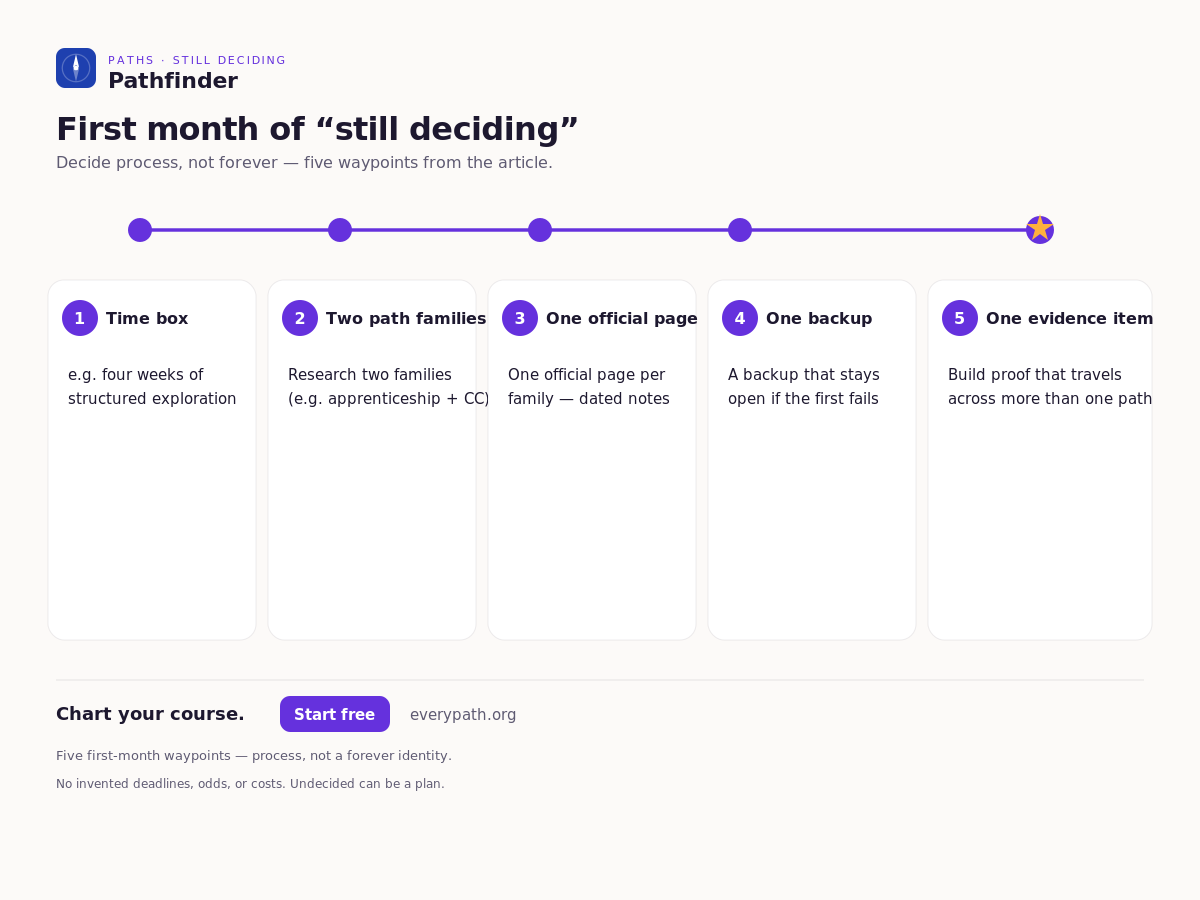
Five concrete things, in order. None of them commits you to anything.
- Take the interest profiler. The O*NET Interest Profiler is a free tool developed by the U.S. Department of Labor's Employment and Training Administration, described on the O*NET Resource Center. It asks what kinds of work you like and returns careers to look at. Treat the output as a reading list, not a verdict about who you are.
- Read three occupation profiles. Pick three from the Occupational Outlook Handbook — one that needs no degree, one that needs an associate's, one that needs a bachelor's. Each profile prints pay, typical entry-level education, and what the work actually involves. Three is enough to see how different the routes are.
- Run one apprenticeship search. Open the Apprenticeship Job Finder and run a search, even if trades are not on your list. The point is to find out what exists within reach of you, which no national figure can tell you.
- Look up one institution properly. Not a ranking list — one real college or training provider you could actually attend, and what it asks for. Write down what you find and where you found it.
- Have one conversation. With someone doing the work, not someone with an opinion about the work. Ask what their first year was like and what they would do differently.
That is roughly one thing a week, which is deliberate: Pathfinder's weekly mission is one prioritised action each week, with nudges when things stall. A month of that leaves you with evidence about yourself instead of a mood.
How do you pick a primary and a backup without committing?
You pick the pair, not the answer. A primary and backup path is the compare-and-commit step: choosing a primary pathway and an explicit backup, rather than a single unhedged choice. You do not have to take that step yet. In Pathfinder's Explore view, an undecided student can run a first experiment on a pathway without committing to anything, so "still deciding" is never blocked behind a choice.
Two rules keep it honest.
- The backup has to be real. A backup you have taken no step towards is a wish. If your backup is community college, you should know which one and what it asks for. If it is trade and apprenticeship, you should have run the search.
- The pair can change. Around a third of students in bachelor's programmes changed major within three years (NCES, 2017). Revising a plan is the normal case, not the failure case. Write the plan so it survives being revised.
There is also a check on the other side. Pathfinder's readiness gate separates a complete profile from a plan-ready one, so a shallow intake never produces a falsely confident plan. If you have not told it enough, it says so instead of guessing. An honest "not enough yet" is more useful than a confident plan built on three answers.
Is a gap year the same as still deciding?
No. A gap year is a deliberate break between school and what comes next. Still deciding is exploring while you carry on — it can happen in your last year of school, during a first job, or alongside a course. One is a use of time; the other is a stance towards a choice.
| Question | Still deciding | Gap year | Source |
|---|---|---|---|
| What is it? | "Not sure yet" as a legitimate starting point, explored honestly | A deliberate break between high school and what comes next | Definitional (Pathfinder glossary) |
| Is it a Pathfinder pathway? | Yes — one of the eight | No, but it is a choice Pathfinder can plan around | Definitional (Pathfinder glossary) |
| Does it require a year off? | No | Yes, by definition | Definitional |
| What if you want to defer a place? | Not applicable until you hold an offer | UCAS says to contact the university or college before submitting your application to make sure they are happy to accept a deferred application | UCAS (accessed 2026-09-11) |
That last row is the one people get wrong. Deferral is not automatic and it is not yours to declare: the university decides. If a break year is the plan, ask first, in writing, before you apply.
You will also notice there is no gap-year outcome statistic on this page. That is not an oversight. This page cites none, because the research for it found no primary official source for one — and you should be wary of the confident percentages you will find elsewhere.
What can't these numbers tell you?
They cannot tell you what will happen to you. Averages, rates and population counts describe groups. You are one person, in one place, with one set of options in front of you.
- The major-change cohort is a decade old. The students in NCES 2018-434 first enrolled in 2011-12 and were followed to 2014 (NCES, 2017). It is the figure NCES's own Data Point on the subject prints, and it describes a different decade of students.
- "Changed major" is not "regretted". The statistic counts a change on a record. It says nothing about whether the change was a correction, a discovery or a disappointment.
- The five figures measure five different things. A cohort rate, a graduation rate, an enrolment rate, a population count and a weekly wage. Do not add, subtract or average them — the table prints each with its own population and year for exactly that reason.
- Occupation medians are national. A median wage sits in the middle of a national range that varies by region and employer.
This is how Pathfinder labels its own claims. A sourced figure is grounded for exactly what it says and no further. Anything Pathfinder calculates for you from it is modelled — a reasoned estimate, marked as one. Neither ever becomes a prediction about you: Pathfinder will not state your chances of getting in, in any wording, which is one of the things its AI is built to refuse, along with inventing a deadline or a cost.
Saying that plainly is the point. A number with its year and publisher attached, plus an honest note about what it does not cover, is worth more than a confident answer nobody can stand behind.
How do you decide what to do this week?
Turn the national figures into questions only you can answer:
- Which of the eight paths have I actually looked at? If the honest answer is one, the shortlist is not a shortlist yet.
- What is open near me? One apprenticeship search and one institution lookup turn a national count into a local fact.
- What does the work look like on an ordinary Tuesday? Pay is easy to find; the daily shape of a job is what the conversation in step five is for.
- What would I have to decide by, and who told me that date? If nobody can name the source of a deadline, treat it as unknown until you check it.
- What is my backup? Choosing a primary path and an explicit backup path beats one unhedged bet.
- Am I ready to choose at all? "Still deciding" is a legitimate answer and a starting point to plan around — not a gap to apologise for.
If it helps to know what a tool costs before you start, Pathfinder's what is free and what is not page sets that out, and the free plan needs no card. For a fuller comparison of the routes themselves, apprenticeship vs. college. For senior-year dated gates that do not assume college, see your 12th-grade plan takes the two most-compared ones apart with sourced figures.
Want a plan that starts from "not sure yet"?
Whatever comes next — including "still deciding" — Pathfinder builds you a plan for it, and labels every claim in it as grounded, modelled or advisory. It will not invent a deadline, a cost, or your odds of getting in.
Start free — no credit card required.
Frequently asked questions
Is it okay to not know what I want to do after high school?
Yes. Pathfinder lists "still deciding" as one of its eight pathways, not a failure state, and its intake has an "Undecided / help me explore" option rather than forcing a choice you have not made.
How many students change their major?
Within 3 years of first enrolling, about 30 percent of students who had declared a major had changed it at least once — 33 percent in bachelor's programmes, 28 percent in associate's (NCES, 2017; 2011-12 cohort).
Should I take a gap year if I am undecided?
They are different things. A gap year is a deliberate break; still deciding is exploring while you carry on. If you want to defer a UK place, UCAS says to contact the university before you apply.
What is a backup path?
An explicit second route you would take if the first does not work out. Pathfinder's compare-and-commit step asks for a primary pathway and a backup instead of one unhedged choice.
Will Pathfinder tell me which path is best for me?
No. It labels every claim as grounded, modelled or advisory, and helps you plan a primary path and a backup. It will not pick for you or state your odds of admission.
Sources
- Data Point: Beginning College Students Who Change Their Majors Within 3 Years of Enrollment (NCES 2018-434) — National Center for Education Statistics (2017), accessed 2026-09-11
- Unemployment rates and earnings by educational attainment — U.S. Bureau of Labor Statistics (2025), accessed 2026-09-11
- Fast Facts: Graduation rates — National Center for Education Statistics (2020), accessed 2026-09-11
- Some College, No Credential — 2025 Report for the Nation and the States — National Student Clearinghouse Research Center (2025), accessed 2026-09-11
- Condition of Education: Immediate College Enrollment Rate — National Center for Education Statistics (2024), accessed 2026-09-11
- O*NET Interest Profiler — O*NET, sponsored by the U.S. Department of Labor, accessed 2026-09-11
- Interest Profiler (IP) at O*NET Resource Center — O*NET Resource Center, U.S. Department of Labor, Employment and Training Administration, accessed 2026-09-11
- Occupational Outlook Handbook — U.S. Bureau of Labor Statistics (2025), accessed 2026-09-11
- Occupational Outlook Handbook — Electricians — U.S. Bureau of Labor Statistics (2025), accessed 2026-09-11
- Occupational Outlook Handbook — Dental Hygienists — U.S. Bureau of Labor Statistics (2025), accessed 2026-09-11
- Occupational Outlook Handbook — Accountants and Auditors — U.S. Bureau of Labor Statistics (2025), accessed 2026-09-11
- Apprenticeship Job Finder — U.S. Department of Labor, accessed 2026-09-11
- How do I apply for deferred entry? — UCAS, accessed 2026-09-11
Chart your course
Pathfinder builds you a plan for whichever path you pick — or for “still deciding” — and labels every claim in it as grounded, modelled or advisory. It will not invent a deadline, a cost, or your chances of getting in.
Start free No credit card required.
Related reading
- Is it okay not to go to college? Sourced answer
Yes — college is one path, not the only valid one. Enrollment data shows a large share of graduates do not enrol immediately. Plan a primary path and a backup.
- Every path after high school, explained honestly
Every path after high school — apprenticeship, community college, work, military, certifications, business, university, still deciding — one sourced page.
- How to tell your parents you don't want to go to college
A student's guide to the college conversation: build a plan first (what instead, when, money, backup), expect their worries, and follow up after you talk.