Paths after high school
Should you apply to college if you might not go yet
By Pathfinder Editorial · Published · 13 min read
About: Pathway University Still deciding Grounded
Should you apply to college if you might not go? Filing the form is not enrolling. Early decision can require you to enroll if you are accepted. Early action does not. At Cal State LA, the later deposit still does not enroll you for the term.
This page stops at that split. It does not judge whether skipping college is acceptable. That question is on whether it is okay not to go to college. It does not coach a season of not knowing. That stance is on still deciding after high school. Both are reached from paths after high school. Nothing here files an aid form.
The College Board pages were opened on 3 October 2026. So was the public deposit page for California State University, Los Angeles. That campus is the example when a rule has to be a real campus rule. Another university can set another amount, another date, and another consequence. Read your own letter after you read the plan you are about to sign.
What sending the application commits you to
College Board's BigFuture page says about 450 colleges offer early admission plans. The counselor page says approximately 450 colleges have early decision or early action, and some have both. Those are counts of colleges with a plan. They are not counts of students, and they are not a chance of admission. This page does not repeat any sentence on those pages about who has an easier time getting in.
The commitment sits in the plan, not in the bare fact that a form left your hands.
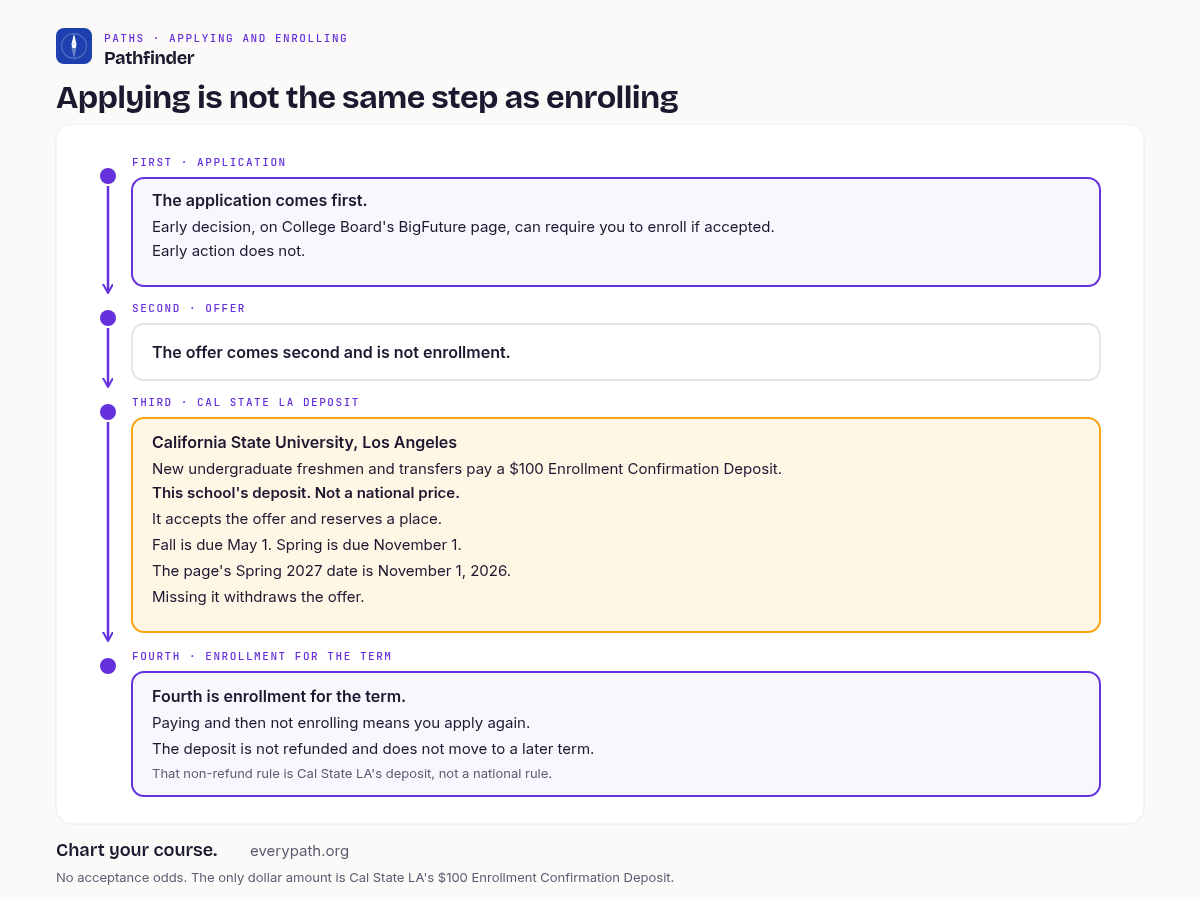
Early decision, on BigFuture, is one college only. If that college accepts you and offers enough financial aid, you must go, which is why the page calls the plan binding. A second early-decision deadline, where a college has one, works the same way and only gives you more time to apply. You may still send regular applications elsewhere, but you must withdraw them if the early-decision college accepts you. When you send the early-decision file, you sign a contract to enroll if accepted. The page says that college should be your true first choice.
Keep the aid bullet and the contract sentence apart. They are not copies. The bullet says you must go if you are accepted and the college offers enough financial aid. The contract sentence says you commit to enroll upon acceptance, and that sentence does not repeat the aid test. This article does not weld them into one smoother rule.
The counselor page says early decision is binding: a student accepted under it must attend. It says early action is not binding, and the student need not commit until the usual reply date of May 1. Lower down, the same page says the student agrees to attend if accepted and if the family considers the aid adequate. Those two early-decision lines are not the same test. Use the line printed on the form you sign.
That counselor list also says the early-decision student applies to only one college that way, may use regular plans elsewhere, withdraws the others if accepted, and sends a nonrefundable deposit well before May 1. The deposit is later. It is not the application. It shows up on the list because the plan expects the money early.
Early action, on BigFuture, can go to more than one college. You may say yes, wait until spring, or decline. The page says it is not binding, and that you usually have until May 1 to say whether you will enroll, so you can compare aid offers. That comparison is the reason it gives. This article does not turn it into aid-form steps.
The counselor page says the same split in staff language. An early-action student hears early, does not have to commit when the offer arrives, may use regular plans at other colleges, and answers no later than the May 1 national response date.
A third pattern is on the counselor page. Some colleges offer single-choice early action, which the page calls nonbinding. Under it, you may not send early decision or early action anywhere else. You are limited in which other early forms you may file. You are not, on that description, required to attend if accepted. "Nonbinding" is not "no rules."
The counselor page says the Common Application, and some colleges' own forms, require the student, a parent, and the counselor to sign an early-decision agreement. That signature is what sending the file commits you to, on that page. The page does not say every college uses the Common Application.
If you might not attend that college, BigFuture's note on the same facts page is to think twice before applying early. The reasons it names are concrete. You want to compare admission offers and aid offers from several colleges. Or another year of high school work would help what you can show. Those are reasons a binding plan fits badly. They are not instructions for an aid form.
Regular admission, on these pages, is the route you can still use while one early-decision file is pending, and the route early-action students can use at other colleges. These College Board pages do not define regular admission as its own binding contract. They do say an early-decision acceptance forces you to withdraw the others, including the regular ones. Until that acceptance, a regular file is still an application. It is not enrollment.
What an admission offer still is not
College Board's summer page speaks to a student who already holds offers. After you choose, you may need an admission deposit to secure a place. Colleges may look at aid and may waive that deposit. A tuition deposit applies toward the tuition and fee bill. The page calls National College Decision Day typically May 1, when most colleges want a commitment, and it says the date can move with the plan and the college.
The rest of that page is bills, loans, and payment plans. Those tasks stay off this article. What matters here is the order: offer, then a decision, then sometimes a deposit. The offer is not described as enrollment. "Most colleges" is the page's own May 1 wording, not a count of students and not your campus. Use the date on your letter.
Set the early-decision deposit beside that May 1 line. The counselor page says early-decision applicants send a nonrefundable deposit well before May 1. BigFuture's early-action answer says you usually have until May 1 to say if you will enroll. The summer page says May 1 is the typical national day, and that the plan can move it. Three College Board sentences, three clocks. None of them says the application file, by itself, enrolled you.
What Cal State LA requires after the offer
California State University, Los Angeles publishes a deposit page for people who already have an undergraduate offer. The first line congratulates the reader on that offer. It is not a page about how to complete an application. On this page, applying has already happened.
The rule for new undergraduate freshmen and transfer students is specific. To accept the offer and reserve a place, they submit a $100 Enrollment Confirmation Deposit. The sum is applied to tuition for the admission term. Send it by May 1 for fall or by November 1 for spring. A note on the page, as opened on 3 October 2026, says the Spring 2027 deadline is November 1, 2026.
Miss the date and the offer is withdrawn. The page does not say the offer stays open in silence. If you still hope to enroll after the date, it tells you to file an admission appeal for a late deposit. An appeal is a request. It is not a promise the late payment will be taken. This article does not guess how often appeals succeed. The page does not say.
The $100 line is not even campus-wide. The page says current and continuing Cal State LA students do not owe it, and neither do new graduate, certificate, or credential students in state-supported programs. Students admitted through the College of Professional and Global Education are sent to a different intent-to-enroll form. If you are not a new undergraduate freshman or transfer, do not borrow the $100. If you are applying somewhere else, do not borrow it. It is one public university's published amount.
A deposit is still not enrollment
The Cal State LA page splits the payment from the term under its own heading: what if you pay and do not enroll. A student who submits the deposit and does not enroll for the admitted term must apply again for a future term, and must meet the admission rules and dates in effect then. The deposit is not refunded. It cannot be moved to a later term.
That is the clearest public split on a university page checked on 3 October 2026. Accepting the offer is the deposit. Enrolling for the term is a further act. You can do the first and skip the second. At this university the cost of that gap is money you do not get back and an application you file again. The page does not say the $100 posted means you are enrolled. It describes the other case: paid, and still not enrolled.
Should you apply to college if you might not go, once you see that gap? Only if the plan you sign lets you decline. Early action leaves room to say no. A regular file, beside those early plans, is not itself the binding contract. Early decision is written so that acceptance means you enroll and withdraw the others. Read the agreement, including the aid line on that form. If you already know you might not attend that college, skip the binding plan.
Common mistakes if you might not go
- Treating every application as early decision. Early action, on both College Board pages, lets you decline. Single-choice early action limits other early filings and, on the counselor page, is still called nonbinding. Regular files are the ones those pages say you may keep until an early-decision acceptance forces a withdrawal.
- Treating early decision as early action. BigFuture says you sign a contract to enroll if accepted, and that you must go if accepted and offered enough financial aid. The counselor page says an accepted early-decision student must attend, and also that the deal is to attend if the family finds the aid adequate. Do not keep shopping after you sign the binding plan, unless your own form describes a release these pages do not.
- Treating Cal State LA's deposit as enrollment. The $100 accepts the offer and reserves a place for new undergraduate freshmen and transfers. Pay it and skip the term, and you apply again. The money does not move forward.
- Treating $100 or May 1 as every campus. May 1 is College Board's typical national decision day, with a warning that plans and colleges differ. November 1, and November 1, 2026, are dates on the Cal State LA page. Another public university can publish neither figure.
- Using this page to decide if college is optional, or to file for aid. Whether it is reasonable not to go is on the page linked above. A season of not knowing is on the other page linked above. The wider set of routes is the paths page linked above.
Should you apply to college if you might not go?
You can send an application and still not enroll. On BigFuture, early decision binds you if you are accepted and the college offers enough financial aid, and the form is a contract to enroll if accepted. Early action is not binding. You may decline, usually until May 1.
Does an admission offer mean you are enrolled?
No. The summer page starts from offers you already hold. After you decide, you may need a deposit to hold a place. It calls May 1 National College Decision Day for most colleges, and says the date can change. A deposit applies to the tuition and fee bill. The offer is not called enrollment.
What does early decision commit you to that early action does not?
BigFuture limits early decision to one college. If you are accepted and offered enough financial aid, you must attend, and the form is a contract to enroll if accepted. Other applications come out if that college says yes. Early action can go to several colleges. You may accept, wait, or decline.
What is Cal State LA's deposit, and who has to pay it?
Cal State LA charges new undergraduate freshmen and transfers $100 to accept the offer and reserve a place. The deposit applies to that term's tuition. Fall is due May 1 and spring November 1. For Spring 2027 the page says November 1, 2026. Continuing students are exempt, as are new graduate, certificate, or credential students in state-supported programs.
If you pay the Cal State LA deposit and then do not enroll, what happens?
That deposit page says a student who pays and does not enroll for the admitted term must apply again for a later term and meet the rules in effect then. The $100 is not refunded. It cannot move to the later term. The payment accepted the offer. On that page, it did not count as being enrolled.
Sources
- BigFuture facts on early decision and early action — College Board, BigFuture, read 3 October 2026
- Counselor page on early decision and early action — College Board counselor page, read 3 October 2026
- BigFuture notes for the summer before college — College Board, read 3 October 2026, deposit and decision-day lines only
- Enrollment Confirmation Deposit at Cal State LA — California State University, Los Angeles, read 3 October 2026
Chart your course
The agreement you sign and the deposit one named campus asks for are different promises. Pathfinder can park the plan you actually picked beside a second route, and each claim carries a label for sourced, estimated, or advisory.
Frequently asked questions
Should you apply to college if you might not go?
You can send an application and still not enroll. On BigFuture, early decision binds you if you are accepted and the college offers enough financial aid, and the form is a contract to enroll if accepted. Early action is not binding. You may decline, usually until May 1.
Does an admission offer mean you are enrolled?
No. The summer page starts from offers you already hold. After you decide, you may need a deposit to hold a place. It calls May 1 National College Decision Day for most colleges, and says the date can change. A deposit applies to the tuition and fee bill. The offer is not called enrollment.
What does early decision commit you to that early action does not?
BigFuture limits early decision to one college. If you are accepted and offered enough financial aid, you must attend, and the form is a contract to enroll if accepted. Other applications come out if that college says yes. Early action can go to several colleges. You may accept, wait, or decline.
What is Cal State LA's deposit, and who has to pay it?
Cal State LA charges new undergraduate freshmen and transfers $100 to accept the offer and reserve a place. The deposit applies to that term's tuition. Fall is due May 1 and spring November 1. For Spring 2027 the page says November 1, 2026. Continuing students are exempt, as are new graduate, certificate, or credential students in state-supported programs.
If you pay the Cal State LA deposit and then do not enroll, what happens?
That deposit page says a student who pays and does not enroll for the admitted term must apply again for a later term and meet the rules in effect then. The $100 is not refunded. It cannot move to the later term. The payment accepted the offer. On that page, it did not count as being enrolled.
Sources
- BigFuture facts on early decision and early action — College Board, accessed 2026-10-03
- Counselor page on early decision and early action — College Board, accessed 2026-10-03
- BigFuture notes for the summer before college — College Board, accessed 2026-10-03
- Enrollment Confirmation Deposit at Cal State LA — California State University, Los Angeles, accessed 2026-10-03
Chart your course
Pathfinder builds you a plan for whichever path you pick — or for “still deciding” — and labels every claim in it as grounded, modelled or advisory. It will not invent a deadline, a cost, or your chances of getting in.
Start free No credit card required.
Related reading
- Can you go to college later? How re-entry works
Yes. Skipping or delaying college doesn't close the door. How applying later works, first-year vs transfer status, credit for what you did, and what to keep.
- How to choose a path after high school
How to choose a path after high school with a primary and an explicit backup — a sourced decision frame, not tip lists or invented odds.
- Is a gap year a good idea if you’re undecided?
A gap year after high school when you're still deciding: what it is, how it differs from drifting, and how to plan primary + backup.