Paths after high school
What is a youth apprenticeship, and can you start at 16?
By Pathfinder Editorial · Published · 13 min read
About: Registered apprenticeship Trade and apprenticeship Pathway Grounded

A youth apprenticeship is a registered apprenticeship that a student starts before leaving high school. The Labor Department says these programs combine academic and technical classes with work experience, and federal standards let a sponsor take apprentices from age 16. So yes, you can start while still in school, if a local program exists.
That last condition matters more than anything else on this page. A youth apprenticeship is not something you can sign up for online from anywhere. It exists where a school, an employer, and often a college have built one together. This page explains what the label means, how it differs from the two programs it gets confused with, and how a student can find out whether one is open nearby.
Two neighbors are covered elsewhere. The adult version, and what registration itself means, is on how a registered apprenticeship works. The preparation step that comes before a program is on what a pre-apprenticeship is. The school classes that often feed into both are on career and technical education in high school. The wider set of routes sits on every path after high school.
Every source below is a United States federal page. States and school districts design local programs, and some states use the words youth apprenticeship for something narrower or broader than the federal description. When a local brochure and this page disagree, the local rules are the ones that apply to you.
What the Labor Department means by youth apprenticeship
Apprenticeship.gov answers the question in two sentences. Its first sentence says programs for high school students pair academic and technical classes with on-the-job experience, and that the pairing runs through a Registered Apprenticeship Program. The second adds that this gives students a base from which to choose among several routes after high school: college, an apprenticeship, full-time work, or a mix of them.
Read that definition slowly. Three pieces sit inside it:
- Classroom instruction. Academic and technical lessons, taught at the high school or at a college partner.
- Work experience. Time on a real job with an employer.
- A registered program. The work and the lessons run through an apprenticeship program that a registration agency has approved.
The third piece is what separates a youth apprenticeship from a summer job or a school internship. A registered program has written standards, a sponsor who answers for it, and a record of the apprentice's progress. A job shadow or an unpaid placement can be useful, but it is not the same thing, even when a school uses the word apprenticeship loosely in a flyer.
The educators page on apprenticeship.gov widens the frame. It says registered apprenticeship is a pathway for career seekers including young people aged 16 to 24, and that many programs link to career and technical education, dual enrollment, and pre-apprenticeship so students meet the skills of a trade early. It also reports that 415,560 young apprentices were served in 2025, with the largest groups in construction, public administration, and educational services.
Why 16 is the earliest starting age
The age floor is written into the federal rules for registered programs. Under 29 CFR 29.5, each program's standards must state the minimum qualifications a sponsor sets for new apprentices, and the eligible starting age in those standards can be no lower than 16. A sponsor can set a higher floor. It cannot go lower and stay inside the federal standard.
That is why most youth apprenticeship descriptions talk about juniors and seniors rather than freshmen. A student who is 14 or 15 can still take related classes, and some schools start career exploration early, but the paid apprentice role begins at 16 at the earliest.
Being 16 or 17 also brings federal youth labor rules into play. Those rules limit some kinds of work for anyone under 18, and the Labor Department's young people page points educators to a fact sheet on interns and students who work for for-profit employers. A sponsor that takes high school apprentices has to plan the job around those limits. If you are under 18, ask the sponsor which tasks you will do now and which wait until your 18th birthday.
Two federal models for students
The Labor Department sorts most programs for young people into two models. They are easy to mix up, because both can start in high school and both can count toward graduation. The difference is whether the student is already an apprentice.
Model 1: a pre-apprenticeship for students. The student takes instruction tied to an apprenticeship field on top of required high school courses, and those courses count toward graduation. The student can take part in on-the-job learning from age 16, and that learning can count toward entry into an apprenticeship. The fact sheet adds that students can apply to an apprenticeship program leading up to or upon high school graduation. The student is preparing, not yet registered.
Model 2: a registered apprenticeship that begins in school. The program can start in high school, at a community college, or through a dual enrollment course. The student becomes an apprentice while still a student. Classes at the high school or a community or technical college sit alongside required coursework, which counts toward graduation and sometimes toward a two- or four-year degree.
The chart below puts the two models side by side.
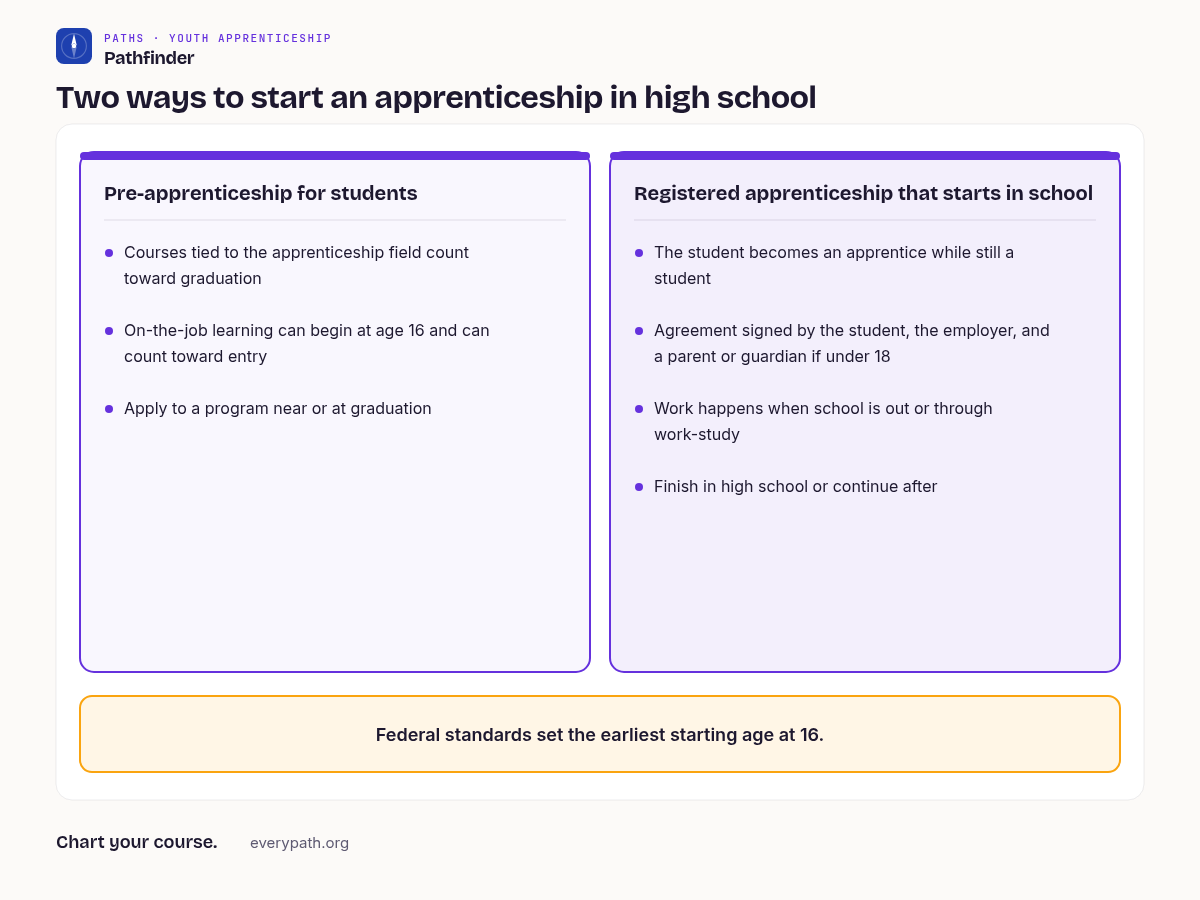
The question to ask any program is simple: when I start, am I an apprentice, or am I getting ready to apply to be one? Both answers can be good. They lead to different paperwork and different expectations on day one.
How a youth apprenticeship differs from a registered apprenticeship
In the federal description, a youth apprenticeship is a registered apprenticeship. It is not a separate legal category with its own rulebook. What changes is the setting and the schedule.
| Question | Registered apprenticeship for adults | Youth apprenticeship (Model 2) |
|---|---|---|
| Who is the apprentice? | Someone the sponsor or employer takes on | A student who is 16 or older |
| Who signs the agreement? | Apprentice and the sponsor or employer, plus a parent or guardian for a minor | Student, employer, and a parent or guardian if under 18 |
| When is the work done? | During the working day | When school is out, or through formal work-study |
| Where are classes? | Often at a college or training center | High school, community or technical college, or both |
| What counts toward a diploma? | Not applicable | Related courses count toward high school graduation |
The adult version, with its standards and what registration requires, is on how a registered apprenticeship works. The point here is narrower: the student version runs on the school calendar, and because a 16- or 17-year-old apprentice is a minor, a parent or guardian signs too. Federal rules at 29 CFR 29.7 require that signature for any apprentice who is a minor.
How a youth apprenticeship differs from a pre-apprenticeship
Apprenticeship.gov describes pre-apprenticeship as a program, or a set of strategies, meant to get people ready to enter registered programs or other jobs. The same help page says one can run for a span of weeks up to several months, and that a wage or stipend is possible but not promised.
That definition marks three differences from a youth apprenticeship:
- Status. A pre-apprentice is preparing to enter a program. A youth apprentice is already in one.
- Length. Pre-apprenticeships are described in weeks or months. A youth apprenticeship lasts as long as the registered program, and may run past graduation.
- Pay. Pre-apprenticeship pay is not a given. A youth apprentice works for an employer as part of a registered program.
Model 1 above is a pre-apprenticeship aimed at students. If a school calls its program a youth apprenticeship but nobody becomes a registered apprentice, it is closer to Model 1. That is not a problem in itself. It just means the next step, entry into a registered program, still lies ahead. More on that preparation route is on what a pre-apprenticeship is.
What happens at graduation
A youth apprenticeship does not have to end on the day you get your diploma. Apprenticeship.gov says students may complete the registered apprenticeship during high school or continue after graduation, depending on how long the program runs. For dual enrollment students, the page says the apprenticeship continues and may be completed at the college.
That gives a graduate three realistic positions:
- Finished. A short program completed before graduation.
- Still an apprentice. A longer program that carries on with the same employer after the diploma.
- Moved to college. A dual enrollment student who keeps the apprenticeship and completes it through the college partner.
The help page's own framing is that a youth apprenticeship gives a base for choosing college, an apprenticeship, full-time work, or some mix. It does not close the college door. If you might want a degree later, ask whether the related classes carry college credit and at which college.
How to find out whether one exists near you
There is no national enrollment form for youth apprenticeships. The Labor Department's advice to students is local. Its New to the Workforce page says a school may offer a youth apprenticeship "that combines work experience with high school and/or college course credit," and tells students to ask a school counselor or administrator whether one is offered, or whether other work-based learning options exist.
A short script for that conversation:
- Does our school or district run a youth apprenticeship, and is it registered?
- Which employers take part, and in which occupations?
- What is the earliest grade or age to start?
- When is the work scheduled: after school, summers, or work-study?
- Which classes count toward my diploma, and which carry college credit?
- What happens to the apprenticeship after I graduate?
If the answer is no, apprenticeship.gov also offers an Apprenticeship Finder for open programs. A student who is not yet 16, or whose school has no program, can still take related career and technical courses and look at pre-apprenticeship options. Those classes are covered on career and technical education in high school.
What a good program looks like on paper
The Labor Department's fact sheet lists features shared by high-quality youth apprenticeship programs. In its words, they meet the needs of students, businesses, school districts, and colleges. They align with academic and technical standards and with industry-recognized credentials. They address skills matching and individual assessment. And they keep strong links to adult apprenticeship programs in the community.
Turned into questions a family can ask:
- Does the program connect to an adult registered program, so the student has somewhere to go next?
- Does it lead to a credential the industry recognizes?
- Is there an assessment at the start, so the placement suits the student?
- Do the school and the employer both have a named person responsible for the student?
The same fact sheet notes that some programs draw on Workforce Innovation and Opportunity Act funds, which can bring supportive services. Ask whether that applies before assuming help with costs such as tools or transport.
Common mistakes with youth apprenticeships
- Assuming every school has one. Programs are built locally. Ask the counselor first.
- Treating a job shadow as an apprenticeship. Without a registered program, it is work-based learning, not an apprenticeship.
- Signing without reading the agreement. The student, the employer, and a parent or guardian if the student is under 18 all sign. Read the hours, the training plan, and what happens after graduation.
- Planning to start at 14 or 15. The federal floor for a registered apprentice is 16. Earlier grades are for classes and exploration.
- Thinking it rules out college. The Labor Department frames youth apprenticeship as a base for college, work, or both. Ask which classes carry college credit.
Can you start an apprenticeship while still in high school?
Yes, in some places. The Labor Department describes registered apprenticeships that begin in high school, a community college, or a dual enrollment course, so a student can become an apprentice before graduating. Federal standards set the earliest starting age at 16. Whether your school or a local employer runs one is a separate question.
What is the difference between a youth apprenticeship and a pre-apprenticeship?
A youth apprenticeship, in the Labor Department's description, runs through a registered apprenticeship program, so the student is an apprentice. A pre-apprenticeship prepares someone to enter a registered program or other jobs. It may last weeks or months and may or may not pay. Ask which of the two a school program is.
Who signs the agreement for a high school apprentice?
The Labor Department fact sheet says students become apprentices through an agreement signed by the student and the employer. If the student is under 18, a parent or guardian signs as well. Read the agreement before anyone signs it, because it sets out the work, the training, and the program you join.
When does a high school apprentice do the work?
Apprenticeship.gov says the work portion is flexible. It happens when school is not in session or through a formal work-study program. Classes at the high school or a community or technical college sit alongside the required coursework that counts toward graduation. Ask the school how it fits the hours into a week.
Does a youth apprenticeship end at graduation?
Not always. Apprenticeship.gov says a student may finish during high school or keep going after graduation, depending on how long the apprenticeship lasts. For students in dual enrollment, it says the apprenticeship continues and may be completed at the college. Ask what happens to your place the day you graduate.
Sources
- What is youth apprenticeship? — Apprenticeship.gov help page from the Labor Department, read 10 October 2026
- Apprenticeship for Young People — Apprenticeship.gov educators page, read 10 October 2026. Two models, age range, and 2025 count only
- Discover Youth Apprenticeship: Providing a Foundation for Career Success — DOL Employment and Training Administration, updated November 2020, accessed 10 October 2026. Agreement signers and program features only
- New to the Workforce — Apprenticeship.gov career seekers page, read 10 October 2026
- What is pre-apprenticeship? — Apprenticeship.gov help page on preparation programs, read 10 October 2026
- Federal apprenticeship standards at 29 CFR 29.5 and 29.7 — eCFR, title 29 as of 6 October 2026, accessed 10 October 2026
Chart your course
Write down the apprenticeship you are asking about, then the route you would take if it fell through. Pathfinder keeps those two plans next to each other, and each claim in them carries a label: sourced, estimated, or advisory.
Frequently asked questions
Can you start an apprenticeship while still in high school?
Yes, in some places. The Labor Department describes registered apprenticeships that begin in high school, a community college, or a dual enrollment course, so a student can become an apprentice before graduating. Federal standards set the earliest starting age at 16. Whether your school or a local employer runs one is a separate question.
What is the difference between a youth apprenticeship and a pre-apprenticeship?
A youth apprenticeship, in the Labor Department's description, runs through a registered apprenticeship program, so the student is an apprentice. A pre-apprenticeship prepares someone to enter a registered program or other jobs. It may last weeks or months and may or may not pay. Ask which of the two a school program is.
Who signs the agreement for a high school apprentice?
The Labor Department fact sheet says students become apprentices through an agreement signed by the student and the employer. If the student is under 18, a parent or guardian signs as well. Read the agreement before anyone signs it, because it sets out the work, the training, and the program you join.
When does a high school apprentice do the work?
Apprenticeship.gov says the work portion is flexible. It happens when school is not in session or through a formal work-study program. Classes at the high school or a community or technical college sit alongside the required coursework that counts toward graduation. Ask the school how it fits the hours into a week.
Does a youth apprenticeship end at graduation?
Not always. Apprenticeship.gov says a student may finish during high school or keep going after graduation, depending on how long the apprenticeship lasts. For students in dual enrollment, it says the apprenticeship continues and may be completed at the college. Ask what happens to your place the day you graduate.
Sources
- What is youth apprenticeship? — U.S. Department of Labor, Apprenticeship.gov, accessed 2026-10-10
- Apprenticeship for Young People — U.S. Department of Labor, Apprenticeship.gov, accessed 2026-10-10
- Discover Youth Apprenticeship: Providing a Foundation for Career Success — U.S. Department of Labor, Employment and Training Administration (2020), accessed 2026-10-10
- New to the Workforce — U.S. Department of Labor, Apprenticeship.gov, accessed 2026-10-10
- What is pre-apprenticeship? — U.S. Department of Labor, Apprenticeship.gov, accessed 2026-10-10
- Federal apprenticeship standards at 29 CFR 29.5 and 29.7 — Electronic Code of Federal Regulations, accessed 2026-10-10
Chart your course
Pathfinder builds you a plan for whichever path you pick — or for “still deciding” — and labels every claim in it as grounded, modelled or advisory. It will not invent a deadline, a cost, or your chances of getting in.
Start free No credit card required.
Related reading
- What happens when you finish an apprenticeship today
What happens when you finish an apprenticeship? You may get a completion certificate. It is not a wage or a journeyworker title. Check who issued it.
- Registered apprenticeship vs trade school explained
A registered apprenticeship is a validated paid job. Trade school can teach the class and still not be the program. Check who sponsors it.
- Registered apprenticeship requirements after high school
The federal age floor is 16 unless a law sets a higher age. A diploma is not a national rule. Sponsors write their own grade and skill qualifications.