Paths after high school
Registered apprenticeship vs trade school explained
By Pathfinder Editorial · Published · 13 min read
About: Registered apprenticeship Trade and apprenticeship Pathway Grounded

A registered apprenticeship is a paid job. A federal or state registration agency validates its standards. Trade school is not that job. A vocational school can teach the classroom piece inside a program. Enrolling at the school does not put you in the program.
This page holds only that pair. It does not weigh trade school against a four-year degree. That comparison is trade school compared with a four-year degree. It also stops short of community college versus trade school, which is a different institution question. If you still need the plain meaning of registration, use what registration itself means. Every route after the diploma, including this one, sits on the map of paths after high school.
A brochure can be stricter than the federal description. It cannot drop approved standards and still be a registered program.
What does registration add that a catalog does not?
Apprenticeship.gov describes apprenticeship as an industry-driven career pathway. Individuals can get paid work experience, classroom instruction, mentorship, and a portable credential (What is apprenticeship?).
A Registered Apprenticeship Program is the form of that pathway that a registration agency has already checked. The help page says the Labor Department or the state registration agency is the one that validates it. Programs seek that check because they want the department or state seal, and because funding tied to the department can follow (the help page on registered programs).
The employer overview names five elements that sit inside every registered program (Registered Apprenticeship Program):
- Industry led. The occupation is vetted so training matches industry standards.
- A paid job. Apprentices are employees. Pay rises as skills and productivity rise.
- On-the-job learning that is structured, plus a mentor. The work itself is planned, not a loose shadowing shift.
- Supplemental education. Classroom work follows the employer's training needs.
- A credential. It is portable and recognized nationally inside the industry.
A separate help page uses the same contrast against other workplace training: wages during training, class plus the job, a mentor at the work setting, and a credential you can carry (How is apprenticeship different from other work-based training?). That is a job. It is not a seat you buy.
Someone has to run that job. The create-a-program page defines a sponsor as any person, association, committee, or organization that operates the program and takes responsibility for how it is administered. A sponsor might be one business, a group of businesses, an industry association, or a labor-management group. A community college or a community-based organization can sponsor too (Create a Program). Career seekers are told to search openings and apply to the employer or the sponsor, and to use an American Job Center if they need help finding one (Career Seekers).
Length varies with the employer, the occupation, the industry, and the program type (How long are apprenticeship programs?). A school calendar is a different measure.
Circular 2026-01, issued 9 March 2026, says a sponsor picks time-based, competency-based, or hybrid measurement, and the registration agency reviews the choice. Time-based programs use the industry standard of on-the-job learning, at least 2,000 hours across the whole term, not per calendar year. Competency-based programs measure demonstrated skills and still include on-the-job learning. The circular drops an older twelve-month clock because the regulation does not set one. Hybrid programs use a minimum number of hours and demonstrated competencies. An older 25 percent adjustment cap was also dropped. The agency may still treat 25 percent as a guide. It is not a ceiling (Circular 2026-01).
The 2,000-hour figure has a narrower job than a personal timetable. An occupation is apprenticeable only if the work is the kind that would take at least 2,000 hours of supervised learning when organized by time. The circular's footnote says that test defines the occupation. A competency-based program does not inherit a 2,000-hour sentence just because the occupation passed.
After the sponsor documents that you finished the standards, the federal apprenticeship office or the state registration agency can issue a Certificate of Completion of Apprenticeship (What will I receive after I complete a Registered Apprenticeship Program?). The circular withdraws an older rule that had required six months, or 1,000 hours, on the sponsor's payroll before that certificate. The regulation does not set that floor. A campus diploma is a different document unless the standards say otherwise.
Where does a trade school sit if it is not the program?
The pages opened today never define trade school as its own federal category. They do name the classroom role a school can play.
On the create-a-program page, supplemental education may come from inside the organization or from outside it. Outside examples are a community college, a vocational school, or an online provider. On-the-job learning and the class produce the worker together, and the training plan should spell out both. Sponsors may adopt a federal outline, tailor one, or write their own.
That is the structural split. A vocational school can be the place related instruction happens. The registered program is still the sponsored job plus that instruction, under standards a registration agency has accepted. If you only enroll at the school, you have the classroom provider. You do not yet have the sponsor, the paid job, the mentor on the work site, or the agency's certificate.
A campus can hold either role, and the create-a-program page separates them. It says a community college can sponsor, meaning it runs the program. It names a vocational school as a classroom provider, not as the sponsor. "We teach apprentices" and "we sponsor the program" are different answers.
Pay belongs to the registered side of the definition: wages during the job, moving up as skills increase. These pages do not price the classroom, and they do not say a school never offers a stipend. A four-year comparison is a different question, already linked above.
What is related instruction if the school is only part of it?
Related instruction is the organized technical teaching that has to sit beside the job in all three approaches. Circular 2026-01 points to the standards rule and describes what that teaching is for. It gives the apprentice theoretical and technical knowledge tied to the occupation. It may be a classroom, an occupational or industrial course, a correspondence course of equivalent value, electronic media, or another form of self-study that the registration agency approves.
The same section is where the 144-hour line lives. The regulation recommends at least 144 hours of related instruction for each year of apprenticeship. It does not require that minimum. Sponsors may record the time as clock hours, credit hours, contact hours, or another commonly recognized measure. When an agency compares a program with the recommended 144, it is told to look at content, learning objectives, and total workload, not at a single clock. Time in class and work done outside class can both count, which matches the rule's acceptance of correspondence and self-study.
Sequence is flexible. Instruction may be front-loaded, split into segments, or taught beside the job. More than 144 hours in year one, and fewer later, can still meet the recommended yearly amount across the term. A school calendar that ends before you are hired is a front-loaded plan only if a sponsor built it and the agency accepted it.
Who may teach is set separately from who mentors you on the job. Every related-instruction instructor must meet that state's requirements for a vocational-technical instructor, or be a subject-matter expert. The circular's example is a journeyworker, or another person the industry already treats as having mastered the occupation. The sponsor judges that expertise. The registration agency can review the judgment. Instructors also need training in how to teach adults, either before they start or after. A skilled worker is not automatically the teacher. A school instructor is not automatically the mentor.
Can school time become advanced standing?
Program standards have to include the sponsor's policy on advanced standing or credit for competency, experience, training, or skills the applicant already has. The policy applies to all applicants equally. The circular says it should rest on objective criteria and must be used uniformly. Credit can attach to related instruction, to on-the-job learning, or to both. It can rest on earlier experience, on skill you show during the program, or on both. When a step is granted, wages have to move with that step. A shortcut that keeps the starting wage is not what the circular describes.
Sponsors are encouraged to use industry tests that already exist, and to look at a partnered preparation program's curriculum when they decide whether a completer of that program has skills worth crediting. A program that is registering for the first time may also credit on-the-job learning or related instruction that happened before the registration date, if it lines up with the approved work processes and the approved class outline.
An older guidance document capped prior-work credit at half of training. Circular 2026-01 withdraws that cap because the regulation sets no 50 percent maximum. Do not demand half credit, and do not accept a school's promise of it, unless the sponsor's written policy says so. Sponsors must keep the exams or other records behind each decision. In industries with high rates of fatal workplace deaths, the circular tells agencies to check that safety training is not skipped by a paper credit.
A school can still help before a sponsor hires you, teach the class after you are hired, or supply evidence for advanced standing. None of those roles makes the school the registered program. You still apply to the sponsor.
How do you tell the two apart before you enroll or apply?
Separate the person who pays you, the agency that validated the standards, and the organization that teaches the class. The chart is that split. It has no wages and no tuition, because neither number was part of the pages used here.
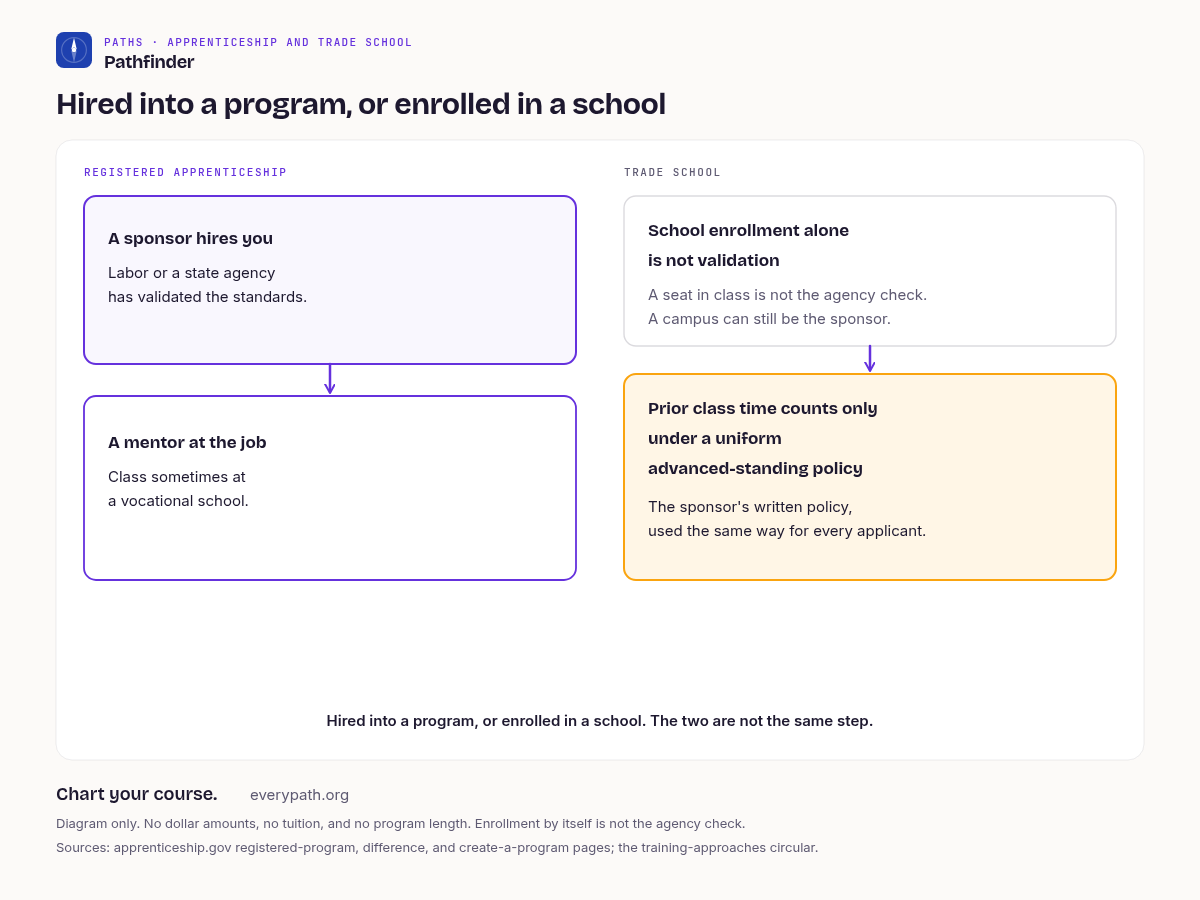
- Name who would employ you. A sponsor and a rising wage put you on the registered side. "I would be a student" keeps you on the school side until someone hires you.
- Name the validator. Ask whether the federal apprenticeship office, or the state agency that registers programs, accepted the standards. The job title is not that acceptance.
- Name the classroom separately. A vocational school, a community college, an online provider, or the employer may teach it. Write down provider versus sponsor. A community college may be either. Do not assume every campus is the sponsor.
- Ask what the standards measure. Time-based, competency-based, or hybrid, and whether class is front-loaded or taught beside the job. Keep 144 hours a year as the 2026 recommendation, not as a brochure's promise.
- Ask about advanced standing in writing. Prior school time counts only under the sponsor's uniform policy, with wages that match any step granted. A verbal "you'll start ahead" is not the policy.
Skipping those steps causes predictable mistakes. A job title with the word apprentice is not registration. A real class at a vocational school is not the program. The 144-hour line is not a hard annual minimum. A campus certificate does not shorten a later program on its own. A wage or a college price from somewhere else is not a result of this comparison.
If you cannot yet say whether you want a sponsor's job or a school's classroom, still deciding is a cleaner status than a guessed brochure. Keep a primary and backup path: one route where you can name the sponsor and the validator, and a second route you can describe before you are ready to begin.
Is a vocational school the same thing as a registered apprenticeship?
No. When a sponsor builds a program, a vocational school is one example of an outside classroom provider, next to a community college or an online provider. Registration is a separate step. A federal office or a state registration agency has to accept the standards. Taking the class does not do that for you.
Can a school sponsor a registered program, or only teach the class?
Both roles exist, and they are not the same role. The create-a-program page says a community college or a community-based organization can sponsor, which means it runs the program and is responsible for it. A vocational school is named there as a possible classroom provider. Ask which role the campus in front of you actually holds.
Do you have to finish 144 hours of class each year?
No. Circular 2026-01, dated 9 March 2026, says the regulation recommends a minimum of 144 hours of related instruction for each year and does not require it. Hours can be counted in more than one way, and a program may put more of them in the first year. Ask the sponsor what the approved standards actually schedule.
If I finish trade school, does that time automatically count?
Not automatically. Sponsors must have a written policy for advanced standing or credit, and they must apply it the same way for every applicant. Prior training can be considered. The policy has to be objective, and any step you are granted comes with wages that match that step. Get the policy before you assume the school shortened the program.
Is every job with apprentice in the title a registered program?
No. A Registered Apprenticeship Program is one a registration agency has validated. Apprenticeship.gov tells career seekers to apply to an employer or a sponsor, not to treat a job title as proof. If nobody can name the federal apprenticeship office, or the state registration agency, as the validator, you are looking at a different arrangement.
Sources
- What is apprenticeship? — U.S. Department of Labor, accessed 2026-10-03
- What is a Registered Apprenticeship Program? — U.S. Department of Labor, accessed 2026-10-03
- Registered Apprenticeship Program — U.S. Department of Labor, accessed 2026-10-03
- Create a Program — U.S. Department of Labor, accessed 2026-10-03
- How is apprenticeship different from other types of work-based training models? — U.S. Department of Labor, accessed 2026-10-03
- How long are apprenticeship programs? — U.S. Department of Labor, accessed 2026-10-03
- Career Seekers — U.S. Department of Labor, accessed 2026-10-03
- What will I receive after I complete a Registered Apprenticeship Program? — U.S. Department of Labor, accessed 2026-10-03
- Office of Apprenticeship Circular 2026-01: Registered Apprenticeship Training Approaches — U.S. Department of Labor, Employment and Training Administration, 9 March 2026, accessed 2026-10-03
Chart your course
The sponsor and the school answer different questions. Keep the validator, the wage step, and the classroom provider in the same plan, and mark anything you have not checked as advisory.
Frequently asked questions
Is a vocational school the same thing as a registered apprenticeship?
No. When a sponsor builds a program, a vocational school is one example of an outside classroom provider, next to a community college or an online provider. Registration is a separate step. A federal office or a state registration agency has to accept the standards. Taking the class does not do that for you.
Can a school sponsor a registered program, or only teach the class?
Both roles exist, and they are not the same role. The create-a-program page says a community college or a community-based organization can sponsor, which means it runs the program and is responsible for it. A vocational school is named there as a possible classroom provider. Ask which role the campus in front of you actually holds.
Do you have to finish 144 hours of class each year?
No. Circular 2026-01, dated 9 March 2026, says the regulation recommends a minimum of 144 hours of related instruction for each year and does not require it. Hours can be counted in more than one way, and a program may put more of them in the first year. Ask the sponsor what the approved standards actually schedule.
If I finish trade school, does that time automatically count?
Not automatically. Sponsors must have a written policy for advanced standing or credit, and they must apply it the same way for every applicant. Prior training can be considered. The policy has to be objective, and any step you are granted comes with wages that match that step. Get the policy before you assume the school shortened the program.
Is every job with apprentice in the title a registered program?
No. A Registered Apprenticeship Program is one a registration agency has validated. Apprenticeship.gov tells career seekers to apply to an employer or a sponsor, not to treat a job title as proof. If nobody can name the federal apprenticeship office, or the state registration agency, as the validator, you are looking at a different arrangement.
Sources
- What is apprenticeship? — U.S. Department of Labor, accessed 2026-10-03
- What is a Registered Apprenticeship Program? — U.S. Department of Labor, accessed 2026-10-03
- Registered Apprenticeship Program — U.S. Department of Labor, accessed 2026-10-03
- Create a Program — U.S. Department of Labor, accessed 2026-10-03
- How is apprenticeship different from other types of work-based training models? — U.S. Department of Labor, accessed 2026-10-03
- How long are apprenticeship programs? — U.S. Department of Labor, accessed 2026-10-03
- Career Seekers — U.S. Department of Labor, accessed 2026-10-03
- What will I receive after I complete a Registered Apprenticeship Program? — U.S. Department of Labor, accessed 2026-10-03
- Office of Apprenticeship Circular 2026-01: Registered Apprenticeship Training Approaches — U.S. Department of Labor, Employment and Training Administration (2026), accessed 2026-10-03
Chart your course
Pathfinder builds you a plan for whichever path you pick — or for “still deciding” — and labels every claim in it as grounded, modelled or advisory. It will not invent a deadline, a cost, or your chances of getting in.
Start free No credit card required.
Related reading
- How long does an apprenticeship take? Why terms vary
Registered apprenticeships run on hours, skills or both. What sets the length, what can shorten or pause it, and how to read the term before you sign.
- Are apprenticeships paid? How apprentice pay works
Yes: registered apprentices are paid from day one. How the wage schedule steps up, whether you pay for classes or fees, and what to check before you sign.
- What is a registered apprenticeship? Sourced definition
DOL-registered apprenticeships: paid work + training, with standards. How they differ from informal “apprentice” jobs.