Paths after high school
How community college differs from trade school
By Pathfinder Editorial · Published · 13 min read
About: Community college Trade and apprenticeship Certifications Grounded

Community college, in federal data, is usually a public institution with programs mainly below a bachelor's degree. Trade school is not an official category. Many skill programs are certificates, a postsecondary nondegree award in BLS terms, offered at schools that may not be public two-year colleges.
This page is only that pair. It does not compare community college with a university, and it does not compare trade school with a four-year degree. Those questions have their own pages: community college compared with a university and trade school compared with college. Both routes, and the others, are on the map of paths after graduation.
Figures below are United States sources. They are averages for defined groups of institutions, not a bill for the campus you will visit. A school outside this classification system is outside the numbers.
What is a community college in the federal data?
The National Center for Education Statistics does not store a single yes-or-no field called community college. In its guide to institutional groupings, NCES says IPEDS covers the universe of U.S. postsecondary institutions that can participate in Title IV federal student aid, "more than 6,000 institutions in 2022–23." Inside that universe, community colleges "are typically publicly controlled postsecondary institutions" funded by state and local sources that "offer a broad range of education and training programs primarily below the baccalaureate level (e.g., certificates, associate’s degrees)." Some also offer bachelor's programs. Researchers and associations often keep their own rosters (Institutional Groupings in IPEDS).
The same page warns against a shortcut. People treat the sector value "public 2-year" as a stand-in for community college. That shortcut fails when a community college adds bachelor's programs and IPEDS classifies it as public 4-year. NCES says the combination of public control with two institutional categories, "not primarily baccalaureate or above" and "associate’s and certificates," can help isolate community colleges. Level itself is simpler: programs are "4-year or above," "2-but-less-than 4-year," or "less than 2-year." Sector crosses that level with control: public, private nonprofit, or private for-profit.
A related handbook definition draws a line you will need later. A degree-granting institution offers an associate's, bachelor's, master's, doctor's, or first professional degree. Institutions that "grant only certificates or awards of any length" are non-degree-granting (IPEDS key concepts). A community college that awards associate degrees is degree-granting even when it also awards certificates. A school that awards only certificates is in a different box, even if the subject you want to study looks the same.
So "community college" on this page means that public, primarily sub-baccalaureate pattern, not every building that offers a two-year clock. If the campus you are considering now grants bachelor's degrees, it may still be a community college in ordinary speech and a public 4-year institution in IPEDS. Ask the admissions office which awards it grants, and look the school up in IPEDS rather than trusting the sector nickname.
What can "trade school" mean if the data set has no such flag?
It can mean at least three different things, and the sources opened today do not collapse them into one.
First, the credential. BLS assigns each occupation a typical education needed for entry. BLS treats an associate's degree as a program that usually takes two years and does not run past four, counting full-time study after high school. A postsecondary nondegree award is the school's own certificate. It is not a degree, and it is not a certification handed out by a professional body. Some of those certificate programs are only a few weeks. Others take one year or two (Employment Projections definitions). When someone says trade school, they often mean this certificate path. Sometimes they mean an associate degree in a skilled field. Those are different awards. The award is the fact you can check. The nickname is not.
Second, the institution's level and control. A certificate program can live at a public community college, at a private nonprofit, or at a private for-profit. It can be part of a degree-granting 2-year school or the whole offering of a non-degree-granting school. It can also sit at a less-than-2-year institution, which is its own IPEDS level. Nothing opened today equates "trade school" with only one of those sectors. If a brochure says trade school, write down control, level, and whether the school grants degrees. Those three answers are the federal description. "Trade school" is the brochure's.
Third, a glossary trap. The Occupational Outlook Handbook defines vocational school as "a secondary school that teaches vocational trades, such as construction trades," and says these schools "may or may not award degrees" (OOH glossary). Secondary means high school, not the campus you attend after graduation. Do not use that glossary line as the definition of a postsecondary trade school. It answers a different question.
BLS also warns that its education category is the typical path, not every path. The category system keeps a single typical route. Other ways in are left out of the category and described, when they are described, in the Handbook narrative. The Handbook narrative is where alternate paths are described (Measures of Education and Training). An occupation can list a postsecondary nondegree award as typical and still be entered with an associate degree, or the reverse. Look up the occupation before you let the school type choose it for you.
Which published prices actually describe which school?
Only the price that matches the institution. Mixing years or mixing groups will invent a comparison the sources did not make.
College Board's highlights for 2025-26 report average published tuition and fees for full-time undergraduates. For in-district students at public two-year colleges the figure is $4,150. The same page says that average "range[s] from $1,440 in California and $2,250 in New Mexico to $8,900 in Vermont." It also says average grant aid has been large enough to offset tuition and fees for undergraduates who start full time in the public two-year sector, and that this has held since the 2009-10 year (Trends in College Pricing: Highlights). That is a sticker for a defined sector, then a statement about average grant aid for a defined student group. It is not your net price. The highlights page does not publish a trade-school average, a less-than-2-year average, or a private for-profit certificate price. Using $4,150 for those schools would be a misuse.
NCES Fast Facts 76 is a different year, a different population, and still not a trade-school series. It covers degree-granting institutions and reports average tuition and fees for first-time, full-time degree/certificate-seeking students in constant 2022-23 dollars. At 2-year degree-granting institutions those averages were 4,000 dollars at public institutions, 16,300 dollars at private for-profit institutions, and 19,500 dollars at private nonprofit institutions. For public institutions the figure is the lower of in-district or in-state published tuition and required fees. The data represent the 50 states and the District of Columbia (Fast Facts 76).
Read the limits before you rank schools. The NCES figures are for degree-granting 2-year institutions, not for less-than-2-year schools and not for non-degree-granting certificate schools. A private for-profit 2-year that grants degrees is inside the $16,300 average. A short certificate school that grants no degree is outside it. The public $4,000 figure is an average across public 2-year degree-granting institutions, which heavily overlaps community colleges but, as NCES already warned, is not identical to every community college. And $4,000 in constant 2022-23 dollars is not the same statistic as College Board's $4,150 for 2025-26. Do not subtract them and call the result inflation.
What you can say, with the groups named, is narrower and still useful. Among degree-granting 2-year institutions in that NCES year, the public average tuition and fees were far below the private for-profit average and the private nonprofit average. If your "trade school" is a private for-profit degree-granting 2-year school, that gap is the relevant published comparison, and it is an average, not your invoice. If your trade school is something else, this page does not have its price. Ask the school for its own tuition, and ask which IPEDS level and control it reports.
Net price is a further step this page will not fake. College Board's grant-aid sentence is an average for undergraduates who start full time in the public two-year sector, and it says aid has covered tuition and fees on average, not that every student pays zero. Fees are not the full cost of attendance. NCES defines total cost of attendance as tuition and required fees, books and supplies, and an average for room, board, and other expenses, and it says that total differs by living arrangement. A student living with family and a student living on campus are not buying the same bundle. None of the opened pages prices tools, uniforms, or exam fees that some skill programs add. Leave those off the comparison until the school writes them down.
How do you choose between them?
Choose the credential the occupation typically uses, then the institution that actually grants it, then the price source that matches that institution. The chart is that order.
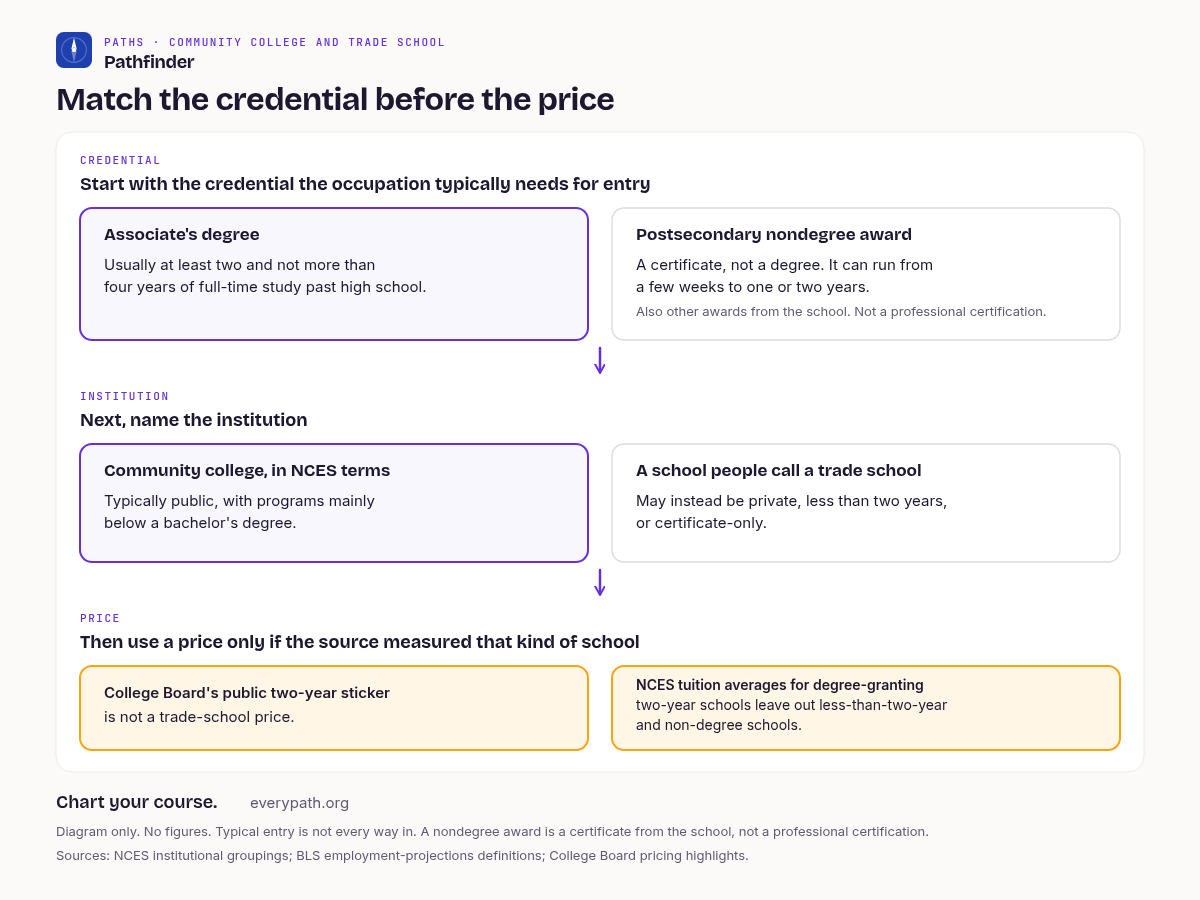
- Look up the occupation's typical entry education. If BLS says associate's degree, a certificate-only school is not the typical path, though the Handbook may describe alternates. If BLS says postsecondary nondegree award, an associate degree may be more schooling than the typical entry, which can still be what you want for later transfer. Typical is not a ban on the other award.
- Name the award this program grants. Associate degree, certificate, or both. If the school grants only certificates, NCES calls it non-degree-granting. If it grants an associate degree, it is degree-granting even if the brochure says trade.
- Name control and level. Public, private nonprofit, or private for-profit. Four-year, 2-year, or less than 2-year. A public college with certificates and associate degrees is the community college pattern even when a private school nearby teaches the same skill. A private for-profit less-than-2-year school is not a community college, whatever the billboard says.
- Attach a price only to a matching source. College Board's 2025-26 in-district sticker for the public two-year sector: $4,150 on average, with a wide state range, and average grant aid that has covered tuition and fees for the student group they describe since 2009-10. Degree-granting 2-year tuition and fees, NCES, constant 2022-23 dollars: 4,000 dollars public, 16,300 dollars private for-profit, 19,500 dollars private nonprofit. If the school is less-than-2-year or non-degree-granting, neither line is its price.
- Send the other comparisons away. Choosing a community college in order to transfer to a university is the job of community college compared with a university. Choosing a trade program instead of a four-year degree is the job of trade school compared with college. This page stops once you know which institution type and which award you are actually holding.
If two schools grant the same certificate, the remaining differences are control, level, price you confirmed with the school, and how you will live during the program. If one grants an associate degree and the other grants only a certificate, you are not choosing between two versions of the same thing. Write the award on a card before you compare cost. If you cannot name the occupation yet, still deciding beats picking a campus nickname. Keep a primary and backup path: one program whose award matches the occupation's typical entry, and a second program whose award you understand even if you are not ready to start.
Is public 2-year the same label as community college?
Not always. NCES says community colleges are typically public and offer programs mainly below a bachelor's degree, including certificates and associate degrees. It also says public 2-year misses some community colleges that now offer bachelor's degrees and are classified as public 4-year. IPEDS has no single community-college flag.
Does College Board publish a trade-school sticker price?
Not on the highlights page opened for this article. That page reports the in-district sticker for public two-year colleges, plus public four-year prices and private nonprofit four-year prices. It does not add a trade-school line. Do not reuse the public two-year figure as a trade-school price.
Is a certificate the same thing as an associate degree?
No. BLS puts an associate's degree at roughly two to four years of full-time study after high school. A postsecondary nondegree award is the school's certificate, and it is not a degree. Length can be a few weeks, or it can be one or two years.
Does the phrase vocational school in the BLS glossary mean trade school?
Not in the way people use trade school after high school. The Occupational Outlook Handbook glossary defines vocational school as a secondary school that teaches vocational trades. It may or may not award degrees. That is a high-school category, not a postsecondary one.
Can a community college teach the same skill a trade school teaches?
Yes, it can offer certificates as well as associate degrees. NCES describes that range as typical. The school type does not settle the credential. Read the award the program actually grants, then check which institution category the school falls into.
Sources
- Institutional Groupings in IPEDS — National Center for Education Statistics, accessed 2026-10-02
- NCES Handbook of Survey Methods — IPEDS key concepts — National Center for Education Statistics, accessed 2026-10-02
- Fast Facts: Tuition costs of colleges and universities (76) — National Center for Education Statistics, 2022-23 figures, accessed 2026-10-02
- Trends in College Pricing: Highlights — College Board, 2025-26 highlights, accessed 2026-10-02
- Employment Projections Data Definitions — U.S. Bureau of Labor Statistics, accessed 2026-10-02
- Measures of Education and Training — U.S. Bureau of Labor Statistics, accessed 2026-10-02
- Occupational Outlook Handbook — Glossary — U.S. Bureau of Labor Statistics, accessed 2026-10-02
Chart your course
The campus nickname is not the credential. Pathfinder can hold the award you named next to a backup route, and it marks each claim as sourced, estimated, or advisory.
Frequently asked questions
Is public 2-year the same label as community college?
Not always. NCES says community colleges are typically public and offer programs mainly below a bachelor's degree, including certificates and associate degrees. It also says public 2-year misses some community colleges that now offer bachelor's degrees and are classified as public 4-year. IPEDS has no single community-college flag.
Does College Board publish a trade-school sticker price?
Not on the highlights page opened for this article. That page reports the in-district sticker for public two-year colleges, plus public four-year prices and private nonprofit four-year prices. It does not add a trade-school line. Do not reuse the public two-year figure as a trade-school price.
Is a certificate the same thing as an associate degree?
No. BLS puts an associate's degree at roughly two to four years of full-time study after high school. A postsecondary nondegree award is the school's certificate, and it is not a degree. Length can be a few weeks, or it can be one or two years.
Does the phrase vocational school in the BLS glossary mean trade school?
Not in the way people use trade school after high school. The Occupational Outlook Handbook glossary defines vocational school as a secondary school that teaches vocational trades. It may or may not award degrees. That is a high-school category, not a postsecondary one.
Can a community college teach the same skill a trade school teaches?
Yes, it can offer certificates as well as associate degrees. NCES describes that range as typical. The school type does not settle the credential. Read the award the program actually grants, then check which institution category the school falls into.
Sources
- Institutional Groupings in IPEDS — National Center for Education Statistics, accessed 2026-10-02
- NCES Handbook of Survey Methods — IPEDS key concepts — National Center for Education Statistics, accessed 2026-10-02
- Fast Facts: Tuition costs of colleges and universities (76) — National Center for Education Statistics (2022-23), accessed 2026-10-02
- Trends in College Pricing: Highlights — College Board (2025), accessed 2026-10-02
- Employment Projections Data Definitions — U.S. Bureau of Labor Statistics, accessed 2026-10-02
- Measures of Education and Training — U.S. Bureau of Labor Statistics, accessed 2026-10-02
- Occupational Outlook Handbook — Glossary — U.S. Bureau of Labor Statistics, accessed 2026-10-02
Chart your course
Pathfinder builds you a plan for whichever path you pick — or for “still deciding” — and labels every claim in it as grounded, modelled or advisory. It will not invent a deadline, a cost, or your chances of getting in.
Start free No credit card required.
Related reading
- Do apprenticeships count as college credit? When and how
Some registered apprenticeships earn college credit, but never automatically. Where credit comes from, how ACE reviews and state deals work, and what to ask.
- Trade school vs. college: costs, wages and time
Trade school vs. college with sourced US data: what each costs, what the jobs pay, how long each takes, and what the averages cannot tell you.
- Community college vs university after high school?
Community college then transfer vs starting at a university: what each path is for, with sourced US figures where available — no invented transfer odds.