Paths after high school
Can you quit an apprenticeship? Probation, notice, credit
By Pathfinder Editorial · Published · 11 min read
About: Registered apprenticeship Trade and apprenticeship Pathway
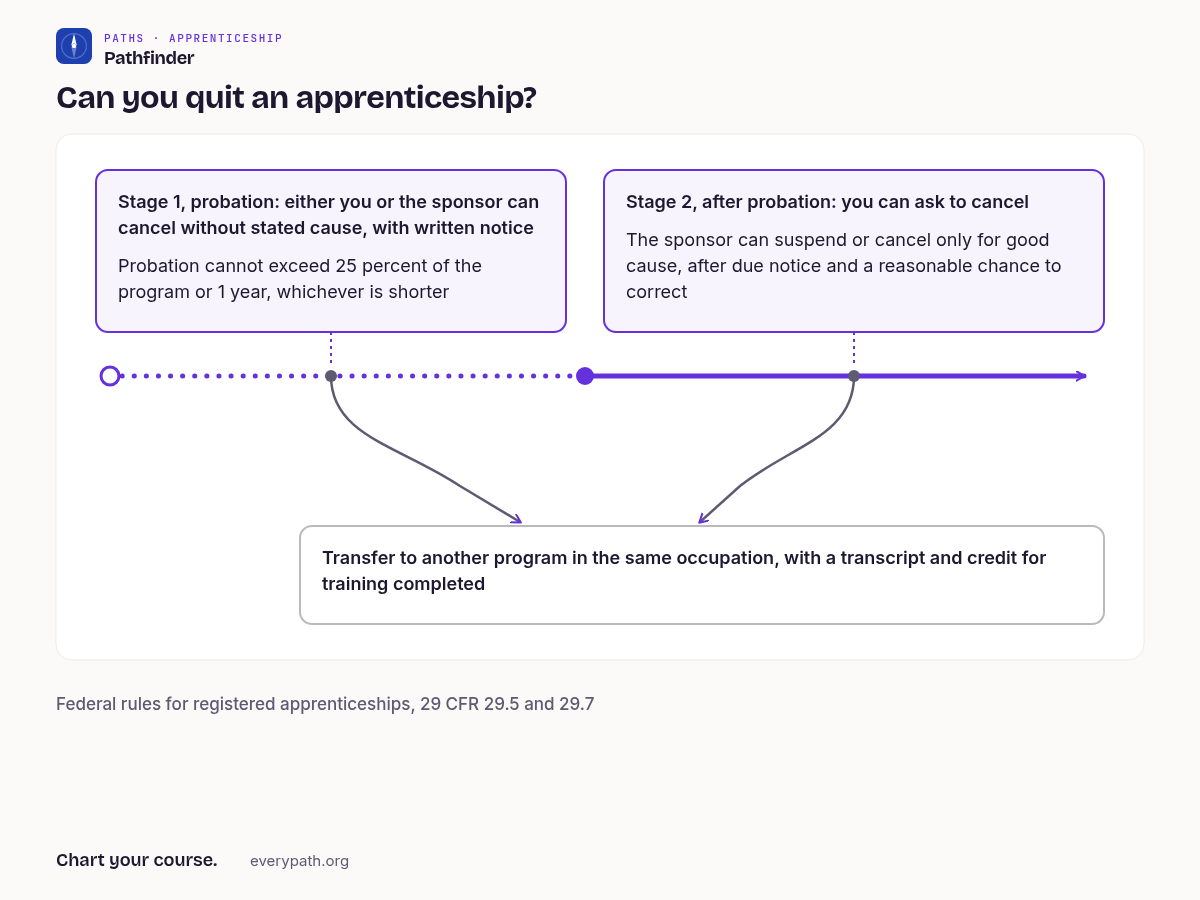
Yes, you can quit a registered apprenticeship. During the probationary period, federal rules let either you or the sponsor cancel the agreement without giving a reason. After probation, the agreement may still be cancelled at your request. If you transfer to another program in the same occupation, the new sponsor must credit the training you satisfactorily completed.
That is the short answer. The useful part is in the details: how long probation can last, what changes once it ends, what a sponsor can and cannot do, and how to leave without throwing away the hours you already put in. This page covers the United States federal rules for registered programs. States that run their own registration agency may add steps, and a training job with no registration falls outside these rules entirely.
If you are not yet sure what registration means, read what a registered apprenticeship is first. To look for a different program before you leave this one, use finding a registered apprenticeship near you. If money is the reason you are thinking of leaving, the wage schedule is explained in how pay works during a registered apprenticeship, and if the length is the problem, see how long a registered apprenticeship takes. The full set of routes after school is on every path after high school.
Where the right to leave is written
Two federal regulations do the work. The first, 29 CFR 29.5, lists what a program's written standards must contain before a registration agency will approve it. The second, 29 CFR 29.7, lists what your individual apprenticeship agreement must say.
Your agreement has to include, "explicitly or by reference," statements on probation and cancellation. It also has to incorporate the program's standards "as they exist on the date of the agreement." So the paper you signed, plus the standards it points to, is where your exit terms live. If you do not have a copy, ask the sponsor for both.
The agreement must also list contact details for the sponsor and the registration agency, and for the person designated to handle disputes that cannot be settled locally. Those names matter if leaving turns into a disagreement.
Quitting during probation
Every registered program has a probationary period at the start. Under 29 CFR 29.5(b)(20), the standards must give "authority for the cancellation of an apprenticeship agreement during the probationary period by either party without stated cause."
That phrase has three parts worth reading slowly:
- Either party. You can cancel, and so can the sponsor.
- Without stated cause. Nobody has to give a reason. You do not need to prove the job is bad, and the sponsor does not need to prove you did poorly.
- During the probationary period. The no-reason rule covers only this window.
The agreement rule in 29 CFR 29.7(h)(1) adds the mechanics: the agreement must provide for a specific probation period during which it "may be cancelled by either party to the agreement upon written notice to the registration agency." The Labor Department's reference guide for sponsors describes the same step from the apprentice's side. Either party may end the agreement "by notifying the other party in writing."
A practical reading: say it in writing, keep a copy, and ask the sponsor to confirm that the registration agency has been told.
How long probation can last
The standards set the length, inside a federal cap. Section 29.5(b)(8) requires "a probationary period reasonable in relation to the full apprenticeship term," and says it "cannot exceed 25 percent of the length of the program, or 1 year, whichever is shorter."
Two examples, worked from that rule rather than from any real program:
| Program length | 25 percent of it | Longest probation allowed |
|---|---|---|
| 2 years | 6 months | 6 months |
| 4 years | 1 year | 1 year |
| 5 years | 15 months | 1 year, because the cap is the shorter figure |
A program can set a shorter probation than the cap. Your agreement tells you the actual period, so check the date it ends.
Probation time is not wasted
The same paragraph says probation comes "with full credit given for such period toward completion of apprenticeship." If you stay, the months you spent on probation count toward finishing. The sponsor guide adds that an apprentice evaluated as satisfactory after probation "must be given full credit for the probationary period and continue in the program."
Why a sponsor will not be penalized
Some people worry that leaving early damages the sponsor and will be held against them. Federal rules answer that directly. Section 29.5(b)(20) and section 29.6(d) both say cancellation during probation "will not have an adverse impact" on the sponsor's completion rate. Registration agencies compare program completion rates to the national average, and probation exits are kept out of that comparison by rule.
Quitting after probation
The no-reason window closes when probation ends, but you are not locked in. Under 29 CFR 29.7(h)(2), after the probationary period the agreement may be "cancelled at the request of the apprentice."
The rule treats the two sides differently from here on. You can ask to cancel. The sponsor can suspend or cancel only "for good cause, with due notice to the apprentice and a reasonable opportunity for corrective action, and with written notice to the apprentice and to the Registration Agency of the final action taken."
The sponsor guide uses the phrase "reasonable cause after documented due notice" and adds a timeline for programs it covers: for all cancellations, the sponsor must give the apprentice written notice and tell the Office of Apprenticeship of the action within 45 days. A state registration agency can set its own timing.
What the rules do not do is set a notice period you owe the employer. The regulations do not say "two weeks." Your employer's own policies or a collective bargaining agreement may say something, so read those before you set a last day.
Transferring instead of quitting
Often the real question is not "can I stop" but "can I stop here and keep going somewhere else." The rules have a separate path for that.
Section 29.5(b)(13) says a transfer between programs, or within one, "must be based on agreement between the apprentice and the affected apprenticeship committees or program sponsors." It then sets three conditions:
- The committee or sponsor must hand you a transcript covering your related instruction and your on-the-job learning.
- The transfer "must be to the same occupation."
- Moving between sponsors means signing a fresh apprenticeship agreement.
The sponsor guide adds the line that answers the credit question: "The apprentice must receive credit from the new sponsor for the training already satisfactorily completed."
So, in a transfer, the hours and instruction you finished well count at the new program. Three limits sit on that promise:
- Same occupation only. Switching to a different occupation is not a transfer under this rule. You would apply as a new entrant.
- Agreement is needed. The rule says transfers are "based on agreement," so the receiving sponsor has to take you on. A transcript does not guarantee a seat.
- "Satisfactorily completed." Credit attaches to training finished to the program's standard, not to every hour clocked.
Credit for experience when you start fresh
If you quit outright and later apply to a program in a different occupation, the transfer rule does not apply. A different rule might still help. Section 29.5(b)(12) requires every program's standards to offer advanced standing or credit for skills, experience, or training you can demonstrate, on equal terms for all applicants, with pay that matches any step you are moved up to.
The sponsor guide says a sponsor that accepts such requests must take them "at the time of application," ask for records, and decide the amount of credit before probation ends. That is a sponsor decision, not an automatic carry-over, but your transcript is the record that makes the request possible.
If the whole program is cancelled
Sometimes the apprentice does not leave; the program does. The sponsor guide says that when a program is deregistered, the sponsor must tell each active apprentice the effective date, that the cancellation "automatically deprives apprentices of individual registration," and that apprentices "may contact the Office of Apprenticeship for information regarding potential transfer to other Registered Apprenticeship programs." If this happens, ask for your transcript at once.
How to leave without losing ground
- Find the date probation ends. It is in your agreement. Leaving before it is the simplest exit under the rules.
- Decide whether you are quitting or transferring. If you want to stay in the same occupation, look for a receiving sponsor before you cancel.
- Ask for your transcript. Related instruction and on-the-job learning, in writing. You are entitled to it in a transfer, and it helps any later credit request.
- Put the cancellation in writing. Keep a copy, and ask that the registration agency be notified.
- Check employer policy separately. The federal rules cover the apprenticeship agreement. Your job may have its own notice terms.
- Use the dispute contact if needed. The agreement names someone to handle disagreements that cannot be settled locally.
Common mistakes when leaving an apprenticeship
- Assuming you need a reason during probation. The rule says "without stated cause." You do not.
- Assuming you are stuck once probation ends. You can still ask to cancel. What ends is the sponsor's right to cancel you without good cause.
- Cancelling before lining up a transfer. Credit for completed training is tied to the transfer path, which needs a receiving sponsor.
- Expecting credit in a different occupation. Transfers must be to the same occupation. Anything else is an advanced-standing request.
- Leaving without a transcript. It is the record of what you finished. Get it before your last day.
Can you quit an apprenticeship during probation?
Yes. Every registered program's standards must give both the apprentice and the sponsor the right to cancel the agreement during the probationary period without stated cause. You do not need to explain why. The Labor Department's sponsor guide says this is done by notifying the other party in writing, so put your decision on paper.
How long is the probationary period?
Each program sets its own, but federal standards cap it. It has to be reasonable for the length of the program and is capped at 25 percent of the program or one year, whichever is shorter. The time counts in full toward finishing the apprenticeship if you stay. Your agreement states the exact period.
Can you quit after probation ends?
Yes. The federal rule on apprenticeship agreements lets an apprentice ask for cancellation once probation is over. The sponsor can also suspend or cancel it, but only for good cause, after due notice and a reasonable chance to fix the problem, with written notice of the final action.
Do you keep credit for hours you already finished?
If you transfer to another registered program in the same occupation, yes. The sponsor must give you a transcript of your related instruction and on-the-job learning, and the Labor Department's sponsor guide says the new sponsor must credit training already completed satisfactorily. Simply quitting with no transfer has no such promise.
Does quitting during probation hurt the sponsor?
Not on its completion rate. Federal rules say cancelling during the probationary period will not have an adverse impact on the sponsor's completion rate. That protection is written into the program standards, so leaving in that window does not count against the program's completion figures. Cancellations still have to be reported to the registration agency.
Sources
- 29 CFR 29.5, Standards of apprenticeship , eCFR, title 29 as of 20 October 2026, paragraphs (b)(8), (b)(12), (b)(13), and (b)(20), read 22 October 2026
- 29 CFR 29.7, Apprenticeship agreement , eCFR, paragraphs (c), (h), (i), and (k), read 22 October 2026
- 29 CFR 29.6, Program performance standards , eCFR, paragraphs (c) and (d), read 22 October 2026
- Requirements for Apprenticeship Sponsors Reference Guide , Office of Apprenticeship, sections on transfer, deregistration, credit for previous experience, and probationary period, read 22 October 2026
Chart your course
Thinking about leaving? Lay the program you are in beside the one you would move to, and let Pathfinder keep both plans in view. Pathfinder tags each claim sourced, estimated, or advisory.
Frequently asked questions
Can you quit an apprenticeship during probation?
Yes. Every registered program's standards must give both the apprentice and the sponsor the right to cancel the agreement during the probationary period without stated cause. You do not need to explain why. The Labor Department's sponsor guide says this is done by notifying the other party in writing, so put your decision on paper.
How long is the probationary period?
Each program sets its own, but federal standards cap it. It has to be reasonable for the length of the program and is capped at 25 percent of the program or one year, whichever is shorter. The time counts in full toward finishing the apprenticeship if you stay. Your agreement states the exact period.
Can you quit after probation ends?
Yes. The federal rule on apprenticeship agreements lets an apprentice ask for cancellation once probation is over. The sponsor can also suspend or cancel it, but only for good cause, after due notice and a reasonable chance to fix the problem, with written notice of the final action.
Do you keep credit for hours you already finished?
If you transfer to another registered program in the same occupation, yes. The sponsor must give you a transcript of your related instruction and on-the-job learning, and the Labor Department's sponsor guide says the new sponsor must credit training already completed satisfactorily. Simply quitting with no transfer has no such promise.
Does quitting during probation hurt the sponsor?
Not on its completion rate. Federal rules say cancelling during the probationary period will not have an adverse impact on the sponsor's completion rate. That protection is written into the program standards, so leaving in that window does not count against the program's completion figures. Cancellations still have to be reported to the registration agency.
Sources
- 29 CFR 29.5, Standards of apprenticeship — U.S. Department of Labor (Electronic Code of Federal Regulations), accessed 2026-10-22
- 29 CFR 29.7, Apprenticeship agreement — U.S. Department of Labor (Electronic Code of Federal Regulations), accessed 2026-10-22
- 29 CFR 29.6, Program performance standards — U.S. Department of Labor (Electronic Code of Federal Regulations), accessed 2026-10-22
- Requirements for Apprenticeship Sponsors Reference Guide — U.S. Department of Labor, Office of Apprenticeship, accessed 2026-10-22
Chart your course
Pathfinder builds you a plan for whichever path you pick — or for “still deciding” — and labels every claim in it as grounded, modelled or advisory. It will not invent a deadline, a cost, or your chances of getting in.
Start free No credit card required.
Related reading
- What is a youth apprenticeship, and can you start at 16?
A youth apprenticeship lets a high school student start a registered apprenticeship at 16, with school, an employer, and a parent signing on.
- What happens when you finish an apprenticeship today
What happens when you finish an apprenticeship? You may get a completion certificate. It is not a wage or a journeyworker title. Check who issued it.
- Registered apprenticeship vs trade school explained
A registered apprenticeship is a validated paid job. Trade school can teach the class and still not be the program. Check who sponsors it.