Paths after high school
Is there an age limit for apprenticeships? The federal rules
By Pathfinder Editorial · Published · 11 min read
About: Registered apprenticeship Trade and apprenticeship Pathway

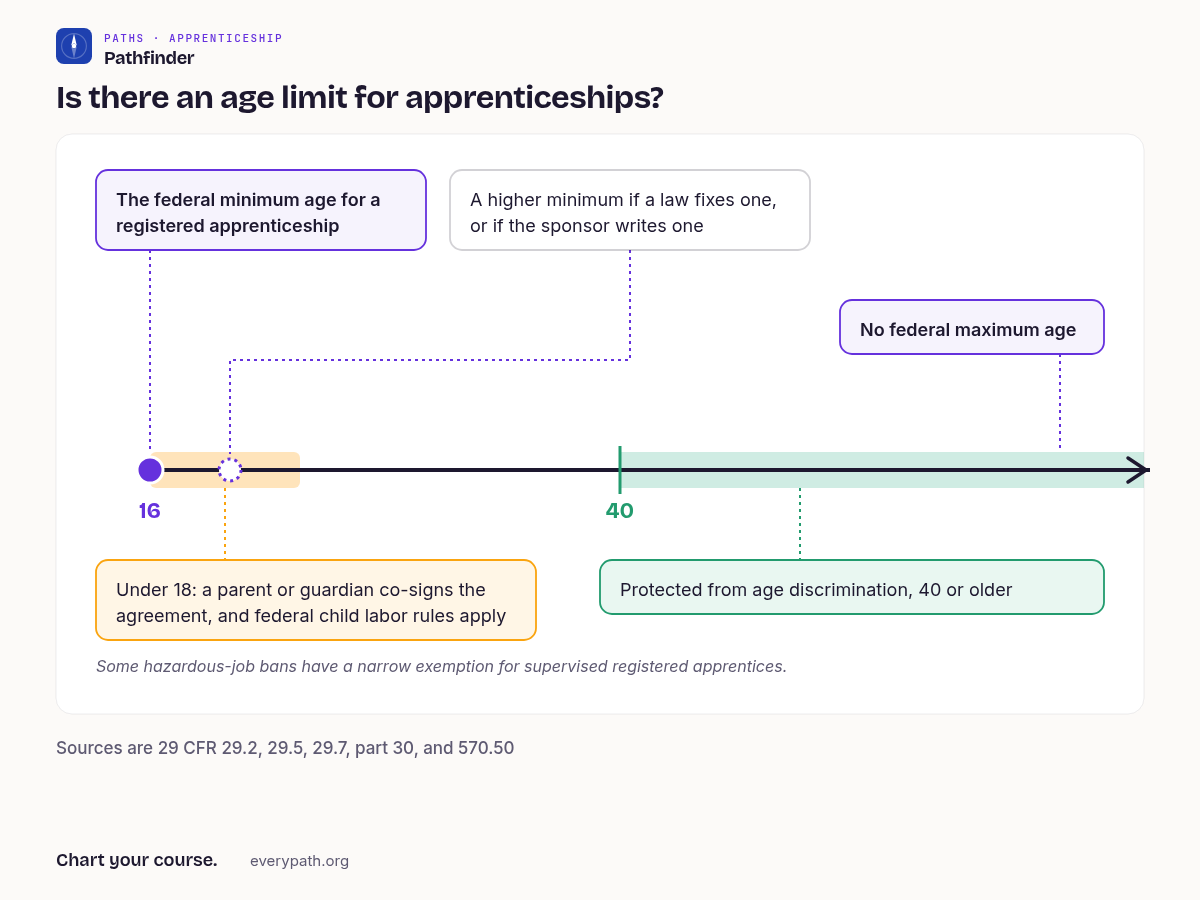
Federal rules (29 CFR 29.5) set a minimum age of 16 for a registered apprenticeship and no maximum. Federal equal opportunity rules (29 CFR part 30) bar sponsors from discriminating against applicants aged 40 or older. The missing cap is a gap in federal rules, not a promise of a place. Sponsors set their own requirements for a registered apprenticeship.
So the age question has two halves, and they work differently. The bottom of the range is a hard floor written into the regulations. The top of the range is not a number at all; it is an anti-discrimination rule. This page explains both, what changes for applicants under 18, and how to tell a legal age rule from a sponsor's own choice.
Grades, a diploma, and tests are covered on the requirements page linked above, not here. If you are still in high school, how youth apprenticeship works covers programs built for students. If you are older and wondering whether apprenticeship only means construction, see registered apprenticeship occupations outside the trades. For a map of every route, start at every path after high school.
Everything below is the federal system for registered programs. A state apprenticeship agency can layer on its own requirements, and an unregistered training job is not bound by any of it.
The minimum age: 16
The floor appears twice in the Labor Department's apprenticeship regulations.
The definition in 29 CFR 29.2 says an apprentice is "a worker at least 16 years of age, except where a higher minimum age standard is otherwise fixed by law, who is employed to learn an apprenticeable occupation."
The standards section, 29 CFR 29.5(b)(10), turns that into a duty on every program seeking registration. Its written standards must spell out the sponsor's minimum qualifications for entrants, and the eligible starting age in them may not be below 16.
The Office of Apprenticeship's reference guide for sponsors puts it plainly: "An apprentice must be at least 16 years old unless applicable law requires a higher age."
Read together, these give three possible minimums for a given program:
| Where the minimum comes from | What it means for you |
|---|---|
| The federal floor | No registered program can set an eligible starting age under 16. |
| A law fixing a higher age for the work | That higher age controls. The regulation points to this case but does not list the laws. |
| The sponsor's own qualifications | A sponsor may choose a higher starting age, written into its standards. |
The highest of the three is the one you face. If a sponsor says "you must be 18," ask which of the last two it is. A legal age travels with the occupation; a sponsor's choice may not apply at the next sponsor.
Is there a maximum age?
The federal apprenticeship regulations set a minimum age and no maximum. Neither the definition in 29.2 nor the list of required standards in 29.5 contains an upper limit or any language ending eligibility at a certain age.
That is a reading of what the text does not say, so it helps that a second set of rules speaks directly. Federal equal opportunity rules for apprenticeship, in 29 CFR part 30, list age as a protected basis for people aged 40 or older.
- 29 CFR 30.3(a)(1) says it is "unlawful for a sponsor of a registered apprenticeship program to discriminate against an apprentice or applicant for apprenticeship" on the basis of several listed traits, including "age (40 or older)." The covered areas include recruitment, outreach and selection, hiring, pay, and the other terms of apprenticeship.
- 29 CFR 30.3(a)(2)(iii) says the registration agency applies the same standards and defenses for age discrimination as those in the Age Discrimination in Employment Act and its implementing regulations.
- 29 CFR 30.10(b)(4) says a sponsor's selection procedures "must be facially neutral" on several bases, including "age (40 or older)."
- 29 CFR 29.7(j) requires every apprenticeship agreement to state that the apprentice will be given equal opportunity without discrimination because of age, among other bases, again written as 40 or older.
The equal opportunity pledge that sponsors must publish, in 30.3(c), says the sponsor "will not discriminate against apprenticeship applicants or apprentices" because they are "a person 40 years old or older."
What these rules do not do is promise you a seat. An older applicant still meets the same written qualifications and goes through the same selection procedure as everyone else. The protection is against being screened out because of age, not against being screened out at all.
What changes if you are 16 or 17
Starting before 18 is allowed under the federal floor, but two extra layers apply.
A parent or guardian signs too. Under 29 CFR 29.7(a), the apprenticeship agreement must carry the names and signatures of the apprentice and the sponsor or employer, "and the signature of a parent or guardian if the apprentice is a minor." The agreement also records your date of birth, under 29.7(b).
Child labor rules still apply. Federal youth employment rules cover 16- and 17-year-olds in any job, including an apprenticeship. Under 29 CFR 570.2(a)(1)(ii), federal law "sets an 18-year minimum age" for any occupation the Labor Department declares "particularly hazardous" for minors. For those jobs, that law can sit above the apprenticeship floor of 16, subject to the narrow exemption described next. Some of the hazardous occupations orders contain a narrow exemption for apprentices. Under 29 CFR 570.50(b), it applies only when the apprentice is in a recognized apprenticeable trade, the hazardous work is "incidental to his training," it is "intermittent and for short periods of time" under the "direct and close supervision of a journeyman," and the apprentice is registered or working under an agreement found to conform to federal or state standards. The same section says nothing in it authorizes breaking any federal, state, or local law that sets a higher standard.
For how those youth rules work in general, read jobs you can do under 18. The short version for this page: being 16 gets you past the apprenticeship floor, but it does not switch off youth work rules.
Can a sponsor set its own age rule?
Yes, within limits. Section 29.5(b)(10) asks the sponsor to write "the minimum qualifications required by a sponsor," and the floor sits inside that sentence. The sponsor guide allows extra qualifications in the standards where they fit the program, and it bars discriminatory ones.
In practice, a sponsor may say its program starts at 18. That is a program rule, written into standards the registration agency approves. What the part 30 rules shut out is a qualification that discriminates against applicants 40 or older.
If a sponsor's age line looks wrong to you, the apprenticeship agreement must list a contact for complaints, and the program standards must name the person with authority to receive and handle complaints, under 29.5(b)(22).
A worked example, labeled as an example
Suppose a 17-year-old and a 52-year-old both apply to the same registered program, and its standards set a starting age of 18. The 17-year-old is under that sponsor's line, even though the federal floor is 16, and can apply once they turn 18 or look for a sponsor whose standards start lower. The 52-year-old clears the age line and faces the same written qualifications and selection procedure as any other applicant. Age alone cannot be the reason they are turned away.
How to check the age rule for a program you want
- Ask for the minimum qualifications. They are part of the written program standards. The age line will be in them.
- Ask where a higher minimum comes from. Is it a law for the occupation, or the sponsor's own choice?
- If you are under 18, ask about youth work rules. Which tasks are off limits until 18, and how the program handles that.
- If you are 40 or older, judge the qualifications on their own terms. Look at what the standards ask for, not at the average age of current apprentices.
- Compare sponsors. A sponsor's own higher minimum may not appear at another sponsor in the same occupation.
Common mistakes about apprenticeship age limits
- Thinking 16 means every program takes 16-year-olds. It is a floor. A law or a sponsor can set a higher starting age.
- Thinking there is a cutoff in your 20s. The federal apprenticeship regulations contain no maximum age.
- Treating a sponsor's age choice as a law. Ask which it is. Only a legal age follows the occupation everywhere.
- Forgetting the guardian signature. A minor's agreement is not complete without a parent's or guardian's signature.
- Reading age protection as a promised place. Applicants 40 or older are protected from age discrimination, but still go through the same selection procedure.
What is the youngest age you can start an apprenticeship?
Under federal rules, 16. Under the federal definition an apprentice is at least 16, and a program's eligible starting age cannot be set lower. Where another law fixes a higher minimum age for the work, that higher age applies instead. A sponsor may also write its own higher minimum.
Is there a maximum age for an apprenticeship?
The federal apprenticeship regulations set a minimum age and no maximum. On top of that, sponsors are barred from discriminating against apprentices or applicants aged 40 or older, and selection procedures must be neutral on age for that group. A cutoff that shuts out older applicants would run against those rules.
Can you be too old to start an apprenticeship at 30, 40, or 50?
Not under the federal rules. Nothing in the registered apprenticeship regulations ends eligibility at a certain age, and people 40 or older are a protected group in recruitment, selection, pay, and other terms. You still have to meet the sponsor's written qualifications and go through its selection procedure, like anyone else.
What changes if you are under 18?
Two things in the federal rules. For a minor, the agreement needs a parent's or guardian's signature as well. And federal child labor rules for 16- and 17-year-olds still apply, though some hazardous-work bans have a narrow exemption for registered apprentices under close supervision. States can add stricter rules.
Can a sponsor set a higher minimum age than 16?
Yes. Federal standards let sponsors write minimum qualifications for entrants, and the sponsor guide says sponsors may note additional minimum qualifications where appropriate. A higher starting age is one example. Those qualifications cannot be discriminatory, and they must sit in the written program standards that the registration agency approves.
Sources
- 29 CFR 29.2, Definitions , eCFR, title 29 as of 20 October 2026, definition of apprentice, read 22 October 2026
- 29 CFR 29.5, Standards of apprenticeship , eCFR, paragraphs (b)(10) and (b)(22), read 22 October 2026
- 29 CFR 29.7, Apprenticeship agreement , eCFR, paragraphs (a), (b), and (j), read 22 October 2026
- 29 CFR 30.3, Equal opportunity standards applicable to all sponsors , eCFR, paragraphs (a) and (c), read 22 October 2026
- 29 CFR 30.10, Selection of apprentices , eCFR, paragraph (b)(4), read 22 October 2026
- 29 CFR 570.2, Minimum age standards , eCFR, paragraph (a)(1)(ii), read 22 October 2026
- 29 CFR 570.50, General rules for the hazardous occupations orders , eCFR, paragraphs (a) and (b), read 22 October 2026
- Requirements for Apprenticeship Sponsors Reference Guide , Office of Apprenticeship, section B, read 22 October 2026
Chart your course
At 16 or at 46, weigh an apprenticeship against your other option with both plans open in Pathfinder. Each claim there is tagged sourced, estimated, or advisory.
Frequently asked questions
What is the youngest age you can start an apprenticeship?
Under federal rules, 16. Under the federal definition an apprentice is at least 16, and a program's eligible starting age cannot be set lower. Where another law fixes a higher minimum age for the work, that higher age applies instead. A sponsor may also write its own higher minimum.
Is there a maximum age for an apprenticeship?
The federal apprenticeship regulations set a minimum age and no maximum. On top of that, sponsors are barred from discriminating against apprentices or applicants aged 40 or older, and selection procedures must be neutral on age for that group. A cutoff that shuts out older applicants would run against those rules.
Can you be too old to start an apprenticeship at 30, 40, or 50?
Not under the federal rules. Nothing in the registered apprenticeship regulations ends eligibility at a certain age, and people 40 or older are a protected group in recruitment, selection, pay, and other terms. You still have to meet the sponsor's written qualifications and go through its selection procedure, like anyone else.
What changes if you are under 18?
Two things in the federal rules. For a minor, the agreement needs a parent's or guardian's signature as well. And federal child labor rules for 16- and 17-year-olds still apply, though some hazardous-work bans have a narrow exemption for registered apprentices under close supervision. States can add stricter rules.
Can a sponsor set a higher minimum age than 16?
Yes. Federal standards let sponsors write minimum qualifications for entrants, and the sponsor guide says sponsors may note additional minimum qualifications where appropriate. A higher starting age is one example. Those qualifications cannot be discriminatory, and they must sit in the written program standards that the registration agency approves.
Sources
- 29 CFR 29.2, Definitions — U.S. Department of Labor (Electronic Code of Federal Regulations), accessed 2026-10-22
- 29 CFR 29.5, Standards of apprenticeship — U.S. Department of Labor (Electronic Code of Federal Regulations), accessed 2026-10-22
- 29 CFR 29.7, Apprenticeship agreement — U.S. Department of Labor (Electronic Code of Federal Regulations), accessed 2026-10-22
- 29 CFR 30.3, Equal opportunity standards applicable to all sponsors — U.S. Department of Labor (Electronic Code of Federal Regulations), accessed 2026-10-22
- 29 CFR 30.10, Selection of apprentices — U.S. Department of Labor (Electronic Code of Federal Regulations), accessed 2026-10-22
- 29 CFR part 30, Equal employment opportunity in apprenticeship — U.S. Department of Labor (Electronic Code of Federal Regulations), accessed 2026-11-02
- 29 CFR 570.2, Minimum age standards — U.S. Department of Labor (Electronic Code of Federal Regulations), accessed 2026-10-22
- 29 CFR 570.50, General rules for the hazardous occupations orders — U.S. Department of Labor (Electronic Code of Federal Regulations), accessed 2026-10-22
- Requirements for Apprenticeship Sponsors Reference Guide — U.S. Department of Labor, Office of Apprenticeship, accessed 2026-10-22
Chart your course
Pathfinder builds you a plan for whichever path you pick — or for “still deciding” — and labels every claim in it as grounded, modelled or advisory. It will not invent a deadline, a cost, or your chances of getting in.
Join the free pilot Free during the pilot. No card, no payment.
Related reading
- Can you quit an apprenticeship? Probation, notice, credit
Yes. Federal rules let you cancel during probation without a reason and ask to cancel later. Transfers to a new sponsor carry your completed training.
- What is a youth apprenticeship, and can you start at 16?
A youth apprenticeship lets a high school student start a registered apprenticeship at 16, with school, an employer, and a parent signing on.
- What happens when you finish an apprenticeship today
What happens when you finish an apprenticeship? You may get a completion certificate. It is not a wage or a journeyworker title. Check who issued it.