Paths after high school
What happens when you finish an apprenticeship today
By Pathfinder Editorial · Published · 13 min read
About: Pathway Registered apprenticeship Trade and apprenticeship Grounded

What happens when you finish an apprenticeship that a registration agency has accepted is a completion certificate, not a wage and not a new clock. Journeyworker is a separate skill word in the rule. The help page that names the certificate does not use that word.
This page is only that ending. It does not time the program. That question stays on how long a registered program is allowed to run. It does not price the months you are learning. Pay belongs on its own page, and this one does not link it. Whether related instruction later counts as college credit is one step, on whether an apprenticeship can count as college credit, and the answer is not copied here. What it means for a program to be registered sits on what registration is, as one route inside paths after high school.
The lines below come from pages opened on 3 October 2026. The rule text is the versioner file for title 29, part 29, at the issue date that file's version list calls latest: 30 September 2026. If no registration agency has accepted the program, these pages are not describing your paper.
What the registration agency issues at the end
The career-seeker help page answers in a single beat. DOL's apprenticeship office, or else the state agency recognized to register programs, grants a Certificate of Completion of Apprenticeship to someone who successfully finished a registered program. The page calls that credential nationally recognized.
Circular 2026-01, dated 9 March 2026, says who moves first. Standards have to provide for recognizing a successful finish by a certificate the registration agency issues. That is the job already given to standards in 29 CFR 29.5(b)(15). The circular then says the agency issues the certificate once the sponsor certifies, and documents, that the apprentice met the training requirements written in the standards.
Keep the order. The sponsor certifies and documents. The agency issues. The help page does not say the employer may print that nationally recognized completion certificate on company letterhead and call it done. The circular does not say the sponsor's signature, standing alone, is the certificate.
The versioner text for the 30 September 2026 issue matches the citation. Section 29.5(b)(15) requires standards to recognize a successful finish, and the evidence it names is a certificate the registration agency issues. Section 29.5(b)(19) requires standards to give the agency notice of people who have successfully finished, plus notice of transfers, suspensions, and cancellations. Finishing is reported. The certificate comes from the agency after that report.
In the definitions, a registration agency is DOL's apprenticeship office or else a state agency recognized to register programs. The definition's task list is registering programs and apprentices, technical help, reviews under this part and under 29 CFR part 30, and quality checks. The completion certificate is the act in 29.5(b)(15).
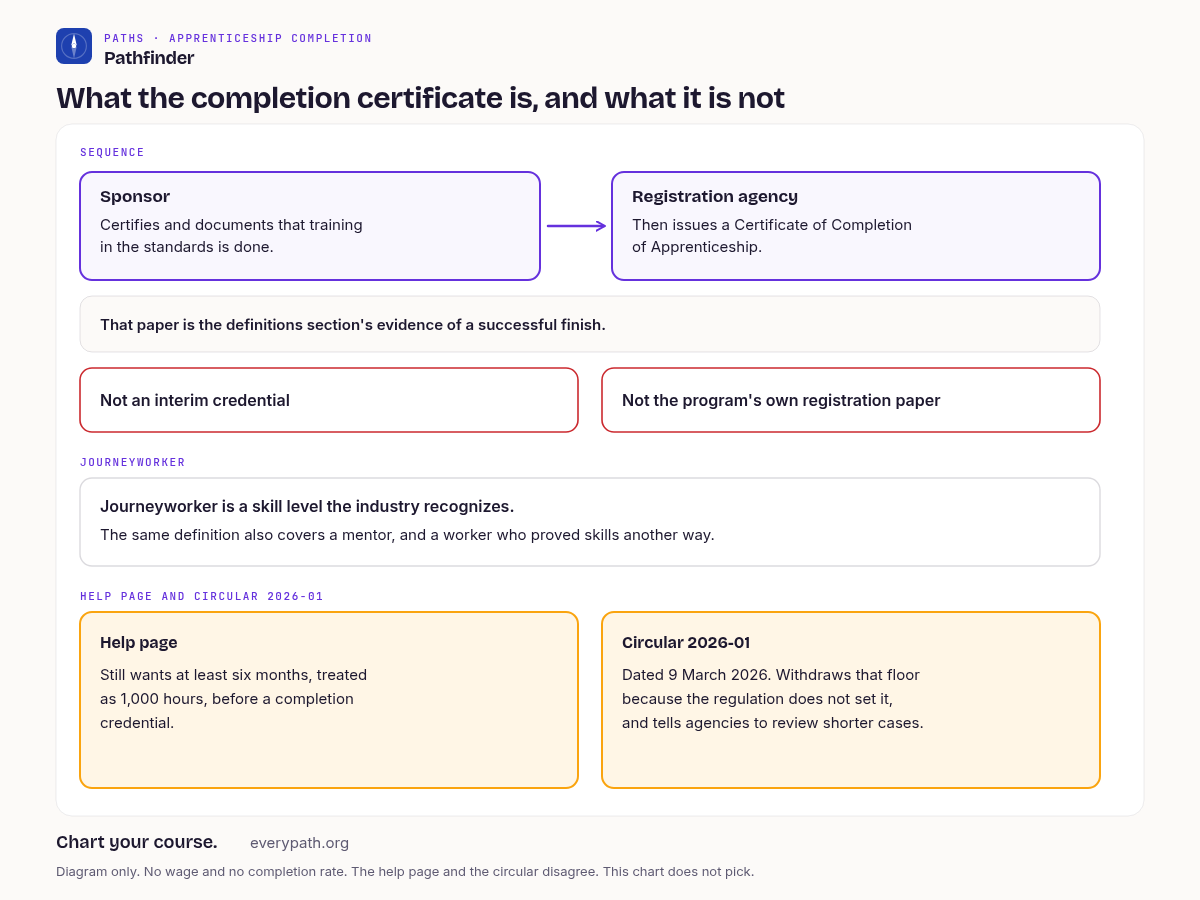
If several papers arrive together, ask three things. Who issued this one. Which of the five meanings in the next section it matches. Whether someone also called you a journeyworker, and in which of the two senses the definition allows.
Five meanings of certificate in the regulation
29 CFR 29.2 does not treat "certificate" as one object. Certification or certificate means documentary evidence that one of five things is true. Only the last is the ending this page owns. The others land in the same drawer and get mistaken for it.
Meaning one is approval of national guidelines. DOL's apprenticeship office has approved a set of National Guidelines for Apprenticeship Standards, written by a national committee or organization, as conforming to section 29.5. That is a template local sponsors can follow. It is not evidence that you finished.
Meaning two is the start. A registration agency has found a person eligible for probationary employment as an apprentice in a registered program. Probation is a beginning status. A paper that only shows you were allowed to start is not the completion certificate. How long the whole term may run is the length page, not this one.
Meaning three is the program, not the person. A registration agency has registered the program, shown by a Certificate of Registration or by some other written sign that registration happened. That paper can be real on the day you apply, and on the day you quit. It does not say you finished.
Meaning four is the interim credential. The definitions section lists it apart from a successful finish: the agency, at the sponsor's request, marks that the apprentice attained a competency. Section 29.5(b)(16) lets competency-based or hybrid standards issue these notes if they choose to, and only for recognized parts of the occupation. A program on those approaches can issue none. A note about one part is not proof the apprenticeship is over.
Meaning five matches the help page. A registration agency has determined that the person successfully completed the apprenticeship. Put that next to the help page's name, Certificate of Completion of Apprenticeship, and next to the circular's timing: the agency issues it after the sponsor certifies and documents that the standards' training requirements were met.
A sort you can do with the envelope in your hand:
- Guidelines approval is a national template. It does not name you as finished.
- Probationary eligibility means you were allowed to start.
- A Certificate of Registration means the program is registered. It does not mean you completed it.
- An interim credential means one part was met, and only if that program chose to issue the note.
- Successful completion means the agency determined the apprenticeship was completed. That is the certificate this page is about.
None of the five is a wage table. None is a college transcript. Credit stays on the page linked above.
Journeyworker status is a definition, not the certificate's title
29 CFR 29.2 defines journeyworker as a worker who has reached a skill level, abilities, and competencies that the industry recognizes as mastery of that occupation. The parentheses are part of the definition. The word may also point to a mentor, a technician, a specialist, or another skilled worker who has documented enough skill and knowledge, either through a formal apprenticeship or through practical time on the job plus formal training.
One use is a level: the industry recognizes mastery of the occupation. The other is a role, a mentor or another skilled worker, and the proof can be a formal apprenticeship or hands-on experience with formal training. The formal route is named. It is not the only one. The completer help page, opened the same day, does not contain the word journeyworker.
Circular 2026-01 quotes that same definition in a footnote. The footnote says sponsors often decide which employees may serve as a journeyworker while giving on-the-job learning or related instruction. That is the mentor use. It is about who may teach the next apprentice. It does not say the completion certificate's printed title is journeyworker.
Finishing is one way the definition says a worker may document the skills the word can cover. The certificate is the agency's evidence that completion happened, under meaning five and under 29.5(b)(15). Industry recognition sits inside the skill-level definition. Related facts, not the same noun. If an employer also wants a license or a further test before it uses the word, that step is not in these federal rules. Ask. Do not treat the certificate as a promise those pages did not make.
A help page and a March 2026 circular disagree
Earlier learning can count. Then the pages split.
The help page says earlier work or classes may count toward completion when the sponsor accepts them, and that other cases are reviewed on their own facts. It then sets a floor: even after that credit, every apprentice must still take part for at least six months, a span the page treats as 1,000 hours, to gain a completion credential.
Circular 2026-01 says the older guidance, Circular 2016-01, had required six months under the sponsor as a registered apprentice before a completion certificate, and, for a time-based or hybrid program, 1,000 hours as well. Advanced standing did not count toward either floor. The 2026 circular withdraws that guidance because the regulation does not impose those limits. The header date is 9 March 2026. It lists Circular 2016-01 as rescinded, and the expiration line says continuing.
If the sponsor has employed the apprentice for less than six months, or for fewer than 1,000 hours, the circular tells registration agencies to review advanced standing, how performance is judged, and how those rules were applied. Review is not a ban, and it is not the help page's must-still line.
Section 29.5(b)(15), in the 30 September 2026 versioner text, is only the recognition sentence. It sets neither a six-month floor nor a 1,000-hour floor. The undated help page and the March 2026 circular do not match. Ask the sponsor which policy is in your standards, and ask the registration agency which document it will apply. This page will not pick for them. It also does not add a wage for the day after you finish.
Replacing a certificate you already earned
If you finished and the paper is gone, the replacement help page is short. Ask DOL's apprenticeship office or the state agency. Use the site's contact page, find the office in the state where you completed, and ask that office for a copy.
That copy repeats a certificate the agency already granted. It is not a new finding that you completed, and it is not an interim credential. The federal pages list no fee, form number, or turnaround time. Those details wait until the office in your state writes them down.
Common mistakes when you read the ending
- Treating a job title as this certificate. A workplace can say apprentice without a registration agency ever issuing a completion certificate. Whether the program was registered is the question on the registration page linked above. This page starts only after that registration is real.
- Holding up an interim credential as the finish. Meaning four is a component. Meaning five is completion. The standards section makes interim notes optional even inside the approaches it names.
- Assuming the certificate's title is journeyworker. The definition covers industry-recognized mastery and also a mentor who may have arrived through a formal apprenticeship or through practical experience plus formal training. The completer help page does not use the word. Do not collapse the two.
- Quoting only the six-month line, or only the withdrawal. The help page still states that six-month floor, equated there with 1,000 hours, for a completion credential. Circular 2026-01 withdraws the older circular that imposed the floor, because the regulation does not, and it tells agencies to review shorter cases. Ask which document governs your file.
- Asking this page for length, pay, or college credit. Length is on the page linked above. Pay is a different subject. College credit is the other link above, and the answer is not copied here.
What do you receive when a registered apprenticeship is finished?
The completer help page says DOL's apprenticeship office, or else the state agency recognized to register programs, grants a Certificate of Completion of Apprenticeship after a successful finish, and calls it nationally recognized. Circular 2026-01 says the agency issues that paper only after the sponsor certifies the standards' training was done. The sponsor's note is not the certificate.
Is journeyworker status the same thing as that certificate?
Not in the rule text retrieved for this page. Journeyworker means a worker the industry treats as having mastered the occupation. The word may also mean a mentor whose proof was a formal apprenticeship or hands-on work plus formal training. The completer help page never uses it.
Does an interim credential mean you have finished?
No. The definitions section treats an interim credential as the agency's note that a competency was met, and it lists that note separately from successful completion. The standards section allows those notes when a competency-based or hybrid program chooses them, and only for recognized pieces of the occupation. A component is not the whole finish.
Can earlier work or classes replace the whole program?
Earlier work or classes may count if the sponsor agrees. Other cases are decided one by one. The same help page still requires at least six months, a span it treats as 1,000 hours, before the completion credential. Circular 2026-01, dated 9 March 2026, withdraws that floor because the regulation does not set it.
Who replaces a completion certificate that was lost?
The replacement help page says to ask DOL's apprenticeship office or the state agency, and to use the site's contact page to find the office in the state where you finished. That office can send a copy. A copy repeats a certificate already granted. It is not a new finding that you finished.
Sources
- Help page on what a completer is granted — Department of Labor help page, opened 3 October 2026
- Help page on asking for another copy of the completion certificate — Department of Labor help page, opened 3 October 2026
- Help page on earlier work and the completion credential — Department of Labor help page, opened 3 October 2026
- Circular 2026-01 on training approaches and completion certificates — Employment and Training Administration circular, 9 March 2026, opened 3 October 2026
- Title 29 version list, latest issue date — versioner metadata, latest issue 30 September 2026, opened 3 October 2026
- 29 CFR part 29 full text, issue of 30 September 2026 — versioner file, sections 29.2 and 29.5, opened 3 October 2026
Chart your course
Name the issuer before you file the paper with the rest of a plan. Pathfinder can keep that named credential beside a second route, and the label on a claim says whether the claim is sourced, estimated, or advisory.
Frequently asked questions
What do you receive when a registered apprenticeship is finished?
The completer help page says DOL's apprenticeship office, or else the state agency recognized to register programs, grants a Certificate of Completion of Apprenticeship after a successful finish, and calls it nationally recognized. Circular 2026-01 says the agency issues that paper only after the sponsor certifies the standards' training was done. The sponsor's note is not the certificate.
Is journeyworker status the same thing as that certificate?
Not in the rule text retrieved for this page. Journeyworker means a worker the industry treats as having mastered the occupation. The word may also mean a mentor whose proof was a formal apprenticeship or hands-on work plus formal training. The completer help page never uses it.
Does an interim credential mean you have finished?
No. The definitions section treats an interim credential as the agency's note that a competency was met, and it lists that note separately from successful completion. The standards section allows those notes when a competency-based or hybrid program chooses them, and only for recognized pieces of the occupation. A component is not the whole finish.
Can earlier work or classes replace the whole program?
Earlier work or classes may count if the sponsor agrees. Other cases are decided one by one. The same help page still requires at least six months, a span it treats as 1,000 hours, before the completion credential. Circular 2026-01, dated 9 March 2026, withdraws that floor because the regulation does not set it.
Who replaces a completion certificate that was lost?
The replacement help page says to ask DOL's apprenticeship office or the state agency, and to use the site's contact page to find the office in the state where you finished. That office can send a copy. A copy repeats a certificate already granted. It is not a new finding that you finished.
Sources
- Help page on what a completer is granted — U.S. Department of Labor, accessed 2026-10-03
- Help page on asking for another copy of the completion certificate — U.S. Department of Labor, accessed 2026-10-03
- Help page on earlier work and the completion credential — U.S. Department of Labor, accessed 2026-10-03
- Circular 2026-01 on training approaches and completion certificates — U.S. Department of Labor, Employment and Training Administration (2026), accessed 2026-10-03
- Title 29 version list, latest issue date — Office of the Federal Register (2026), accessed 2026-10-03
- 29 CFR part 29 full text, issue of 30 September 2026 — Office of the Federal Register (2026), accessed 2026-10-03
Chart your course
Pathfinder builds you a plan for whichever path you pick — or for “still deciding” — and labels every claim in it as grounded, modelled or advisory. It will not invent a deadline, a cost, or your chances of getting in.
Start free No credit card required.
Related reading
- Registered apprenticeship vs trade school explained
A registered apprenticeship is a validated paid job. Trade school can teach the class and still not be the program. Check who sponsors it.
- Registered apprenticeship requirements after high school
The federal age floor is 16 unless a law sets a higher age. A diploma is not a national rule. Sponsors write their own grade and skill qualifications.
- How to find a registered apprenticeship after high school
Search apprenticeship.gov's Job Finder and Partner Finder, check your state's agency, confirm a program is registered, and know what applying involves.