Paths after high school
What is YouthBuild? Who it serves and how the program works
By Pathfinder Editorial · Published · 10 min read
About: Pathway Trade and apprenticeship
YouthBuild is a Labor Department program for people aged 16 to 24 who left school without a diploma. The department calls it a community-based pre-apprenticeship. Participants split their time between a classroom, where they work toward a diploma or equivalency, and a work site, where they train and help build affordable housing.
The program has a narrow front door. Federal rules set the age range, require that most participants have dropped out of school, and add a list of further conditions. This page explains who qualifies, how a program divides its time, what happens at the end, and how to find one.
YouthBuild is one of the free training routes on free job training after high school, which covers the wider set of youth programs. Because it is a pre-apprenticeship, read how pre-apprenticeship programs work for the general questions to ask of any program with that name. If the diploma question is what brought you here, the difference between a diploma and an equivalency is on whether a GED is the same as a diploma. All the routes after high school sit on every path after high school.
Every fact below comes from the Labor Department's YouthBuild page or from the federal YouthBuild regulations it links to. Local programs set details within those rules, so a nearby program may run differently from the description here.
What YouthBuild is, in the Labor Department's words
The Employment and Training Administration's YouthBuild page describes it as "a community-based pre-apprenticeship program that provides job training and educational services for opportunity youth ages 16-24 who left school without a secondary diploma."
The federal regulation at 20 CFR 688.100 frames it as a workforce development program offering employment, education, leadership development, and training. It says participants receive education that may lead to a diploma or its state-recognized equivalent, plus occupational skills training. They are encouraged to go on to more education or training, including registered apprenticeship and pre-apprenticeship programs.
Three parts run side by side:
- Classroom. Work toward a high school diploma or equivalency, plus leadership skills and preparation for what comes next.
- Work site. Hands-on training, mostly in construction, sometimes in another in-demand field.
- Community service. The required construction or rehabilitation of affordable housing for low-income or homeless families in participants' own neighborhoods.
The regulation's list of goals, in 20 CFR 688.110, explains why housing sits inside a training program. Alongside education and job skills, the program aims to expand the supply of permanent affordable housing for homeless and low-income families, and to improve community and public facilities, using the work of the young people it trains.
According to the Labor Department page, the program serves more than 5,000 young people in about 200 programs in more than 40 states, run through the Division of Youth Services in the Office of Workforce Investment.
Who YouthBuild is for
The eligibility rule is in 20 CFR 688.300. To join under the main rule, a person must meet all three of these:
- Be at least 16 and no more than 24 on the date of enrollment.
- Be a school dropout, or someone who dropped out and has since reenrolled.
- Be one or more of the following: a member of a low-income family, a youth in foster care, an offender, a youth with a disability, the child of a current or formerly incarcerated parent, or a migrant youth.
The Labor Department page uses a shorter phrase for the same group: opportunity youth who left school without a secondary diploma.
The 25 percent exception
The same section allows a limited exception. Up to 25 percent of the participants in a program may be people who do not meet the second or third condition above, as long as they fit one of two cases:
- They are basic skills deficient even though they have a diploma or its recognized state equivalent, including recognized certificates of attendance or similar documents for people with disabilities.
- They were referred by a local secondary school to a YouthBuild program that offers a diploma, with the aim of earning that diploma.
The age range still applies to everyone. The exception does not open the program to someone who is 25.
For a reader who already has a diploma, this matters. You are not automatically ruled out, but you would be applying for one of a capped number of seats, and the local program decides. Ask directly whether it has room under the exception.
How a YouthBuild program spends its time
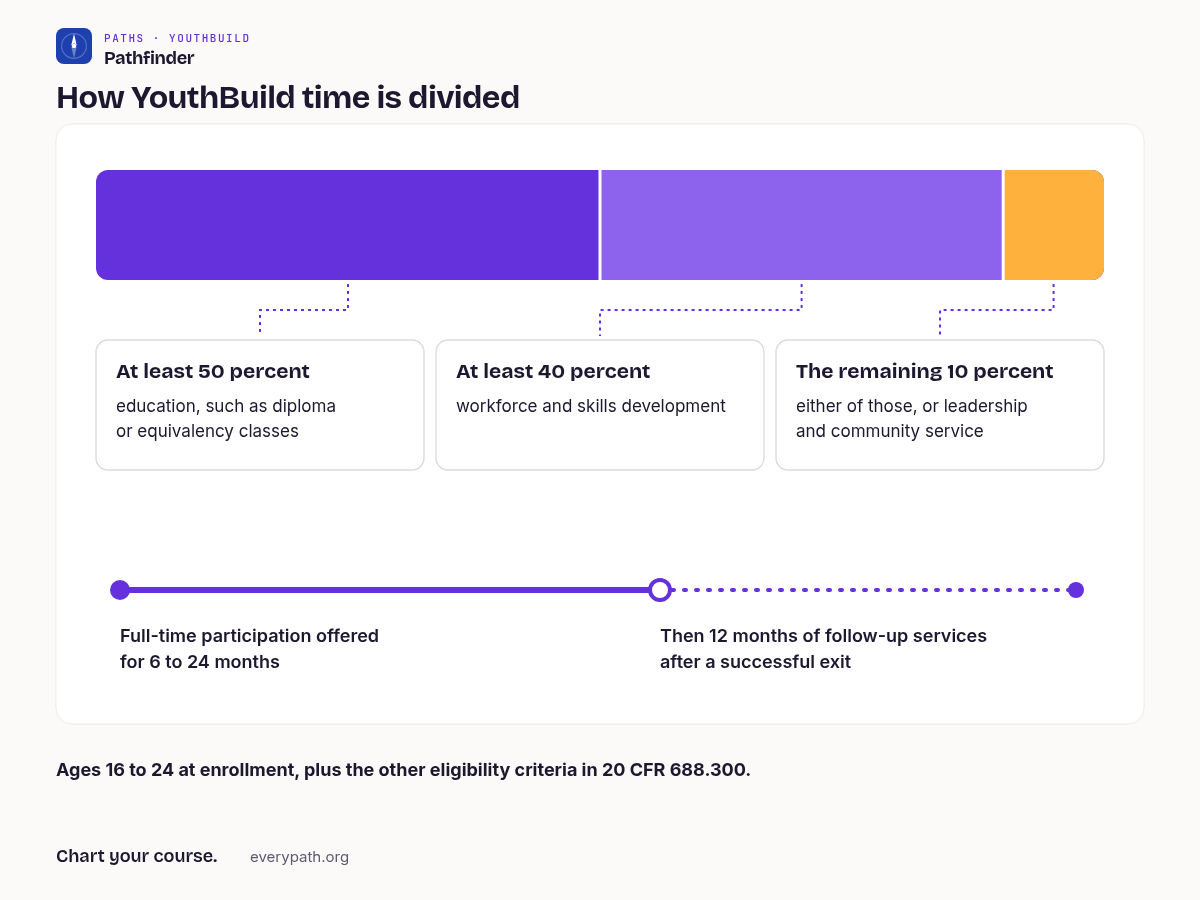
Federal rules set the shape of a participant's time. Under 20 CFR 688.350, programs must offer education and related services for at least 50 percent of the time a participant is in the program, and workforce and skills development for at least 40 percent. The remaining 10 percent can go to either of those, or to leadership development and community service.
The education side covers more than exam preparation. Section 688.320 lists basic skills and remedial instruction, language classes for English language learners, secondary education services such as tutoring and dropout recovery that lead to a diploma or its equivalent, counseling on postsecondary education, and alternative secondary school services.
The workforce side includes supervised work on housing and public facilities, occupational skills training, and other paid and unpaid work experience, including internships and job shadowing. The rule says work experience and skills training should be coordinated with registered apprenticeship programs to the maximum extent feasible.
How long it lasts
Section 688.340 says an eligible person selected for the program must be offered full-time participation for at least 6 months and no more than 24 months. Within that window, the local program sets the length.
After a participant exits successfully, 20 CFR 688.360 requires the program to provide follow-up services for 12 months. The Labor Department page says supportive services can continue through that follow-up period, and may include transportation help, childcare, healthcare referrals, and work clothing and protective equipment.
What a successful exit means
There is no single national finish line. Under 20 CFR 688.370, a successful exit requires at least two things. The participant must have received hands-on construction training, or hands-on training in another field for programs approved to train outside construction. And the participant must meet the exit policy the local program has set.
Each program's policy must describe the outcomes or personal goals a participant has to reach, and the program must apply that policy consistently. Before you enroll, ask to see the exit policy in writing.
Is it only construction?
Construction is at the center, but it is not the only field. The Labor Department page says participants learn construction skills and also train in other in-demand industries, including healthcare, information technology, and hospitality.
The housing work stays. The same page calls the construction or rehabilitation of affordable housing a required part of the community service. Expect time on a building site whatever your training field.
Safety on the work site
Because participants work on real construction projects, and some are 16 or 17, safety rules apply. Under 20 CFR 688.700, programs must follow federal and state health and safety standards, including the child labor hazardous occupations orders at 29 CFR part 570.
They must also provide full safety training for youth on construction projects, keep a written, site-specific safety plan overseen by an on-site supervisor who has the authority to enforce it, supply personal protective equipment, and file required injury reports.
How to find a YouthBuild program
The Labor Department's YouthBuild page links to a map of current grant recipients and to program summaries by year. Those are the official starting points for finding a program near you. Questions about the program can go to the department's YouthBuild mailbox, youth.build@dol.gov.
When you contact a local program, ask:
- Do I meet the main eligibility rule, or would I need a seat under the 25 percent exception?
- How many months is your program, and is it full time?
- Does your classroom lead to a diploma, an equivalency, or both?
- Which training fields do you offer besides construction?
- What is your exit policy, and what follow-up do you provide afterward?
Common mistakes with YouthBuild
- Assuming anyone aged 16 to 24 can join. Most seats require that you left school and belong to a listed group.
- Assuming a diploma rules you out. A capped exception exists for diploma holders who are basic skills deficient.
- Expecting one national program length. The rule sets a range of 6 to 24 months, and each program chooses within it.
- Thinking it is a registered apprenticeship. The Labor Department calls it a pre-apprenticeship. It prepares you for a registered program, among other routes.
- Skipping the exit policy. Each program defines its own successful exit. Read it before you start.
What is YouthBuild?
The Labor Department describes YouthBuild as a community-based pre-apprenticeship program offering job training and education to young people aged 16 to 24 who left school without a diploma. Participants split their time between a training work site and a classroom, earn a diploma or equivalency, and build or repair affordable housing in their own neighborhoods.
Who is YouthBuild for?
Under federal rules, a participant must be 16 to 24 at enrollment, must have dropped out of school, including people who later reenrolled, and must belong to at least one listed group, such as a low-income family, foster care, a youth with a disability, or a migrant youth. A limited share of seats can go to others.
Can you join YouthBuild if you already have a diploma?
Possibly, but only through an exception. Federal rules let up to 25 percent of a program's participants fall outside the main rules, including people who hold a diploma or its state equivalent but are still basic skills deficient. Whether a seat is open under that exception is up to the local program.
How long does YouthBuild last?
Federal rules say a selected participant must be offered full-time participation for at least 6 months and no more than 24 months. After a successful exit, the program must provide follow-up services for 12 months. The exact length of your program is set locally within that range, so ask before you enroll.
Is YouthBuild only construction?
No. The Labor Department says participants learn construction skills and may also train in other in-demand fields, including healthcare, information technology, and hospitality. Building or repairing affordable housing for low-income or homeless families is still a required part of the program's community service, so expect some construction work either way.
Sources
- YouthBuild — Employment and Training Administration program page, read 10 October 2026
- 20 CFR part 688, Provisions Governing the YouthBuild Program — eCFR, title 20 as of 30 September 2026, sections 688.100, 688.300, 688.320, 688.340, 688.350, 688.360, 688.370, and 688.700, read 10 October 2026
Chart your course
Put a YouthBuild program you might join next to the route you would take without it. Pathfinder holds the two plans together. Next to every claim you will see one word, sourced, estimated, or advisory.
Frequently asked questions
What is YouthBuild?
The Labor Department describes YouthBuild as a community-based pre-apprenticeship program offering job training and education to young people aged 16 to 24 who left school without a diploma. Participants split their time between a training work site and a classroom, earn a diploma or equivalency, and build or repair affordable housing in their own neighborhoods.
Who is YouthBuild for?
Under federal rules, a participant must be 16 to 24 at enrollment, must have dropped out of school, including people who later reenrolled, and must belong to at least one listed group, such as a low-income family, foster care, a youth with a disability, or a migrant youth. A limited share of seats can go to others.
Can you join YouthBuild if you already have a diploma?
Possibly, but only through an exception. Federal rules let up to 25 percent of a program's participants fall outside the main rules, including people who hold a diploma or its state equivalent but are still basic skills deficient. Whether a seat is open under that exception is up to the local program.
How long does YouthBuild last?
Federal rules say a selected participant must be offered full-time participation for at least 6 months and no more than 24 months. After a successful exit, the program must provide follow-up services for 12 months. The exact length of your program is set locally within that range, so ask before you enroll.
Is YouthBuild only construction?
No. The Labor Department says participants learn construction skills and may also train in other in-demand fields, including healthcare, information technology, and hospitality. Building or repairing affordable housing for low-income or homeless families is still a required part of the program's community service, so expect some construction work either way.
Sources
- YouthBuild — U.S. Department of Labor, Employment and Training Administration, accessed 2026-10-10
- 20 CFR part 688, Provisions Governing the YouthBuild Program — Electronic Code of Federal Regulations, linked from the DOL YouthBuild page, accessed 2026-10-10
Chart your course
Pathfinder builds you a plan for whichever path you pick — or for “still deciding” — and labels every claim in it as grounded, modelled or advisory. It will not invent a deadline, a cost, or your chances of getting in.
Start free No credit card required.
Related reading
- What is a youth apprenticeship, and can you start at 16?
A youth apprenticeship lets a high school student start a registered apprenticeship at 16, with school, an employer, and a parent signing on.
- Union vs non-union apprenticeship: joint or non-joint
Union vs non-union apprenticeship turns on the committee. A joint one seats a bargaining agent, a non-joint one does not. Both share a federal floor.
- What happens when you finish an apprenticeship today
What happens when you finish an apprenticeship? You may get a completion certificate. It is not a wage or a journeyworker title. Check who issued it.