Paths after high school
Free job training after high school through WIOA Youth
By Pathfinder Editorial · Published · 12 min read
About: Pathway Straight to work Grounded
Free job training after high school can come through more than one public door. DOL's WIOA Youth program serves eligible youth ages 14 to 24 who face barriers to education, training, and employment. CareerOneStop says youth programs may offer free job, career, and training help. American Job Centers offer free help to job seekers.
This page owns those two doors: WIOA Youth and American Job Centers. If a program calls itself a pre-apprenticeship, the checks for that label are on what a pre-apprenticeship is. If you would rather take a job now and train later, that route is on going straight to work after high school. Training is one of several routes on every path after high school.
Free here means what the sources say and no more. CareerOneStop uses the word for American Job Center help and says youth programs may offer free assistance. The DOL program page describes who the program serves and what it must offer. It does not promise a seat, a stipend, or a job to any one person.
What the WIOA Youth program is
The Department of Labor's page says the Workforce Innovation and Opportunity Act of 2014 created a full youth employment program for eligible youth, ages 14 to 24, who face barriers to education, training, and employment.
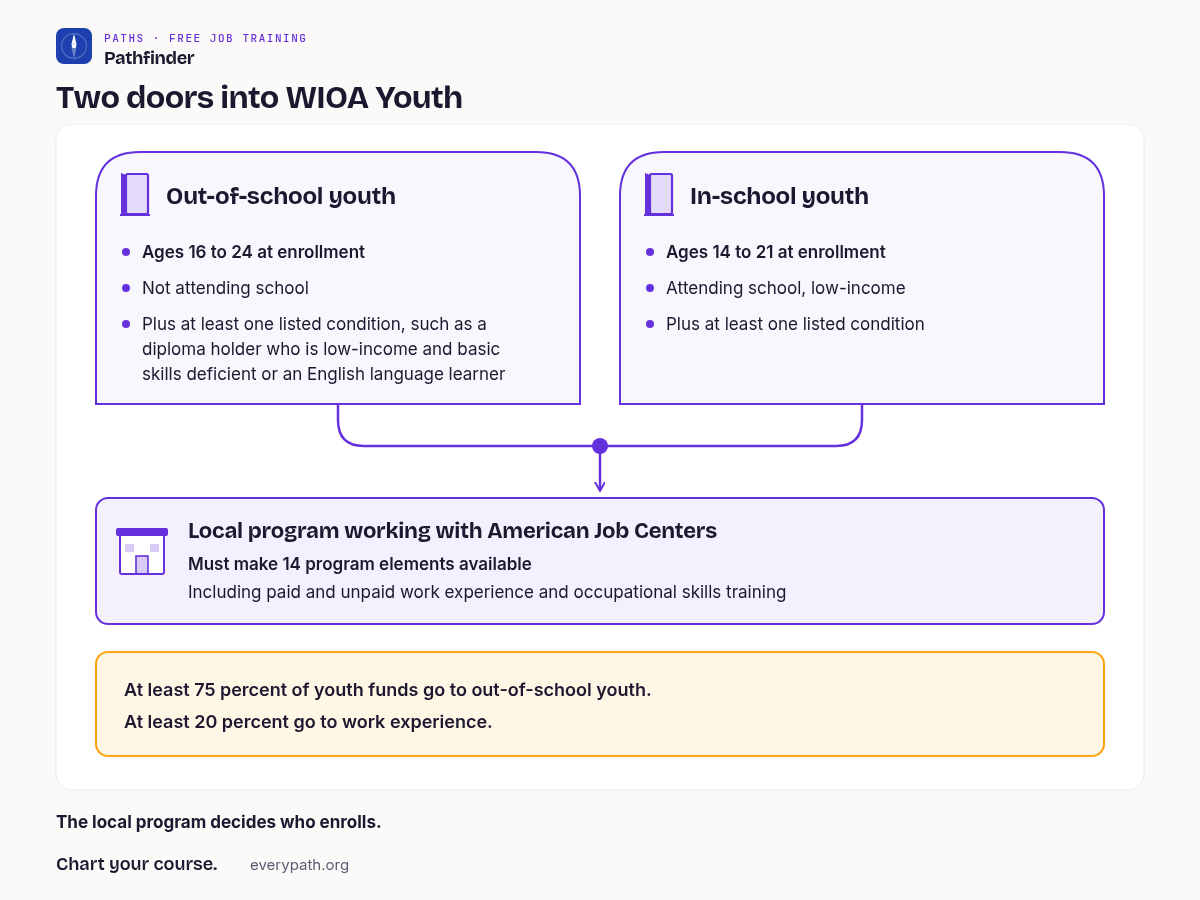
Money for youth services goes to states and local areas by a formula. The program focuses mainly on out-of-school youth. Local areas must spend at least 75 percent of WIOA youth funds on them. The program has 14 elements that must be made available to participants, and it puts work experience first by requiring that at least 20 percent of funds go to that element.
Delivery is local. The DOL page says local programs provide youth services in partnership with American Job Centers and under the direction of local Workforce Development Boards.
The DOL fact sheet, updated January 2025 and linked from that page, fills in the aim. Under Title I of the act, states pass resources to local workforce areas to deliver youth services. Those services help youth with one or more barriers to employment prepare for work and for education after high school, earn educational or skills training credentials, and find jobs with room to advance.
Two of those numbers tell you where the money leans. The 75 percent rule tilts local spending toward young people who are no longer in school. The 20 percent rule gives paid and unpaid work experience a guaranteed share of local funds. The 75 percent floor can be waived, though: a November 2025 Labor guidance letter says the waiver lets a state lower that minimum to 50 percent for local youth funds, statewide reserve funds, or both.
The 14 program elements, in plain groups
The fact sheet lists 14 elements that must be made available in each local area. That is a duty on the area. It does not mean each person gets all 14. Grouped by what they do for you:
Finishing school or catching up
- Tutoring, study skills training, instruction, and evidence-based dropout prevention and recovery strategies.
- Alternative secondary school services or dropout recovery services.
Working while you learn
- Paid and unpaid work experiences.
- Occupational skills training.
- Education offered at the same time as workforce preparation and training for a specific occupation.
Support around the training
- Leadership development opportunities.
- Supportive services.
- Adult mentoring.
- Follow-up services.
- Comprehensive guidance and counseling.
Skills for planning a working life
- Financial literacy education.
- Entrepreneurial skills training.
- Services that provide labor market information.
- Postsecondary preparation and transition activities.
Occupational skills training is the element closest to the phrase job training. Work experience is the one the program funds most heavily by rule. The others are what keep a person in training long enough to finish it.
Two doors in: out-of-school and in-school youth
The fact sheet sorts participants into two groups. The age limits apply at the time of enrollment.
Out-of-school youth are not attending any school as state law defines it, are between 16 and 24, and meet at least one of these conditions:
- a school dropout
- within compulsory school age but absent for at least the most recent complete school year calendar quarter
- a diploma or equivalent holder who is low-income and either basic skills deficient or an English language learner
- an offender
- homeless, a homeless child or youth, or a runaway
- in foster care, aged out of it, or in a related placement the fact sheet names
- pregnant or parenting
- an individual with a disability
- a low-income individual who needs additional help to enter or complete an educational program or to secure or hold a job
In-school youth are attending school, including secondary and postsecondary school, are between 14 and 21 unless a disability rule extends that, are low-income, and meet at least one listed condition. The list overlaps the first one and adds being basic skills deficient or an English language learner on its own.
For a recent graduate, the out-of-school door is the one to read first. The diploma line names a specific combination, low-income plus a basic skills or English learning need. Other lines do not depend on a diploma at all. If you are already enrolled in college classes, the in-school door may be the one that applies.
This page does not decide which group you fit. The local program does. Bring the questions in the last section to that conversation.
What American Job Centers offer
CareerOneStop, which the Department of Labor sponsors, says American Job Centers provide free help to job seekers for a range of career and employment needs. It counts nearly 2,300 centers, funded by DOL's Employment and Training Administration, across the United States.
Staff career counselors, the page says, help job seekers name interests, assess skills and abilities, and get advice on in-demand jobs and possible training. Services vary by location, but the page lists these among them:
- resource rooms with phones, free internet, and resume writing tools
- employment plan development
- job training services
- job search assistance and practice interviewing
- career counseling and skills testing
- labor market and employer information
- employment workshops and hiring events
- supportive services information, which can cover SNAP, Medicaid, child care, emergency funds, and other benefits
- accessibility and special accommodations for people with disabilities
- referrals to community resources and other agencies
The page splits centers into two types. Comprehensive centers offer a full range of employment and training services for workers, youth, and businesses, and host the mandatory WIOA partners on site. Affiliate centers offer limited services and do not host every mandatory partner. The page gives veterans and vocational rehabilitation services as examples of partners an affiliate site may lack.
That split is the reason to call first. The finder page says affiliate centers offer some help on site and refer people for other services. It also lets you click a center's name to see what that center offers.
How to use the CareerOneStop finders
Start with the Youth Program Finder. It says that if you are between 14 and 24, you may be able to find free job, career, and training assistance at a local youth program. It also warns that different programs offer different services, so try contacting a few and ask what each one provides. Enter a city or ZIP code and choose a radius of 5, 25, 50, or 100 miles.
Then open the American Job Center Finder. It returns centers closest to the place you enter, with phone numbers and websites. CareerOneStop suggests checking which services a center offers, then contacting it about the services you want before you visit. If someone told you to register as a condition of getting benefits or services, the finder page says to contact your local center and ask for instructions.
The same menu lists other finders worth a look:
- Workforce Development Board Finder, for the board that directs local youth services
- Youth Committee Finder
- WIOA Eligible Training Program finder
- Apprenticeship Office Finder
If a search comes up empty, call the employment and training helpline CareerOneStop lists: 1-877-US2-JOBS (1-877-872-5627), or TTY 1-877-889-5627.
Questions for the first call
You will get more from the first call with a short script. These questions ask the program to answer in its own terms:
- Which of the 14 program elements do you offer directly, and which do you refer out?
- Do you serve out-of-school youth, in-school youth, or both?
- What do you need from me to decide whether I can enroll, and how long does that take?
- Is the work experience paid, unpaid, or either, and who arranges it?
- Does the occupational skills training lead to a credential, and who issues it?
- Are supportive services available, and how do I ask for them?
- If you cannot take me, which American Job Center or other program should I call next?
Write the answers down. Two programs in the same county can answer the same question differently, and the Youth Program Finder says to expect that.
Common mistakes with free training programs
- Treating the age range as a guarantee. Ages 14 to 24 describe who the program serves. Each door adds conditions, and the local program decides.
- Expecting all 14 elements from one office. The elements must be available in each local area. One provider may offer some and refer you for others.
- Walking into the nearest center without calling. Affiliate centers offer limited services and may lack some partners. Check the center's listing first.
- Calling one program and stopping. The Youth Program Finder says services differ by program. Contact a few.
- Assuming free covers every cost. CareerOneStop calls American Job Center help free and says youth programs may offer free help. Ask in writing about any cost before you sign up.
Is there free job training after high school?
There can be. DOL's WIOA Youth program serves eligible youth ages 14 to 24 who face barriers to education, training, and employment, and it must make occupational skills training available in each local area. CareerOneStop says people in that age range may find free job, career, and training help at a local youth program.
Who runs WIOA Youth where you live?
Local programs deliver it in partnership with American Job Centers, under the direction of local Workforce Development Boards. Funds reach states and local areas by a formula. CareerOneStop lists Youth Program, American Job Center, and Workforce Development Board finders, so you can start from a ZIP code or city.
Can a high school graduate join WIOA Youth?
The fact sheet describes two groups. Out-of-school youth are 16 to 24 at enrollment, not in school, and meet at least one listed condition. One condition covers a diploma holder who is low-income and basic skills deficient or an English language learner. The local program makes the decision, not this page.
What do American Job Centers offer?
CareerOneStop says they give free help to job seekers. Services vary by center but can include career counseling, skills testing, job training services, workshops, resume tools, and supportive services information. Comprehensive centers host all mandatory WIOA partners on site. Affiliate centers offer limited services and not every partner. Call before you go.
Does every WIOA Youth participant get all 14 program elements?
The fact sheet says the 14 elements must be made available in each local area. That is a duty on the local area, not a promise that one person receives all 14. Ask the program which elements it offers you, and which come from a partner it refers you to.
Sources
- WIOA Youth Formula Program — DOL youth program page, accessed 7 October 2026
- WIOA Youth Program Fact Sheet, updated January 2025 — DOL Employment and Training Administration, linked from the program page, accessed 7 October 2026. Program description, 14 elements, eligibility groups, and spending priorities only
- Training and Employment Guidance Letter 05-25 on WIOA waivers — DOL Employment and Training Administration, 25 November 2025, accessed 7 October 2026. Out-of-school youth spending waiver only
- CareerOneStop Youth Program Finder — CareerOneStop, sponsored by DOL, accessed 7 October 2026
- CareerOneStop American Job Center Finder — CareerOneStop, sponsored by DOL, accessed 7 October 2026
- CareerOneStop page on how American Job Centers help — CareerOneStop, sponsored by DOL, accessed 7 October 2026
Chart your course
Put the program you call first and the one you call next into the same plan. Pathfinder holds both side by side. A tag beside every claim reads sourced, estimated, or advisory.
Frequently asked questions
Is there free job training after high school?
There can be. DOL's WIOA Youth program serves eligible youth ages 14 to 24 who face barriers to education, training, and employment, and it must make occupational skills training available in each local area. CareerOneStop says people in that age range may find free job, career, and training help at a local youth program.
Who runs WIOA Youth where you live?
Local programs deliver it in partnership with American Job Centers, under the direction of local Workforce Development Boards. Funds reach states and local areas by a formula. CareerOneStop lists Youth Program, American Job Center, and Workforce Development Board finders, so you can start from a ZIP code or city.
Can a high school graduate join WIOA Youth?
The fact sheet describes two groups. Out-of-school youth are 16 to 24 at enrollment, not in school, and meet at least one listed condition. One condition covers a diploma holder who is low-income and basic skills deficient or an English language learner. The local program makes the decision, not this page.
What do American Job Centers offer?
CareerOneStop says they give free help to job seekers. Services vary by center but can include career counseling, skills testing, job training services, workshops, resume tools, and supportive services information. Comprehensive centers host all mandatory WIOA partners on site. Affiliate centers offer limited services and not every partner. Call before you go.
Does every WIOA Youth participant get all 14 program elements?
The fact sheet says the 14 elements must be made available in each local area. That is a duty on the local area, not a promise that one person receives all 14. Ask the program which elements it offers you, and which come from a partner it refers you to.
Sources
- WIOA Youth Formula Program — U.S. Department of Labor, Employment and Training Administration, accessed 2026-10-07
- WIOA Youth Program Fact Sheet, updated January 2025 — U.S. Department of Labor, Employment and Training Administration (2025), accessed 2026-10-07
- Training and Employment Guidance Letter 05-25 on WIOA waivers — U.S. Department of Labor, Employment and Training Administration (2025), accessed 2026-10-07
- CareerOneStop Youth Program Finder — CareerOneStop, sponsored by the U.S. Department of Labor, accessed 2026-10-07
- CareerOneStop American Job Center Finder — CareerOneStop, sponsored by the U.S. Department of Labor, accessed 2026-10-07
- CareerOneStop page on how American Job Centers help — CareerOneStop, sponsored by the U.S. Department of Labor, accessed 2026-10-07
Chart your course
Pathfinder builds you a plan for whichever path you pick — or for “still deciding” — and labels every claim in it as grounded, modelled or advisory. It will not invent a deadline, a cost, or your chances of getting in.
Start free No credit card required.
Related reading
- Straight to work after high school? Sourced guide
Going straight to work after high school: what it means, how it differs from college and apprenticeships, and how to plan a primary + backup.
- Apprenticeship vs internship after high school
A registered apprenticeship is paid, structured training that ends in a national completion certificate. An internship is usually short and is not a substitute.
- Starting a business instead of college
Starting a business instead of college: one valid pathway, primary + backup plan, and official tools to test locally — no invented survival rates.