Paths after high school
What is a pre-apprenticeship? Prep for a registered program
By Pathfinder Editorial · Published · 13 min read
About: Registered apprenticeship Trade and apprenticeship Pathway Grounded

A pre-apprenticeship is preparation for a registered apprenticeship, and sometimes for other jobs. It is not itself a registered apprenticeship. The Office of Apprenticeship does not regulate these programs the way it regulates registered ones. They are aimed at people who are not yet ready to meet a sponsor's entry rules, including some high school and community college students.
This page stays on that preparation step. It does not restate who may enter a registered program. That question is in what you need before a sponsor can take you. For what registration itself means, read how a program becomes registered. When you are ready to look for the registered program, use where to look up a registered apprenticeship. The wider set of routes is collected on every path after high school.
The descriptions below are United States federal sources. States and schools design local programs, and those local rules can be stricter or simply different. Do not treat this page as a description of apprenticeships outside the United States.
What is a pre-apprenticeship if it is not the apprenticeship?
Apprenticeship.gov's help page answers in one place: "Pre-apprenticeship is a program or set of strategies designed to prepare individuals for entry into Registered Apprenticeship Programs (RAP) or other job opportunities." It adds a time range of weeks at the short end and months at the long end, says a wage or a stipend might be included or might not, says designs vary, and says the core idea is a route toward employability by way of a RAP (What is Pre-Apprenticeship?).
The public explore page uses a shorter version. "Pre-Apprenticeship is a program or set of strategies that is designed to prepare individuals to enter and succeed in a Registered Apprenticeship Program (RAP)" (Explore Pre-Apprenticeship). Both sentences point forward, to a registered program you have not entered yet. Neither sentence says the preparation program is registered.
The regulatory definition used in the equal-opportunity rules is more specific about who it serves. The rule describes a training model for people who still fall short of a sponsor's selection criteria, so they can reach the criteria written in that sponsor's standards. The model also has to keep a documented partnership, and the partner has to be a registered program. It is "structured workplace education and training" in which an employer, employer group, industry association, labor union, community-based organization, or educational institution collaborates on instruction that introduces the competencies, skills, and materials of one or more apprenticeable occupations (29 CFR 30.2).
That definition does two jobs. It says the participant has not cleared the criteria that sponsor uses for selection. And it says the program keeps a documented tie to a registered program. Partnership is not the same thing as being the registered program. The person is getting ready to meet someone else's standards.
Training and Employment Notice No. 23-23, dated 5 March 2024, is the department's current guidance on quality pre-apprenticeship. The notice says it rescinds and replaces the earlier notice, TEN No. 13-12. On oversight, the notice says OA does not run these programs day to day, and it does not regulate them. OA still recommends the elements in the notice because they make later success in a RAP more likely. It also says pre-apprenticeship programs "are not subject to the EEO requirements of 29 CFR Part 30," even though sponsors of registered programs may benefit if preparation programs borrow ideas from those rules (TEN 23-23).
Read the oversight sentence as a boundary, not as an insult. A program can be useful and still be unregulated by the Office of Apprenticeship. "Not regulated as a registered apprenticeship" means you do not get the registered program's paperwork just because you finished the preparation. The individual agreement used when someone does enter a registered program asks a separate question: "Did the apprentice complete a pre-apprenticeship program prior to their registration in this apprenticeship program?" (ETA Form 671, Section II). Prior to registration means the preparation and the registration are different moments. Downloaded 2 October 2026, the file still shows an OMB expiration of 06/30/2024, so treat the question as what that posted file asks, and use the agreement the agency hands you if you actually register.
One more definition applies only in a narrower statute. In the WIOA youth rules, a pre-apprenticeship "is a program designed to prepare individuals to enter and succeed in an apprenticeship program registered under" the National Apprenticeship Act, and it includes training aligned to employer skill needs, access to counseling and supportive services, hands-on learning connected to the training, "Opportunities to attain at least one industry-recognized credential," and a partnership with one or more registered programs that helps place completers (20 CFR 681.480). That section sits in 20 CFR Part 681, "Youth Activities Under Title I of the Workforce Innovation and Opportunity Act." It is not a sentence that every program using the word pre-apprenticeship must award a credential. If a recruiter quotes the credential line, ask whether the program is operating under that youth regulation or under the more general apprenticeship.gov description, which stresses varied elements.
Who is it for after high school?
Use the definitions as a filter, not as a marketing label.
You are in the group the equal-opportunity rule describes if you want a particular registered program and you do not yet meet the selection criteria in that sponsor's standards. The missing piece might be a course, a document, or a skill the sponsor wrote down. The preparation program exists to help you meet that line. It is not a consolation prize, and it is not automatic admission later. The explore page's facilitated-entry element is a written deal with registered sponsors so participants can move straight into a RAP. That is an element of a quality program when the agreement exists. It is not a promise that every local class has one. Ask to see the agreement, or accept that this class does not offer direct entry.
You are also in the group the explore page names if you are still in school. "Many successful Pre-Apprenticeship programs are housed at high schools and community colleges because they offer hands-on learning opportunities for students." A senior can be in one of those programs before graduation. A graduate can still use a community college program the next year. Housing a class at a community college does not convert the class into a registered apprenticeship, and it does not convert it into an associate degree. Ask what you finish with: a seat in a named registered program, a credential, a stipend, or only the experience.
Career seekers are the third group on that page. "A Pre-Apprenticeship program can help you prepare for the apprenticeship that's right for you." The same paragraph points to YouthBuild and Job Corps as federal preparation routes, and to the Partner Finder for sponsors that may offer a pre-apprenticeship. Those are starting points for a search, not proof that a given seat is open or that the program is high quality.
You are probably not the audience if you already meet the sponsor's written qualifications and a registered seat is open. In that case the preparation step can be extra time. Compare the sponsor's qualifications, using what you need before a sponsor can take you, before you enroll in a class whose job is to help people who do not meet those qualifications yet.
What should a quality program include?
Designs vary. The help page says so. The explore page still lists elements the department wants readers to recognize. Use the list as a questionnaire, not as a score you can compute from the outside.
- Approved curriculum. "Training that is based on industry standards and approved by a RAP partner." Ask which registered program approved the curriculum, and for which occupation.
- Simulated experience. "Hands-on training or volunteer opportunities that do not displace paid employees." Hands-on can mean a lab or a volunteer shift. The "do not displace paid employees" line is a quality marker. It also means you should not assume the shift is a paid job.
- Facilitated entry. A written deal for direct entry with registered sponsors. Ask who signed it, and what you must finish before "direct" applies.
- Increased access. The page says programs should recruit and prepare people for the workforce, and it points at equal-opportunity resources for registered apprenticeship. A class that only recruits people who already look like the current workforce is missing this element even if the lab is excellent.
- Supportive services. "Wrap-around services or referrals to help participants complete the program," with childcare and transportation as examples. Ask what is actually offered, not what the poster mentions.
- Sustainable partnerships. "Collaboratively promote Registered Apprenticeship to other employers." One employer partner is a start. The regulatory definition wants a documented tie to a registered program, and a single tie is enough. Promotion to other employers is the explore page's further element.
Pay sits outside that element list. Go back to the help page: pay, including a stipend, is optional. If someone tells you every preparation program pays because registered apprentices are paid, they are applying the wrong rule to the wrong step. Ask this program. If the answer is a stipend, ask the amount, the hours it covers, and whether it continues only while you attend. If the answer is no pay, decide whether the curriculum and the entry agreement are still worth the time. Once you are in a registered program, pay works differently: see are apprenticeships paid?.
How do you decide whether to enroll?
Walk this sequence before you say yes.
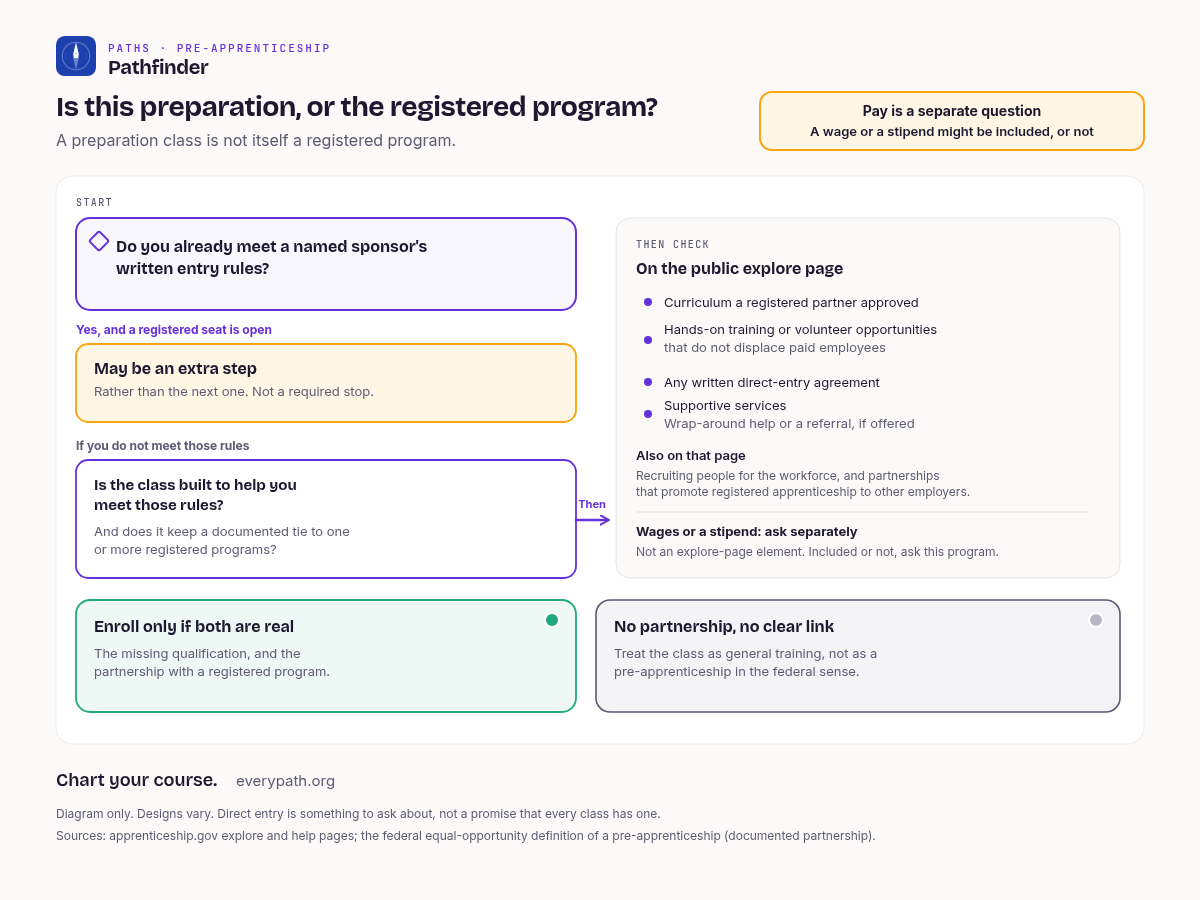
- Name the registered program you are preparing for. If the class cannot name one, it may still be useful training. It is a weak match for the regulatory definition, which expects a documented tie to a registered program, and for the explore page, which is about entering a RAP.
- Name the qualification you do not meet yet. Write the sponsor's sentence, not a guess. If you already meet it, reconsider the class. The eligibility read lives on what you need before a sponsor can take you.
- Ask which definition the program claims. General apprenticeship.gov language, the equal-opportunity definition, or the WIOA youth rule with its credential element. The answer changes what you should expect to finish holding.
- Ask the six explore-page questions. Curriculum approval, hands-on work, direct-entry agreement, who gets recruited, supportive services, and other employer partners. Write the answers down.
- Ask about pay separately. Weeks to a few months, with or without wages or a stipend. Put the answer next to your costs for that period, including transportation if no referral exists.
- Decide what "done" means. Done might mean you now meet the sponsor's written line. Done might mean a written chance to enter directly. Done is not a nationally recognized completion certificate from a registration agency. That certificate belongs to people who finish a registered program, which is a later and separate step described in how a program becomes registered.
If the class fails steps 1 and 2, you can still take it as general preparation or as straight to work experience when it is a job. Call it what it is. If you are not sure you want the occupation, still deciding is a fair status while you visit one class and one registered sponsor. Do not let a recruiter collapse those visits into a single word.
After you can meet the sponsor's line, the next task is finding an opening, not collecting another preparation label. Use where to look up a registered apprenticeship, and keep the wider choice of routes visible from every path after high school.
Is a pre-apprenticeship a registered apprenticeship?
No. Apprenticeship.gov describes it as preparation for entry into a registered program or other work. The Office of Apprenticeship says it does not directly oversee these programs, and it does not regulate them. Registration, when it happens, is a later step.
Does a pre-apprenticeship always pay?
No. The apprenticeship.gov help page treats pay, including a stipend, as optional. Ask the program in front of you. Do not assume the pay rules of a registered apprenticeship apply before you are registered.
Who is a pre-apprenticeship meant for?
People who still fall short of the rules a sponsor uses to choose apprentices, plus students who want hands-on preparation. The public explore page points to programs housed at high schools and community colleges, and to career seekers getting ready for a specific apprenticeship.
Does every pre-apprenticeship have to award a credential?
Not from the pages that describe pre-apprenticeship in general. Those pages stress varied designs. A separate WIOA youth regulation says a pre-apprenticeship, in that youth-program context, includes a chance to attain at least one industry-recognized credential. Ask which definition the program is using.
How long can a pre-apprenticeship last?
The help page clocks these programs in weeks or in months. That range describes the preparation step only. It says nothing about the length of a registered program afterward.
Sources
- What is Pre-Apprenticeship? — U.S. Department of Labor, accessed 2026-10-02
- Explore Pre-Apprenticeship — U.S. Department of Labor, accessed 2026-10-02
- Training and Employment Notice No. 23-23 — U.S. Department of Labor, Employment and Training Administration, 2024, accessed 2026-10-02
- 29 CFR 30.2 — Definitions — U.S. Department of Labor (Electronic Code of Federal Regulations), accessed 2026-10-02
- 20 CFR 681.480 — What is a pre-apprenticeship program? — U.S. Department of Labor (Electronic Code of Federal Regulations), accessed 2026-10-02
- ETA Form 671, Section II — Apprentice Agreement and Registration — U.S. Department of Labor, Employment and Training Administration, accessed 2026-10-02
Chart your course
Preparation is a step you can date. Pathfinder can park that step beside the registered program you are aiming at, and it marks each claim as sourced, estimated, or advisory.
Frequently asked questions
Is a pre-apprenticeship a registered apprenticeship?
No. Apprenticeship.gov describes it as preparation for entry into a registered program or other work. The Office of Apprenticeship says it does not directly oversee these programs, and it does not regulate them. Registration, when it happens, is a later step.
Does a pre-apprenticeship always pay?
No. The apprenticeship.gov help page treats pay, including a stipend, as optional. Ask the program in front of you. Do not assume the pay rules of a registered apprenticeship apply before you are registered.
Who is a pre-apprenticeship meant for?
People who still fall short of the rules a sponsor uses to choose apprentices, plus students who want hands-on preparation. The public explore page points to programs housed at high schools and community colleges, and to career seekers getting ready for a specific apprenticeship.
Does every pre-apprenticeship have to award a credential?
Not from the pages that describe pre-apprenticeship in general. Those pages stress varied designs. A separate WIOA youth regulation says a pre-apprenticeship, in that youth-program context, includes a chance to attain at least one industry-recognized credential. Ask which definition the program is using.
How long can a pre-apprenticeship last?
The help page clocks these programs in weeks or in months. That range describes the preparation step only. It says nothing about the length of a registered program afterward.
Sources
- What is Pre-Apprenticeship? — U.S. Department of Labor, accessed 2026-10-02
- Explore Pre-Apprenticeship — U.S. Department of Labor, accessed 2026-10-02
- Training and Employment Notice No. 23-23 — U.S. Department of Labor, Employment and Training Administration (2024), accessed 2026-10-02
- 29 CFR 30.2 — Definitions — U.S. Department of Labor (Electronic Code of Federal Regulations), accessed 2026-10-02
- 20 CFR 681.480 — What is a pre-apprenticeship program? — U.S. Department of Labor (Electronic Code of Federal Regulations), accessed 2026-10-02
- ETA Form 671, Section II — Apprentice Agreement and Registration — U.S. Department of Labor, Employment and Training Administration, accessed 2026-10-02
Chart your course
Pathfinder builds you a plan for whichever path you pick — or for “still deciding” — and labels every claim in it as grounded, modelled or advisory. It will not invent a deadline, a cost, or your chances of getting in.
Start free No credit card required.
Related reading
- What is a registered apprenticeship? Sourced definition
DOL-registered apprenticeships: paid work + training, with standards. How they differ from informal “apprentice” jobs.
- Registered apprenticeship vs trade school explained
A registered apprenticeship is a validated paid job. Trade school can teach the class and still not be the program. Check who sponsors it.
- Apprenticeship requirements after high school: age 16+
Apprenticeship requirements: be at least 16 (higher if a law says so). A diploma is not a national rule; each sponsor sets its own grade and skill rules.