Paths after high school
Is a GED the same as a diploma? What a GED opens and doesn't
By Pathfinder Editorial · Published · 11 min read
About: Pathway Still deciding Grounded

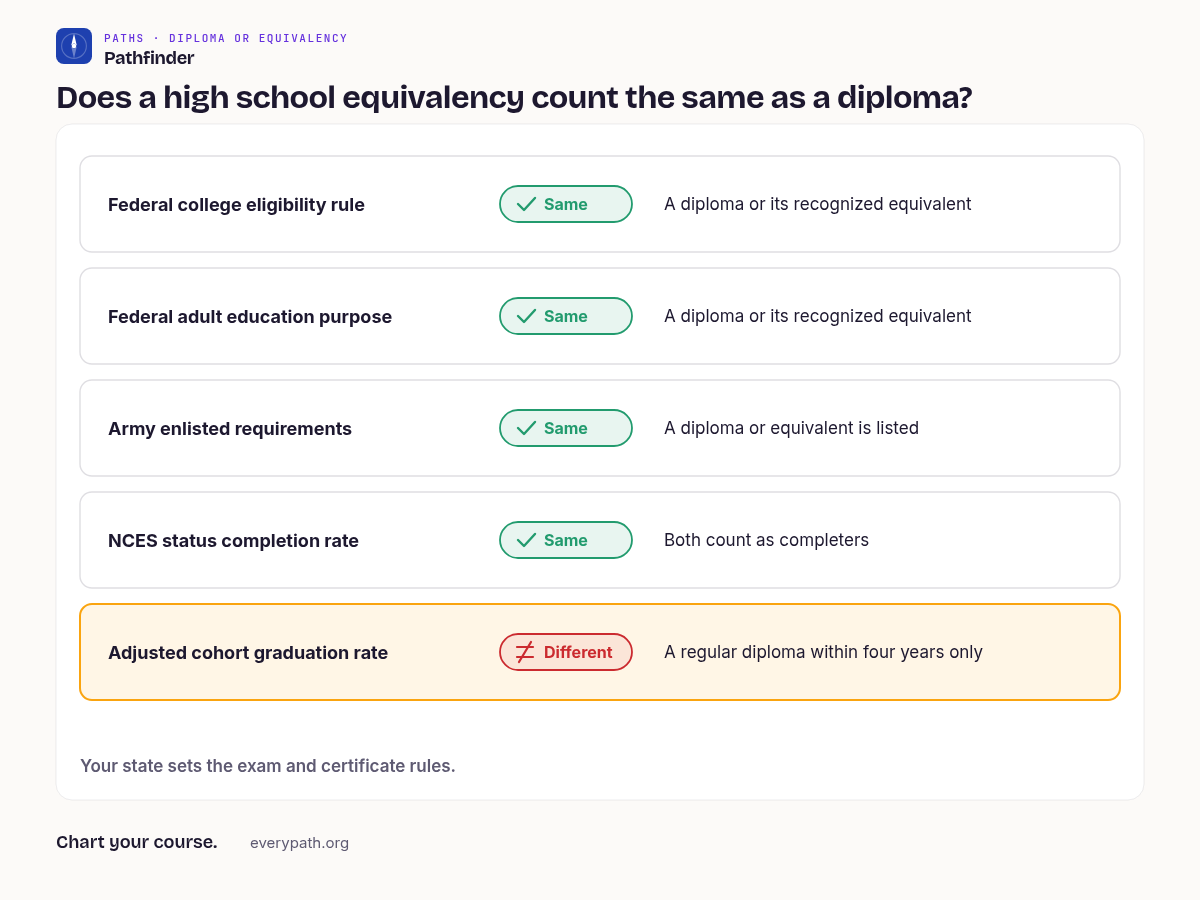
A high school equivalency, such as a GED, counts as the same as a diploma under many federal rules. College eligibility rules name it as the recognized equivalent, and the Army lists a diploma or equivalent for enlistment. It is not identical in every count, though, and your state sets the exam and certificate rules.
That is the answer in brief. The more useful answer is a map. Some doors treat the two credentials as one. Some count only the diploma. And some leave the decision to a state, a college, or an employer. This page goes through the federal places where the difference shows up, and where to look for the rest.
Training that does not ask for either credential, or that helps you earn one, is covered on free job training after high school. What an apprenticeship sponsor can ask of a new applicant, including education, is on apprenticeship entry requirements after high school. Other routes, with or without a credential, are mapped on every path after high school.
A note on words. GED is a brand name for one exam. Federal rules use broader terms, such as "recognized equivalent" and "alternative credential." This page uses high school equivalency, or HSE, for the general idea and GED only where a source names it.
What a high school equivalency is
A high school equivalency is a credential for people who did not finish with a standard diploma. The usual way to earn one is to pass an exam that your state recognizes, and the credential is meant to stand in for the diploma.
The U.S. Department of Education's rules for colleges define the term directly. Under 34 CFR 600.2, the following count as the recognized equivalent of a high school diploma:
- A General Education Development Certificate, or GED.
- A state certificate earned by passing a state-authorized exam that the state recognizes as the equivalent of a diploma.
- A transcript showing successful completion of at least a two-year program that counts for full credit toward a bachelor's degree.
- For someone seeking an associate degree or higher who did not finish high school but excelled academically, documentation that meets the college's written policy for admitting such students.
The second item matters most. It means the exam is a state decision. Which tests your state accepts, the minimum age to sit them, and how to request a copy of your certificate are all set where you live.
Where it counts the same as a diploma
Three federal places treat the two credentials alike.
College eligibility. Under 34 CFR 600.4, an institution of higher education admits as regular students only people who have a high school diploma, have its recognized equivalent, or are beyond the age of compulsory school attendance in the state. The rule lists the diploma and the equivalent side by side. A college can add its own admission standards, but this federal definition does not rank one above the other.
Adult education. The federal adult education law, run by the Education Department's Office of Career, Technical, and Adult Education, states its purpose in 34 CFR 463.1. One part of that purpose is to help adults attain "a secondary school diploma or its recognized equivalent" and move on to postsecondary education and training through career pathways. The law funds both routes.
The same section lists other aims, and they explain what a local adult education provider may offer besides exam prep. It aims to help adults become literate and gain the knowledge and skills needed for work and economic self-sufficiency. It aims to help parents gain skills to support their children's education. And it aims to help English language learners improve reading, writing, speaking, comprehension, and mathematics, and learn about the American system of government. If English is not your first language, ask whether the same provider runs both kinds of class.
The Army. The Army's requirements page lists, for enlisted soldiers, being between 17 and 42, being medically and physically fit, being a U.S. citizen or permanent resident, having "a high school diploma or equivalent," and earning a minimum score on the entrance test. The equivalent is on the list. The page does not say whether every kind of equivalency is handled the same way, and it points applicants to a recruiter for questions.
Where the two are counted differently
The clearest difference is in how schools are measured. NCES, the Education Department's statistics office, publishes several rates, and they do not treat the credentials the same way.
| Measure | Who it counts | Does an HSE count as finishing? |
|---|---|---|
| Status completion rate | 18- to 24-year-olds not enrolled in high school | Yes. Diploma and alternative credential holders, such as GED recipients, both count as completers |
| Adjusted cohort graduation rate | Public school students who started ninth grade together | No. Only a regular diploma within four years counts |
| Event dropout rate | 15- to 24-year-olds in grades 10 to 12 | Leaving without a diploma or alternative credential counts as dropping out |
The status completion rate shows how common the combined group is. NCES reports that of the 27.6 million 18- to 24-year-olds not enrolled in high school in October 2017, about 25.8 million, or 93.3 percent, held a high school diploma or an alternative credential. NCES adds a limit: its survey data cannot reliably separate equivalency holders from diploma holders, so the two are not shown apart in that rate.
None of this changes what you can do with your credential. It does explain a common confusion. If you read that a school's graduation rate went up or down, equivalency holders may not be in that number at all.
Where it depends on someone else
Many decisions sit outside federal rules. In those cases, the honest answer is that it depends on who is deciding.
- Colleges. The federal definition sets the floor. A college may set extra requirements, such as course or test expectations. Read each school's admission page.
- Employers. Read exactly what the posting asks for. If it says diploma and nothing more, ask the employer whether an equivalency is accepted. Do not assume either way.
- Apprenticeship sponsors. Each program states its own entry requirements. Check the program's posted requirements. More on that is in what an apprenticeship sponsor can require.
- Other military branches. The Army page covers the Army. Each branch publishes its own requirements, and a recruiter for that branch is the person to ask.
Your state sets the rules
Two parts of the federal rules point back to your state.
First, the definition of a recognized equivalent includes a state certificate earned by passing a "State-authorized examination that the State recognizes as the equivalent of a high school diploma." The state picks the exam and issues the certificate.
Second, the money for adult education runs through the state. Under 34 CFR 463.20, the state's eligible agency must award competitive multiyear grants or contracts to local providers, who then run the classes. That is why classes are run locally, by whichever providers your state has funded.
To find the rules for your state:
- Search for your state's adult education office.
- Ask which equivalency exams the state accepts and the minimum age to test.
- Ask where the nearest state-funded prep classes meet.
- Ask how to get a copy of a past score or certificate if you tested years ago.
Is it the right choice for you?
That question has no single answer, and this page will not pretend it does. A few things are worth weighing.
If you can still finish your diploma, ask your school or district what options exist to finish before deciding. The adult education law covers both a diploma and its equivalent, so some programs offer a route to either.
If you have already left school, an equivalency opens the federal doors listed above. Federal college rules and the Army both name it. Plan to check the specific door you want, because the step after the credential is where requirements differ.
Common mistakes with a high school equivalency
- Assuming it is the same everywhere. It matches a diploma under many federal rules, not all measures. Check the specific college, branch, or employer.
- Assuming it is different everywhere. Federal college rules and the Army's requirements page both list it alongside the diploma.
- Using national rules for the exam. The state picks the exam, the age to test, and the certificate. Start with your state's adult education office.
- Skipping the employer question. If a posting says diploma, ask whether an equivalency is accepted before you rule yourself out.
- Losing the paperwork. Keep a copy of your certificate and scores. Your state can help you find an old record.
Is a high school equivalency the same as a diploma?
For many purposes, yes. Federal rules for colleges list a GED, or a state certificate from a state-authorized exam, as the recognized equivalent of a diploma, and the Army lists a diploma or equivalent for enlisted applicants. It is not identical everywhere. The four-year graduation rate counts only regular diplomas, and states set their own exam rules.
Can you go to college with a GED?
Under federal rules, an institution of higher education admits as regular students people who have a high school diploma, the recognized equivalent of one, or who are beyond compulsory school age in that state. A GED is named as a recognized equivalent. Each college still sets its own admission requirements on top of that.
Can you join the Army with a GED?
The Army's requirements page lists a high school diploma or equivalent among the conditions for enlisted soldiers, along with age, citizenship, fitness, and a minimum entrance test score. It does not say every equivalency holder is treated the same way in every case, so ask a recruiter how your credential is counted.
Who decides the rules for a high school equivalency?
Your state. The federal definition refers to a state certificate earned by passing a state-authorized exam that the state recognizes as equal to a diploma. Federal adult education funds go to a state agency, which then awards grants to local providers. Start with your state's adult education office for exam and class rules.
Is an equivalency counted as graduating in school statistics?
It depends on the measure. NCES counts diploma holders and alternative credential holders, such as GED recipients, together as high school completers in its status completion rate. The adjusted cohort graduation rate counts only students who earn a regular diploma within four years of starting ninth grade.
Sources
- 34 CFR 600.2 and 600.4, definitions for institutions of higher education — eCFR, title 34 as of 8 October 2026, read 10 October 2026. Recognized equivalent definition and admission rule only
- 34 CFR part 463, Adult Education and Family Literacy Act programs — eCFR, title 34 as of 8 October 2026, sections 463.1 and 463.20, read 10 October 2026
- Trends in High School Dropout and Completion Rates, Introduction — NCES compendium, read 10 October 2026. Rate definitions only
- Trends in High School Dropout and Completion Rates, Indicator 3 — NCES compendium, October 2017 data, read 10 October 2026
- Eligibility and Requirements to Join — U.S. Army recruiting site, read 10 October 2026. Enlisted requirements only
Chart your course
Name the door you want to open with your credential, then the one you would try next. Pathfinder lines up both. Each claim carries a small tag, sourced, estimated, or advisory, so you can tell how firm it is.
Frequently asked questions
Is a high school equivalency the same as a diploma?
For many purposes, yes. Federal rules for colleges list a GED, or a state certificate from a state-authorized exam, as the recognized equivalent of a diploma, and the Army lists a diploma or equivalent for enlisted applicants. It is not identical everywhere. The four-year graduation rate counts only regular diplomas, and states set their own exam rules.
Can you go to college with a GED?
Under federal rules, an institution of higher education admits as regular students people who have a high school diploma, the recognized equivalent of one, or who are beyond compulsory school age in that state. A GED is named as a recognized equivalent. Each college still sets its own admission requirements on top of that.
Can you join the Army with a GED?
The Army's requirements page lists a high school diploma or equivalent among the conditions for enlisted soldiers, along with age, citizenship, fitness, and a minimum entrance test score. It does not say every equivalency holder is treated the same way in every case, so ask a recruiter how your credential is counted.
Who decides the rules for a high school equivalency?
Your state. The federal definition refers to a state certificate earned by passing a state-authorized exam that the state recognizes as equal to a diploma. Federal adult education funds go to a state agency, which then awards grants to local providers. Start with your state's adult education office for exam and class rules.
Is an equivalency counted as graduating in school statistics?
It depends on the measure. NCES counts diploma holders and alternative credential holders, such as GED recipients, together as high school completers in its status completion rate. The adjusted cohort graduation rate counts only students who earn a regular diploma within four years of starting ninth grade.
Sources
- 34 CFR 600.2 and 600.4, definitions for institutions of higher education — Electronic Code of Federal Regulations, U.S. Department of Education rules, accessed 2026-10-10
- 34 CFR part 463, Adult Education and Family Literacy Act programs (sections 463.1 and 463.20) — Electronic Code of Federal Regulations, Office of Career, Technical, and Adult Education rules, accessed 2026-10-10
- Trends in High School Dropout and Completion Rates in the United States, Introduction — U.S. Department of Education, National Center for Education Statistics, accessed 2026-10-10
- Trends in High School Dropout and Completion Rates in the United States, Indicator 3: Status Completion Rate — U.S. Department of Education, National Center for Education Statistics, accessed 2026-10-10
- Eligibility and Requirements to Join — U.S. Army, accessed 2026-10-10
Chart your course
Pathfinder builds you a plan for whichever path you pick — or for “still deciding” — and labels every claim in it as grounded, modelled or advisory. It will not invent a deadline, a cost, or your chances of getting in.
Start free No credit card required.
Related reading
- How to choose a path after high school
How to choose a path after high school with a primary and an explicit backup — a sourced decision frame, not tip lists or invented odds.
- Is a gap year a good idea if you’re undecided?
A gap year after high school when you're still deciding: what it is, how it differs from drifting, and how to plan primary + backup.
- Is it okay not to go to college? Sourced answer
Yes — college is one path, not the only valid one. Enrollment data shows a large share of graduates do not enrol immediately. Plan a primary path and a backup.