Paths after high school
What career and technical education is in high school
By Pathfinder Editorial · Published · 13 min read
About: Pathway Grounded Trade and apprenticeship Community college

Career and technical education, in federal statistics, means courses in high school that teach skills and knowledge for specific jobs or fields of work. The same definition uses the name for programs below a bachelor's degree after high school. It is not a route you begin on graduation day.
The routes after the diploma are already listed on the paths after high school. This page stays inside the school year. If the question is a campus you would attend later, use how trade school stacks up against college. If the question is preparation for a registered program, use what a pre-apprenticeship is. Neither of those pages defines the courses you can take before you leave.
The description below comes from Department of Education pages opened 3 October 2026. States design the local version. A course catalog can be narrower than the federal wording. It should not be described as something the federal wording does not cover.
What does the federal definition cover while you are still enrolled?
The National Center for Education Statistics states its definition "in accordance with federal law (P.L. 115-224)." Career and technical education is courses at the high school level, and programs at the postsecondary subbaccalaureate level, that focus on the skills and knowledge required for specific jobs or fields of work (What is CTE?).
Two halves of that sentence do different jobs. The high school half is this page. Courses, not a diploma you start afterward. The postsecondary half is programs below a bachelor's degree. That half explains why the same label shows up on a college schedule. It does not turn the high school courses into one of the choices you make after commencement.
The same page names the occupational fields inside the definition. They are agriculture and natural resources; business support, management, and finance; communications; computer and information sciences; construction; consumer services; education; engineering and architecture; health sciences; manufacturing; marketing; public, social, and protective services; repair; and transportation. That list is the boundary of the term. It is not a menu of jobs, and it does not say what any of those fields pay.
A fitting class can be career and technical education even when you have not joined a multi-year sequence. The sequence has its own name, program of study, and a test later on this page. Do not collapse the two.
NCES also limits what it reports about money. States and localities typically do not fund this coursework as a separate line item. Staff, facilities, and other lines absorb it. Because of that, the CTE Statistics program does not have a funding series for those state and local budgets. At the national level, the page points to the Strengthening Career and Technical Education for the 21st Century Act, Public Law 115-224, also called Perkins V.
What sits inside high school CTE besides a job-specific class?
The secondary glossary splits high school career and technical education into two kinds of coursework (Secondary glossary).
Non-occupational coursework has two parts. Family and consumer sciences education prepares students for roles outside the paid labor market. General labor-market preparation teaches employment skills that are not tied to one occupation. The glossary's examples are word processing and introductory technology skills.
Occupational education teaches skills required in specific occupations or occupational clusters. The glossary organizes that slice into 12 broad areas, or 20 if you split some of them. The areas track the statistics series. They are based on the 2007 Revision of the Secondary School Taxonomy. Archived tables use an older 1998 taxonomy and 11 areas, with manufacturing combined with repair and transportation. If a table and a counselor disagree about the number of areas, ask which taxonomy the table used.
Where the class meets is a separate fact. An area CTE school provides this education part-time to students who receive all or most of their academic instruction at their home high school. You can be a student of your home school and still spend part of the day in a shared center. A career academy is different again. It is a school-within-a-school whose curriculum is organized around one or more broad career areas. Neither arrangement is a new school you enter after graduation.
Credit, in this glossary, is a Carnegie unit: a class that meets one period a day for the school year, or the equivalent time. A shorter class can be worth less than one unit. An occupational concentrator, for these tables, earns 2.0 or more credits in one of the 12 areas, or, under the other count used here, 3.0 or more. Those counts are not your state's accountability label. The public Perkins data explorer does not print a concentrator definition in its page text.
Work-based learning, in the same glossary, means supervised learning activities in paid or unpaid workplace assignments for which course credit is awarded. The definition itself is the supervised assignment plus credit. Pay is one option. It is not the test. A credit-bearing unpaid placement can fit the glossary. A paid job with no course credit does not, at least not under that sentence.
What is Perkins V doing in that high school?
Perkins V is the Strengthening Career and Technical Education for the 21st Century Act. The Office of Career, Technical, and Adult Education says President Trump signed it on 31 July 2018. It reauthorized the Carl D. Perkins Career and Technical Education Act of 2006, called Perkins IV on that page. The page says the law continued a congressional commitment of nearly $1.4 billion annually for career and technical education for youth and adults (Perkins V).
The same page describes the opportunity in plain language. Every student should be able to explore, choose, and follow programs of study and career pathways that lead to credentials of value. "Youth and adults" means the money is not only a high school line. The high school courses are the part this article owns.
History on that page starts with a clean fact and then a chain of names. The Smith-Hughes Act of 1917 was the first authorization for federal funding of vocational education. The page says vocational education is now termed career and technical education. It dates the Carl D. Perkins Act to 1984, then reauthorizations in 1990 (Perkins II), 1998 (Perkins III), and 2006 (Perkins IV), before the 2018 signing. One clause on the page, "the Vocational Act or 1973," is not a clean statute title. It is left out here rather than repeated as a law you could look up under that name.
Accountability is a separate OCTAE page. It says Congress made accountability for results a central focus of Perkins V, with performance requirements for states and local programs, so states can be assessed on statewide progress and on the return from federal funds (About Accountability). The same fetched page states three funding lines in its own words. Annually, the United States allocates $1.4 billion for states to develop these programs. Over $26 million is provided yearly for four special grant programs. Congress annually allocates $7.4 million for research and evaluation. Those are the page's sentences. They are not a sum, and the legislation page's "nearly $1.4 billion annually" is not edited here to match the accountability page's "$1.4 billion" exactly. Quote the page you mean.
Nothing on those pages says what a single high school receives. Nothing on them says that state and local money is a minority or a majority of the classroom budget. NCES already said it does not hold that series. A counselor who quotes a district figure is using a local budget, not this article.
What has to be true before a sequence is a program of study?
OCTAE's programs-of-study page says local education agencies and postsecondary institutions should offer more than one program of study. Each one should do six things (Programs of Study):
- It incorporates challenging state academic standards.
- It addresses academic knowledge and technical knowledge and skills, including employability skills.
- It is aligned with the needs of industries in the economy of the state, region, Tribal community, or local area.
- It progresses in specificity, starting with all aspects of an industry or a career cluster and leading to more occupation-specific instruction.
- It has multiple entry and exit points that incorporate credentialing.
- It culminates in a recognized postsecondary credential.
That list is the test. A sequence that skips industry alignment, or that never says which credential it ends in, can still include CTE courses under the NCES wording. It is not yet the program of study the OCTAE page describes. Ask the catalog which of the six it actually meets, and write the gaps down.
The sequence is supposed to include academic standards, so it is not defined as a track that drops those classes. It is supposed to end in a recognized postsecondary credential, so the description points past the diploma even while you are still enrolled. "More than one" means a single sequence does not finish the school's job. Entry and exit points should show where someone can step in and which credential marks a step out.
The page does not say every student must earn that credential. It says the program of study culminates in one. Leaving after a course or two does not erase the course. It does mean the program of study was not finished. A Carnegie unit measures the high school class. The postsecondary credential is the end of the sequence and may come later. Ask the school what, if anything, transfers. Dual-enrollment rules were not on the pages used here.
How do you read a CTE offer without turning it into a ninth path?
Use three questions, in order. The chart is that order. It has no enrollment totals and no wages, because those figures were not on the pages opened for this article.
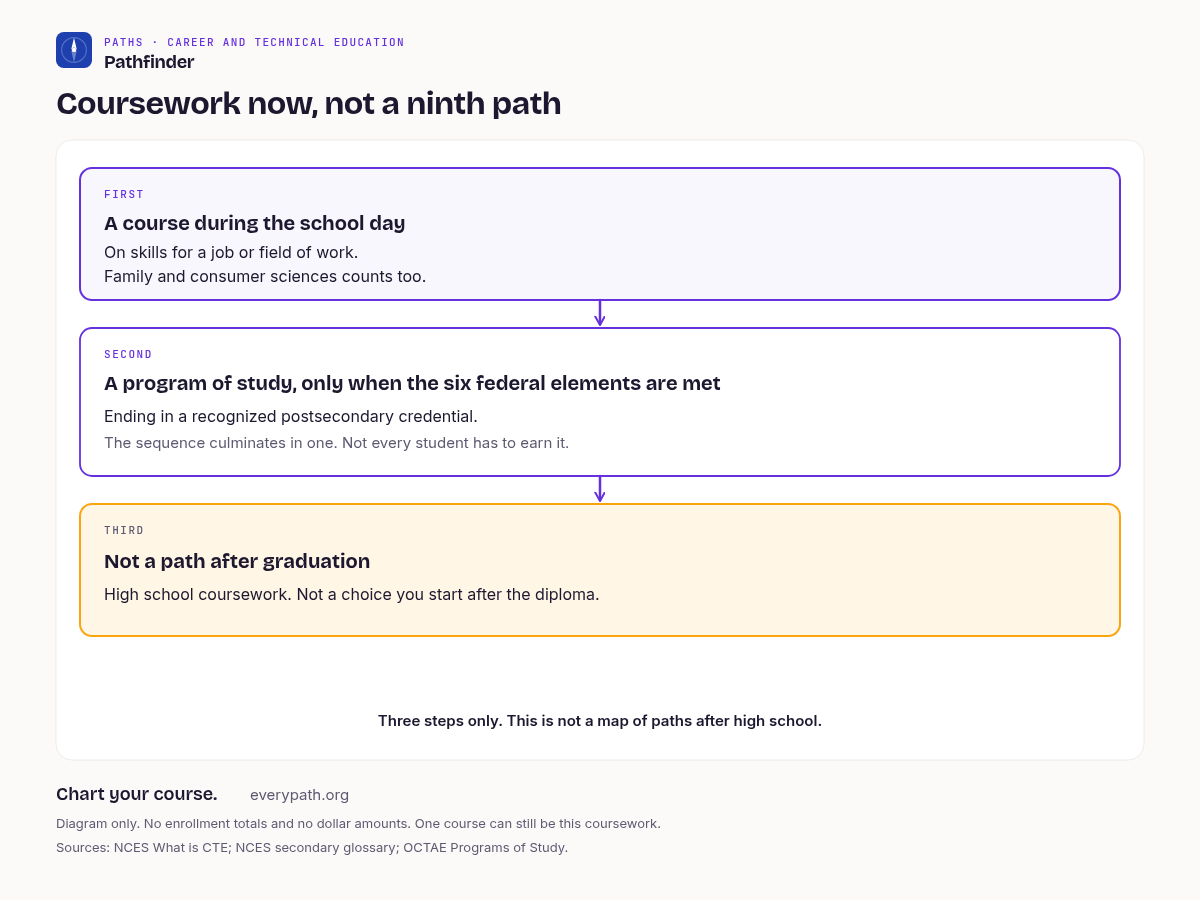
- Is it coursework while you are enrolled? If yes, the NCES high school half of the definition is the right test. Skills for a job or a field of work, or the non-occupational kinds the glossary names. If the offer starts after the diploma, you have left this page.
- Is it one course or a program of study? One course can be CTE. A program of study needs the six elements, including a recognized postsecondary credential at the end. Ask which elements the printed sequence actually has.
- Where does the learning happen? Home high school, a part-time area CTE school, a career academy inside the building, a credit-bearing workplace assignment that may be paid or unpaid, or some mix. Write the place down. The place is not a new path after graduation.
- Which credit rule is the school using? The glossary's 2.0 and 3.0 credit counts are for that statistics series. Your state's reporting rule may differ. Do not let a website treat those two numbers as the only federal answer.
- What are you not deciding yet? Choosing trade school set beside a bachelor's degree is a later comparison. Preparing for a registered program is what a pre-apprenticeship is. Both can sit next to high school CTE. Neither one is the definition of it.
The usual mistakes are shortcuts. Calling these courses a ninth choice on the after-graduation map. Treating "vocational" as a second system after the legislation page has renamed it. Reading the field list as a job board. Treating 2.0 credits as a state concentrator rule. Assuming a workplace assignment must pay, or that pay alone makes it CTE. Assuming one elective has already met every program-of-study element.
If the catalog is still a pile of electives, still deciding fits better than a forced sequence. Keep a primary and backup path for what happens after the diploma, and let the high school courses inform that choice without pretending they are the choice.
Is career and technical education just a newer name for vocational education?
The Perkins V page says vocational education is now termed career and technical education. It calls the Smith-Hughes Act of 1917 the first federal funding authorization for vocational education, and it dates the newest reauthorization to 31 July 2018. Use the name your school prints. Then check whether the courses match the federal description on this page.
Is CTE a path you start after graduation?
No. In the federal statistics definition, high school CTE is courses you take while you are still enrolled. Programs below a bachelor's degree can use the same name after high school, and that is a later decision. The routes after graduation are already on the hub. This page does not add another one.
Does one elective count as a program of study?
Not by itself. A course can still be CTE if it focuses on skills for a job or a field of work. A program of study is a sequence with academic standards, technical and employability skills, industry alignment, narrower instruction later, credentialed entry and exit points, and a recognized postsecondary credential at the end.
Do 2.0 credits or 3.0 credits make me a concentrator in my state?
Only inside the secondary glossary opened for this article. That glossary uses two counts, 2.0 or more credits and 3.0 or more, in one of 12 occupational areas, for its own tables. It is not your state's Perkins accountability rule. Ask the school which definition it reports.
Does CTE work-based learning have to be a paid job?
No. The secondary glossary defines work-based learning as supervised activities in paid or unpaid workplace assignments, and it says course credit is awarded. Pay is allowed. It is not required by that sentence. A pre-apprenticeship is a different preparation step. Ask whether the assignment is credit-bearing classwork, a job, or both.
Sources
- Perkins V — Office of Career, Technical, and Adult Education, U.S. Department of Education, accessed 2026-10-03
- Programs of Study — Office of Career, Technical, and Adult Education, U.S. Department of Education, accessed 2026-10-03
- About CTE Statistics — What is CTE? — National Center for Education Statistics, accessed 2026-10-03
- CTE Statistics — Secondary/High School Level Glossary — National Center for Education Statistics, accessed 2026-10-03
- About Accountability — Office of Career, Technical, and Adult Education, U.S. Department of Education, accessed 2026-10-03
Chart your course
A course during the school day is not the route you start after the diploma. Keep the six program-of-study elements next to the catalog, and mark any local rule you have not checked as advisory.
Frequently asked questions
Is career and technical education just a newer name for vocational education?
The Perkins V page says vocational education is now termed career and technical education. It calls the Smith-Hughes Act of 1917 the first federal funding authorization for vocational education, and it dates the newest reauthorization to 31 July 2018. Use the name your school prints. Then check whether the courses match the federal description on this page.
Is CTE a path you start after graduation?
No. In the federal statistics definition, high school CTE is courses you take while you are still enrolled. Programs below a bachelor's degree can use the same name after high school, and that is a later decision. The routes after graduation are already on the hub. This page does not add another one.
Does one elective count as a program of study?
Not by itself. A course can still be CTE if it focuses on skills for a job or a field of work. A program of study is a sequence with academic standards, technical and employability skills, industry alignment, narrower instruction later, credentialed entry and exit points, and a recognized postsecondary credential at the end.
Do 2.0 credits or 3.0 credits make me a concentrator in my state?
Only inside the secondary glossary opened for this article. That glossary uses two counts, 2.0 or more credits and 3.0 or more, in one of 12 occupational areas, for its own tables. It is not your state's Perkins accountability rule. Ask the school which definition it reports.
Does CTE work-based learning have to be a paid job?
No. The secondary glossary defines work-based learning as supervised activities in paid or unpaid workplace assignments, and it says course credit is awarded. Pay is allowed. It is not required by that sentence. A pre-apprenticeship is a different preparation step. Ask whether the assignment is credit-bearing classwork, a job, or both.
Sources
- Perkins V — U.S. Department of Education, Office of Career, Technical, and Adult Education, accessed 2026-10-03
- Programs of Study — U.S. Department of Education, Office of Career, Technical, and Adult Education, accessed 2026-10-03
- About CTE Statistics — What is CTE? — National Center for Education Statistics, accessed 2026-10-03
- CTE Statistics — Secondary/High School Level Glossary — National Center for Education Statistics, accessed 2026-10-03
- About Accountability — U.S. Department of Education, Office of Career, Technical, and Adult Education, accessed 2026-10-03
Chart your course
Pathfinder builds you a plan for whichever path you pick — or for “still deciding” — and labels every claim in it as grounded, modelled or advisory. It will not invent a deadline, a cost, or your chances of getting in.
Start free No credit card required.
Related reading
- How community college differs from trade school
Community college is usually a public sub-baccalaureate pattern. Trade school is not an official category. Match the credential before any price.
- Community college vs university after high school?
Community college then transfer vs starting at a university: what each path is for, with sourced US figures where available — no invented transfer odds.
- What is a registered apprenticeship? Sourced definition
DOL-registered apprenticeships: paid work + training, with standards. How they differ from informal “apprentice” jobs.