Paths after high school
Union vs non-union apprenticeship: joint or non-joint
By Pathfinder Editorial · Published · 12 min read
About: Pathway Registered apprenticeship Trade and apprenticeship Grounded
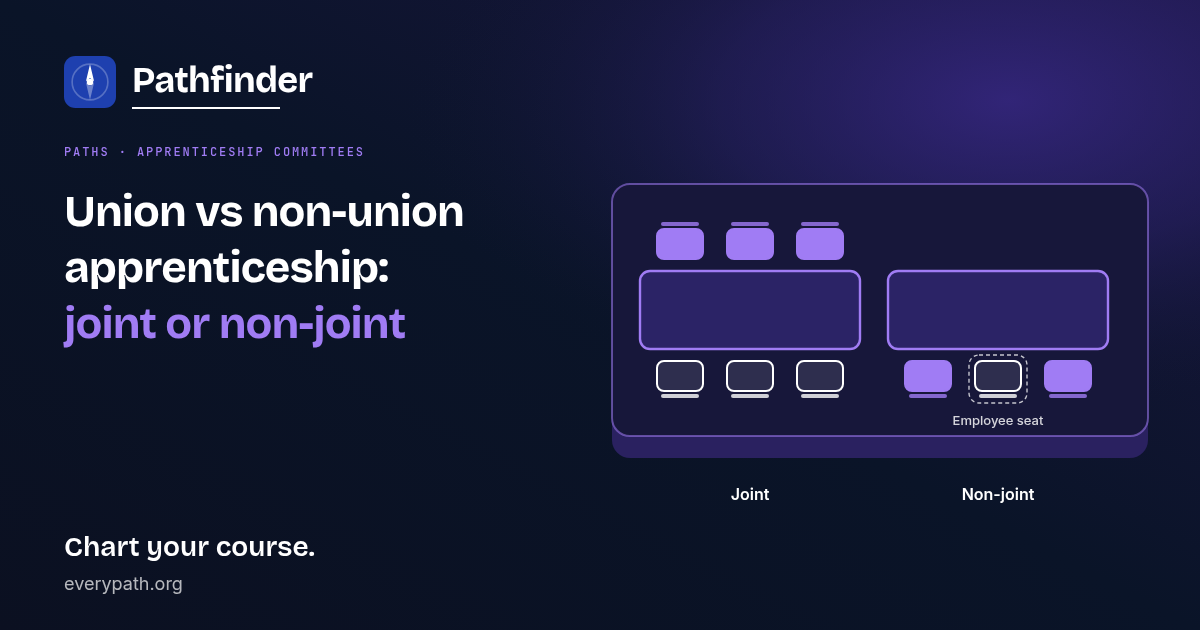
Union vs non-union apprenticeship, in the federal rule, comes down to who runs the program's committee. A joint committee seats equal numbers of employer representatives and of representatives for employees with a bona fide collective bargaining agent. The non-joint kind has employer representatives and no such agent. Programs run either way can be registered under one set of standards.
This page owns that split and nothing wider. What makes a program registered in the first place is on what a registered apprenticeship is, which is one route on every path after high school. Where to look for programs near you is on how to find a registered apprenticeship. The age and entry rules a sponsor may set are on apprenticeship requirements after high school. No occupation is singled out below, and no pay figure appears.
The rule text is 29 CFR part 29 in the eCFR issue dated 30 September 2026, the latest issue on the title 29 version list. Two apprenticeship.gov pages fill in who can act as a sponsor.
Where the words joint and non-joint come from
Section 29.2 defines an apprenticeship committee as the people a sponsor designates to administer the program. Then it splits committees in two.
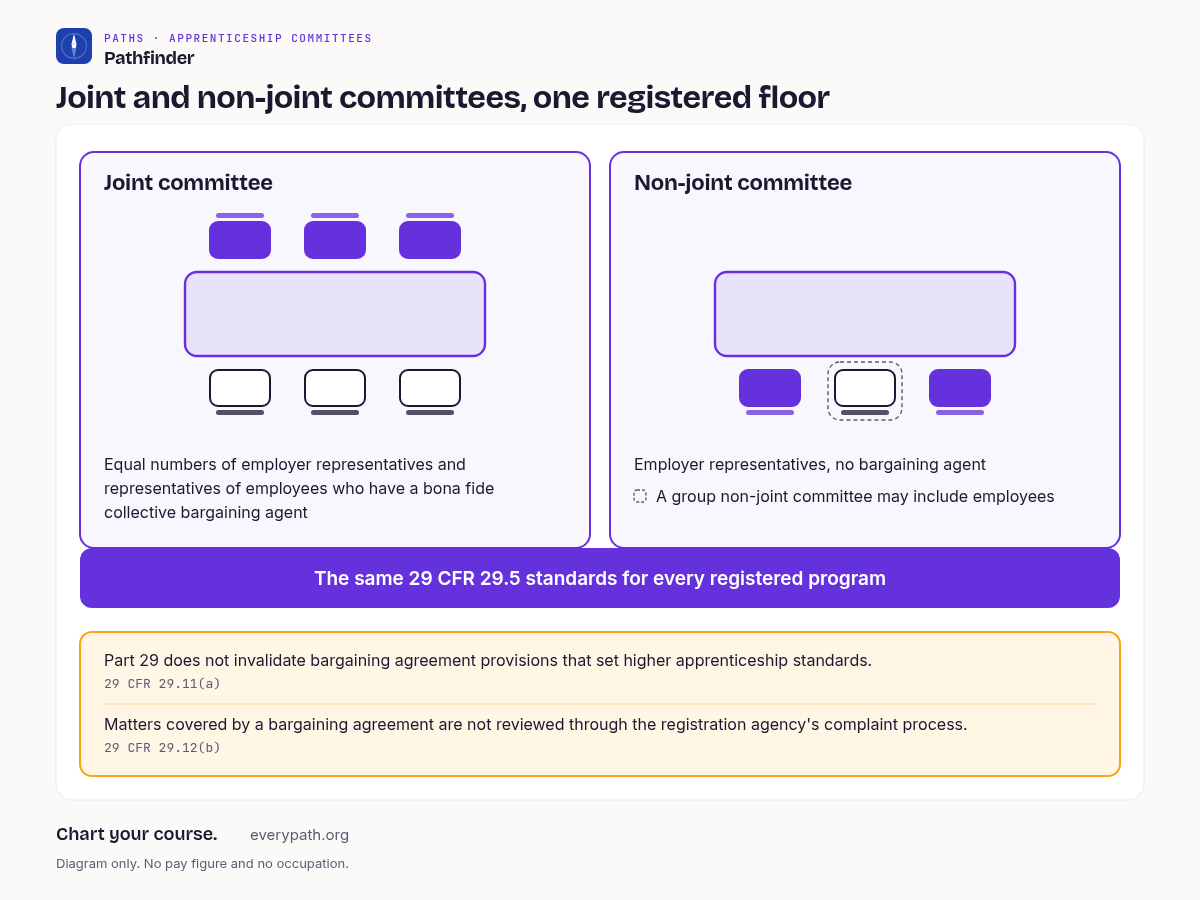
A joint committee is made up of an equal number of representatives of the employer or employers and of the employees, where a bona fide collective bargaining agent speaks for those employees. Equal is the working word. Neither side outnumbers the other on paper.
A non-joint committee seats employer representatives, and no bona fide collective bargaining agent takes part in it. The definition adds two other names for it: unilateral, and group non-joint. It also says, in a parenthesis, that the group version may include employees.
That parenthesis matters more than it looks. Non-union, in this rule, does not mean no workers sit at the table. It means no bargaining agent sits there. A group non-joint committee can have employees on it and still be non-joint.
The same section uses the joint and unilateral pair once more, in the first meaning of certificate. There, the national committee or organization that writes national guideline standards for local affiliates may be joint or unilateral. So the split runs from national templates down to the local committee that runs a program.
Two neighbouring definitions frame the committee's job. A sponsor, in the definitions, is whoever operates the program, whether a person, association, committee, or organization, and in whose name it is or will be registered. An apprenticeship agreement is the written agreement between you and either the sponsor or a committee acting as the sponsor's agent. So in some programs the committee signs with you on the sponsor's behalf.
Who can sponsor a program of either kind
The apprenticeship.gov help page on sponsors describes a sponsor as any employer, association, committee, or organization that operates a Registered Apprenticeship Program. The sponsor takes full responsibility for administering and operating it.
The page lists the shapes a sponsor can take. A single business. A group of businesses. A workforce intermediary, which it gives as an industry association or a labor-management organization. Community colleges and community-based organizations can sponsor programs too.
It then lists the sponsor's work: designing and running the program, providing jobs to apprentices, overseeing how training is built, and providing hands-on learning and technical instruction. Programs run on a voluntary basis, the page says, and often draw support from community groups, schools, the workforce system, and others.
The partner page on the same site repeats that sponsor description. Under intermediaries, it names labor management partnerships next to industry associations, community and technical colleges, nonprofits, and workforce development boards.
Put that beside section 29.2. A labor-management organization acting as sponsor is one way a joint committee shows up in practice. A single employer or an industry association without a bargaining agent at the table is one way a non-joint committee shows up. The sponsor page does not rank them, and neither does the rule.
How a union's role enters registration
Section 29.3 covers how a program gets registered, and two paragraphs deal with unions directly.
Paragraph (j) starts with a program an employer or an employers' association proposes. Suppose the standards, a bargaining agreement, or another document gives a union a part in running the substantive matters of the program, and the union actually uses that part. Then registration needs written acknowledgement that the union agrees, or that it has no objection.
If that participation is not written down and practiced, the employer or association has a different duty. It must, at the same time it applies, give a copy of its application and its program to an existing union that is the bargaining agent of the employees to be trained. The registration agency must then allow 45 days for any union comments before it takes final action.
Paragraph (k) covers the other case. Where the employees to be trained have no collective bargaining agreement, an employer, a group of employers, or an employer association may propose a program for registration.
So a union has a say in registration where it bargains for the workers being trained, and a written duty to notify applies even when it is not running the program. Where there is no bargaining agreement, the employer side can file alone.
One federal floor under both kinds
Section 29.5 lists what every registered program's standards must address. It does not carve out a joint version and a non-joint version. A few items show the shared floor:
- An organized, written plan of employment, training, and supervision, subscribed to by a sponsor.
- An outline of work processes, with the approximate time in each major one.
- Organized related instruction in technical subjects, with 144 hours a year recommended rather than required.
- A schedule of wages that rises as skill is acquired. The rule ties the entry wage to the federal minimum where the Fair Labor Standards Act applies, unless other law or a bargaining agreement requires more. This page gives no figure.
- A probation period that counts toward completion and cannot run longer than 25 percent of the program or one year, whichever is shorter.
- Credit for demonstrated skill or experience offered to all applicants equally.
- A completion certificate issued by the registration agency.
- Compliance with the equal opportunity rules in 29 CFR part 30.
Two items name bargaining agreements outright. The ratio of apprentices to journeyworkers must fit proper supervision, training, safety, and continuity of work, and also fit any ratio terms in a bargaining agreement, unless that agreement expressly bars ratios. And the entry wage line, above, lets a bargaining agreement require a higher entry wage.
Section 29.11 adds a guard. Nothing in part 29, or in an apprenticeship agreement, invalidates an apprenticeship clause in a bargaining agreement that sets higher apprenticeship standards. Section 29.5 itself names bargaining agreements only in the entry wage and ratio items above. The floor itself is the same for both.
Where the difference shows up for an apprentice
The clearest gap for an apprentice is where a complaint goes.
Section 29.7 lists what your written apprenticeship agreement must contain. One line is contact information for the authority the program designates to handle controversies or differences under the agreement. That authority takes the matters that cannot be adjusted locally or settled under the program's procedure or applicable bargaining provisions. Another line requires contact information for the sponsor and the registration agency. Read both before you sign.
Section 29.12 sets the complaint route. If a controversy under your agreement cannot be adjusted locally and is not covered by a bargaining agreement, you or your representative may send it to the registration agency that registered the program. Matters covered by a bargaining agreement are not subject to that review. Those matters are left out of the agency's complaint process, and the disputes line in your agreement may point to the bargaining provisions instead.
The section sets the form and the clock. A complaint must be in writing, signed, and filed within 60 days of the final local decision, with the specific matters, the facts, and copies of relevant papers. The agency will give an opinion within 90 days and must try to reach a resolution between the parties during that time.
Two limits apply to every program. Complaints about discrimination or other equal opportunity matters do not use this route. They go under 29 CFR part 30 or an approved state plan. And nothing in section 29.12 stops you from using another remedy under federal, state, or local law.
How to tell which kind a program is
A job post may not say joint or non-joint. The program papers can answer it.
- Ask who administers the program. The definitions make the committee the people the sponsor designates. Ask whether the committee includes a bargaining agent and whether its sides are equal.
- Ask to read the standards. Section 29.5 makes them a written plan, and the agreement you sign must bring them in, directly or by reference.
- Read the disputes line in the agreement. If it points to bargaining provisions, a bargaining agreement covers at least some disputes.
- Find the registration agency. Standards must identify it, and the agreement must give its contact details. That agency is who registered the program.
- Check entry rules and search separately. Entry rules belong to the requirements page linked above. Search tools belong to the finding page linked above.
Common mistakes with this split
- Hearing non-union as no workers involved. A group non-joint committee may include employees. What it lacks is a bargaining agent.
- Assuming a joint program is registered and a non-joint one is not. Registration is a separate step under section 29.3, open to programs with or without a bargaining agreement. Check registration itself.
- Expecting the federal standards to differ by label. Section 29.5 lists one set of items for every registered program. Section 29.11 only keeps part 29 from invalidating a bargaining agreement clause that sets higher apprenticeship standards.
- Sending every dispute to the agency. If a bargaining agreement covers the matter, section 29.12 keeps it out of the agency's complaint review. Read the disputes line first.
- Using this split to pick a trade or a wage. The rule says nothing here about which occupation pays more, and this page adds no figure. Compare real offers in writing.
What is the difference between a union and a non-union apprenticeship?
Federal rules frame it as the committee that runs the program. A joint committee seats equal numbers of employer representatives and representatives of employees who have a bona fide collective bargaining agent. The non-joint kind has employer representatives and no such agent. Programs of either kind can be registered under the same standards.
Can a non-joint committee include workers?
Yes. The definitions say a non-joint committee may also be called unilateral or group non-joint, and that the group version may include employees. What it lacks is a bona fide collective bargaining agent taking part. So non-union, in this rule, means no bargaining agent at the table, not an absence of workers.
Do union and non-union programs follow different federal standards?
The same section of the rule lists what every registered program's standards must cover, from a written plan and related instruction to a probation limit and a completion certificate. Where a bargaining agreement sets higher apprenticeship standards, the rule says nothing in it invalidates those provisions. The floor is shared.
What role does a union have when an employer registers a program?
If the standards or a bargaining agreement give a union a part in running the program and that part is used, registration needs the union's written agreement or no objection. If not, the employer must send the union that bargains for those workers a copy, and the agency allows 45 days for comments.
Where does an apprentice take a complaint in each kind of program?
The agreement must name who handles disputes that cannot be settled locally or under bargaining provisions. A complaint can go to the registration agency for review only if the matter is not covered by a bargaining agreement. It must be written and signed, and filed within 60 days of the final local decision. Discrimination complaints follow a separate part.
Sources
- Title 29 version list, latest issue date — eCFR versioner metadata, latest issue 30 September 2026, accessed 7 October 2026
- Part 29 rule text, eCFR versioner, 2026-09-30 issue — eCFR versioner file, sections 29.2, 29.3, 29.5, 29.7, 29.11, and 29.12, accessed 7 October 2026
- Help page on what an apprenticeship program sponsor is — U.S. Department of Labor, accessed 7 October 2026
- Apprenticeship.gov partner page for employers — U.S. Department of Labor, accessed 7 October 2026
Chart your course
Name the committee type and the registration agency before you weigh an offer against a second route. Pathfinder keeps both routes in one plan, with a sourced, estimated, or advisory tag on each claim.
Frequently asked questions
What is the difference between a union and a non-union apprenticeship?
Federal rules frame it as the committee that runs the program. A joint committee seats equal numbers of employer representatives and representatives of employees who have a bona fide collective bargaining agent. The non-joint kind has employer representatives and no such agent. Programs of either kind can be registered under the same standards.
Can a non-joint committee include workers?
Yes. The definitions say a non-joint committee may also be called unilateral or group non-joint, and that the group version may include employees. What it lacks is a bona fide collective bargaining agent taking part. So non-union, in this rule, means no bargaining agent at the table, not an absence of workers.
Do union and non-union programs follow different federal standards?
The same section of the rule lists what every registered program's standards must cover, from a written plan and related instruction to a probation limit and a completion certificate. Where a bargaining agreement sets higher apprenticeship standards, the rule says nothing in it invalidates those provisions. The floor is shared.
What role does a union have when an employer registers a program?
If the standards or a bargaining agreement give a union a part in running the program and that part is used, registration needs the union's written agreement or no objection. If not, the employer must send the union that bargains for those workers a copy, and the agency allows 45 days for comments.
Where does an apprentice take a complaint in each kind of program?
The agreement must name who handles disputes that cannot be settled locally or under bargaining provisions. A complaint can go to the registration agency for review only if the matter is not covered by a bargaining agreement. It must be written and signed, and filed within 60 days of the final local decision. Discrimination complaints follow a separate part.
Sources
- Title 29 version list, latest issue date — Office of the Federal Register (2026), accessed 2026-10-07
- Part 29 rule text, eCFR versioner, 2026-09-30 issue — Office of the Federal Register (2026), accessed 2026-10-07
- Help page on what an apprenticeship program sponsor is — U.S. Department of Labor, accessed 2026-10-07
- Apprenticeship.gov partner page for employers — U.S. Department of Labor, accessed 2026-10-07
Chart your course
Pathfinder builds you a plan for whichever path you pick — or for “still deciding” — and labels every claim in it as grounded, modelled or advisory. It will not invent a deadline, a cost, or your chances of getting in.
Start free No credit card required.
Related reading
- What happens when you finish an apprenticeship today
What happens when you finish an apprenticeship? You may get a completion certificate. It is not a wage or a journeyworker title. Check who issued it.
- Registered apprenticeship vs trade school explained
A registered apprenticeship is a validated paid job. Trade school can teach the class and still not be the program. Check who sponsors it.
- Registered apprenticeship requirements after high school
The federal age floor is 16 unless a law sets a higher age. A diploma is not a national rule. Sponsors write their own grade and skill qualifications.