Paths after high school
Are there apprenticeships outside the trades? What qualifies
By Pathfinder Editorial · Published · 10 min read

Yes. Apprenticeship.gov says apprenticeship spans more than 1,000 occupations, including careers in health care, cybersecurity, information technology, and energy. What makes a job eligible is not the industry. It is four tests in federal rules, 29 CFR 29.4, about how the skills are learned, recognized, built up, and taught.
The picture many students carry, that apprenticeship means hard hats and job sites, is out of date. Construction is one industry that uses the model, but the rules were written for occupations, not for one industry. This page explains the four tests, what they mean for jobs you might not think of as apprenticeable, and how to tell whether a program in any field is the registered kind.
This page is about the rule, not a list of jobs. It names no specific trade or occupation and gives no pay figures.
Some neighboring questions are covered elsewhere. How registration works, who runs a program, and what the standards demand are on how a registered apprenticeship works. Searching for an open program near you is on finding a registered apprenticeship. Starting one while still a student is on youth apprenticeships for high schoolers. The rest of the routes are on every path after high school.
The four tests in 29 CFR 29.4
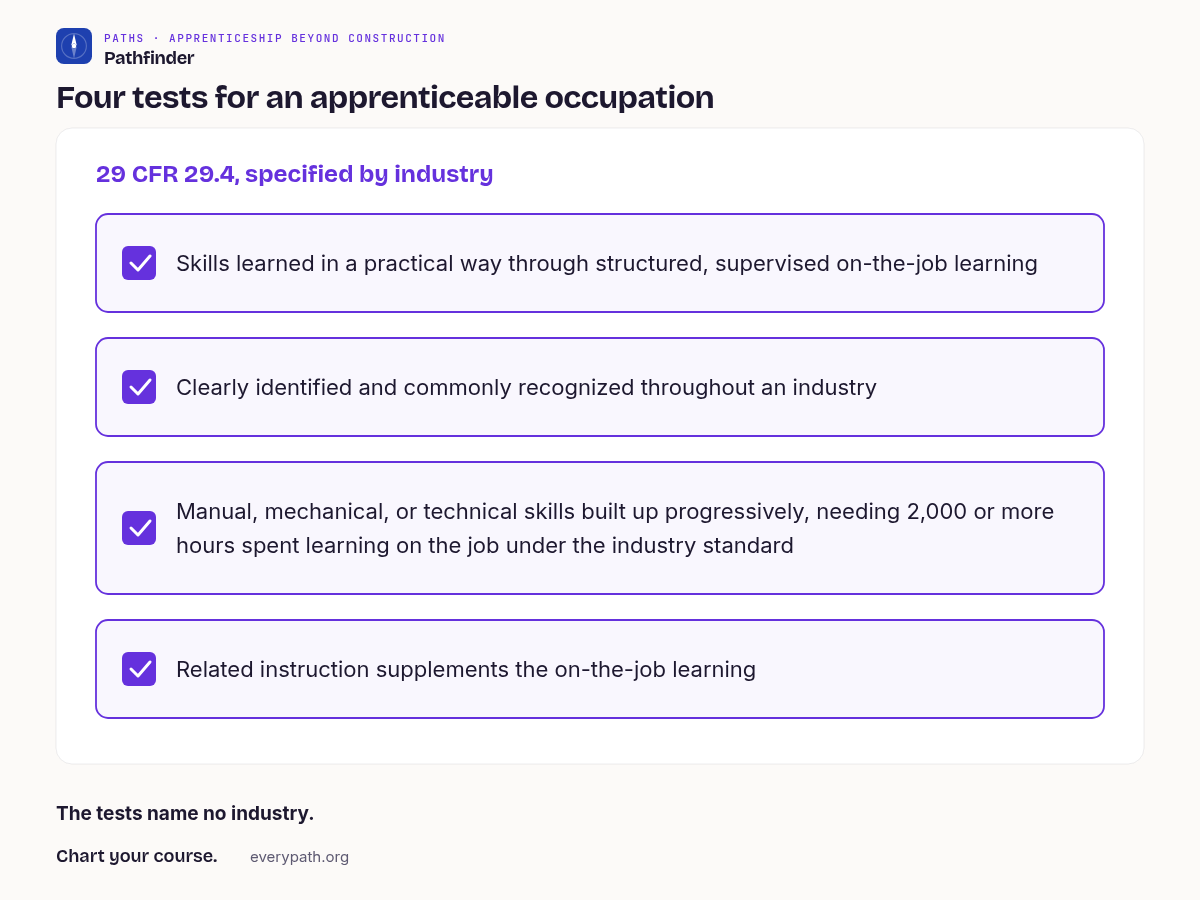
The Labor Department's apprenticeship rules sit in title 29, part 29, of the Code of Federal Regulations. Section 29.4 is short. It says an apprenticeable occupation is "one which is specified by industry" and must meet four conditions.
In plain words, the occupation must:
- Be learned by doing. Its skills are customarily learned in a practical way, through a structured, systematic program of supervised learning on the job.
- Be recognized. It is clearly identified and commonly recognized throughout an industry.
- Build up over time. It involves the progressive attainment of manual, mechanical, or technical skills and knowledge that, by the industry's own standard, would need 2,000 or more hours spent learning on the job to reach.
- Need classes too. It requires related instruction to supplement what is learned on the job.
What the tests leave out
Read the four tests again and notice what is missing. None of them names an industry. None says the work has to be physical, outdoors, or done with tools. The third test lists technical skills alongside manual and mechanical ones, which opens the door to work done in an office, in a lab, or on a screen.
The phrase "specified by industry" points the same way. An occupation is apprenticeable because an industry recognizes it and has a standard for how long it takes to learn, not because it belongs to one traditional sector.
That is how a single rule can cover jobs that look nothing alike. A role in a hospital, an office, a data center, and a building site can all pass if each meets the four tests.
What the tests do require
The tests are not a low bar. Several kinds of work will not fit.
- Skills you can pick up in a few days. The third test points to a skill level that, by the industry's standard, takes 2,000 or more hours spent learning on the job to reach.
- Work with no recognized identity. A one-off role invented by a single employer, with no counterpart across the industry, fails the second test.
- Learning that is purely classroom. The first test needs supervised learning on the job, and the fourth needs classes on top of it. Both halves have to be there.
So when you hear "apprenticeship" used for a short training course or a casual job with some coaching, it may not be an apprenticeship in the federal sense at all.
How programs measure progress
The 2,000-hour figure in section 29.4 is about the occupation. Section 29.5, which sets standards for each registered program, describes how a program measures an apprentice's progress. It allows three approaches:
- Time-based. The apprentice completes 2,000 or more hours spent learning on the job, following a work process schedule.
- Competency-based. The apprentice shows the skills and knowledge, as verified by the sponsor. An on-the-job learning component is still required.
- Hybrid. A set minimum number of hours plus a demonstration of competency.
The sponsor chooses the approach, and the registration agency approves it as suitable for that occupation. A program in a fast-moving field may lean on demonstrated skills, while another may count hours. Both can be registered.
Evidence that apprenticeship reaches past construction
The Labor Department's own pages show the reach.
- More than 1,000 occupations. The apprenticeship.gov help pages answer the question of high-growth industries with "Yes! Apprenticeship spans more than 1,000 occupations," naming health care, cybersecurity, information technology, and energy.
- Healthcare. A Labor Department industry fact sheet reports 37,346 apprentices served in the healthcare industry in 2024.
- Technology. Another fact sheet reports more than 64,800 registered apprentices served in technology occupations in 2024.
- Federal government. The help pages say there are more than 150 apprenticeship programs across the federal government, enrolling nearly 1,500 apprentices in areas that include healthcare, financial services, and transportation.
These are counts of apprentices served or enrolled, not job openings. They are enough to answer the question on this page. Apprenticeship is not limited to construction.
What registered means in any industry
The same help pages define a Registered Apprenticeship Program as one "validated by the Department of Labor or State Apprenticeship Agency." That validation does not depend on the industry. A program in a clinic and a program on a job site meet the same national framework.
The Labor Department's employer page lists the elements every registered program shares:
- Industry led. Programs are vetted and approved to match industry standards.
- A paid job. Apprentices earn wages that rise as their skills and productivity increase.
- Structured on-the-job learning with a mentor.
- Supplemental classroom education tied to the employer's training needs.
- A credential. Apprentices earn a portable, nationally recognized credential in their industry.
That list is your checklist for any program outside construction. If an offer has a mentor and classes but is not registered, ask why. If it is registered, ask which agency registered it.
Reading an offer outside construction
Offers outside construction sometimes borrow the word apprenticeship loosely. A paid trainee role, a rotational program, or a long internship can all be useful, and none of them is automatically a registered apprenticeship. The difference shows up in the paperwork, so read it with the four tests and the registered elements in mind.
Questions that sort one from the other:
- Which registration agency approved this program, the Labor Department or a state apprenticeship agency?
- Which occupation is the program registered for, and how is that occupation described in the standards?
- Is progress measured by hours, by demonstrated competencies, or by both?
- What related instruction comes with the job, and who teaches it?
- Who is my mentor on the job, and how often will we meet?
- What credential do I receive when I complete the program?
An employer running a registered program should be able to answer each of these in a sentence. If the answers are vague, the offer may still be a good job. It just may not be the federal model this page describes.
How to look for one outside construction
Apprenticeship.gov's help pages point to two tools. The Partner Finder lists program sponsors, and you can search for sponsors in a particular occupation or industry. The site also runs an Apprenticeship Job Finder for open opportunities.
A short process:
- Start from an industry you are interested in, not from a job title you already know.
- Use the Partner Finder to see which sponsors operate there.
- Check each program you find: is it registered, and by which agency?
- Ask how progress is measured: hours, competencies, or both.
- Ask what related instruction is required and who provides it.
More on searching, including state agencies, is on finding a registered apprenticeship.
Common mistakes about apprenticeships outside the trades
- Assuming apprenticeship means construction. The federal tests name no industry, and the Labor Department counts more than 1,000 apprenticeable occupations.
- Assuming any training job is an apprenticeship. It needs supervised on-the-job learning, industry recognition, a meaningful skill build, and related instruction, plus registration to be a registered program.
- Reading 2,000 hours as a fixed term. The occupation test uses it as a measure of skill. Programs may be time-based, competency-based, or a hybrid.
- Skipping the registration question. Ask whether the program is registered and by whom. That is what makes it the federal model.
- Searching by a job title only. Starting from an industry and its sponsors can surface occupations you had not considered.
Are there apprenticeships outside the construction trades?
Yes. Apprenticeship.gov says apprenticeship spans more than 1,000 occupations, including careers in health care, cybersecurity, information technology, and energy. Labor Department fact sheets report tens of thousands of registered apprentices served in 2024 in healthcare and in technology alone. Construction is one industry among many that use the model.
What makes a job apprenticeable?
Under 29 CFR 29.4, an apprenticeable occupation is specified by industry and must meet four tests. Its skills are usually learned on the job through structured, supervised learning. It is clearly recognized across an industry. Its skills build progressively to a level needing 2,000 or more hours spent learning on the job. And it needs related instruction.
Does an apprenticeship have to last 2,000 hours?
The occupation test in 29.4 refers to skills that would need 2,000 or more hours spent learning on the job under the industry standard. Programs can then measure progress three ways under 29.5. A time-based program uses at least 2,000 hours. A competency-based program uses demonstrated skills. A hybrid uses both.
Is an office or tech apprenticeship a real registered apprenticeship?
It can be, if it is registered. The Labor Department says a registered program has been validated by the Department or a State Apprenticeship Agency, whatever the industry. Ask the employer whether the program is registered and which agency registered it. A job called an apprenticeship without registration is not the same thing.
Are there apprenticeships in the federal government?
Yes. Apprenticeship.gov says more than 150 apprenticeship programs across the federal government enroll nearly 1,500 apprentices. It lists healthcare, financial services, transportation, and skilled trades occupations among them, as examples rather than a complete list. The same page says federal apprentices get incremental wage increases and industry-recognized credentials.
Sources
- 29 CFR 29.4 and 29.5 — eCFR via the versioner API, title 29 current to 6 October 2026, read 10 October 2026. Occupation tests and progress approaches only
- Apprenticeship.gov frequently asked questions — Labor Department help pages, read 10 October 2026
- Registered Apprenticeship Program — Labor Department employer page, read 10 October 2026. Program elements only
- Healthcare industry fact sheet — Labor Department, read 10 October 2026. 2024 apprentice count only
- Technology industry fact sheet — Labor Department, 2025, read 10 October 2026. 2024 apprentice count only
Chart your course
Pick an industry you had not linked with apprenticeship, and set it beside the route you already had in mind. Pathfinder keeps both plans in one place, with every claim tagged sourced, estimated, or advisory.
Frequently asked questions
Are there apprenticeships outside the construction trades?
Yes. Apprenticeship.gov says apprenticeship spans more than 1,000 occupations, including careers in health care, cybersecurity, information technology, and energy. Labor Department fact sheets report tens of thousands of registered apprentices served in 2024 in healthcare and in technology alone. Construction is one industry among many that use the model.
What makes a job apprenticeable?
Under 29 CFR 29.4, an apprenticeable occupation is specified by industry and must meet four tests. Its skills are usually learned on the job through structured, supervised learning. It is clearly recognized across an industry. Its skills build progressively to a level needing 2,000 or more hours spent learning on the job. And it needs related instruction.
Does an apprenticeship have to last 2,000 hours?
The occupation test in 29.4 refers to skills that would need 2,000 or more hours spent learning on the job under the industry standard. Programs can then measure progress three ways under 29.5. A time-based program uses at least 2,000 hours. A competency-based program uses demonstrated skills. A hybrid uses both.
Is an office or tech apprenticeship a real registered apprenticeship?
It can be, if it is registered. The Labor Department says a registered program has been validated by the Department or a State Apprenticeship Agency, whatever the industry. Ask the employer whether the program is registered and which agency registered it. A job called an apprenticeship without registration is not the same thing.
Are there apprenticeships in the federal government?
Yes. Apprenticeship.gov says more than 150 apprenticeship programs across the federal government enroll nearly 1,500 apprentices. It lists healthcare, financial services, transportation, and skilled trades occupations among them, as examples rather than a complete list. The same page says federal apprentices get incremental wage increases and industry-recognized credentials.
Sources
- 29 CFR 29.4 and 29.5, apprenticeable occupations and program standards — Electronic Code of Federal Regulations, accessed 2026-10-10
- Apprenticeship.gov frequently asked questions — U.S. Department of Labor, Apprenticeship.gov, accessed 2026-10-10
- Registered Apprenticeship Program — U.S. Department of Labor, Apprenticeship.gov, accessed 2026-10-10
- Healthcare industry fact sheet — U.S. Department of Labor, Apprenticeship.gov, accessed 2026-10-10
- Technology industry fact sheet — U.S. Department of Labor, Apprenticeship.gov (2025), accessed 2026-10-10
Chart your course
Pathfinder builds you a plan for whichever path you pick — or for “still deciding” — and labels every claim in it as grounded, modelled or advisory. It will not invent a deadline, a cost, or your chances of getting in.
Start free No credit card required.
Related reading
- What is a youth apprenticeship, and can you start at 16?
A youth apprenticeship lets a high school student start a registered apprenticeship at 16, with school, an employer, and a parent signing on.
- Union vs non-union apprenticeship: joint or non-joint
Union vs non-union apprenticeship turns on the committee. A joint one seats a bargaining agent, a non-joint one does not. Both share a federal floor.
- What happens when you finish an apprenticeship today
What happens when you finish an apprenticeship? You may get a completion certificate. It is not a wage or a journeyworker title. Check who issued it.