Paths after high school
Jobs you can do under 18: federal work rules at 16 and 17
By Pathfinder Editorial · Published · 12 min read
About: Pathway Straight to work Grounded
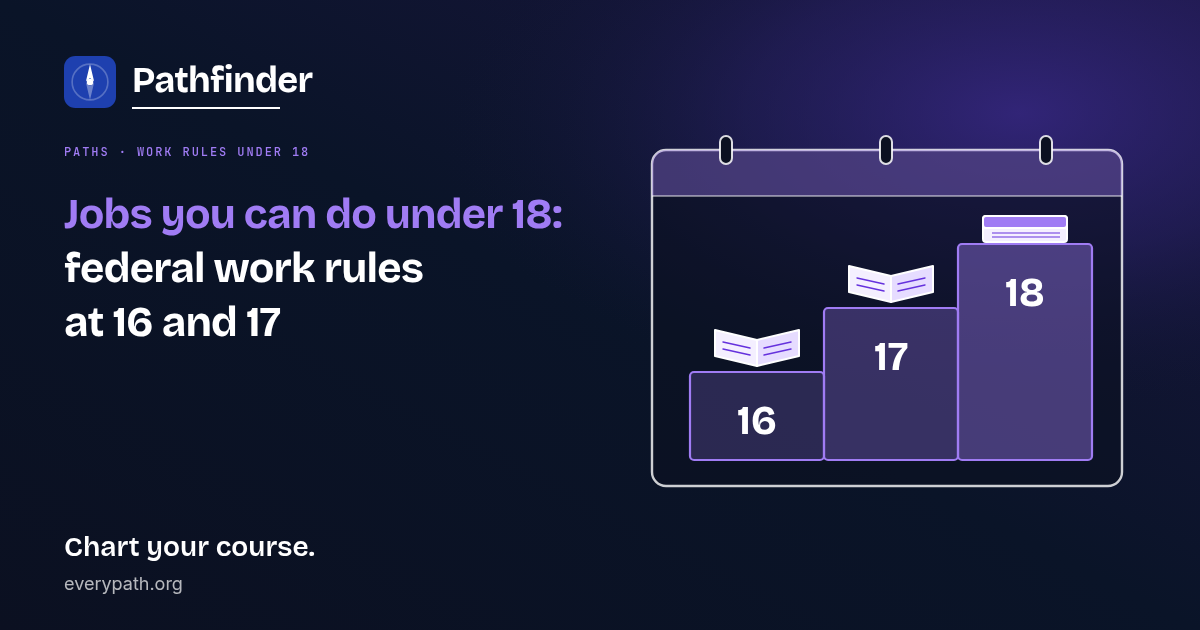
Federal rules let 16- and 17-year-olds work unlimited hours in any job except those the Labor Department has declared hazardous. Seventeen hazardous occupations orders cover those jobs. Registered apprentices and student-learners get limited exceptions to seven of them. Your state can add stricter rules, and when both apply, the stricter one is the rule you follow.
That is the whole frame. This page is about the rules, not a list of job ideas. It explains what federal law covers before 18, the 17 hazardous orders in plain language, the two training exceptions, and where state law takes over.
For the job hunt itself, read our guide to working right after graduation. To learn a trade while still in school, see how a youth apprenticeship works. If you are looking at government work, see federal job routes for new graduates. The other routes sit together on every path after high school.
Everything here is federal and covers jobs outside farming. Farm work runs on a separate set of age rules. The Wage and Hour Division's fact sheet notes that it is general information and is not the same as the regulations, so this page links both.
Who the federal youth rules cover
The Fair Labor Standards Act, or FLSA, sets federal youth employment rules. The Labor Department's Wage and Hour Division enforces them, and the details sit in the regulations at 29 CFR part 570.
The Wage and Hour Division's Fact Sheet #43 sets out the age steps for jobs outside agriculture:
- 18 and older. The federal youth rules no longer apply.
- 16 and 17. The basic minimum age for employment. Work is allowed for unlimited hours in any job not declared hazardous.
- 14 and 15. Work is allowed outside school hours in a limited set of non-manufacturing, non-hazardous jobs, for limited hours.
- Under 14. Generally not allowed in covered non-farm jobs, apart from work the law exempts, such as delivering newspapers to customers or acting.
The fact sheet is also clear about what the federal rules leave alone. They do not require work permits, though many states do. They do not limit hours for workers 16 and older, though many states do. They do not regulate breaks or meal periods. They do not apply where there is no employment relationship under the FLSA.
Why 16 and 17 is a separate stage
The regulation at 29 CFR 570.2 explains the structure. The law sets a general minimum age of 16. It then sets a higher minimum of 18 for any occupation the Labor Secretary finds and declares to be particularly hazardous, or harmful to the health or well-being of minors of that age.
So at 16 and 17 the question is not how many hours you may work under federal law. It is which tasks you may do. A 16-year-old can work a full-time summer schedule at a store or an office under the federal rules. The same 16-year-old cannot run a forklift there, because that task falls under a hazardous order.
The rule against hazardous work applies even when the employer is your parent. Section 570.2 exempts a parent employing their own child from the minimum age rules, but not for occupations covered by the 18-year minimum.
The 17 hazardous occupations orders in plain terms
Section 570.120 says hazardous occupations orders are the means by which jobs are declared too dangerous for 16- and 17-year-olds, and their effect is to raise the minimum age to 18. Seventeen orders are in force. Fact Sheet #43 summarizes each. Some ban a whole industry. Others ban particular machines wherever they are used.
Whole industries or settings, mostly banned:
- HO 1: making or storing explosives.
- HO 3: coal mining.
- HO 4: logging, sawmills, forestry services, and forest firefighting.
- HO 6: work with exposure to radioactive substances.
- HO 9: mining other than coal, including quarries and sand and gravel sites.
- HO 13: making brick, tile, and similar products.
- HO 15: wrecking, demolition, and ship-breaking.
- HO 16: roofing and work on or about a roof.
- HO 17: trenching and excavation, including work in a trench more than four feet deep.
Machines and vehicles, banned wherever they are:
- HO 2: driving a motor vehicle on public roads, or working as an outside helper on one.
- HO 5: power-driven woodworking machines, including chain saws, nailing machines, and sanders.
- HO 7: power-driven hoisting equipment, such as forklifts, skid-steers, backhoes, scissor lifts, cherry pickers, and cranes.
- HO 8: certain power-driven metal-forming, punching, and shearing machines.
- HO 10: power-driven meat-processing machines, such as meat slicers, including in restaurants and delis. Cleaning them is also banned.
- HO 11: power-driven bakery machines, such as large dough mixers, with narrow exceptions for some small countertop mixers.
- HO 12: balers, compactors, and certain paper-products machines.
- HO 14: power-driven circular saws, band saws, chain saws, reciprocating saws, wood chippers, guillotine shears, and abrasive cutting discs.
For several machine orders, the fact sheet says "operation" also covers setting up, adjusting, repairing, oiling, or cleaning the machine. Being told you are only cleaning it does not take the task outside the rule.
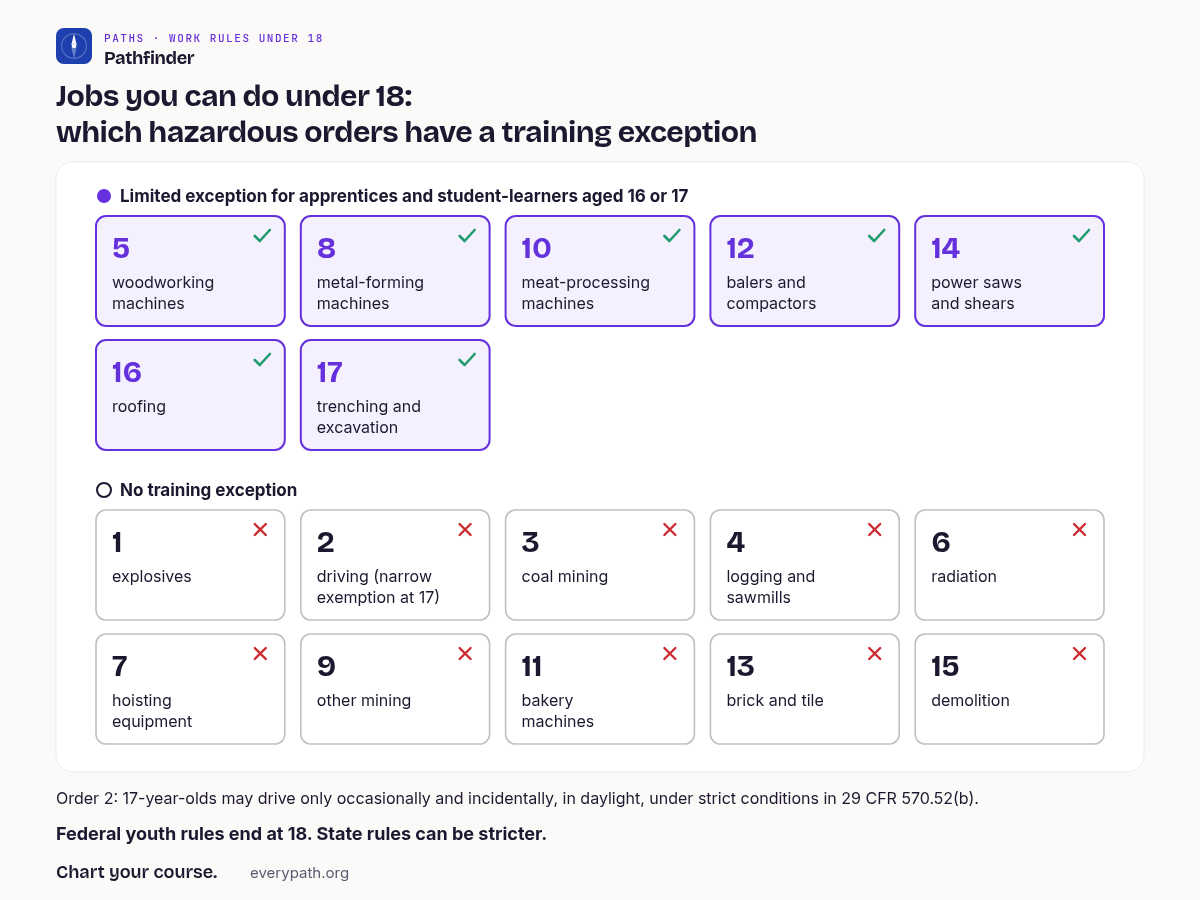
The chart below shows which orders carry a training exception.
The driving rule at 17
Hazardous Order 2 is the one most students run into. It bans operating a motor vehicle on public roads, and working as an outside helper on one, for anyone under 18. Fact Sheet #43 says the only opening is narrow: 17-year-olds may drive cars or small trucks during daylight hours, for limited times, and under strictly limited circumstances. Those conditions are set out in a separate Wage and Hour fact sheet on driving for work. The regulation behind that order, 29 CFR 570.52(b), frames it as an exemption for driving that is only occasional and incidental to the job, limited to daylight hours, within a 30-mile radius, and excluding route deliveries, towing, and urgent, time-sensitive deliveries. It is not a training exception. A 16-year-old has no exception.
If a job posting lists deliveries or driving, ask the employer how it handles workers under 18 before you accept.
The apprentice exception
Some hazardous orders contain an exemption for apprentices. Section 570.50(b) says it applies only when four conditions are all met:
- The apprentice is employed in a craft recognized as an apprenticeable trade.
- The hazardous work is incidental to the apprentice's training.
- The work is intermittent and for short periods, under the direct and close supervision of a journeyman, as a necessary part of training.
- The apprentice is registered by the federal apprenticeship office or by a state agency that office recognizes, or works under a written agreement and conditions the Labor Secretary finds substantially conform to those standards.
Fact Sheet #43 adds the age: the limited exemption covers apprentices who are at least 16 and enrolled in approved programs. It applies to seven orders only: 5, 8, 10, 12, 14, 16, and 17.
The fourth condition is why registration matters. A job titled apprentice at a business with no registered program does not, on its own, meet the test. More on how a student can become a registered apprentice is on how a youth apprenticeship works.
The student-learner exception
The second exception is for students in school-run vocational programs. Section 570.50(c) says a student-learner qualifies when enrolled in a cooperative vocational training program under a recognized state or local education authority, or a substantially similar private school program, and employed under a written agreement.
That agreement must say that:
- The hazardous work is incidental to training.
- It is intermittent, for short periods, and under the direct and close supervision of a qualified and experienced person.
- The school gives safety instructions, and the employer ties them into the job training.
- A schedule of organized, progressive work processes has been prepared.
The agreement names the student and is signed by the employer and the school coordinator or principal. Both keep a copy. The exemption can be withdrawn in any case where reasonable safety precautions have not been taken.
One more line in that section matters at graduation. A high school graduate may keep working in an occupation they trained for as a student-learner, even if they are not yet 18.
Where state law takes over
Federal rules are a floor. Fact Sheet #43 says both federal and state laws govern young workers, and when both apply, the stricter standard must be followed. Section 570.50(a) makes the same point for the hazardous orders: nothing in them allows breaking a federal, state, or local rule that sets a higher standard.
In practice, that means three things to check with your state's labor department:
- Whether you need a work permit or working papers, and who issues it.
- Whether your state limits hours or times of day for 16- and 17-year-olds.
- Whether your state bans jobs that the federal orders allow.
The Wage and Hour Division runs a toll-free helpline, 1-866-487-9243, from 8 a.m. to 5 p.m. in your time zone, for questions about the federal rules.
If you are 14 or 15
This page focuses on 16 and 17, but younger workers face tighter federal rules. Under 29 CFR 570.35, 14- and 15-year-olds may work only outside school hours, no more than 3 hours on a school day, 8 on a non-school day, 18 in a school week, and 40 in a non-school week. Work must fall between 7 a.m. and 7 p.m., or 9 p.m. from June 1 through Labor Day. All 17 hazardous orders apply to them too.
The same section relaxes some of those limits for a 14- or 15-year-old who has already graduated from high school, because school is then treated as not in session for that worker.
Common mistakes with work rules before 18
- Treating federal rules as the whole story. States can be stricter on hours, permits, and jobs. The stricter rule applies.
- Calling any trainee an apprentice. The hazardous-order exemption needs a registered program or a written agreement that substantially conforms, plus close supervision.
- Assuming cleaning a machine is fine. For several machine orders, cleaning, oiling, and adjusting count as operating.
- Driving for work at 16. HO 2 has no opening for 16-year-olds, and only a narrow one at 17.
- Forgetting a parent's business is covered. A parent can employ their own child, but not in occupations covered by the 18-year minimum.
What work rules apply before you turn 18?
Under federal law, 16 and 17-year-olds may work unlimited hours in any job except those the Labor Secretary has declared hazardous, which are covered by 17 hazardous occupations orders. Your state may add stricter rules on hours, permits, or jobs, and when both apply, the stricter rule wins. The federal rules end at 18.
Do 16-year-olds need a work permit?
Not under federal law. The Labor Department's Wage and Hour Division says the federal youth rules do not require working papers or work permits, but many states do. Check your state's labor department before your first shift, because an employer may need the paperwork on file before you start.
Can a 17-year-old drive for work?
Mostly no. Hazardous Occupations Order 2 bans operating motor vehicles on public roads and working as an outside helper on them for anyone under 18. The one exception lets 17-year-olds drive cars or small trucks in daylight, for limited times and under strictly limited conditions that a separate Labor Department fact sheet sets out.
Can a 16-year-old apprentice use power tools that are otherwise banned?
Sometimes. Seven hazardous orders, including power-driven woodworking machines, circular saws, roofing, and trenching, have a limited exemption for apprentices and student-learners who are at least 16 and in approved programs. The hazardous work must be incidental to training, brief and occasional, and closely supervised. The other ten orders have no such exemption.
Do the federal youth labor rules still apply after high school graduation?
The age rules still apply until 18, whether or not you have graduated. One rule does change. A high school graduate who trained in an occupation as a student-learner may keep working in it before turning 18. For 14 and 15-year-olds, graduating also removes some hour limits tied to school being in session.
Sources
- Fact Sheet #43: Child Labor Provisions of the FLSA for Nonagricultural Occupations — Wage and Hour Division, revised December 2016, read 10 October 2026
- 29 CFR 570.2, Minimum age standards — federal regulations, title 29 issue of 6 October 2026, checked 10 October 2026
- 29 CFR 570.50, General rules for the hazardous occupations orders — federal regulations, title 29 issue of 6 October 2026, checked 10 October 2026
- 29 CFR 570.52, Motor-vehicle driver and outside helper (Order 2) — eCFR versioner API, Order 2 text as of 6 October 2026, read on 10 October 2026. Driving exemption only
- 29 CFR 570.120, Eighteen-year minimum — federal regulations, title 29 issue of 6 October 2026, checked 10 October 2026
- 29 CFR 570.35, Hours for minors 14 and 15 years of age — federal regulations, title 29 issue of 6 October 2026, checked 10 October 2026
Chart your course
Name the job you hope to do before your 18th birthday, and a fallback in case a rule blocks it. Pathfinder keeps both in view, tagging each claim sourced, estimated, or advisory.
Frequently asked questions
What work rules apply before you turn 18?
Under federal law, 16 and 17-year-olds may work unlimited hours in any job except those the Labor Secretary has declared hazardous, which are covered by 17 hazardous occupations orders. Your state may add stricter rules on hours, permits, or jobs, and when both apply, the stricter rule wins. The federal rules end at 18.
Do 16-year-olds need a work permit?
Not under federal law. The Labor Department's Wage and Hour Division says the federal youth rules do not require working papers or work permits, but many states do. Check your state's labor department before your first shift, because an employer may need the paperwork on file before you start.
Can a 17-year-old drive for work?
Mostly no. Hazardous Occupations Order 2 bans operating motor vehicles on public roads and working as an outside helper on them for anyone under 18. The one exception lets 17-year-olds drive cars or small trucks in daylight, for limited times and under strictly limited conditions that a separate Labor Department fact sheet sets out.
Can a 16-year-old apprentice use power tools that are otherwise banned?
Sometimes. Seven hazardous orders, including power-driven woodworking machines, circular saws, roofing, and trenching, have a limited exemption for apprentices and student-learners who are at least 16 and in approved programs. The hazardous work must be incidental to training, brief and occasional, and closely supervised. The other ten orders have no such exemption.
Do the federal youth labor rules still apply after high school graduation?
The age rules still apply until 18, whether or not you have graduated. One rule does change. A high school graduate who trained in an occupation as a student-learner may keep working in it before turning 18. For 14 and 15-year-olds, graduating also removes some hour limits tied to school being in session.
Sources
- Fact Sheet #43: Child Labor Provisions of the FLSA for Nonagricultural Occupations — U.S. Department of Labor, Wage and Hour Division (2016), accessed 2026-10-10
- 29 CFR 570.2, Minimum age standards — Electronic Code of Federal Regulations, accessed 2026-10-10
- 29 CFR 570.50, General rules for the hazardous occupations orders — Electronic Code of Federal Regulations, accessed 2026-10-10
- 29 CFR 570.52, Motor-vehicle driver and outside helper (Order 2) — Electronic Code of Federal Regulations, accessed 2026-10-10
- 29 CFR 570.120, Eighteen-year minimum — Electronic Code of Federal Regulations, accessed 2026-10-10
- 29 CFR 570.35, Hours for minors 14 and 15 years of age — Electronic Code of Federal Regulations, accessed 2026-10-10
Chart your course
Pathfinder builds you a plan for whichever path you pick — or for “still deciding” — and labels every claim in it as grounded, modelled or advisory. It will not invent a deadline, a cost, or your chances of getting in.
Start free No credit card required.
Related reading
- Federal jobs after high school: USAJOBS and Pathways
Federal jobs after high school start on USAJOBS. Any U.S. citizen can apply to public listings. Pathways internships need a school or program spot.
- Free job training after high school through WIOA Youth
Free job training after high school can start at a WIOA Youth program, built for ages 14 to 24 with barriers, or at an American Job Center near you.
- Straight to work after high school? Sourced guide
Going straight to work after high school: what it means, how it differs from college and apprenticeships, and how to plan a primary + backup.