Paths after high school
Apprenticeship vs internship after high school
By Pathfinder Editorial · Published · 11 min read
About: Registered apprenticeship Pathway Straight to work Grounded

A registered apprenticeship is paid, structured training that ends in a national completion certificate. The Labor Department has no official internship definition. Its general comparison treats an internship as short work experience, not a stand-in for that certificate. Internship pay depends on the facts, not a national wage.
This page compares only that pair. It does not price colleges, and it does not rank occupations. For what registration means, read what the registered model includes. If the alternative in front of you is an ordinary job rather than an internship, use going straight to work after graduation. Both also belong on every path after high school.
The sources are United States federal pages. Other countries use the same English words for different legal arrangements. Do not export these sentences abroad.
What does each word mean in federal sources?
Start with the side that has a legal model. A registered program, on the help page, is a model DOL or a state apprenticeship agency has validated (What is a Registered Apprenticeship Program?). The employer-facing page lists what that model includes: a paid job with wages that progress as skills increase, structured on-the-job learning with a mentor, supplemental classroom education, and a portable, nationally recognized credential (Registered Apprenticeship Program).
The standards regulation matches the credential and the pay structure without naming a dollar amount. Wages have to rise as the apprentice's skills grow. The starting wage cannot undercut the Fair Labor Standards Act minimum where that law applies, unless another law or a bargaining agreement sets a higher floor. Completion has to be shown by a certificate the registration agency issues (29 CFR 29.5). The help page for finishers names that paper: finishers can be granted "a nationally recognized Certificate of Completion of Apprenticeship" by OA or by the state agency (completion help page).
Now the other side. Apprenticeship.gov says, in so many words, "The U.S. Department of Labor does not have an official definition of internship or externship." What follows is labeled "generally speaking," not as a regulation (difference FAQ). Hold that label. If a school or an employer uses "intern" for something long, paid, and highly structured, the department's general picture can miss that case. The way to stay honest is to test the offer against the points below, not to win an argument about the word.
Where do the two actually diverge?
The same FAQ lines up six contrasts. Use them as the comparison, and keep the "generally speaking" tag on every row that comes from that page.
| Point | Registered apprenticeship | Internship, in the department's general comparison |
|---|---|---|
| Time | Longer term, described there as 1 to 3 years | Usually short term, described there as 1 to 3 months |
| Plan | A structured training plan aimed at skills the employer needs for an occupation | Often not structured, and often aimed at entry-level general experience |
| Mentor | Individualized training with an experienced mentor through the process | Mentorship is not always included |
| Pay | Paid work that often leads to a full-time job | Often unpaid, and may not lead to a full-time job |
| Credential | Leads to an industry-recognized credential | Typically does not lead to a credential |
| College credit | May lead to college credit, and some programs lead to a degree without student debt | May also lead to college credit |
The time row is a general contrast, not a rule that every registered program lasts three years or that every internship ends in a season. The FAQ says "usually" for internships and gives a range for both. A program's real calendar is whatever its standards or its offer letter say. This page will not convert "1 to 3 years" into a promise about your trade.
The credential row is the one that decides whether an internship can stand in. The completion help page names a certificate issued by a registration agency. The FAQ says internships typically do not lead to a credential. Finishing a summer placement can still belong on a resume. It does not produce that certificate, and it does not mean you completed a registered program.
The pay row needs a second source, because "often unpaid" is not the wage-and-hour rule. Fact Sheet 71, updated January 2018, explains when interns and students at for-profit employers are entitled to minimum wage and overtime. The Fair Labor Standards Act requires for-profit employers to pay employees. Interns and students "may not be employees" under that law, "in which case the FLSA does not require compensation for their work." Courts use the primary beneficiary test and look at the economic reality of the relationship. The fact sheet lists seven factors, and it says the test is flexible: "no single factor is determinative." If the intern is an employee, minimum wage and overtime are required. If the intern is not an employee, neither is required under the FLSA (Fact Sheet 71).
The seven factors, in short, are: whether both sides clearly understand there is no expectation of compensation; whether the training is similar to an educational environment; whether the internship is tied to formal education by coursework or credit; whether it fits the academic calendar; whether its duration is limited to the period of beneficial learning; whether the intern's work complements, rather than displaces, paid employees while providing significant educational benefits; and whether both sides understand there is no entitlement to a paid job at the end. A promise of compensation, "express or implied, suggests that the intern is an employee."
Two limits matter. First, the fact sheet's footnote says unpaid internships in the public sector and at nonprofit charitable organizations, where the intern volunteers without expecting compensation, are generally permissible. A for-profit company does not get that footnote. Second, the fact sheet says it is general information and "is not to be considered in the same light as official statements of position contained in the regulations." Use it to see that "often unpaid" is not "always unpaid," and that nobody on this page can quote you an internship wage, because neither source states one.
Registered apprenticeships are not run through that seven-factor test. They are jobs under standards that require a progressive wage schedule. Do not average the two ideas into a claim that apprentices "earn more." This page did not open a wage table, and it will not invent one.
How do you choose after high school?
Pick by the outcome you need, then check the offer against the row that matches.
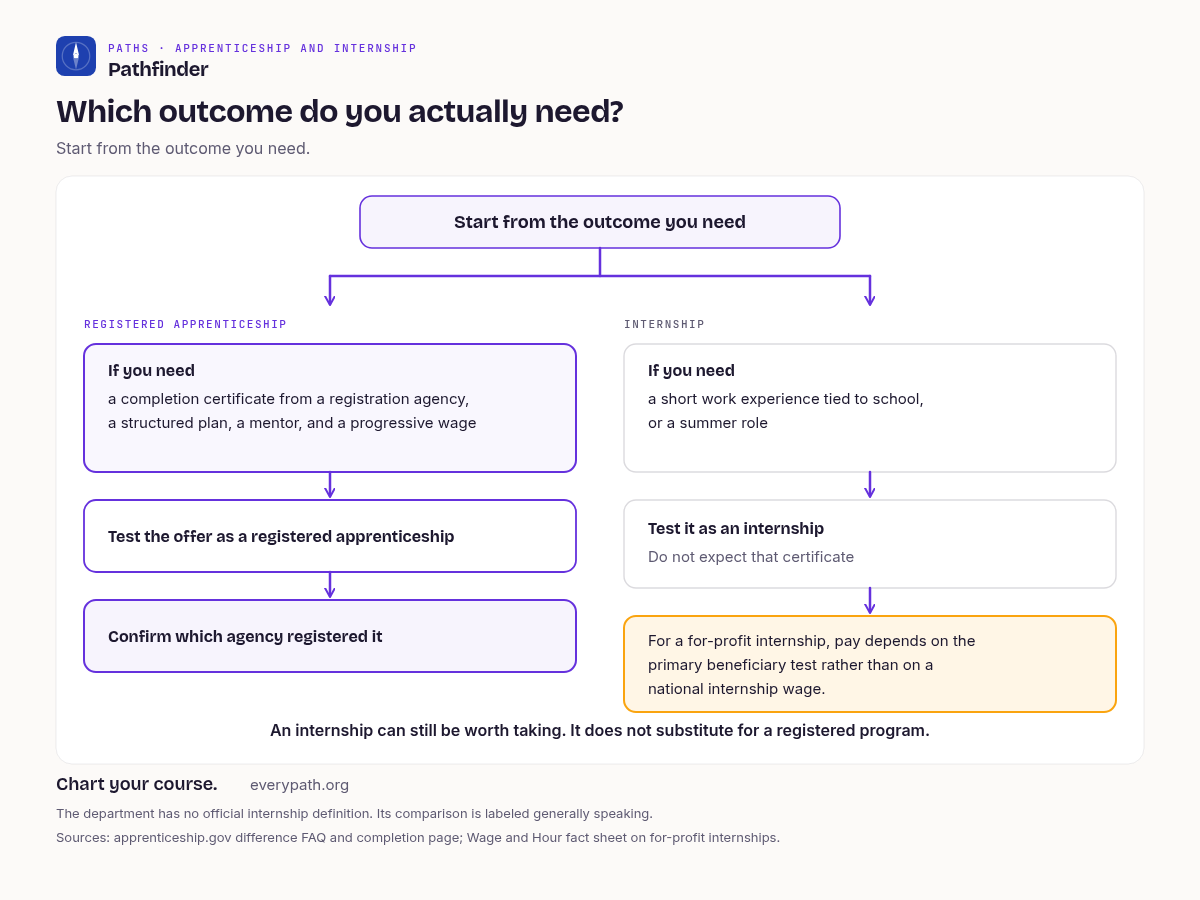
- Name the outcome. If you need the Certificate of Completion of Apprenticeship, only a registered program issues it. An internship is the wrong instrument, even if the tasks look similar and even if the internship is paid.
- If the outcome is the certificate, confirm the model. The offer should be a registered program: paid, structured on-the-job learning, related instruction, and a credential at the end. How those pieces fit together is the subject of what the registered model includes. Ask which agency registered the program. A job title with "apprentice" in it is not the test.
- If the outcome is short experience, call the internship what it is. The department's general picture is 1 to 3 months, often unstructured, not always mentored, often unpaid, and typically without a credential. Your offer may differ. Read the letter. If a for-profit employer says the role is unpaid, Fact Sheet 71 is the worksheet, not a slogan. Educational tie-in, duration, displacement of paid staff, and whether anyone promised pay all matter, and no one factor wins by itself.
- Do not use an internship as a back door into the certificate. Nothing opened today says a summer internship counts as progress inside a registered program. Some registered programs grant credit for previous experience, but that is a program-by-program decision, not a feature of internships. Ask the sponsor later, in writing, if you want that considered. Until then, keep the internship in the experience column.
- If the offer is simply a job, leave the internship column. A paid job with no training plan and no certificate is closer to going straight to work after graduation than to either column in the table. That can be the right move for this year. It is still not a registered apprenticeship.
College credit can show up on either side. The FAQ says both experiences may lead to credit, and that some apprenticeship programs lead to a degree without student debt. Credit is not the certificate. A transcript line from an internship does not replace the completion certificate, and a transcript line from related instruction does not, by itself, prove the program is registered.
If you cannot tell which outcome you want, still deciding is a cleaner status than signing an offer you do not understand. Give yourself one question to answer before you accept: do you need the registration agency's certificate, or do you need a short look at the work? Every path after high school is where that question sits next to school and work, not only next to these two labels.
Does the Labor Department define an internship?
No. Apprenticeship.gov says the department does not have an official definition of internship or externship. The comparison it offers is labeled generally speaking, and it covers length, structure, mentorship, pay, credentials, and college credit.
Are internships always unpaid?
No. Apprenticeship.gov says internships are often unpaid. Fact Sheet 71 says a different thing for for-profit employers. If the intern is an employee under the primary beneficiary test, minimum wage and overtime are required. No single factor decides that test.
Do both paths end in the same certificate?
No. People who finish a registered program can receive a nationally recognized Certificate of Completion of Apprenticeship. Either OA or the state agency can issue it. The department says internships typically do not lead to a credential.
Can a short internship replace a registered apprenticeship?
No. An internship can be useful work experience. It does not put you under registered standards, and it does not issue that completion certificate. Treat it as its own arrangement.
What if I only need something to put on a job application this summer?
Then a short internship, or another job, may match the calendar you actually have. If the occupation you want is normally learned through a registered program, the summer role is not the program. You can still apply to the program later.
Sources
- What is the difference between an apprenticeship and an internship? — U.S. Department of Labor, accessed 2026-10-02
- What is a Registered Apprenticeship Program? — U.S. Department of Labor, accessed 2026-10-02
- What will I receive after I complete a Registered Apprenticeship Program? — U.S. Department of Labor, accessed 2026-10-02
- Registered Apprenticeship Program — U.S. Department of Labor, accessed 2026-10-02
- 29 CFR 29.5 — Standards of apprenticeship — U.S. Department of Labor (Electronic Code of Federal Regulations), accessed 2026-10-02
- Fact Sheet #71: Internship Programs Under The Fair Labor Standards Act — U.S. Department of Labor, Wage and Hour Division, updated January 2018, accessed 2026-10-02
Chart your course
The label on the offer is not the plan. Pathfinder can hold the outcome you named, certificate or short experience, next to a backup, and it marks each claim as sourced, estimated, or advisory.
Frequently asked questions
Does the Labor Department define an internship?
No. Apprenticeship.gov says the department does not have an official definition of internship or externship. The comparison it offers is labeled generally speaking, and it covers length, structure, mentorship, pay, credentials, and college credit.
Are internships always unpaid?
No. Apprenticeship.gov says internships are often unpaid. Fact Sheet 71 says a different thing for for-profit employers. If the intern is an employee under the primary beneficiary test, minimum wage and overtime are required. No single factor decides that test.
Do both paths end in the same certificate?
No. People who finish a registered program can receive a nationally recognized Certificate of Completion of Apprenticeship. Either OA or the state agency can issue it. The department says internships typically do not lead to a credential.
Can a short internship replace a registered apprenticeship?
No. An internship can be useful work experience. It does not put you under registered standards, and it does not issue that completion certificate. Treat it as its own arrangement.
What if I only need something to put on a job application this summer?
Then a short internship, or another job, may match the calendar you actually have. If the occupation you want is normally learned through a registered program, the summer role is not the program. You can still apply to the program later.
Sources
- What is the difference between an apprenticeship and an internship? — U.S. Department of Labor, accessed 2026-10-02
- What is a Registered Apprenticeship Program? — U.S. Department of Labor, accessed 2026-10-02
- What will I receive after I complete a Registered Apprenticeship Program? — U.S. Department of Labor, accessed 2026-10-02
- Registered Apprenticeship Program — U.S. Department of Labor, accessed 2026-10-02
- 29 CFR 29.5 — Standards of apprenticeship — U.S. Department of Labor (Electronic Code of Federal Regulations), accessed 2026-10-02
- Fact Sheet #71: Internship Programs Under The Fair Labor Standards Act — U.S. Department of Labor, Wage and Hour Division (2018), accessed 2026-10-02
Chart your course
Pathfinder builds you a plan for whichever path you pick — or for “still deciding” — and labels every claim in it as grounded, modelled or advisory. It will not invent a deadline, a cost, or your chances of getting in.
Start free No credit card required.
Related reading
- What is a pre-apprenticeship, and who is it for?
A pre-apprenticeship prepares you for a registered program. It is not registered itself. It fits people who do not yet meet a sponsor's entry rules.
- Registered apprenticeship requirements after high school
The federal age floor is 16 unless a law sets a higher age. A diploma is not a national rule. Sponsors write their own grade and skill qualifications.
- How to find a registered apprenticeship after high school
Search apprenticeship.gov's Job Finder and Partner Finder, check your state's agency, confirm a program is registered, and know what applying involves.