Paths after high school
What is a service academy? Free college, then officer duty
By Pathfinder Editorial · Published · 12 min read

A service academy is a federal college that trains military officers. Tuition is covered, and you graduate with a bachelor's degree and a commission. In return you serve at least five years: on active duty from the Army, Navy, Air Force, and Coast Guard academies, or at sea, in a maritime job, or on active duty from the Merchant Marine.
If you have heard of West Point or Annapolis, you may wonder whether a service academy is a college, a branch of the military, or both. The short answer is both, in sequence. You are a student first, under military discipline, and an officer afterward. That sequence is why the choice belongs on the line between college and service.
This page sits under our comparison of military service and college, which covers enlisting and the other ways to combine the two. If you want government work without the officer commitment, look at civilian federal jobs you can start after high school. Since academy applications open early, also read whether to apply to college when you are not sure you will go. Every route the site covers starts from the full list of paths after high school.
Everything here is drawn from federal statutes, the Bureau of Labor Statistics, and the academies' own admissions pages, each checked on 14 October 2026. Admission rules change by class year, so confirm the details with the academy you want.
The five federal service academies
The Bureau of Labor Statistics names five federal service academies:
| Academy | Service it is named for | Nomination needed? |
|---|---|---|
| U.S. Military Academy (West Point) | Army | Yes |
| U.S. Naval Academy (Annapolis) | Navy and Marine Corps | Yes |
| U.S. Air Force Academy | Air Force and Space Force | Yes |
| U.S. Coast Guard Academy | Coast Guard | No |
| U.S. Merchant Marine Academy | Merchant Marine, with reserve or active-duty options | Yes |
According to the bureau, the academies award a Bachelor of Science degree, and graduates receive regular or reserve commissions. Students at West Point, the Air Force Academy, and the Coast Guard Academy are called cadets. Students at the Naval Academy are midshipmen. Each academy sets its own majors. The Coast Guard Academy, for example, lists nine, among them civil, electrical, and mechanical engineering, cyber systems, government, management, and marine and environmental sciences.
The commissions on offer are wider than the names suggest. The Naval Academy law lists commissions in the Navy, the Marine Corps, or the Air Force. The Air Force Academy law lists the Air Force or the Space Force. The Merchant Marine Academy says graduates can work as merchant marine officers while serving as reserve officers, or apply to serve on active duty in any branch of the armed forces.
What it costs
The bureau says cadets and midshipmen receive free tuition, free room and board, free medical and dental care, and a monthly allowance.
West Point puts numbers on that allowance. Its tuition page says the academy does not charge for tuition, room, board, or medical and dental coverage, and that cadets receive a salary that covers their other fees and leaves them between $225 and $625 a month in spending money. Because the academy is federally funded, West Point says it does not have a financial aid office. It adds that outside scholarships, college savings plans, or savings bonds can, under certain conditions, cover the fees normally taken out of a cadet's monthly salary.
Free does not mean without a price. The cost is the service obligation that comes with the degree.
The service commitment
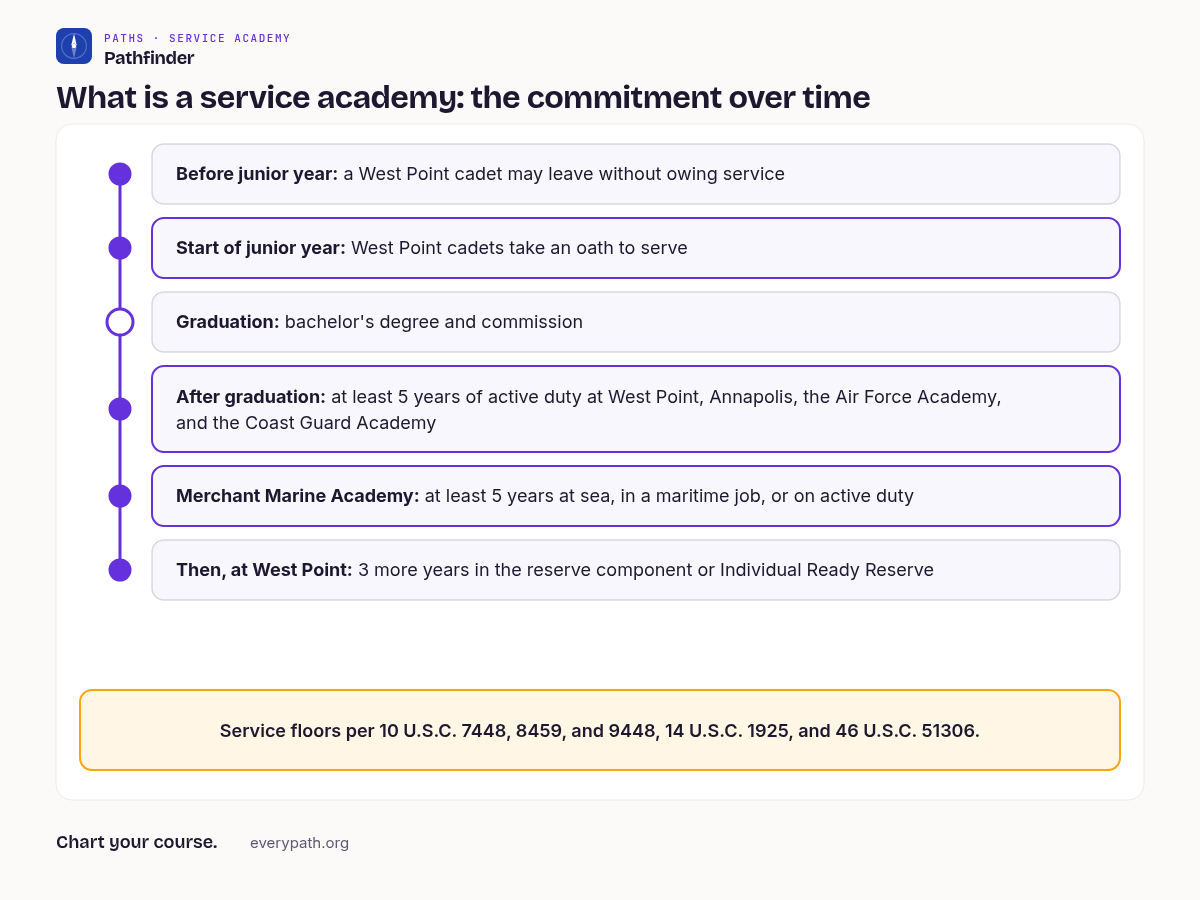
The Army, Navy, and Air Force academies each have a federal law requiring a written agreement from every student. For West Point (10 U.S.C. 7448), the Naval Academy (10 U.S.C. 8459), and the Air Force Academy (10 U.S.C. 9448), the student agrees to finish the course of instruction, accept a commission if offered, and serve on active duty for at least five years immediately after that appointment. If a regular commission is not offered, the graduate accepts a reserve commission instead and stays in the reserve until the obligation is complete.
The Coast Guard Academy has the same kind of agreement in a different title of the code. Under 14 U.S.C. 1925, each cadet agrees to finish the course, accept a Coast Guard commission if offered, and "serve on active duty for at least five years immediately after such appointment."
The Merchant Marine Academy works differently. Under 46 U.S.C. 51306, each cadet agrees to earn a merchant mariner license before graduating and keep it for at least 6 years, to apply for and accept a reserve commission if offered and stay in good standing for at least 8 years, and to serve for at least 5 years after graduation as a merchant marine officer, as an employee in a maritime-related industry if sea service is not available, or as a commissioned officer on active duty, among other options the law lists.
West Point spells out the full picture for its graduates: a minimum of five years on active duty plus three more years in the reserve component or the Individual Ready Reserve. It says cadets take an oath to fulfill this obligation at the start of their junior year, and that before then a cadet may leave the academy for any reason without owing service.
The bureau adds that the active-duty obligation is typically five years and may be longer for some specialties, such as medicine or aviation.
Two other details in the West Point law are worth knowing. A cadet who breaches the agreement can be moved to the Army Reserve and ordered to active duty for up to four years. And a graduate may not take a job as a professional athlete until two years after graduating.
Who can apply
The Naval Academy and the Air Force Academy publish nearly identical basic rules. To be eligible you must:
- Be a U.S. citizen.
- Be at least 17 and not past your 23rd birthday on 1 July of the year you enter.
- Be unmarried.
- Have no dependents. The Naval Academy also lists not being pregnant.
The Naval Academy also asks for a valid Social Security number. The Bureau of Labor Statistics notes that officer candidates training through the academies must be unmarried and without dependents.
The Air Force Academy says its admissions review covers two academic performance measures, a fitness assessment, a medical evaluation, and a character evaluation. To be academically competitive, it recommends four years of English, four years of college-prep math up to pre-calculus or higher, and three years of social studies, along with other courses.
How admission works
The Naval Academy lays out nine steps: confirm eligibility, submit a preliminary application, apply for a nomination, take college entrance exams, send a transcript, complete a medical examination, take the Candidate Fitness Assessment, interview, and go through the admission selection process. It says you can start as early as your junior year of high school.
A few of those steps need more explanation.
The nomination. The bureau says candidates must be nominated by an authorized source, usually a member of Congress. The Naval Academy lists its sources as U.S. senators, representatives, and delegates, the President, the Vice President, the Navy and Marine Corps, ROTC units, and certain children of deceased or disabled veterans, prisoners of war, service members missing in action, and Medal of Honor recipients. It says you do not need to know your nominator personally and encourages you to apply to every source available to you.
The West Point statute shows how nominations are allotted. Under 10 U.S.C. 7442, each senator can have five cadets from the state at the academy at one time, each representative five from the district, and each member may nominate up to 15 people for each vacancy.
Tests and records. The Naval Academy requires the SAT, ACT, or CLT and an official transcript uploaded by your counselor. It uses your highest math score and your highest reading and writing score, or ACT English score, across every sitting, and it counts PSAT scores only for the preliminary step. If you are still too young to apply, it invites you to register for information about its summer programs.
Medical and fitness. The Naval Academy says candidates get a medical exam reviewed by the Department of Defense Medical Examination Review Board and take a fitness assessment that measures strength, speed, agility, and endurance.
Deadlines. The Naval Academy's application deadline is January 31, and it notes many nominations are not announced until early to mid-January. The Merchant Marine Academy lists February 1 as its application deadline and May 1 as the date appointed candidates must accept or decline.
The Coast Guard exception. The Coast Guard Academy says admission is competitive and based on merit, and that congressional nominations are not required or considered. The bureau confirms that Coast Guard Academy appointments do not require a nomination.
Service academy or another officer route?
The bureau lists other ways to become an officer, including officer candidate or officer training school after a college degree. Officer candidates generally need a bachelor's degree, and enlisting is a separate route with its own requirements. The closest contrast is ROTC, where you attend a civilian college and add military instruction to your regular courses.
An academy suits someone who wants the degree and the officer path bundled from day one, and who is ready to commit by the start of junior year. If you are unsure you want military service at all, an academy is a heavy commitment to test that idea with, though West Point's rule lets a cadet leave before junior year without owing service.
Common mistakes with service academies
- Waiting until senior year to start. The Naval Academy says you can begin in junior year, and nominations take time.
- Applying to only one nomination source. The Naval Academy encourages applying to all the sources available to you.
- Assuming every academy needs a nomination. The Coast Guard Academy does not use them.
- Calling it a free degree with no strings. Tuition is covered because graduates owe years of service, with at least five on active duty at the Army, Navy, Air Force, and Coast Guard academies and at least five years of maritime or military service at the Merchant Marine Academy.
- Missing the basic eligibility rules. Age limits, citizenship, and the rule on marriage and dependents apply before anything else counts.
What is a service academy?
It is a federal college that educates future military officers. The Bureau of Labor Statistics lists five, for the Army, Navy, Air Force, Coast Guard, and Merchant Marine. The bureau says they award a Bachelor of Science degree, and graduates receive regular or reserve commissions.
Is a service academy free?
Tuition is covered. The Bureau of Labor Statistics says cadets and midshipmen get free tuition, room and board, and medical and dental care, plus a monthly allowance. The cost is paid back through service as an officer after graduation.
How long do you have to serve after a service academy?
At least five years. Army, Navy, Air Force, and Coast Guard academy graduates owe five years of active duty (10 U.S.C. 7448, 8459, 9448; 14 U.S.C. 1925). Merchant Marine graduates owe five years at sea, in a maritime job, or on active duty, plus reserve service if commissioned (46 U.S.C. 51306). West Point adds three reserve years.
Do you need a nomination to get into a service academy?
For most, yes. Candidates usually need a nomination from an authorized source, often a member of Congress. The Coast Guard Academy is the exception. It says congressional nominations are not required or considered, and admission is based on merit.
What is the age limit for a service academy?
The Naval Academy and Air Force Academy both say you must be at least 17 and not past your 23rd birthday on 1 July of the year you enter. They also require U.S. citizenship and say you must be unmarried with no dependents.
Sources
- Military Careers , Bureau of Labor Statistics, Occupational Outlook Handbook, read 14 October 2026. Academy list, benefits, obligation, and nomination rules
- Apply: Steps for Admission , U.S. Naval Academy, read 14 October 2026
- Become a Cadet: Eligibility Requirements , U.S. Air Force Academy Admissions, read 14 October 2026
- Tuition and Service Commitment , U.S. Military Academy, read 14 October 2026
- Admissions , U.S. Coast Guard Academy, read 14 October 2026
- Admissions , U.S. Merchant Marine Academy, read 14 October 2026
- 10 U.S.C. 7442, 7448, 8459, and 9448 , West Point nominations and the three service agreements, read 14 October 2026
- 14 U.S.C. 1925, Agreement , Coast Guard Academy cadet service agreement, read 22 October 2026
- 46 U.S.C. 51306, Cadet commitment agreements , Merchant Marine Academy service obligation, read 22 October 2026
Chart your course
Put an academy appointment beside the plan you would follow if the nomination never came. Pathfinder holds both, and each claim on them is flagged sourced, estimated, or advisory, so a guess never passes for a fact.
Frequently asked questions
What is a service academy?
It is a federal college that educates future military officers. The Bureau of Labor Statistics lists five, for the Army, Navy, Air Force, Coast Guard, and Merchant Marine. The bureau says they award a Bachelor of Science degree, and graduates receive regular or reserve commissions.
Is a service academy free?
Tuition is covered. The Bureau of Labor Statistics says cadets and midshipmen get free tuition, room and board, and medical and dental care, plus a monthly allowance. The cost is paid back through service as an officer after graduation.
How long do you have to serve after a service academy?
At least five years. Army, Navy, Air Force, and Coast Guard academy graduates owe five years of active duty (10 U.S.C. 7448, 8459, 9448; 14 U.S.C. 1925). Merchant Marine graduates owe five years at sea, in a maritime job, or on active duty, plus reserve service if commissioned (46 U.S.C. 51306). West Point adds three reserve years.
Do you need a nomination to get into a service academy?
For most, yes. Candidates usually need a nomination from an authorized source, often a member of Congress. The Coast Guard Academy is the exception. It says congressional nominations are not required or considered, and admission is based on merit.
What is the age limit for a service academy?
The Naval Academy and Air Force Academy both say you must be at least 17 and not past your 23rd birthday on 1 July of the year you enter. They also require U.S. citizenship and say you must be unmarried with no dependents.
Sources
- Military Careers, Occupational Outlook Handbook — U.S. Bureau of Labor Statistics, accessed 2026-10-14
- Apply: Steps for Admission — United States Naval Academy, accessed 2026-10-14
- Become a Cadet: Eligibility Requirements — United States Air Force Academy Admissions, accessed 2026-10-14
- Tuition and Service Commitment — United States Military Academy at West Point, accessed 2026-10-14
- Admissions — United States Coast Guard Academy, accessed 2026-10-14
- Admissions — United States Merchant Marine Academy, accessed 2026-10-14
- 10 U.S.C. 7442, Cadets: appointment; numbers, territorial distribution — Legal Information Institute, Cornell Law School (United States Code text), accessed 2026-10-14
- 10 U.S.C. 7448, Cadets: agreement to serve as officer — Legal Information Institute, Cornell Law School (United States Code text), accessed 2026-10-14
- 10 U.S.C. 8459, Midshipmen: agreement for length of service — Legal Information Institute, Cornell Law School (United States Code text), accessed 2026-10-14
- 10 U.S.C. 9448, Cadets: agreement to serve as officer — Legal Information Institute, Cornell Law School (United States Code text), accessed 2026-10-14
- 14 U.S.C. 1925, Coast Guard Academy cadet agreement — Legal Information Institute, Cornell Law School (United States Code text), accessed 2026-10-22
- 46 U.S.C. 51306, Merchant Marine Academy cadet commitment agreements — Legal Information Institute, Cornell Law School (United States Code text), accessed 2026-10-22
Chart your course
Pathfinder builds you a plan for whichever path you pick — or for “still deciding” — and labels every claim in it as grounded, modelled or advisory. It will not invent a deadline, a cost, or your chances of getting in.
Start free No credit card required.
Related reading
- Military vs college after high school? Sourced
Enlisting after high school vs starting college: what each path is for, with VA/DoD/BLS primaries only — no invented odds or prestige rankings.
- How to tell your parents you don't want to go to college
A student's guide to the college conversation: build a plan first (what instead, when, money, backup), expect their worries, and follow up after you talk.
- Can you go to college later? How re-entry works
Yes. Skipping or delaying college doesn't close the door. How applying later works, first-year vs transfer status, credit for what you did, and what to keep.