Paths after high school
Federal jobs after high school: USAJOBS and Pathways
By Pathfinder Editorial · Published · 11 min read
About: Pathway Straight to work Grounded
Yes, you can apply for federal jobs right after high school. USAJOBS says any U.S. citizen is eligible for jobs marked Open to the public. The Pathways Internship, OPM's student program, needs one more step: you must be enrolled, or accepted, at least half-time in a qualifying school or a program such as a registered apprenticeship.
So the honest answer has two halves. Public listings are open to a new graduate who meets the job's qualifications. The student program is closed to a graduate who has stopped studying and open to one who has signed up for the next stage, even if classes have not started. This page explains both halves and the one federal program a diploma does not unlock.
This topic sits under going straight to work after high school, where the broader job search is covered. If you want training at no cost before you apply anywhere, see free job training programs after graduation. If you are weighing a federal internship against an earn-while-you-learn program, compare them on apprenticeship vs internship. All the routes after graduation are gathered on every path after high school.
Pay is left out on purpose. Every federal announcement must state its starting salary, so the listing itself is the right place to read it.
How USAJOBS decides who can apply
USAJOBS is the federal government's job site, run by the Office of Personnel Management (OPM). Its help center says federal jobs use hiring paths, which are groups of people eligible to apply for a given announcement. Agencies can post jobs open only to certain groups.
The help center lists the paths an announcement may show. They include Open to the public, Students, Recent graduates, Veterans, Military spouses, Individuals with a disability, National Guard and Reserves, Peace Corps and AmeriCorps VISTA, and several paths for current or former federal employees.
Two sentences on that help page matter most for a new graduate:
- "Anyone is eligible for jobs that are 'Open to the public', as long as you're a U.S. citizen."
- "You can apply to any job, but you may not be eligible for the job if you don't fall into one of the required hiring paths. If you're not eligible, the hiring agency will reject your application."
The page tells applicants to look for the section headed This job is open to in each announcement. That section decides whether you are eligible at all. The rest of the announcement decides whether you qualify.
Path 1: jobs open to the public
A job marked Open to the public is the most direct route for a graduate who is not enrolled anywhere. Eligibility is about citizenship, not schooling. Whether you get the job then depends on the qualifications the announcement lists, which differ from one position to the next.
A practical approach for a first search:
- Filter for jobs open to the public in your area.
- Open each announcement and read This job is open to before anything else.
- Read the qualifications. Note any that ask for experience or education you do not yet have.
- Read the duties and the location. Some announcements require you to work at a named site.
- Read the starting salary on the announcement itself, then decide whether to apply.
Expect some listings to be out of reach for now. A posting may ask for experience you have not had time to build. That is information, not rejection. It tells you what a year of work or training would need to add.
Path 2: the Pathways Internship Program
OPM runs three Pathways Programs: the Internship Program, the Recent Graduates Program, and the Presidential Management Fellows Program. They place people in what OPM calls Schedule D excepted service appointments, a separate hiring route from the standard competitive process.
The Internship Program is the one that reaches high school age. OPM describes it as paid work in agencies for high school, undergraduate, and graduate students, so they can explore federal careers while still in school.
To be eligible, OPM's student page says an applicant must be one of the following:
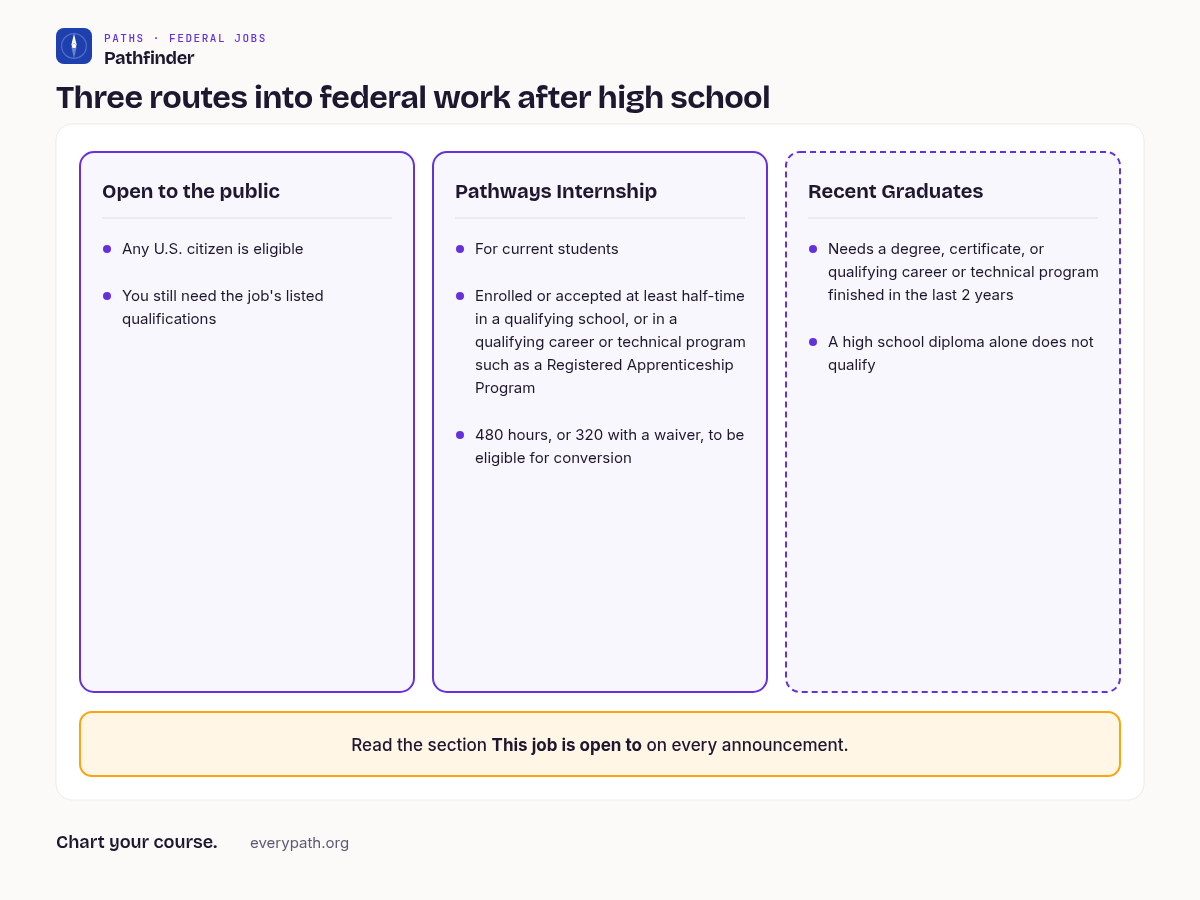
- Accepted for enrollment, or enrolled and seeking a degree, diploma, or certificate, at a qualifying educational institution, on at least a half-time basis as the institution defines it.
- Accepted for enrollment, or enrolled, in a qualifying career or technical education program that awards a recognized postsecondary credential, such as a Registered Apprenticeship Program.
The federal rules at 5 CFR 362.202 say the same and add a useful detail. A student who needs less than half a course load right before graduating still counts as a student.
Agencies can add their own conditions. OPM's student page says an agency may require the ability to work a set number of hours a week, good academic standing, or the ability to work at the location named in the announcement.
The chart below shows how the three routes line up for someone finishing high school.
What counts as a qualifying school
The definitions at 5 CFR 362.102 set out which institutions count. In plain terms, a qualifying educational institution is either:
- A public high school whose curriculum a state or local governing body has approved, a private school providing secondary education as state law determines, or a homeschool allowed to operate in the state; or
- An institution accredited by an accrediting body that the U.S. Department of Education recognizes: a technical or vocational school, a two-year or four-year college or university, a graduate or professional school, or a postsecondary homeschool curriculum.
The same section defines a qualifying career or technical education program. It includes a federally administered program of at least one year that awards a recognized postsecondary credential, a Registered Apprenticeship Program, and federally administered volunteer service programs.
That is why a high school senior can be a Pathways intern. It is also why the same person, the week after graduation, no longer is, unless they have been accepted for the next stage.
The gap the day after graduation
Here is the situation the question is really about. You graduate in June. You have not signed up for anything. Are you eligible for Pathways?
On the federal definition, no. A student must be enrolled, or accepted for enrollment, in a qualifying institution or program. A diploma closes the high school door.
Now change one fact. You graduate in June, and you have already been accepted for the fall at a community college or an accredited trade school, at least half-time. Or you have been accepted into a Registered Apprenticeship Program. The rule covers someone who is accepted for enrollment, so you meet the student definition before your first class. Whether an agency takes you is still its decision, and its own criteria still apply.
That makes Pathways a reason to line up the next step before summer, not after. Your plan for the fall can open a federal door in the spring.
Why a diploma does not unlock Recent Graduates
The Recent Graduates Program sounds as if it fits anyone who has just graduated. It does not include high school.
OPM says eligibility requires an associate's, bachelor's, master's, professional, doctorate, vocational, or technical degree, or a certificate, from a qualifying educational institution, or completion of a qualifying career or technical education program, within the previous two years. Veterans who could not apply because of a service obligation have up to six years.
A high school diploma is not on that list. Recent Graduates is a door for later, once you have finished a postsecondary credential or a qualifying program such as a registered apprenticeship.
How a Pathways internship can lead to a permanent job
OPM's student page describes conversion. Interns must complete at least 480 hours of work, or 320 hours with a waiver, to be eligible. Agencies may convert an intern to a permanent position, or in limited cases a term position of one to four years, within 120 days of finishing the program. To be converted, the intern must also meet the qualifications for the new position.
Eligible for conversion is the key phrase. It is a possibility the agency can use, not a promise. Ask during the interview whether the office has converted interns before and what it expects from them.
Where Pathways jobs are posted
Federal rules at 5 CFR 362.203 require an agency to give public notice of internship openings. It can post a searchable announcement on USAJOBS, or post a link to a custom USAJOBS announcement on its own careers page. OPM's student page also points students to a Federal Internship Portal at intern.usajobs.gov.
Each announcement must include, among other details, the position title and grade, the location, how long the appointment lasts, the starting salary, the minimum qualifications, and whether conversion is possible. Read those details before you apply. They answer most of the questions people ask afterward.
Common mistakes with federal jobs after high school
- Skipping This job is open to. It decides eligibility. Applying outside your hiring path gets the application rejected.
- Assuming Pathways ends at graduation for everyone. Acceptance for enrollment in a qualifying school or program, including a Registered Apprenticeship Program, keeps you inside the student definition.
- Applying to Recent Graduates with a diploma. The program needs a postsecondary degree, certificate, or qualifying program finished in the last two years.
- Treating conversion as guaranteed. It is an option after 480 hours, or 320 with a waiver, not a right.
- Ignoring agency conditions. An agency can require set weekly hours, good academic standing, or a specific location.
Can you get a federal job right after high school?
You can apply. USAJOBS says anyone who is a U.S. citizen is eligible for jobs marked Open to the public, so a graduate can apply to those if they meet the position's qualifications. Jobs limited to other groups, such as students or veterans, are a different matter, and an ineligible application is rejected.
What is the Pathways Internship Program?
It is an OPM program that gives high school, undergraduate, and graduate students paid work in federal agencies. Applicants must be enrolled, or accepted for enrollment, at least half-time in a qualifying school, or in a qualifying career or technical program such as a Registered Apprenticeship Program, and they must stay students throughout.
Can a high school graduate join the Pathways Internship Program?
Not on the diploma alone. The program is for current students. A graduate who has been accepted for enrollment at least half-time in a qualifying college, trade school, or career or technical program, including a Registered Apprenticeship Program, meets the student definition in the federal rules. The agency's own criteria still apply.
Does a high school diploma count for the Recent Graduates Program?
No. OPM lists the qualifying awards as an associate's, bachelor's, master's, professional, doctorate, vocational, or technical degree, or a certificate from a qualifying institution, or completion of a qualifying career or technical program within the previous two years. A high school diploma is not on that list.
Can a Pathways intern become a permanent federal employee?
Possibly. OPM says interns must complete at least 480 hours, or 320 with a waiver, to be eligible for conversion. An agency may then convert an intern to a permanent job, or in limited cases a term job, within 120 days of finishing the program. Eligibility for conversion is not a promise of a job.
Sources
- Students and Recent Graduates — OPM hiring information page, read 10 October 2026
- What is the Pathways Programs framework? — OPM frequently asked questions, read 10 October 2026
- 5 CFR part 362, Pathways Programs — eCFR, title 5 as of 5 October 2026, sections 362.102, 362.202, and 362.203, read 10 October 2026
- What jobs am I eligible to apply for? — USAJOBS Help Center, updated 10 July 2026, read 10 October 2026
Chart your course
List the federal listing you would apply to now and the school or program that would make you a Pathways student. Pathfinder sets those two plans beside each other. Any claim inside them is marked sourced, estimated, or advisory.
Frequently asked questions
Can you get a federal job right after high school?
You can apply. USAJOBS says anyone who is a U.S. citizen is eligible for jobs marked Open to the public, so a graduate can apply to those if they meet the position's qualifications. Jobs limited to other groups, such as students or veterans, are a different matter, and an ineligible application is rejected.
What is the Pathways Internship Program?
It is an OPM program that gives high school, undergraduate, and graduate students paid work in federal agencies. Applicants must be enrolled, or accepted for enrollment, at least half-time in a qualifying school, or in a qualifying career or technical program such as a Registered Apprenticeship Program, and they must stay students throughout.
Can a high school graduate join the Pathways Internship Program?
Not on the diploma alone. The program is for current students. A graduate who has been accepted for enrollment at least half-time in a qualifying college, trade school, or career or technical program, including a Registered Apprenticeship Program, meets the student definition in the federal rules. The agency's own criteria still apply.
Does a high school diploma count for the Recent Graduates Program?
No. OPM lists the qualifying awards as an associate's, bachelor's, master's, professional, doctorate, vocational, or technical degree, or a certificate from a qualifying institution, or completion of a qualifying career or technical program within the previous two years. A high school diploma is not on that list.
Can a Pathways intern become a permanent federal employee?
Possibly. OPM says interns must complete at least 480 hours, or 320 with a waiver, to be eligible for conversion. An agency may then convert an intern to a permanent job, or in limited cases a term job, within 120 days of finishing the program. Eligibility for conversion is not a promise of a job.
Sources
- Students and Recent Graduates — U.S. Office of Personnel Management, accessed 2026-10-10
- What is the Pathways Programs framework? — U.S. Office of Personnel Management, accessed 2026-10-10
- 5 CFR part 362, Pathways Programs (sections 362.102, 362.202, 362.203) — Electronic Code of Federal Regulations, accessed 2026-10-10
- What jobs am I eligible to apply for? — USAJOBS Help Center, U.S. Office of Personnel Management, accessed 2026-10-10
Chart your course
Pathfinder builds you a plan for whichever path you pick — or for “still deciding” — and labels every claim in it as grounded, modelled or advisory. It will not invent a deadline, a cost, or your chances of getting in.
Start free No credit card required.
Related reading
- Free job training after high school through WIOA Youth
Free job training after high school can start at a WIOA Youth program, built for ages 14 to 24 with barriers, or at an American Job Center near you.
- Straight to work after high school? Sourced guide
Going straight to work after high school: what it means, how it differs from college and apprenticeships, and how to plan a primary + backup.
- Apprenticeship vs internship after high school
A registered apprenticeship is paid, structured training that ends in a national completion certificate. An internship is usually short and is not a substitute.