Paths after high school
What is ROTC? College with officer training, explained
By Pathfinder Editorial · Published · 12 min read
About: Pathway Military University
ROTC is a college program that trains you to become a military officer while you earn a regular degree. You take your normal classes plus military instruction, usually a few hours a week. The first years can be a trial, but advanced training requires a written agreement to accept a commission and serve after graduation.
The full name is the Senior Reserve Officers' Training Corps, set up under chapter 103 of Title 10 of the U.S. Code. The Army, Navy, and Air Force departments each run their own program, and the law lists Marine Corps and Space Force commissions among the outcomes. Air Force ROTC, for example, prepares students to become Air Force or Space Force officers. You live as a regular college student, pick a college the usual way, and add the ROTC course on top.
ROTC is one of the routes covered in the military versus college comparison, which also explains enlisting. If you want the officer path at a federal college instead, read how a service academy works, where the degree and the commitment come as one package. Because ROTC scholarships are tied to the college you attend, deciding whether to apply to college at all matters here too. The rest of the options sit on every route after high school, in one place.
This page draws on the federal statute, the Bureau of Labor Statistics, and the Army and Air Force ROTC pages, each checked on 14 October 2026.
What ROTC is, in federal law
Under 10 U.S.C. 2102, the Secretary of each military department may set up a Senior ROTC program "for the purpose of preparing selected students for commissioned service in the Army, Navy, Air Force, Marine Corps, or Space Force." Units can be placed at any accredited civilian college authorized to grant bachelor's degrees, and at schools that are essentially military, when the institution asks.
The law puts conditions on the college too. A host school must give the senior officer assigned there the academic rank of professor, keep the terms of its agreement with the military department, and adopt as part of its curriculum either a four-year course of military instruction or a two-year advanced course, or both. Whether membership is elective or compulsory is left to state law or the college.
There is also a rule meant to spread units around the country. The President must keep at least one unit in each state if a college in that state asks for one, the governor approves, and the military department expects at least 40 students to enroll.
You do not need a unit at your own school. Under 10 U.S.C. 2103, a student at a college without a unit can, if otherwise qualified, join a unit at another institution.
How ROTC fits into a college schedule
The Bureau of Labor Statistics says ROTC participants take regular college courses along with 3 to 5 hours of military instruction per week. After graduation, they may serve as officers on active duty, in the Reserves, or in the National Guard.
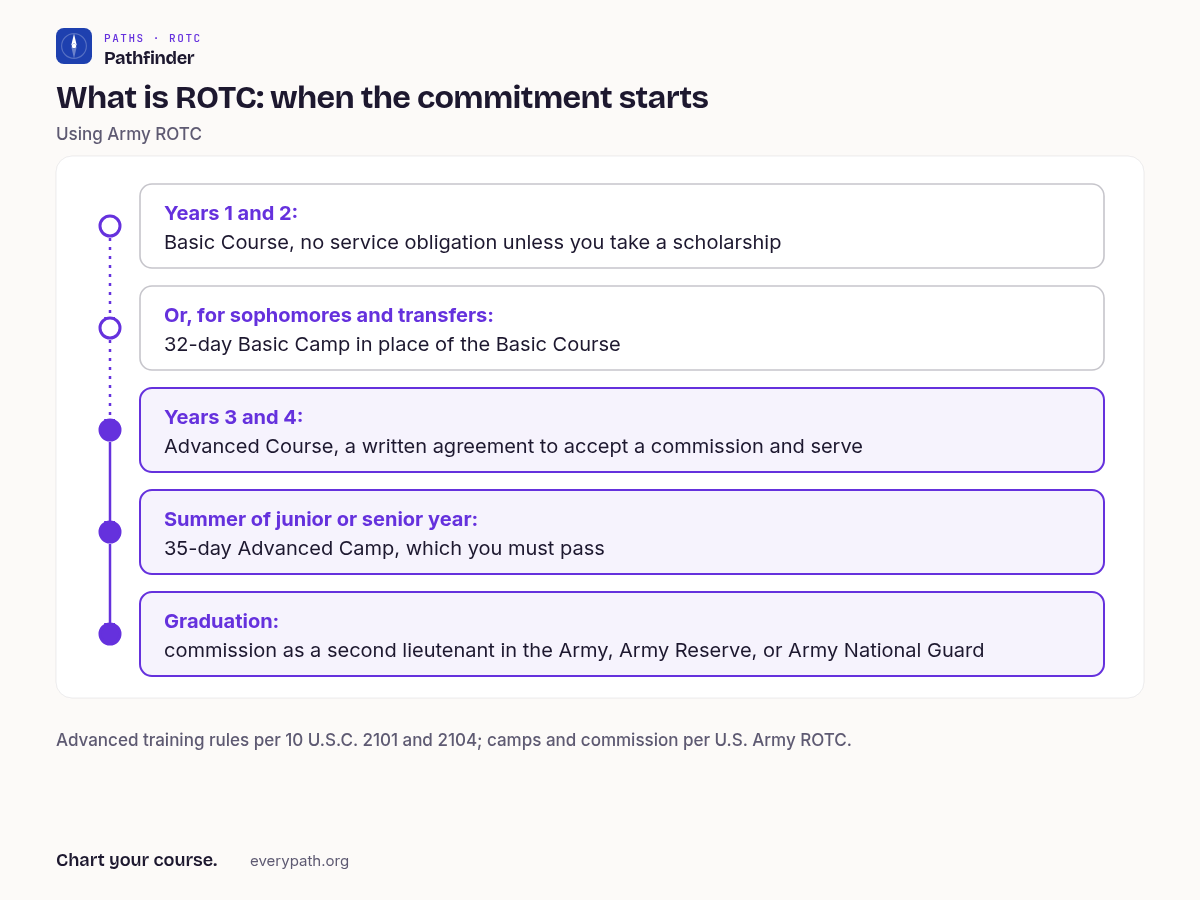
The Army describes its version in four stages:
| Stage | When | What the Army says it involves |
|---|---|---|
| Basic Course | Freshman or sophomore year | One elective class and lab each semester, plus physical training and field training exercises |
| Basic Camp | Sophomore year or after a transfer | A 32-day training event that can stand in for the Basic Course and qualifies you for the Advanced Course |
| Advanced Course | Junior and senior year | Classroom study of military strategy; requires the Basic Course or Basic Camp and establishes your commitment to serve |
| Advanced Camp | Summer of junior or senior year | A 35-day field training event you must pass to qualify as an Army officer |
The Army also says its ROTC classes are standard college classes that fit a normal academic schedule, that you can pick any major, and that you do not attend Basic Combat Training because that training comes through ROTC coursework. The Army says graduates are commissioned as second lieutenants in the Army, Army Reserve, or Army National Guard, and federal law at 10 U.S.C. 2107 makes Army ROTC scholarship graduates eligible for appointment as second lieutenants. After graduation, new Army officers attend the Basic Officer Leader Course.
Air Force ROTC splits its program into a General Military Course and a Professional Officer Course. It says cadets take courses on effective leadership, leadership concepts, and the role of a military leader in today's society, to prepare for careers as Air Force or Space Force officers.
When ROTC becomes a commitment
The law draws a line between the first part of the program and advanced training. Under 10 U.S.C. 2101, advanced training means the third and fourth years of a four-year course, the equivalent in an approved two-year course, or study beyond the bachelor's degree.
To enter or continue in advanced training, 10 U.S.C. 2104 says you must:
- Be a U.S. citizen.
- Be selected under the military department's procedures.
- Enlist in that armed force for the period it sets.
- Sign a contract to serve, with a parent's or guardian's consent if you are a minor.
- Agree in writing to accept a commission if offered and to serve for the period the Secretary sets.
- Complete the first two years of the course, or field training, or agree to complete field training within two years.
- Sign a loyalty certificate or take a loyalty oath.
A student who does not meet those conditions is released from the program.
That is why the Army can say its Basic Course does not obligate you to serve unless you take a scholarship. The commitment arrives when you sign for advanced training or accept a scholarship, not on the first day of class.
ROTC scholarships
What the law allows. Under 10 U.S.C. 2107, a military department may appoint selected ROTC members as scholarship cadets or midshipmen and pay tuition, fees, books, and laboratory expenses. It can extend that to a fifth academic year for approved degree programs that take longer than four years, and it may pay room and board and other required expenses in place of some or all of the tuition help. To qualify, you must be a U.S. citizen or national and be under 31 on December 31 of the year you become eligible for a commission.
What the bureau says. ROTC scholarships for 2, 3, and 4 years of school are available on a competitive basis. Students in the last 2 years of a program receive a monthly allowance while in school, plus pay for summer training.
What the Army says. High school students who apply are eligible for scholarships covering up to the full cost of tuition based on merit and grades, plus $420 per month for personal expenses and $1,200 per year for books. You can apply for the four-year National Scholarship once you finish your junior year of high school, and applications open at the start of each summer. Enlisted soldiers can pursue a commission and possibly a scholarship through the Green to Gold program.
What the Air Force says. Air Force ROTC offers capped scholarships, with a maximum tuition benefit each year, and uncapped ones with no fixed limit. Types and amounts are set at the time of the award, and it says it does not upgrade offers. Recipients can convert the benefit to a room scholarship that pays on-campus or university-billed housing up to $10,000 per academic year. Its book stipend is $900 per academic year, and its monthly stipend rises from $300 for freshmen to $350, $450, and $500 for seniors.
Neither branch page states how many applicants win a scholarship, so treat any figure you hear elsewhere with care.
How long you serve afterward
The scholarship law gives the military department several options for the service you agree to:
- Serve on active duty for four or more years.
- Serve in a reserve component until the eighth anniversary of your commission.
- Serve in a reserve component until at least the sixth anniversary, and up to the eighth, including not less than two years of active duty.
The department chooses which applies. The Army spells out its version for four-year scholarship cadets: four years full time as an Army officer after graduation, then either four more years on contract or four years in the Individual Ready Reserve. It says scholarship recipients can face a four-year full-time or eight-year part-time contract.
Who ROTC suits
ROTC fits someone who wants a normal college experience, in a chosen major at a chosen school, with an officer career as the planned next step. Because the first part of the program can be tried without an obligation in the Army's case, it also gives you room to test the idea before you sign.
It suits you less if you want no military commitment at all, or if a scholarship is the only way you could afford college, since accepting one brings a service obligation. The officer route through a federal academy, by contrast, bundles the degree and the commitment from the start.
How to start
- Find a school with a unit. The Army says its program is offered at more than 1,000 colleges and universities, and Air Force ROTC says more than 1,100. If your school has none, ask whether you can join a unit at a nearby campus.
- Apply for a high school scholarship early. The Army's four-year application opens the summer after your junior year.
- Check major rules. The Army allows any major. Air Force ROTC publishes highly desired majors.
- Ask when the contract starts. Find out which semester or which award triggers your service agreement.
- Read the service options. Ask the unit which of the active or reserve paths your contract would use.
Common mistakes with ROTC
- Assuming you commit on day one. In Army ROTC, the Basic Course carries no obligation unless you take a scholarship.
- Assuming a scholarship is free money. Accepting one comes with a written service agreement.
- Ruling out a school because it has no unit. Federal law lets you join a unit at another institution.
- Treating every branch's scholarship the same. Army and Air Force stipends, book money, and caps differ.
- Forgetting the age limit on scholarships. The law requires you to be under 31 on December 31 of the year you become eligible for a commission.
What is ROTC?
ROTC, the Senior Reserve Officers' Training Corps, is a federal program that trains college students to become officers while they earn a degree. Federal law lets each military department run units at colleges to prepare students for commissioned service in the Army, Navy, Air Force, Marine Corps, or Space Force.
Does joining ROTC mean you have to serve in the military?
Not right away. The Army says its Basic Course, the first two years of college, does not obligate you to serve unless you take a scholarship. Entering advanced training requires a written agreement to accept a commission and serve, so the commitment comes later.
How much does an ROTC scholarship pay?
It depends on the branch. The Army says high school applicants can earn scholarships of up to full tuition plus $420 a month and $1,200 a year for books. Air Force ROTC lists a $900 yearly book stipend and monthly stipends from $300 to $500.
Can you choose any major in ROTC?
In Army ROTC, yes. The Army says you can choose any college major and still commission as an officer when you graduate. Air Force ROTC publishes a list of highly desired majors, so check how your major fits before you apply for a scholarship there.
How long do you serve after ROTC?
It depends on the agreement you sign. For Army four-year scholarship cadets, the Army says the obligation is four years full time as an officer, then either four more years on contract or four years in the Individual Ready Reserve.
Sources
- 10 U.S.C. chapter 103 , Senior ROTC statute, sections 2101, 2102, 2103, 2104, and 2107, read 14 October 2026
- Military Careers , ROTC training section of the BLS handbook entry, read 14 October 2026. Weekly hours, allowance, and scholarship lengths
- Army ROTC , U.S. Army, read 14 October 2026
- Air Force ROTC , U.S. Air Force ROTC home and about pages, read 14 October 2026
- High School Scholarship Types , U.S. Air Force ROTC, read 14 October 2026
Chart your course
List the ROTC unit you might join and the college plan you would keep with no contract at all. Pathfinder lays the pair out together. Each claim in either plan wears one label, sourced, estimated, or advisory, and the weak ones are easy to spot.
Frequently asked questions
What is ROTC?
ROTC, the Senior Reserve Officers' Training Corps, is a federal program that trains college students to become officers while they earn a degree. Federal law lets each military department run units at colleges to prepare students for commissioned service in the Army, Navy, Air Force, Marine Corps, or Space Force.
Does joining ROTC mean you have to serve in the military?
Not right away. The Army says its Basic Course, the first two years of college, does not obligate you to serve unless you take a scholarship. Entering advanced training requires a written agreement to accept a commission and serve, so the commitment comes later.
How much does an ROTC scholarship pay?
It depends on the branch. The Army says high school applicants can earn scholarships of up to full tuition plus $420 a month and $1,200 a year for books. Air Force ROTC lists a $900 yearly book stipend and monthly stipends from $300 to $500.
Can you choose any major in ROTC?
In Army ROTC, yes. The Army says you can choose any college major and still commission as an officer when you graduate. Air Force ROTC publishes a list of highly desired majors, so check how your major fits before you apply for a scholarship there.
How long do you serve after ROTC?
It depends on the agreement you sign. For Army four-year scholarship cadets, the Army says the obligation is four years full time as an officer, then either four more years on contract or four years in the Individual Ready Reserve.
Sources
- 10 U.S.C. chapter 103, Senior Reserve Officers' Training Corps (sections 2101, 2102, 2103, 2104, 2107) — Legal Information Institute, Cornell Law School (United States Code text), accessed 2026-10-14
- Military Careers, Occupational Outlook Handbook — U.S. Bureau of Labor Statistics, accessed 2026-10-14
- Army ROTC — U.S. Army, accessed 2026-10-14
- Air Force ROTC — U.S. Air Force ROTC, accessed 2026-10-14
- High School Scholarship Types — U.S. Air Force ROTC (2026), accessed 2026-10-14
Chart your course
Pathfinder builds you a plan for whichever path you pick — or for “still deciding” — and labels every claim in it as grounded, modelled or advisory. It will not invent a deadline, a cost, or your chances of getting in.
Start free No credit card required.
Related reading
- Military vs college after high school? Sourced
Enlisting after high school vs starting college: what each path is for, with VA/DoD/BLS primaries only — no invented odds or prestige rankings.
- Can you go to college later? How re-entry works
Yes. Skipping or delaying college doesn't close the door. How applying later works, first-year vs transfer status, credit for what you did, and what to keep.
- What is a service academy? Free college, then officer duty
A service academy is a federal college that trains officers. Tuition is free, most need a nomination, and graduates usually serve at least five years.