Paths after high school
What is a conservation corps? Paid work on public lands
By Pathfinder Editorial · Published · 12 min read
About: Pathway
A conservation corps is a paid work program where young people restore trails, habitat, historic sites, and other public resources. Federal law sets out two main versions: the Youth Conservation Corps for ages 15 through 18, and the Public Lands Corps for ages 16 to 30, with veterans eligible up to 35.
The word corps can sound military, and the phrase gets used loosely for any summer trail job. In practice, a conservation corps is closer to a job with training attached than to service in uniform. You work outdoors, often in a crew, on a project a land agency needs done, and you get paid.
If you are deciding whether to start working right after graduation, the wider options sit on the page about going straight to work after high school. A conservation corps is one of the more structured ways to do that. If you left school without a diploma and want training plus a classroom, compare it with the YouthBuild program for ages 16 to 24. Every route this site covers is mapped on the guide to every path after high school.
The facts below come from the federal statutes that create these programs and from National Park Service program pages, all checked on 14 October 2026. Local corps add their own rules on top, so a program near you may differ in pay, hours, and housing.
What a conservation corps is, in federal law
Two laws in Title 16 of the United States Code do most of the defining. The Public Lands Corps law, at 16 U.S.C. 1722, describes a "qualified youth or conservation corps" as a program set up by a state or local government, by a tribal government, or by a nonprofit organization. To count, the program must meet three tests:
- It can offer meaningful, full-time, productive work in a natural or cultural resource setting for people between 16 and 30, inclusive, or for veterans aged 35 or younger.
- It gives participants a mix of work experience, basic and life skills, education, training, and support services.
- It offers participants the chance to develop citizenship values and skills through service to their community and the country.
That definition matters because it shows a corps is more than a seasonal labor crew. Under the law, the training and support pieces are part of what makes a program qualify.
The same section defines the kind of work involved. An "appropriate conservation project" is any project for the conservation, restoration, construction, or rehabilitation of natural, cultural, historic, archaeological, recreational, or scenic resources. That covers a wide span, from rebuilding a footbridge to stabilizing an old building.
The two federal programs
The Youth Conservation Corps
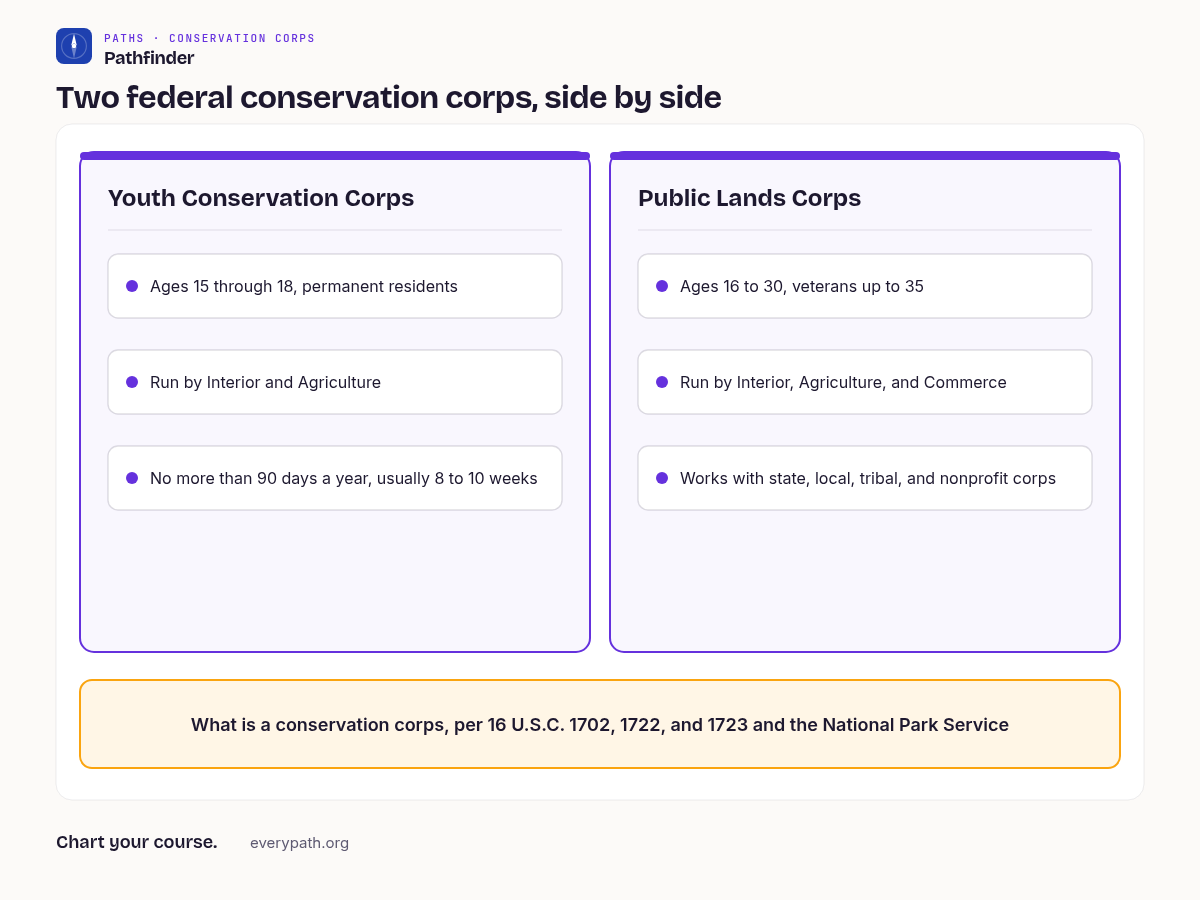
The Youth Conservation Corps law dates to 1970, and its stated purpose is to expand the corps and make it permanent. Under 16 U.S.C. 1702, the corps sits in both the Department of the Interior and the Department of Agriculture. Members must be permanent residents of the United States or its territories and must have reached age 15 but not yet turned 19.
The law also says the corps is open to youth from all parts of the country and from every social, economic, and racial background. Members are paid in line with the work they do, and no one can be a member for more than 90 days in any single year.
In the law's opening findings, Congress wrote that the early pilot gave youth an understanding of the nation's environment and heritage that it judged equal to a full academic year of study. That is a statement of purpose from 1970, not a measured outcome, but it explains why education is built into the program.
The Public Lands Corps
The Public Lands Corps, created under 16 U.S.C. 1723, is housed in the Department of the Interior, the Department of Agriculture, and the Department of Commerce. Its participants are people aged 16 to 30, inclusive, and veterans aged 35 or younger. The agency can give preference to applicants who are economically, physically, or educationally disadvantaged.
Agencies can also sign contracts and cooperative agreements with qualified youth or conservation corps to carry out projects. That is how many state and nonprofit corps end up working on federal land. When a project is in a specific area, the law lets the agency prefer a local corps whose members are largely disadvantaged.
The National Park Service groups this work under a national effort it calls the 21st Century Conservation Service Corps. The Park Service says that effort puts young people aged 16 to 30 and veterans 35 or younger to work protecting, restoring, and enhancing public lands, and that it includes the Public Lands Corps.
What the work looks like
The Park Service lists the kinds of projects Youth Conservation Corps crews take on: building trails, maintaining fences, cleaning up campgrounds, improving wildlife habitat, place-based science and math projects, stream restoration, and historic building preservation. Members also go on educational field trips.
For the broader corps network, the Park Service names these opportunity areas:
- Natural resources
- Cultural resources
- Historic preservation
- Communications
- Science, technology, engineering, arts, and math
- Community building
The Public Lands Corps law also tells agencies which projects to favor. Under 16 U.S.C. 1723(e), preference goes to projects that provide long-term public benefits, instill a work ethic and a sense of public service in the enrollee, are labor intensive, can be planned and started promptly, and offer academic, experiential, or environmental education.
The law separately lists "priority projects" tied to forest and habitat health. Examples include reducing wildfire risk to a community or water supply, protecting a watershed, dealing with insect or disease damage to forests, and restoring coastal or river habitat. If you want fieldwork with a clear environmental purpose, those are the kinds of jobs to ask about.
Pay, hours, and housing
The Park Service says Youth Conservation Corps members are paid at least the state or federal minimum wage, whichever is higher, usually for a 40-hour week. It also says programs generally run 8 to 10 weeks and can last up to 18 weeks.
Housing is the detail most people get wrong. The Park Service says Yellowstone is currently the only overnight Youth Conservation Corps program where members stay at a park facility. All its other programs are day programs: no housing is provided, and members must get themselves to the site every day. The Park Service describes the program as local for that reason.
The Public Lands Corps law is broader. Under 16 U.S.C. 1724, agencies may set up conservation centers for corps use, must set health, nutrition, sanitation, and safety standards for those centers, and may arrange transportation to project sites for members who live at home. Whether a given corps offers lodging, a camp, or a daily commute is a program-level choice.
One more legal detail: under 16 U.S.C. 1703, Youth Conservation Corps members are not treated as federal employees except for the purposes of two specific federal laws named in that section. Being in the corps does not make you a federal civil servant.
Who can join
Eligibility depends on which program you mean.
| Program | Ages | Other rules in the sources |
|---|---|---|
| Youth Conservation Corps | 15 through 18 | Permanent resident; must be able to commute daily to most sites |
| Public Lands Corps | 16 to 30 | Veterans up to 35; agency may prefer disadvantaged applicants |
| Qualified youth or conservation corps | 16 to 30 | Veterans up to 35; run by a state, local government, tribe, or nonprofit |
The Public Lands Corps law also points to other enrollment criteria in a separate section of federal law, 42 U.S.C. 12591(a). Those are not spelled out on this page, so ask the program what it checks at enrollment.
How a conservation corps fits after high school
A corps can work as a primary plan or as a bridge year. Because the Youth Conservation Corps ends at 18 and runs for a short season, it often fits the summer before or after senior year. The Public Lands Corps and the corps that partner with it run to age 30, so they can come after graduation, after a semester of college, or after military service.
The law and the Park Service both stress skills and career exposure. The Park Service says members learn about careers with the agency and gain work skills that can help with the next job. It also links corps members to a page on hiring pathways that explains how certain hiring authorities can help them qualify for jobs. Read that page yourself before you count on it, since the details belong to the agency.
A corps is not a degree and not a registered apprenticeship. Treat it as paid work experience with a training component. If a specific corps promises a credential, ask which one and who issues it.
How to find and apply to a conservation corps
The Park Service says applications for the 2027 Youth Conservation Corps season will open in late January or early February. It publishes a list of participating parks each year, with contacts for each site. Other federal places to ask include the U.S. Forest Service, the National Fish Hatchery System, and the National Wildlife Refuge System.
For the 16-to-30 programs, the Park Service points to its Work With Us page and to a jobs list run by its partner, The Corps Network. Each corps runs its own application.
Before you accept a spot, ask these questions:
- Which program is this: the Youth Conservation Corps, the Public Lands Corps, or a separate state, tribal, or nonprofit corps?
- What is the hourly pay, and how many hours a week will I work?
- Is housing provided, or do I need my own ride to the site every day?
- How many weeks does the term last, and can I return next season?
- What training, education, or certification is included?
Common mistakes with conservation corps
- Thinking every corps has the same age limit. The Youth Conservation Corps stops at 18. The Public Lands Corps runs to 30, and veterans can join up to 35.
- Assuming housing comes with the job. Most Park Service Youth Conservation Corps sites are day programs with no lodging and no transport.
- Treating it as a federal job. Members are generally not federal employees, and the program does not by itself make you one.
- Waiting until spring to look. Park Service applications for the summer season open in late January or early February.
- Skipping the questions about pay and hours. The federal floor is set for the Youth Conservation Corps. Other corps set their own terms.
What is a conservation corps?
It is a program that pays young people to do hands-on work on natural, cultural, or historic resources, often on public land. Federal law describes a qualified corps as one offering full-time productive work plus training, education, and support services, run by a state or local government, a tribe, or a nonprofit.
How old do you have to be to join a conservation corps?
It depends on the program. The National Park Service says its Youth Conservation Corps takes youth 15 through 18. The Public Lands Corps and the qualified corps it partners with serve people aged 16 to 30, plus veterans aged 35 or younger.
Do conservation corps members get paid?
In the federal programs covered here, yes. The Park Service says Youth Conservation Corps members earn at least the higher of the state or federal minimum wage, usually for a 40-hour week. Pay in other corps is set by the program, so ask before you apply.
How long does a conservation corps program last?
The Park Service says its Youth Conservation Corps programs usually run 8 to 10 weeks and can go up to 18. The law caps any one member at 90 days of Youth Conservation Corps work in a single year. Other corps set their own terms.
Is a conservation corps the same as AmeriCorps?
Not necessarily. This page covers the federal Youth Conservation Corps and Public Lands Corps and the state, local, tribal, and nonprofit corps that federal land agencies can contract with. Ask each corps which rules and which funding source it runs under before you sign up.
Sources
- 16 U.S.C. 1722, Definitions , Public Lands Corps definitions, including qualified youth or conservation corps and priority projects, read 14 October 2026
- 16 U.S.C. 1723, Public Lands Corps program , establishment, participants, contracts, and project preferences, read 14 October 2026
- 16 U.S.C. 1724, Conservation centers , centers, standards, and transportation, read 14 October 2026
- 16 U.S.C. 1701, 1702, and 1703 , Youth Conservation Corps findings, membership, and administration, read 14 October 2026
- Youth Conservation Corps (YCC) Program , National Park Service, page last updated 5 October 2026, read 14 October 2026
- 21st Century Conservation Service Corps , National Park Service, page last updated 18 June 2025, read 14 October 2026
Chart your course
Sketch a season on a trail crew next to the plan you would follow without one. Pathfinder keeps both routes on one screen. A crew season and its backup each get a tag on every claim, whether that tag reads sourced, estimated, or advisory.
Frequently asked questions
What is a conservation corps?
It is a program that pays young people to do hands-on work on natural, cultural, or historic resources, often on public land. Federal law describes a qualified corps as one offering full-time productive work plus training, education, and support services, run by a state or local government, a tribe, or a nonprofit.
How old do you have to be to join a conservation corps?
It depends on the program. The National Park Service says its Youth Conservation Corps takes youth 15 through 18. The Public Lands Corps and the qualified corps it partners with serve people aged 16 to 30, plus veterans aged 35 or younger.
Do conservation corps members get paid?
In the federal programs covered here, yes. The Park Service says Youth Conservation Corps members earn at least the higher of the state or federal minimum wage, usually for a 40-hour week. Pay in other corps is set by the program, so ask before you apply.
How long does a conservation corps program last?
The Park Service says its Youth Conservation Corps programs usually run 8 to 10 weeks and can go up to 18. The law caps any one member at 90 days of Youth Conservation Corps work in a single year. Other corps set their own terms.
Is a conservation corps the same as AmeriCorps?
Not necessarily. This page covers the federal Youth Conservation Corps and Public Lands Corps and the state, local, tribal, and nonprofit corps that federal land agencies can contract with. Ask each corps which rules and which funding source it runs under before you sign up.
Sources
- 16 U.S.C. 1722, Definitions (Public Lands Corps) — Legal Information Institute, Cornell Law School (United States Code text), accessed 2026-10-14
- 16 U.S.C. 1723, Public Lands Corps program — Legal Information Institute, Cornell Law School (United States Code text), accessed 2026-10-14
- 16 U.S.C. 1724, Conservation centers and program support — Legal Information Institute, Cornell Law School (United States Code text), accessed 2026-10-14
- 16 U.S.C. 1701 to 1703, Youth Conservation Corps — Legal Information Institute, Cornell Law School (United States Code text), accessed 2026-10-14
- Youth Conservation Corps (YCC) Program — U.S. National Park Service (2026), accessed 2026-10-14
- 21st Century Conservation Service Corps — U.S. National Park Service (2025), accessed 2026-10-14
Chart your course
Pathfinder builds you a plan for whichever path you pick — or for “still deciding” — and labels every claim in it as grounded, modelled or advisory. It will not invent a deadline, a cost, or your chances of getting in.
Start free No credit card required.
Related reading
- Are there apprenticeships outside the trades? What qualifies
Yes. Registered apprenticeships cover more than 1,000 occupations, and any job that passes the four federal tests in 29 CFR 29.4 can qualify.
- How to check if a trade school is accredited, step by step
Check if a trade school is accredited with two free federal tools, DAPIP and College Navigator, then confirm state approval before you sign up.
- What is YouthBuild? Who it serves and how the program works
YouthBuild is a Labor Department pre-apprenticeship for ages 16 to 24 who left school without a diploma. It mixes class, training, and home building.