Paths after high school
What is job shadowing? Watch real work before you choose
By Pathfinder Editorial · Published · 10 min read

Job shadowing is a short look at a real job. CareerOneStop, a Labor Department site, says you follow a worker for a few hours, a day, or a few days. You observe the work and the workplace. It is not an internship and not a registered apprenticeship.
That short window is the point. If you are still deciding after high school, a day beside someone who already does the work can answer questions that a brochure cannot. It will not replace training, and it will not guarantee a hire. It can tell you whether the day-to-day of a path matches what you imagined.
Job shadowing sits next to other short experiences on CareerOneStop's work-experience page, including internships and volunteer work. For a longer paid training path, compare apprenticeship versus internship. If you are under 18 and looking at structured youth programs, read what a youth apprenticeship is. The wider map of options is on every path after high school.
What CareerOneStop means by job shadowing
On its GetMyFuture work-experience page, CareerOneStop puts job shadowing in plain language: you follow a person in their job for a few hours, a day, or a few days. On the related "Learn about careers" page, it repeats the same idea: job shadowing means you follow a worker for a few hours or a day.
The agency's framing is practical. Experience helps people get hired, and shadowing is one way to build work know-how and contacts when you have never held that kind of job. It sits beside internships, volunteering, neighborhood work, and school or community activities. None of those pages treat shadowing as a degree, a license, or a substitute for training hours.
The Labor Department's Office of Disability Employment Policy lists job shadowing among work-based learning options for young people, alongside internships, pre-apprenticeships, apprenticeships, and summer work. That list is about career preparation, not about a single federal "job shadowing program" you apply to the way you apply to AmeriCorps or YouthBuild.
What you actually do while shadowing
Most of the time you observe. You sit in on meetings, walk a floor, watch a technician open a panel, or listen to how a nurse hands off a patient. You may be invited to ask questions at set times. CareerOneStop does not publish a national checklist of tasks you must complete. Local hosts set the day.
A few programs blur the line. A school "externship" week may ask students to help with small office tasks while they shadow. That is still closer to observation than to a job. If the host starts scheduling you for regular productive work, stop and clarify the arrangement. CareerOneStop's internship definition is the better fit when you are expected to deliver work over days or weeks.
Bring a notebook. Write down tools you saw, software names, safety gear, and phrases people used for routine steps. Ask what a typical Tuesday looks like, what someone had to learn in the first month, and what they wish they had known in high school. Those notes matter more than a polished thank-you email, though you should send one.
How job shadowing differs from nearby options
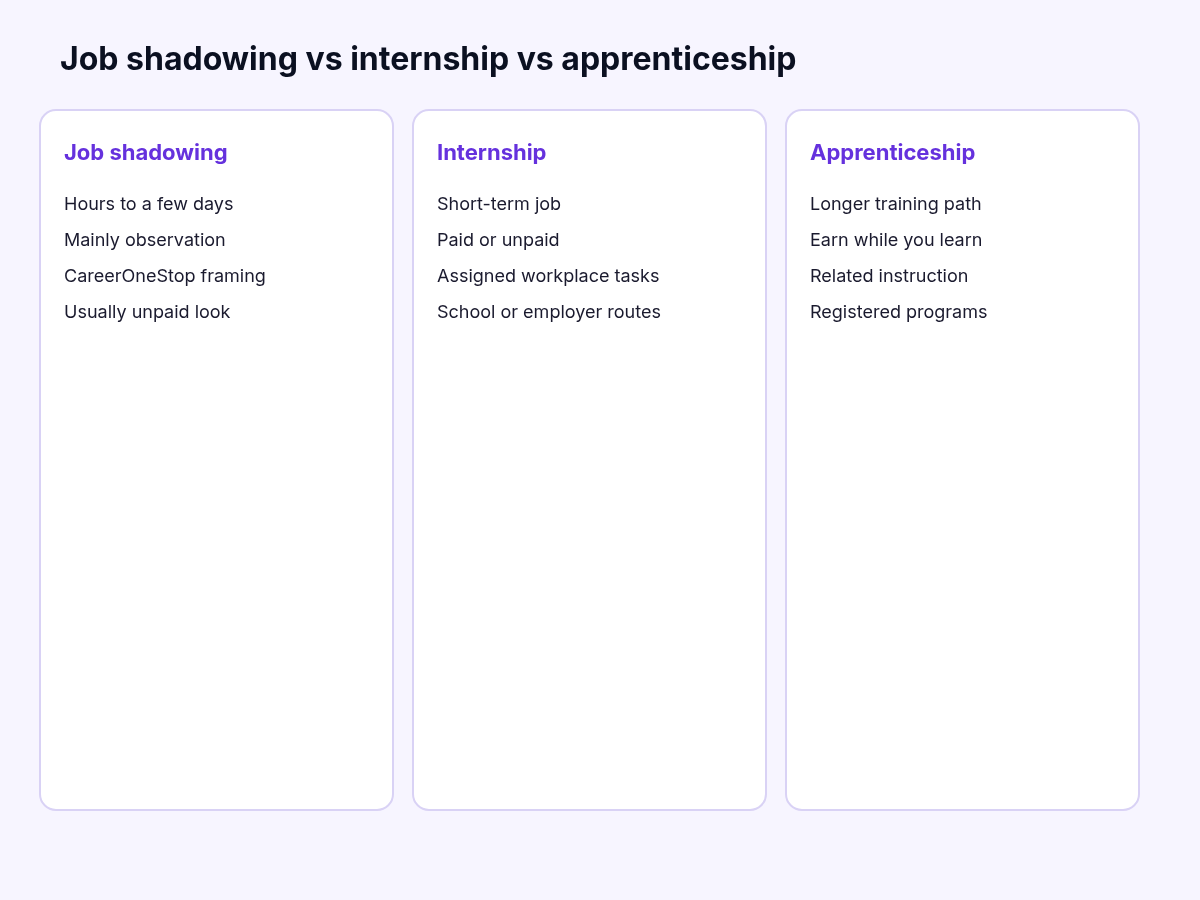
CareerOneStop keeps these categories separate, and the differences are useful when you are choosing a next step:
- Job shadowing. Short observation. Hours to a few days. You follow a worker. CareerOneStop does not frame it as paid employment.
- Internship. A short-term job that may be paid or unpaid. You gain experience in a real workplace. Schools, employers, and online finders are common routes in.
- Volunteer work. Unpaid work that can build skills. You contact a nonprofit or school and ask what they need.
- Registered apprenticeship. A longer earn-while-you-learn path with related instruction. That is a different article; start with the internship comparison if you are weighing short versus long training.
Shadowing answers "Do I want to be around this work?" An internship answers "Can I do parts of this work for a stretch?" An apprenticeship answers "Will I train in this occupation under a registered program?" Mixing those questions up wastes months.
Who it helps most after high school
Shadowing is useful when the decision is still open. You may be choosing between a trade and a two-year program, or between two trades that sound similar on paper. A day in each setting can settle more than another week of scrolling.
It also helps when adults around you keep talking about prestige instead of the work. Watching someone stock a pharmacy, wire a panel, or take a customer call is a better argument than a ranking list. Pathfinder will not invent hiring odds for you. A host who lets you watch is giving you evidence you can use in a primary-and-backup plan.
If you already have a firm offer for an apprenticeship or a college program, shadowing is optional. Use it to check a backup path, not to delay a commitment you already made.
How to ask for a shadow day
CareerOneStop's advice is direct: ask someone you or your family knows, or request a contact through a professional association or school program. That is enough of a plan for most seniors.
A workable sequence:
- Pick one occupation, not five. Name the setting you want to see.
- Ask a counselor, CTE teacher, coach, or relative for a name. Cold-emailing strangers works less often than a warm introduction.
- Offer two or three dates and a time window of a few hours. Make it easy to say yes.
- Ask what to wear, where to park, and whether you need an ID badge or a parent signature.
- Show up early, phones away, and leave when you said you would.
If the first host says no, ask for one referral. Many people who cannot host will still know someone who can.
What a useful shadow day looks like
A useful day is narrow. You are there to watch one role, not to tour an entire company. Ask the host to pick a typical shift, not a showcase day that never happens again. If the workplace is loud or restricted, ask in advance whether you need boots, hearing protection, or a signed waiver.
Arrive with three questions written down. Good ones are concrete: What did you do in your first 90 days? Which credential actually mattered for hiring here? What would make you tell a teenager to pick a different path? Avoid questions that only fish for encouragement.
Afterward, write a half page while the details are fresh. Note tasks you liked, tasks you disliked, and anything that surprised you about pace or physical demand. That note becomes evidence in a primary-and-backup plan. Pathfinder will not invent a score for the day. Your notes are the record.
If you are under 18, ask about age rules before you go. Some sites bar minors from shop floors or clinical areas even for observation. A counselor can often find an alternate host in the same occupation with fewer restrictions.
Job shadowing and school credit
CareerOneStop does not require school credit for shadowing. Some high schools still attach credit or a reflection assignment to a structured visit. If your school offers that, take the paperwork seriously. It does not change the federal definition of shadowing, but it can keep the visit on your transcript as career exploration.
Do not delay graduation requirements for an unpaid observation week unless your counselor confirms the credit. Shadowing is a tool inside a plan, not the plan.
When shadowing is the wrong next step
Skip shadowing, or postpone it, when you already have a registered apprenticeship interview on the calendar and the occupation is fixed. Prepare for that interview instead. Skip it when a host can only offer you unsupervised productive work with no training plan; that is not observation. Skip it when every adult in your life is pushing one prestige path and you are using "I need to shadow first" only to avoid a hard conversation. Have the conversation, then shadow the backup path on purpose.
Building a small shadowing plan without turning it into a project
You do not need a twelve-week curriculum. You need two or three visits tied to real choices. Example: you are torn between HVAC and electrical work. Shadow one residential HVAC tech and one electrical apprentice or journeyworker. Keep the visits within the same two weeks so the memories stay comparable. Then write which day left you more willing to repeat the boring parts, not only the exciting parts.
If both days felt wrong, that is still data. Move the backup path up. If one day felt right, ask that host how people actually enter the occupation in your area: apprenticeship sponsor, community college certificate, or direct hire. CareerOneStop will not name your local sponsor for you. The host often will.
Parents sometimes want to sit in. Ask the host first. Many workplaces will allow a student but not a family tour. Respect that limit. Your goal is observation of work, not a family open house.
Talking about the visit afterward
When adults ask how it went, avoid the empty answer "It was fine." Report one concrete task you watched, one tool or software name, and one thing that surprised you. That keeps the conversation on evidence. If someone pushes prestige language, point back to the tasks. Pathfinder refuses acceptance-odds talk; you can refuse prestige-only talk the same way.
If the visit went poorly because the host was rushed or unkind, do not decide the whole occupation is closed. Try a second host before you burn the path. One bad morning is a sample of one person, not of the trade.
Common mistakes
- Treating a two-hour visit as proof you will love the career forever.
- Confusing shadowing with free labor and staying late to "help" without a clear agreement.
- Shadowing only people in your family's current jobs and never testing a different path.
- Skipping safety briefings because the visit feels informal.
- Leaving without notes, then forgetting what you actually saw.
- Using shadowing to postpone every other application deadline you already have.
Safety, privacy, and professionalism
Some workplaces handle private data, patients, or hazardous equipment. Follow the host's rules even if they feel strict for a short visit. Do not take photos unless you are told you may. Do not post identifying client or patient details. Do not touch tools you have not been cleared to touch.
If anything feels unsafe, leave. Tell your counselor or parent what happened. Observation is not worth an injury or a privacy violation.
Capturing the visit for applications without lying
When you later apply to an apprenticeship, college, or job, you can describe shadowing as career exploration. Do not inflate it into employment. "Observed residential HVAC service calls for one workday under Tech X" is honest. "Worked as an HVAC assistant" is not. Honesty is part of Pathfinder's product rules; it should be part of yours too.
What this page will not tell you
This page will not invent wage figures, hiring rates, or a national waitlist for shadowing seats. CareerOneStop does not publish those numbers for job shadowing, and Pathfinder will not invent them. Local rules for minors, background checks, and industry safety vary. Ask the host and your school.
Job shadowing is advisory career exploration, not a credential. Start free at /auth?mode=signup if you want help naming a primary path and a backup after what you saw.
Sources
Facts on this page come from CareerOneStop's GetMyFuture pages on work experience and career exploration, and from the Labor Department's youth career-preparation overview that lists job shadowing among work-based learning options. Opened 2026-10-26.
Frequently asked questions
What is job shadowing?
CareerOneStop describes job shadowing as following a person in their job for a few hours, a day, or a few days so you can observe the work. It is a short look at a real workplace, not a full internship and not a paid job by itself.
How long does job shadowing last?
CareerOneStop's range is a few hours, a day, or a few days. A school or employer program may set a tighter window. Ask before you go so you know whether you are expected for a morning, a full shift, or more than one visit.
Is job shadowing the same as an internship?
No. CareerOneStop lists internships as short-term jobs that may be paid or unpaid and that give you experience in a real workplace. Job shadowing is mainly observation. An internship usually assigns you tasks over a longer stretch.
Do you get paid for job shadowing?
CareerOneStop does not describe job shadowing as paid work. Treat it as unpaid observation unless a specific program tells you otherwise in writing. If you are asked to do regular productive work for free, ask whether the arrangement is actually an internship or something else.
How do you find a job shadowing opportunity?
CareerOneStop suggests asking someone you or your family knows, or requesting a contact through a professional association or school program. A counselor, CTE teacher, or local workforce office can also help you find a host.
Sources
- Get work experience — CareerOneStop (U.S. Department of Labor, Employment and Training Administration), accessed 2026-10-26
- Learn about careers — CareerOneStop (U.S. Department of Labor, Employment and Training Administration), accessed 2026-10-26
- Policymakers , Youth — U.S. Department of Labor, Office of Disability Employment Policy, accessed 2026-10-26
Chart your course
Pathfinder builds you a plan for whichever path you pick — or for “still deciding” — and labels every claim in it as grounded, modelled or advisory. It will not invent a deadline, a cost, or your chances of getting in.
Start free No credit card required.
Related reading
- How to tell your parents you don't want to go to college
A student's guide to the college conversation: build a plan first (what instead, when, money, backup), expect their worries, and follow up after you talk.
- How to choose a path after high school
How to choose a path after high school with a primary and an explicit backup — a sourced decision frame, not tip lists or invented odds.
- Is a gap year a good idea if you’re undecided?
A gap year after high school when you're still deciding: what it is, how it differs from drifting, and how to plan primary + backup.