Paths after high school
How to check if a trade school is accredited, step by step
By Pathfinder Editorial · Published · 10 min read
About: Trade and apprenticeship Pathway
To check if a trade school is accredited, look the school up in two free Education Department tools: DAPIP, the accreditation database, and College Navigator. Note the accrediting agency and its status. Then confirm that agency is federally recognized and that your state has approved the school to operate. Do all three before you pay.
This page is about how to check, not whether a trade school is the right choice. It names no schools and stays off cost and financial aid. It walks through what accreditation means, what each tool shows, how state approval differs, and what to do when the records are unclear.
Whether trade school is the right route at all is weighed on trade school vs college. If you are comparing a trade school with a public two-year college, see community college vs trade school. If you would rather be paid while you train, see apprenticeship vs trade school. Every other route is listed on every path after high school.
These are United States federal tools, and they cover schools in the states and outlying areas. The Education Department notes that its recognition of accreditors covers accrediting activity inside the United States only.
What accreditation is, and who does it
The Education Department's accreditation database opens with a plain statement: the department "does not accredit educational institutions and/or programs." Accrediting agencies do. The database describes them as private educational associations of regional or national scope. They write evaluation criteria and run peer reviews to see whether a school meets them. A school that asks for a review and meets the criteria becomes accredited by that agency.
The department's role is oversight of the accreditors. The database says it reviews all federally recognized accrediting agencies, holds them accountable for enforcing their own standards, and is required by law to publish a list of nationally recognized agencies it considers reliable authorities on the quality of the education or training they accredit.
That gives you a two-part test:
- Is the school accredited by an agency?
- Is that agency one the Education Department recognizes?
A school can say it is accredited and be telling the truth, while the agency doing the accrediting is not one the department recognizes. The second question catches that.
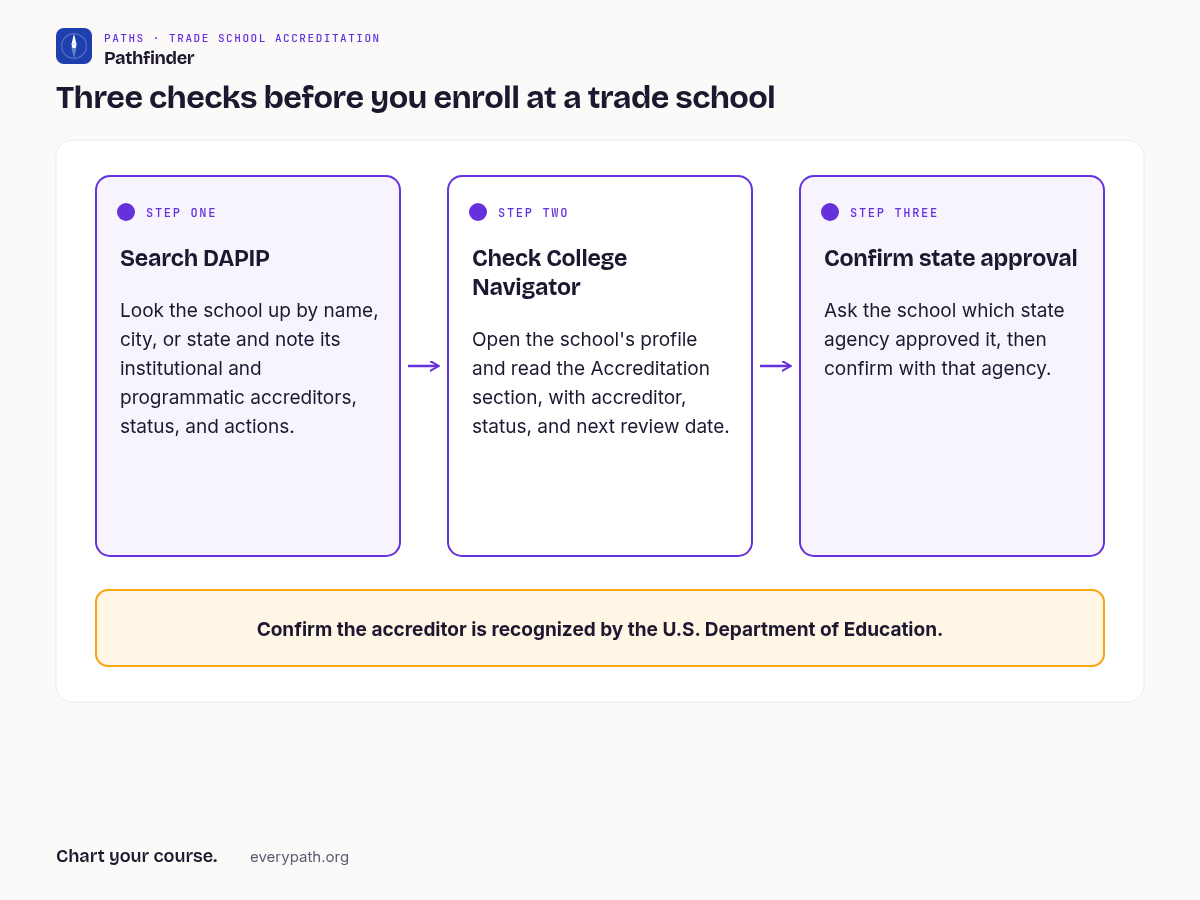
Step 1: search DAPIP
DAPIP stands for the Database of Accredited Postsecondary Institutions and Programs. The Office of Postsecondary Education runs it, and it is free to search.
The search page lets you limit results by three fields: the name of the institution, the city, and the state or outlying area. Its tips are practical. Do not put your search in quotes. If you are unsure how a city is spelled, enter only the part you are sure of. Try other spellings for names with abbreviations. The page gives the example of St. Mary's, St Mary's, and Saint Mary's.
If a name search comes back empty, search by city or state alone and scan the list. The results mark schools that have had a name or address change, so a school you know by one name may appear under another.
When you open a school's record, look for:
- Institutional accreditation. The agency that accredits the whole school.
- Programmatic accreditation. Any agency that accredits a specific program at the school.
- Status. Whether the accreditation is current.
- Action and date, and the justification for the action. The history of decisions the agency has reported.
The database also lists the recognized accrediting agencies themselves, with three dates for each: the year it was first listed, the year its recognition was last renewed, and the year of its next scheduled review by the National Advisory Committee on Institutional Quality and Integrity.
Step 2: check the school's College Navigator profile
College Navigator is a school search tool from NCES, the Education Department's statistics office. Its search form lets you filter by state, ZIP code and distance, programs or majors, level of award, including certificate, and institution type, including less-than-two-year schools.
On a school's profile, scroll to the Accreditation section. It shows two tables:
- Institutional Accreditation, with the accreditor, the status, such as "Accredited since" a date, and the next review date.
- Programmatic Accreditation, with each accreditor and program, the status, and the next review date.
At the bottom of that section, the profile links to the school's record in DAPIP "for more detailed information on accreditation for this institution, including all actions and justification for actions."
So the two tools work together. College Navigator gives a quick summary. DAPIP gives the full record.
Institutional or programmatic: which one matters
Institutional accreditation covers the school as a whole. Programmatic accreditation covers one program inside it. A school can hold both, and some fields expect a program-level review on top of the school's own.
For trade schools, there is one more wrinkle. DAPIP marks certain programmatic accreditors that are recognized "for the accreditation of freestanding, single purpose institutions in addition to the accreditation of specialized programs at larger institutions." A school that teaches a single field may be accredited by one of these. In that case, the agency listed may look like a program accreditor while in fact covering the whole school.
What to do with that:
- Note the accreditor's exact name from the school's record.
- Find the same agency in DAPIP's list of recognized accreditors.
- If the school teaches one field only, check whether the agency is marked as recognized for single-purpose schools.
Step 3: confirm state approval
Accreditation and state approval are different things. Accreditation is a review by a private agency. State approval, or licensure, is the state's permission for a school to operate and offer programs beyond high school.
The two meet in federal rules. Under 34 CFR 600.4, the federal definition of an institution of higher education includes being legally authorized to provide education beyond high school in its state. Section 600.9 explains what that authorization means. A state must have a process to review and act on complaints about the school. A school established by name as an educational institution must comply with any state approval or licensure rules, though a state may exempt it on the basis of recognized accreditation or at least 20 years in operation. A school set up only as a business or charity in the state must be approved or licensed by name, and cannot be exempted on the basis of accreditation.
You do not need to work through those rules yourself. The takeaway is simpler. Your state has an agency that approves or licenses schools, and it has a complaint process. DAPIP says state approval agencies report to it too. Ask the school which state agency approved it, then confirm with that agency.
When the records do not match
DAPIP carries its own warning. It says its information is reported to the department by recognized accrediting agencies and state approval agencies, that it is not audited, and that the department cannot guarantee it is accurate, current, or complete. It tells users to contact the appropriate agency for the most accurate information. It also says listing a school is not an endorsement.
So if the school's website, College Navigator, and DAPIP disagree, or if a school is missing from one of them:
- Write down what each source shows, with the date you checked.
- Contact the accrediting agency named and ask for the school's current status.
- Contact your state's approval agency and ask whether the school is approved or licensed.
- Ask the school for its accreditation and state approval in writing.
Questions to ask the school
Before you sign anything, ask:
- Which agency accredits the school as a whole?
- Does my program have its own accreditor, and is it listed?
- When is the next review date?
- Which state agency approved or licensed the school?
- Has the school had any recent accreditation actions, and why?
Compare each answer with DAPIP and College Navigator. A school that answers clearly and matches the records is easier to trust than one that changes the subject.
Common mistakes when checking a trade school
- Taking "accredited" on trust. Ask who the accreditor is, then confirm the agency is federally recognized.
- Checking only the school, not the program. If your field has a programmatic accreditor, confirm the program is listed.
- Treating accreditation as state approval. They are different checks. Confirm both.
- Relying on one database. DAPIP's own notice says its data are not audited. Cross-check with College Navigator and the agency.
- Ignoring the next review date and actions. Both are in the record. A recent action is worth a question.
How do you check whether a trade school is accredited?
Search for the school by name, city, or state in the Education Department's accreditation database, DAPIP, and on the school's College Navigator profile. Both show the accrediting agency and the status. Then confirm the agency itself is federally recognized, and check that your state has approved or licensed the school to operate.
Does the Department of Education accredit trade schools?
No. The Education Department says it does not accredit institutions or programs. Private accrediting agencies do that. The department reviews and recognizes accrediting agencies and publishes a list of the ones it considers reliable authorities on quality. A school's accreditor should be on that list.
What is the difference between institutional and programmatic accreditation?
Institutional accreditation covers the school as a whole. Programmatic accreditation covers a specific program inside it, such as a nursing degree. College Navigator profiles list the two separately. Some programmatic accreditors are also recognized to accredit freestanding, single-purpose schools, which matters for some trade schools that teach one field.
Is state approval the same as accreditation?
No. Accreditation is a review by a private agency. State approval or licensure is permission from the state to operate. Federal rules generally expect a school to be legally authorized by its state, and a state may exempt some accredited schools from its own approval rules. Check both rather than assuming one implies the other.
What if the accreditation database shows something odd?
Contact the agency. The Education Department says the database holds information reported by accrediting agencies and state approval agencies, that it is not audited, and that it cannot guarantee it is accurate, current, or complete. For the most accurate status, ask the accrediting agency or state agency directly.
Sources
- Database of Accredited Postsecondary Institutions and Programs (DAPIP) — Office of Postsecondary Education, home, search, and accreditor pages, read 10 October 2026
- College Navigator — NCES search form and an institution profile's Accreditation section, read 10 October 2026
- 34 CFR 600.4 and 600.9 — federal regulations, title 34 issue of 8 October 2026, checked 10 October 2026. State authorization only
Chart your course
Write down the school you are checking and the program you would pick if it fails a check. Pathfinder keeps them in one view, and each claim is flagged sourced, estimated, or advisory.
Frequently asked questions
How do you check whether a trade school is accredited?
Search for the school by name, city, or state in the Education Department's accreditation database, DAPIP, and on the school's College Navigator profile. Both show the accrediting agency and the status. Then confirm the agency itself is federally recognized, and check that your state has approved or licensed the school to operate.
Does the Department of Education accredit trade schools?
No. The Education Department says it does not accredit institutions or programs. Private accrediting agencies do that. The department reviews and recognizes accrediting agencies and publishes a list of the ones it considers reliable authorities on quality. A school's accreditor should be on that list.
What is the difference between institutional and programmatic accreditation?
Institutional accreditation covers the school as a whole. Programmatic accreditation covers a specific program inside it, such as a nursing degree. College Navigator profiles list the two separately. Some programmatic accreditors are also recognized to accredit freestanding, single-purpose schools, which matters for some trade schools that teach one field.
Is state approval the same as accreditation?
No. Accreditation is a review by a private agency. State approval or licensure is permission from the state to operate. Federal rules generally expect a school to be legally authorized by its state, and a state may exempt some accredited schools from its own approval rules. Check both rather than assuming one implies the other.
What if the accreditation database shows something odd?
Contact the agency. The Education Department says the database holds information reported by accrediting agencies and state approval agencies, that it is not audited, and that it cannot guarantee it is accurate, current, or complete. For the most accurate status, ask the accrediting agency or state agency directly.
Sources
- Database of Accredited Postsecondary Institutions and Programs (DAPIP) — U.S. Department of Education, Office of Postsecondary Education, accessed 2026-10-10
- College Navigator — U.S. Department of Education, National Center for Education Statistics, accessed 2026-10-10
- 34 CFR 600.4 and 600.9, institution definition and state authorization — Electronic Code of Federal Regulations, U.S. Department of Education rules, accessed 2026-10-10
Chart your course
Pathfinder builds you a plan for whichever path you pick — or for “still deciding” — and labels every claim in it as grounded, modelled or advisory. It will not invent a deadline, a cost, or your chances of getting in.
Start free No credit card required.
Related reading
- What career and technical education is in high school
Career and technical education is high school coursework, not a ninth path after graduation. Test the program of study before you choose classes.
- Registered apprenticeship vs trade school explained
A registered apprenticeship is a validated paid job. Trade school can teach the class and still not be the program. Check who sponsors it.
- How long does an apprenticeship take? Trades compared
Usually one to six years. Construction trades like electrician and carpenter list 7,328 to 8,000 hours. What sets the term and how to check yours.