Paths after high school
What to do if you didn't get into college: next steps
By Pathfinder Editorial · Published · 13 min read
About: Pathway University Still deciding Grounded
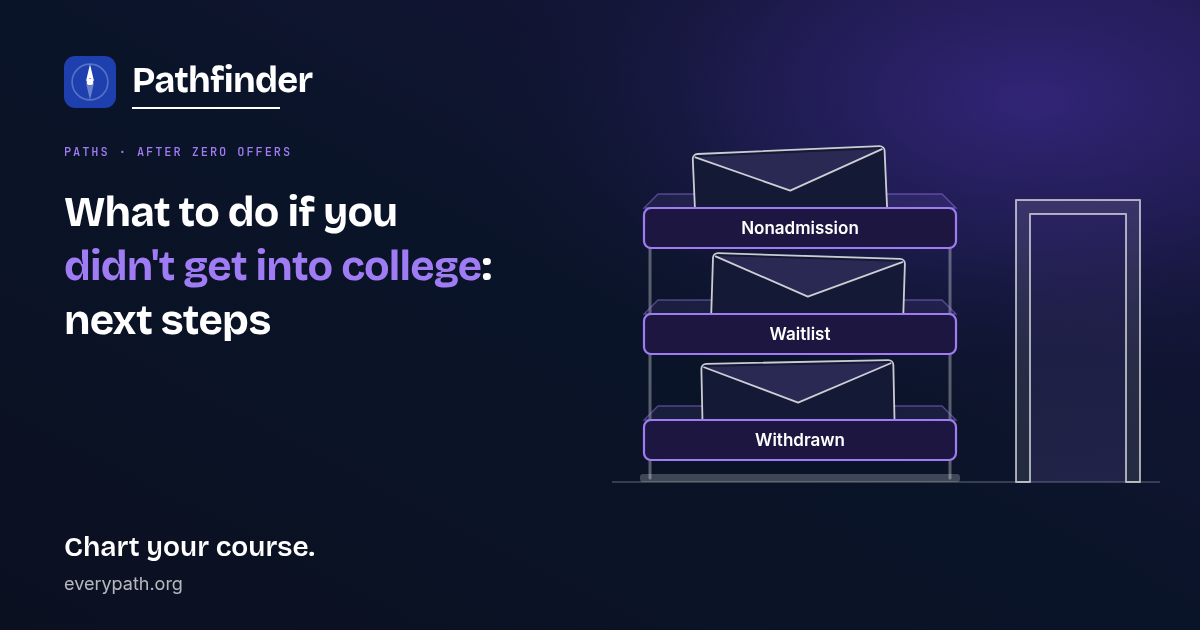
What to do if you didn't get into college this round starts with sorting each letter: a nonadmission, a waitlist place, or a withdrawn file. Then check open-admission colleges, which federal survey rules describe as admitting virtually all students who finished high school or an equivalent. Then pick a route for this year.
This page covers the weeks after zero offers and nothing earlier. Whether a later start still works, and how re-entry is handled, sits on whether you can go to college later. What a form binds you to before you send the next round is on whether to apply if you might not go. College is one branch on every path after high school, and the others are a fair choice too.
No acceptance odds appear below. The terms come from the National Center for Education Statistics (NCES). Colleges report to NCES through a data collection called IPEDS, and its definitions give admissions words one meaning across federal data. A college's own letter still outranks any general definition for your file.
Sort every letter before you call it zero
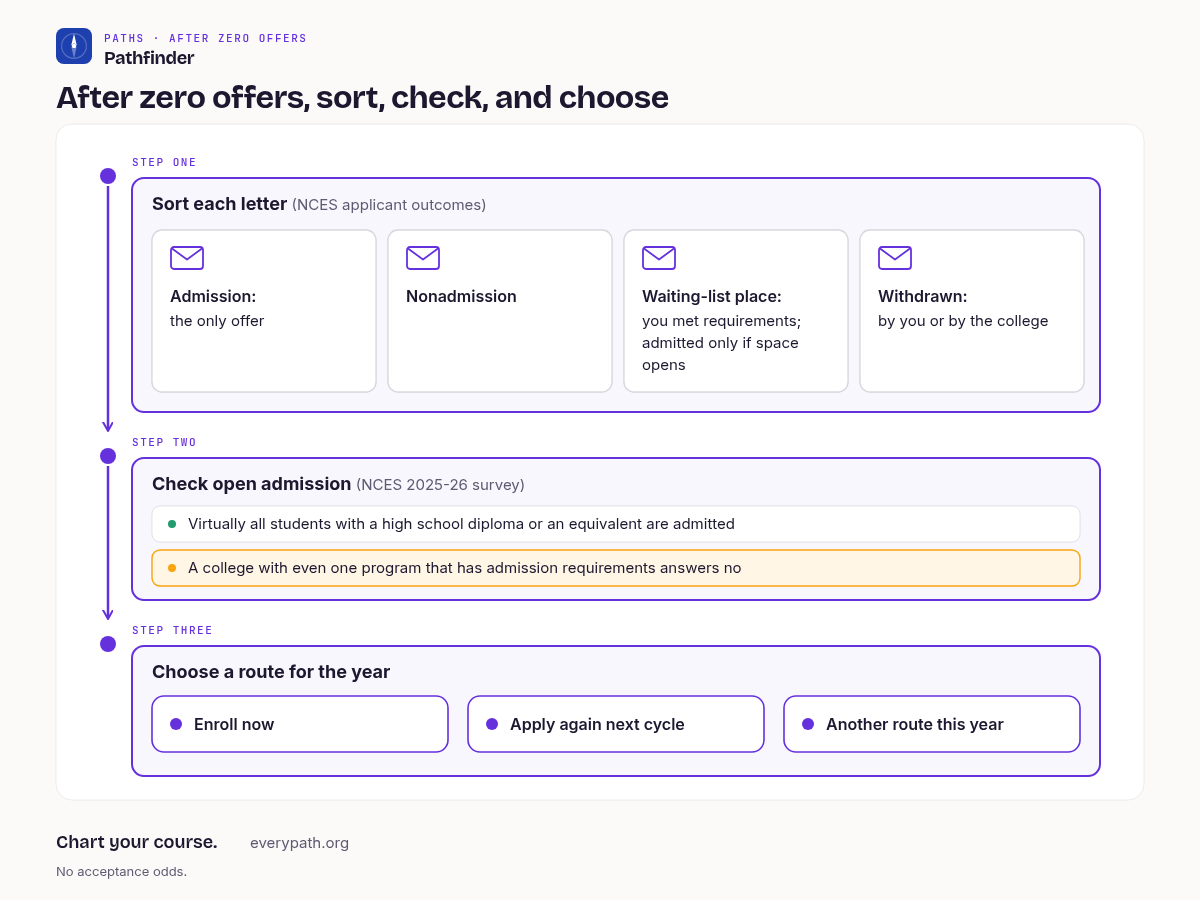
The IPEDS glossary defines an applicant as someone who met a college's requirements to be considered, including paying the application fee or having it waived. That person is then told one of four things: admission, nonadmission, placement on the waiting list, or that the application was withdrawn, either by the applicant or by the institution.
Only the first one is an offer. The same glossary calls admitted students applicants who were granted an official offer to enroll. If none of your letters says that, you have zero offers. You do not yet know that you have zero open doors.
Make a short table with one row per college. In the first column, write which of the four outcomes the letter names. In the second, the date on the letter. In the third, anything the letter asks you to do next. A waitlist place and a withdrawn file are not the same as a nonadmission, and each one calls for a different move.
A withdrawn file deserves a phone call. The definition allows withdrawal by the college, not only by you, and it gives no reason. Ask the admissions office what happened, whether anything was missing, and whether the file can be considered for a later term. Do not guess at the cause.
One more case is easy to miss. If you never finished an application, IPEDS would not treat you as an applicant at that college at all, because the definition requires meeting the requirements to be considered. That college has not turned you down. It never reviewed a complete file.
A waitlist place is a different answer
The 2025-26 IPEDS admissions survey asks colleges whether they kept a waitlist for first-time students. It describes one as a list of applicants who met admission requirements but were only to be admitted if space became available. Read that slowly. On that wording, a waitlist place means the college found you met its requirements. Room was the limit.
The same survey asks whether the list is ranked. Some lists have an order and some do not. Neither kind tells you a chance, and this page does not estimate one. The survey also collects how many people were placed on a list and how many were admitted from it, but that is a college's past count, not a forecast for you.
Questions for the admissions office, in writing if you can:
- Is the waitlist still active for this term, or has it closed?
- Is it ranked, and if so, can the college tell you where you stand?
- Does the college need anything from you to keep the place?
- If room opens, how will you hear, and how long will you have to answer?
- If you enroll somewhere else in the meantime, does the college need to know?
Keep a second plan moving while you wait. A waitlist place is held for you only as long as the college says it is, and the survey wording ties any offer to space.
What open admission means in the federal definition
Two NCES texts define the term, and they are not word for word the same.
The IPEDS glossary is short. Open admission is an admission policy whereby the school will accept any student who applies.
The 2025-26 admissions survey is stricter about what a college may report. It asks whether, for the Fall 2025 admission cycle, virtually all students who completed a high school diploma or received a GED or other equivalent were admitted for all or most entering undergraduate programs. A college that adds only an Ability to Benefit test, or a similar test, can still count as open if that test turns away a very small number of students.
The 2024-25 institutional survey for public two-year colleges adds two plain points. A college whose only requirement is a diploma or an equivalent is still open admission. And IPEDS has no set percentage that decides the label.
Then comes the catch. The 2025-26 survey tells a college with one or more programs that have admission requirements to answer no. It then picks between two kinds of no. In one, all or nearly all undergraduate programs have requirements. In the other, nearly all programs are open and only students applying to one or a few programs are measured against admission criteria.
The earlier survey asked about all or most entering first-time students. The newer one pushes a college with a single screened program out of the yes box. That no can still describe a college where all or nearly all programs are open admission, and only students applying to a limited number of programs are evaluated against admission criteria. So the same campus can look different depending on which year's answer you are reading. If you are planning around one program, ask the college whether that specific program has admission requirements, even at a college you think of as open.
How to check a college's policy on College Navigator
College Navigator is the NCES college search tool, and each profile carries an IPEDS ID. The search form takes a state, a ZIP code with a distance in miles, a program, and the award you want: certificate, associate's, bachelor's, or advanced. You can narrow by public, private nonprofit, or private for-profit, and by 4-year, 2-year, or less-than-2-year schools.
Open a profile and find the Admissions section. Where a college reported an open admission policy, that section can be a single line. On the profile for Santa Monica College in California, it reads: This institution has an open admission policy. Contact the institution for more information.
You will not find an admission rate on a profile like that, and the gap is by design. NCES says only institutions without an open admission policy complete the IPEDS admissions component, and admission-rate data come from that component. The same NCES page says IPEDS does not sort colleges by selectivity and does not rank them.
Two cautions before you lean on a profile. First, it shows what a college reported for a past cycle, and policies change. Second, as the section above shows, the survey wording has shifted between years. Treat the profile as the reason to call, not the last word. The admissions office answers for the coming term.
First-time or transfer-in: the label on your next application
How a college sorts you next time depends on what you do in between, and IPEDS draws the line clearly.
A first-time undergraduate has no prior postsecondary experience at the undergraduate level. The definition still counts someone who earned college credits before finishing high school as first-time, and someone who began in the summer just before a fall term.
A transfer-in student is entering a college for the first time after enrolling at a different postsecondary institution, and not as a high school student. The student may bring credit or may not.
Colleges can screen one group and not the other. The 2025-26 survey asks each college which entering student types it has admission requirements for: first-time students, transfer-in students, or both.
That matters for your year. A term at an open-admission college may move you from the first-time pile to the transfer-in pile at a college you still want. At one college that may be a better door, and at another it may not. Ask the college you hope to reach which group you would land in and what it asks of each. How re-entry works in detail, including credit, is on the later-college page linked above, and it is not repeated here.
One more status exists. A non-degree-seeking student takes courses for credit without being recognized as seeking a degree or credential. If a college offers that status, ask what it leads to, and what it does not, before you sign up for it.
Three routes for the year ahead
Zero offers can force a choice you did not plan to make. Lay three routes side by side. Pick one as the main plan and one as the backup, and write down what would make you switch.
Route one is to enroll now at an open-admission college. List a few near you on College Navigator, confirm the policy with each college, and ask whether your program screens applicants. Ask when the next term starts. Do not assume a date.
Route two is to apply again next cycle. Rebuild the list. For each college that waitlisted you, ask whether you can reapply and whether anything from this round carries over. Before you file, read what each plan commits you to, because early decision can bind you. That rule is on the applying page linked above.
Route three is work, training, or an apprenticeship this year, with college later or not at all. Each of those has its own page off the hub linked above.
| Enroll now, open admission | Apply again next cycle | Another route this year | |
|---|---|---|---|
| First thing you need | A college that confirms open admission for your program | A new list and a calendar | A specific job, program, or training offer |
| What to confirm | Program screening and the next start date | What each plan binds you to | Who runs it and what you finish holding |
| What it changes later | You may apply later as transfer-in | In IPEDS terms you stay first-time if you do not enroll elsewhere | Depends on the route |
| Who answers for it | The college | Each college you apply to | The employer or program |
Common mistakes after zero offers
- Counting a withdrawn file as a no. The applicant definition lets the college withdraw a file, and it gives no reason. Call and ask what happened before you cross that college off.
- Reading a waitlist place as a number. The survey ties admission from a list to space. A college's past count of people admitted from its list is not your chance.
- Assuming open admission covers every program. Under the 2025-26 survey, one screened program pushes a college to answer no. Ask about your program by name.
- Treating a College Navigator profile as this term's rule. A profile reflects a past report. The admissions office answers for the coming term.
- Enrolling without asking how it changes your status. A term elsewhere can make you transfer-in at the college you still want. Ask that college first, then decide.
What should you do first if you didn't get into college anywhere?
Sort every letter. In federal college data, an applicant is told one of four things. Admission, nonadmission, a place on the waiting list, or that the file was withdrawn, by the student or by the college. Only admission is an offer. A waitlist place or a withdrawn file calls for a different move than a plain no.
Does a waitlist place mean you could still be admitted?
The 2025-26 federal admissions survey describes a waitlist as applicants who met admission requirements and would be admitted only if space became available. So the place is real, but it is not an offer. Ask whether the list is ranked, whether it is still active, and what the college needs from you.
What does open admission mean?
The NCES glossary says the school accepts any student who applies. The 2025-26 survey is stricter. Virtually all students with a high school diploma or an equivalent are admitted, and a short screening test is allowed only if it turns away very few. A college with even one screened program must answer no.
How can you tell whether a college has open admission?
Search College Navigator, the NCES college search tool, then open a college's profile and read its Admissions section. An open-admission profile can say the institution has an open admission policy and to contact it for more. No admission rate appears there. Confirm the current policy, and your program, with the college itself.
If you take college classes this year, will you apply as a transfer student later?
Under the federal definitions, a transfer-in student enrolled at another college after high school. College credit earned while still in high school does not change first-time status. Colleges can set different requirements for first-time and transfer-in applicants, so ask the college you hope to reach which group you would join.
Sources
- IPEDS glossary download — National Center for Education Statistics, accessed 7 October 2026. Applicant, admitted students, open admission, first-time, transfer-in, and non-degree-seeking entries
- IPEDS 2025-26 Admissions survey materials — NCES, accessed 7 October 2026. Open admission screening question, student types, and waitlist wording
- IPEDS 2024-25 Institutional Characteristics survey materials, public 2-year — NCES, accessed 7 October 2026. Open admission question and instructions
- Institutional Groupings in IPEDS — NCES, accessed 7 October 2026
- College Navigator search — NCES, accessed 7 October 2026
- College Navigator profile with an open admission line — NCES, Santa Monica College profile, accessed 7 October 2026
Chart your course
Write the main route and the backup side by side before the next deadline lands. Pathfinder can hold both. Each claim in a saved plan is tagged as sourced, estimated, or advisory.
Frequently asked questions
What should you do first if you didn't get into college anywhere?
Sort every letter. In federal college data, an applicant is told one of four things. Admission, nonadmission, a place on the waiting list, or that the file was withdrawn, by the student or by the college. Only admission is an offer. A waitlist place or a withdrawn file calls for a different move than a plain no.
Does a waitlist place mean you could still be admitted?
The 2025-26 federal admissions survey describes a waitlist as applicants who met admission requirements and would be admitted only if space became available. So the place is real, but it is not an offer. Ask whether the list is ranked, whether it is still active, and what the college needs from you.
What does open admission mean?
The NCES glossary says the school accepts any student who applies. The 2025-26 survey is stricter. Virtually all students with a high school diploma or an equivalent are admitted, and a short screening test is allowed only if it turns away very few. A college with even one screened program must answer no.
How can you tell whether a college has open admission?
Search College Navigator, the NCES college search tool, then open a college's profile and read its Admissions section. An open-admission profile can say the institution has an open admission policy and to contact it for more. No admission rate appears there. Confirm the current policy, and your program, with the college itself.
If you take college classes this year, will you apply as a transfer student later?
Under the federal definitions, a transfer-in student enrolled at another college after high school. College credit earned while still in high school does not change first-time status. Colleges can set different requirements for first-time and transfer-in applicants, so ask the college you hope to reach which group you would join.
Sources
- IPEDS glossary download — National Center for Education Statistics, accessed 2026-10-07
- IPEDS 2025-26 Admissions survey materials — National Center for Education Statistics (2025-26), accessed 2026-10-07
- IPEDS 2024-25 Institutional Characteristics survey materials, public 2-year — National Center for Education Statistics (2024-25), accessed 2026-10-07
- Institutional Groupings in IPEDS — National Center for Education Statistics, accessed 2026-10-07
- College Navigator search — National Center for Education Statistics, accessed 2026-10-07
- College Navigator profile with an open admission line — National Center for Education Statistics, accessed 2026-10-07
Chart your course
Pathfinder builds you a plan for whichever path you pick — or for “still deciding” — and labels every claim in it as grounded, modelled or advisory. It will not invent a deadline, a cost, or your chances of getting in.
Start free No credit card required.
Related reading
- Should you apply to college if you might not go yet
Should you apply to college if you might not go? Applying is not enrolling. Early decision can bind you. Then check Cal State LA's deposit rule.
- Can you go to college later? How re-entry works
Yes. Skipping or delaying college doesn't close the door. How applying later works, first-year vs transfer status, credit for what you did, and what to keep.
- How to choose a path after high school
How to choose a path after high school with a primary and an explicit backup — a sourced decision frame, not tip lists or invented odds.