Paths after high school
What help is there after high school with a disability?
By Pathfinder Editorial · Published · 13 min read
About: Pathway Still deciding Grounded
After high school with a disability, the federal door for work help is your state vocational rehabilitation (VR) agency. Under 34 CFR 361, VR agencies must make pre-employment transition services available statewide to students with disabilities, whether or not a student has applied for VR. Your state agency decides who it serves, so contact it directly.
This page is guidance about that door, not a ruling on your case. It does not say whether you qualify, and it does not promise any service. Your state VR agency makes those calls. Setting a main plan beside a backup is covered in weighing a main path against a backup. If you are still choosing classes in school, what career and technical education is covers that coursework. The wider set of routes is on every path after high school.
Everything below comes from two kinds of federal text. One is the Rehabilitation Services Administration (RSA), part of the U.S. Department of Education, which gives the formula grants. The other is 34 CFR part 361 in the eCFR issue of 29 September 2026, the latest one on the title 34 version list.
What the state VR program is
RSA's program page says the State Vocational Rehabilitation Services Program rests on the Rehabilitation Act of 1973, as amended by WIOA Title IV, the workforce law. The program gives grants to help states run statewide VR programs, and each one is part of a statewide workforce development system.
The page says state VR programs provide services that fit a person's strengths, resources, priorities, concerns, abilities, capabilities, interests, and informed choice. The aim is to prepare for and take part in competitive integrated employment or supported employment, and to reach economic self-sufficiency. VR agencies also work with employers to open more jobs to people with disabilities.
RSA's agency page says it funds VR agencies in all 50 states, the District of Columbia, Puerto Rico, and four territories. In 34 of those states and territories, one agency serves people with all types of disabilities. In 22 states, there are two: one for people who are blind or have visual impairments, and one for everyone else. That makes 78 VR agencies, and RSA lists the phone number and website for each.
So the first practical step is to find your state on that list. If your state has two agencies, the RSA page tells you which one covers blindness and visual impairment.
In the rule, the agency that runs VR day to day is called the designated State unit. This page calls it your state VR agency.
Pre-employment transition services: the five required activities
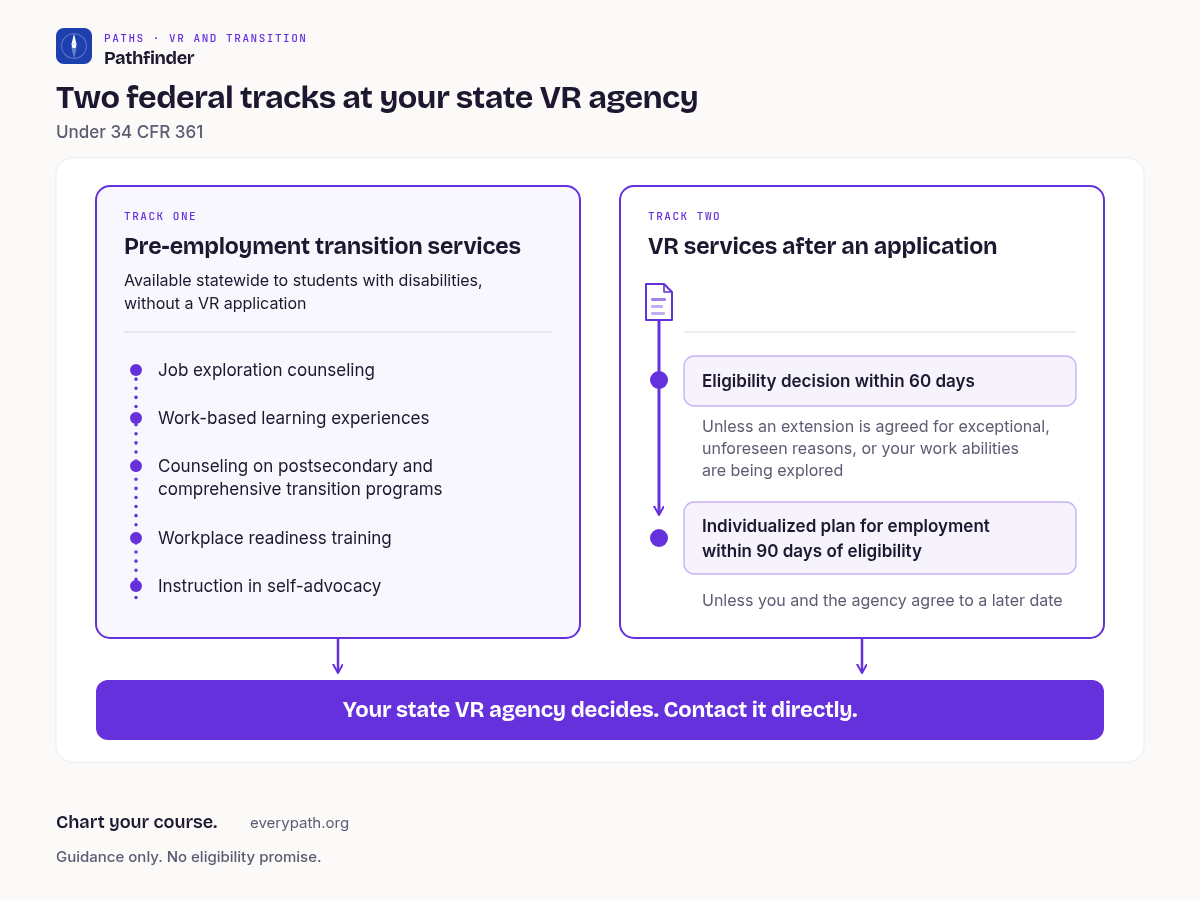
Section 361.48(a) says each state must make sure its VR agency, working with the local school districts involved, provides or arranges pre-employment transition services for all students with disabilities who need them. It adds that this applies without regard to the type of disability.
The rule names five activities the agency must provide:
- Job exploration counseling.
- Work-based learning experiences. These can happen in school, after school, or outside the usual school setting, internships included, and in an integrated community setting as far as possible.
- Counseling on enrolling in comprehensive transition or postsecondary programs at institutions of higher education.
- Workplace readiness training to build social skills and independent living.
- Instruction in self-advocacy, including person-centered planning. It may include peer mentoring, including from people with disabilities who work in competitive integrated employment.
Section 361.48(a)(1) says these services must be available statewide to all students with disabilities, regardless of whether a student has applied for VR or been found eligible. You do not need a VR case open to ask for them.
Who counts as a student with a disability is defined in section 361.5(c)(51). The definition is not limited to high school. It names students in secondary, postsecondary, or other recognized education programs, and it sets age limits that states can adjust. Your state VR agency applies that definition. Ask it how the definition reads in your state.
The money is set aside by rule. Section 361.65 tells each state to reserve at least 15 percent of its federal VR allotment for these services, and says the reserve may not pay administrative costs.
How VR is supposed to meet your school before you leave
Section 361.22 requires each state's VR plan to set out how the VR agency and education officials coordinate the move from school services to VR services. It also calls for a formal agreement between the VR agency and the state education agency.
That agreement must cover, at a minimum, transition planning by VR and school staff that supports a student's individualized education program (IEP), and outreach to students who need transition services. The outreach is supposed to start as early as possible and describe the purpose of VR, its eligibility requirements, how to apply, and the scope of services.
Timing is written in. For a student the agency has found eligible, the individualized plan for employment should be developed and approved as early as possible during transition planning. The latest point is when the student leaves the school setting. If the state is using an order of selection, explained below, that timing applies to each eligible student the agency is able to serve.
Each local VR office also has duties under section 361.48(a)(4). It attends IEP meetings when invited. It works with local workforce development boards, one-stop centers, and employers to build work opportunities, such as internships, summer jobs, jobs during the school year, and apprenticeships. And it works with schools to coordinate pre-employment transition services.
If an IEP meeting is still ahead, ask that the VR office be invited.
Applying for VR services: the steps the rule sets
Pre-employment transition services are one track. Full VR services are a second track, and that one starts with an application.
Section 361.41 says you have applied once three things are true. You, or your representative, have signed the agency's form, completed a common intake form at a one-stop center asking for VR, or otherwise asked the agency for services. You have given the information needed to begin the eligibility assessment. And you are available to complete that assessment. The agency must keep application forms widely available, including at one-stop centers.
The clock starts there. The agency must make an eligibility decision within 60 days, unless exceptional and unforeseen circumstances beyond its control get in the way and you both agree to a specific extension, or unless it is exploring your abilities in work situations under section 361.42(e).
The assessment must be done in the most integrated setting possible, consistent with your needs and informed choice. This page does not list the eligibility criteria or predict the result. Your state VR agency applies section 361.42, and it is the one to ask.
If you are found eligible, section 361.45 says your individualized plan for employment must be developed as soon as possible, and no later than 90 days after the eligibility decision, unless you and the agency agree to a later specific date. You can write all or part of the plan yourself, or with help from a VR counselor at the agency, a qualified counselor outside it, a disability advocacy organization, or other resources.
Section 361.48(b) lists the services a plan can draw on. Among them:
- vocational rehabilitation counseling and guidance
- vocational and other training, including books, tools, and other training materials
- transportation connected to a VR service
- interpreter services, reader services, and orientation and mobility services
- job-related services, such as job search and placement help, job retention, and follow-up
- supported employment services
- rehabilitation technology
- transition services for students and youth with disabilities
- occupational licenses, tools, equipment, and supplies
Not every plan includes every item. Section 361.52 requires the agency to support your informed choice throughout, including students moving from school programs to VR.
Waitlists, costs, and disagreements
When an agency cannot serve everyone. Section 361.36 says that if a VR agency cannot provide the full range of services to every eligible person who applies, its state plan must set an order of selection. Under that order, and under criteria the state sets, people with the most significant disabilities are selected first, and the agency can close one or more priority categories, so some eligible people may wait for services. Ask your state agency whether it is using one. The agency must tell eligible people the priority categories, which category they are in, and that they can appeal that assignment. Two protections follow. A student who was already receiving pre-employment transition services before being found eligible for VR keeps receiving them. And someone who had begun receiving services under a plan before the order took effect keeps receiving the services listed on that plan.
When cost comes up. Section 361.54 says there is no federal requirement to consider financial need. A state may choose to, with written policies applied the same way to everyone in similar circumstances. Even then, the agency may not apply a financial needs test to the eligibility assessment, the assessment of VR needs, counseling and guidance, referral, job-related services, personal assistance services, or auxiliary aids a person needs to take part. It also may not apply one to anyone found eligible for Social Security disability benefits under title II or title XVI.
When you disagree. Section 361.57 requires a way to ask for a timely review of any agency decision that affects your services. The agency must tell you in writing about your right to an impartial due process hearing, your right to mediation, who to file with, and the client assistance program that can help you through mediation or a hearing. That notice comes when you apply, when you are assigned a priority category, when your plan is developed, and when services are reduced, suspended, or ended. A hearing must be held within 60 days of your request, unless the dispute is settled first or both sides agree to more time.
Questions to bring to your state VR agency
Find the agency on RSA's state list, then ask:
- How does this state define a student with a disability for pre-employment transition services, and does that include me?
- Which of the five required activities can I start now, and who delivers them near me?
- Can someone from your office come to my next IEP meeting?
- How do I apply for VR services, and what do you need from me for the 60-day clock to start?
- Is the state using an order of selection right now, and how are categories assigned?
- Does this state consider financial need, and for which services?
- Who runs the client assistance program here?
Write down the name of the person you speak with and the date. Every answer that matters to your case comes from that agency.
Common mistakes with VR and transition services
- Waiting for a VR case before asking for transition services. Section 361.48(a)(1) makes pre-employment transition services available regardless of whether a student has applied.
- Calling the wrong agency in a two-agency state. In 22 states, one agency serves blindness and visual impairment and another serves everyone else. Check RSA's list.
- Reading a summary as an eligibility answer. This page does not decide who qualifies. The state agency applies section 361.42 and section 361.5(c)(51).
- Letting the plan wait until after graduation. Section 361.22 points to an employment plan as early as possible in transition planning, and no later than leaving school, for an eligible student the agency can serve.
- Missing the review rights. Section 361.57 gives mediation, a hearing, and the client assistance program. Keep every written notice.
What help is there after high school if you have a disability?
The federal program for work is state vocational rehabilitation. The Rehabilitation Services Administration funds VR agencies in every state, and 34 CFR 361 sets the rules they follow. Those rules list services from counseling and training to job placement and transition help. Your state VR agency decides who it serves. Contact it directly.
What are pre-employment transition services?
Five activities the rule requires state VR agencies to provide. Job exploration counseling, work-based learning experiences, counseling on college and comprehensive transition programs, workplace readiness training, and instruction in self-advocacy. The rule makes them available statewide to students with disabilities, even if a student has not applied for VR. Ask your agency how it offers them.
Do you have to apply for VR to get pre-employment transition services?
No application is required by the rule. Section 361.48 says these services must be available statewide to all students with disabilities, regardless of whether a student has applied or been found eligible for VR. Who counts as a student with a disability is set in the rule and partly by state choice, so ask your state agency.
How long does a VR eligibility decision take?
Section 361.41 says the agency must decide within 60 days of a complete application, unless exceptional, unforeseen circumstances outside its control arise and you both agree to a set extension, or the agency is exploring your abilities in work situations. Once you are found eligible, section 361.45 sets 90 days for your employment plan unless you agree otherwise.
What if you disagree with a VR decision?
Section 361.57 requires the agency to tell you in writing about your right to mediation, to an impartial due process hearing, and to help from the client assistance program. That notice comes when you apply, when you are placed in a priority category, when your plan is written, and when services are cut or ended.
Sources
- State Vocational Rehabilitation Services Program — Rehabilitation Services Administration, U.S. Department of Education, accessed 7 October 2026
- State Vocational Rehabilitation Agencies — Rehabilitation Services Administration, accessed 7 October 2026
- Title 34 issue dates from the eCFR versioner — Office of the Federal Register, newest issue 29 September 2026, accessed 7 October 2026
- 34 CFR part 361 rule text, eCFR versioner, 2026-09-29 issue — sections 361.5, 361.22, 361.36, 361.41, 361.42, 361.45, 361.48, 361.52, 361.54, 361.57, and 361.65, accessed 7 October 2026
Chart your course
Keep the agency's answers next to a main route and a backup. Pathfinder stores both, and each statement in a plan shows whether it is sourced, estimated, or advisory.
Frequently asked questions
What help is there after high school if you have a disability?
The federal program for work is state vocational rehabilitation. The Rehabilitation Services Administration funds VR agencies in every state, and 34 CFR 361 sets the rules they follow. Those rules list services from counseling and training to job placement and transition help. Your state VR agency decides who it serves. Contact it directly.
What are pre-employment transition services?
Five activities the rule requires state VR agencies to provide. Job exploration counseling, work-based learning experiences, counseling on college and comprehensive transition programs, workplace readiness training, and instruction in self-advocacy. The rule makes them available statewide to students with disabilities, even if a student has not applied for VR. Ask your agency how it offers them.
Do you have to apply for VR to get pre-employment transition services?
No application is required by the rule. Section 361.48 says these services must be available statewide to all students with disabilities, regardless of whether a student has applied or been found eligible for VR. Who counts as a student with a disability is set in the rule and partly by state choice, so ask your state agency.
How long does a VR eligibility decision take?
Section 361.41 says the agency must decide within 60 days of a complete application, unless exceptional, unforeseen circumstances outside its control arise and you both agree to a set extension, or the agency is exploring your abilities in work situations. Once you are found eligible, section 361.45 sets 90 days for your employment plan unless you agree otherwise.
What if you disagree with a VR decision?
Section 361.57 requires the agency to tell you in writing about your right to mediation, to an impartial due process hearing, and to help from the client assistance program. That notice comes when you apply, when you are placed in a priority category, when your plan is written, and when services are cut or ended.
Sources
- State Vocational Rehabilitation Services Program — U.S. Department of Education, Rehabilitation Services Administration, accessed 2026-10-07
- State Vocational Rehabilitation Agencies — U.S. Department of Education, Rehabilitation Services Administration, accessed 2026-10-07
- Title 34 issue dates from the eCFR versioner — Office of the Federal Register (2026), accessed 2026-10-07
- 34 CFR part 361 rule text, eCFR versioner, 2026-09-29 issue — Office of the Federal Register (2026), accessed 2026-10-07
Chart your course
Pathfinder builds you a plan for whichever path you pick — or for “still deciding” — and labels every claim in it as grounded, modelled or advisory. It will not invent a deadline, a cost, or your chances of getting in.
Start free No credit card required.
Related reading
- What to do if you didn't get into college: next steps
What to do if you didn't get into college? Sort each letter first, then check open-admission colleges, which admit virtually all diploma holders.
- Should you apply to college if you might not go yet
Should you apply to college if you might not go? Applying is not enrolling. Early decision can bind you. Then check Cal State LA's deposit rule.
- How to choose a path after high school
How to choose a path after high school with a primary and an explicit backup — a sourced decision frame, not tip lists or invented odds.