Paths after high school
What is dual enrollment, and does it lock you into college?
By Pathfinder Editorial · Published · 12 min read

Dual enrollment means taking a course for college credit while you are still in high school. NCES found that about a third of students who began ninth grade in 2009 did so. It does not commit you to college. You finish the course, you keep the record, and the choice of what comes after graduation stays yours.
That is the short version. The rest of this page explains how federal statisticians define the term, where students actually take these courses, why a credit is not always a guaranteed credit, and how dual enrollment can sit inside a plan that has nothing to do with a four-year degree.
The neighbors to this topic are covered on their own pages. The high school classes that build job skills, and how they connect to a credential, are covered under what CTE courses are. If you are weighing whether you can start college at a later age, read whether you can go to college later. The full set of routes after graduation is on every path after high school.
Nothing here covers cost, aid, or price. Rules on who pays for a dual enrollment course differ by state, district, and college, and they change. Ask your school counselor and the college directly.
What dual enrollment means in federal data
NCES, the statistics office of the U.S. Department of Education, uses a broad working definition. Its 2019 data point on dual enrollment covers any course taken during high school for postsecondary credit, whether a student reported it on a survey or it appeared on a transcript. It says this arrangement "is commonly known as 'dual' or 'concurrent' enrollment."
Two points about that definition are worth holding on to:
- It is about credit, not location. A course counts whether it is taught in your own school building, on a college campus, or online.
- It leaves out Advanced Placement and International Baccalaureate. NCES notes that AP and IB courses can also lead to college credit if a student passes the exam, but it counts them separately.
An older NCES survey of colleges draws a further line. It separates students who take courses "within a dual enrollment program," meaning an organized system with special rules for high school students, from students who simply sign up for a college's credit courses and are treated like regular college students. The first group might face entry requirements, limits on how many courses they take, or particular funding rules. The second group is enrolling on the college's ordinary terms. Both count as dual enrollment in the broad sense, but the paperwork and the support can look very different.
What kinds of courses count
A 2022 NCES table built from 2019 high school transcripts lists three kinds of courses that can count:
- College-level academic courses, taught either in the high school building or at a nearby college.
- Advanced career and technical courses that count for credit at vocational colleges or trade schools.
- High school level academic courses that count for credit at liberal arts or community colleges.
The second category is the one most students miss. Dual enrollment is not only English and math. In the same 2019 data, 12.5 percent of graduates had taken a career or technical dual enrollment course. That was the largest share of any subject group in the table, ahead of English at 10.5 percent and mathematics at 8.2 percent.
That matters for a student who is unsure about college. A welding, health science, or information technology course that also earns college credit is useful whether you go on to a degree, an apprenticeship, or straight into work. The Labor Department's page on apprenticeship for young people says many registered apprenticeships connect with CTE classes, college courses taken in high school, and pre-apprenticeship. For a student in a college course, it says, the apprenticeship carries on and can be finished through that college.
How many students take it
NCES reports two national figures. They come from different studies and do not measure quite the same thing.
| Study | Who was counted | Share who took dual enrollment |
|---|---|---|
| High School Longitudinal Study of 2009 | Students who were ninth graders in fall 2009 | 34 percent took courses for postsecondary credit |
| 2019 High School Transcript Study | Public and private 2019 graduates whose transcripts met the study's rules | 28.4 percent took any dual enrollment course |
The 2009 cohort figure follows one group of students through high school. The 2019 figure looks at the transcripts of graduates who met five conditions, including a standard or honors diploma and at least 16 Carnegie credits. Neither figure is wrong. They answer slightly different questions.
The longitudinal data also show a gap by family background. Among the 2009 ninth graders, 42 percent of students whose parents held a bachelor's degree or higher took courses for postsecondary credit, compared with 26 percent of students whose parents had not finished high school. If no one in your family has been to college, that is a reason to ask about dual enrollment early, not a reason to assume it is not for you.
Where the courses happen
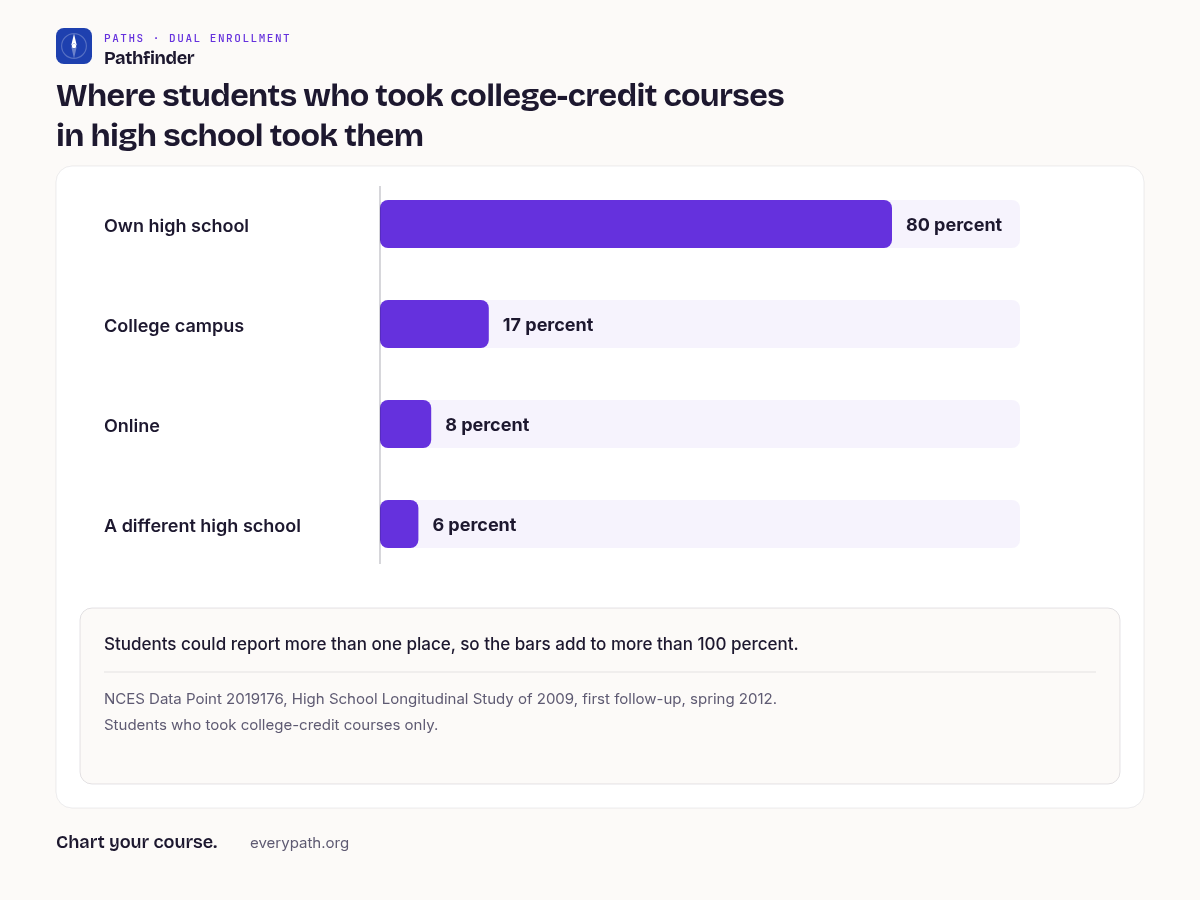
Most dual enrollment does not mean leaving your school. The NCES data point (2019176) reports where students took their courses for postsecondary credit, and the shares describe only those students, not every student in the study. The location question comes from the first follow-up of the 2009 ninth-grade cohort, asked in spring 2012. Of the students who took such courses, 80 percent took them at their own high school, 17 percent on a college campus, 8 percent online, and 6 percent at a different high school. Students could name more than one place, so the shares add up to more than 100 percent.
Location changed with the type of community. Students at city schools took these courses on a college campus more often, at 26 percent, than students at rural or suburban schools, at 11 percent each. Rural students took them online more often, at 12 percent, than suburban students, at 5 percent.
The practical reading is simple. Your first question is probably not which college to drive to. It is which courses at your own school already carry college credit.
Does dual enrollment lock you into college?
No federal source describes dual enrollment as a commitment to enroll anywhere after high school. You take a course, you finish it, and the credit is a record of that work. Nothing in the NCES definitions ties a student to a later application or admission.
What dual enrollment does is change what is already done when you make the decision. A student who has finished a college course has a few things that a student without one does not:
- A sample of college work. You know how a college syllabus, deadline, and grading scale feel before committing a year to them.
- A credit that may count later. If you do enroll, at that college or another, the course may save you from repeating it.
- A technical head start. A career or technical dual enrollment course builds job skills, and in some places it is the route into a registered apprenticeship that starts while you are still a student.
It also leaves every other route where it was. You can still apprentice, work, serve, or take a gap year. If you decide on college five years from now, the course you took at 17 is still on a transcript. More on starting a degree at an older age is in our page on enrolling in college years later.
Why a credit is not always a credit
Here is the part that brochures tend to skip. College credit from a high school course is not always automatic, and it is not always portable.
An NCES table on 2009 public high school graduates defines dual credit courses as courses in which a student can earn high school and postsecondary credit for the same course. Its footnote adds a warning. Some courses that year gave college credit only on conditions. In one example, a school's consumer economics course earned college credit only if the student later attended that college and took an advanced course there. A student who did not do both earned high school credit only. NCES notes that such conditional courses made up an unweighted 15 percent of the dual credit courses in its sample.
That is the closest thing to a lock-in in the federal data, and it runs the other way. The condition does not force you into the college. It means the college credit disappears if you do not go.
Before you enroll in any dual enrollment course, get written answers to three questions:
- Does this course earn college credit on completion, or only if I meet later conditions?
- Which college grants the credit, and what grade do I need?
- Which other colleges, including any I am considering, accept it?
How it fits with career and technical education
Dual enrollment and career and technical education often meet in the same classroom. The NCES transcript table counts career and technical dual enrollment courses as a group of their own, and it is the largest group. The Labor Department describes registered apprenticeships that can begin through dual enrollment while a student is still in school.
So a student who is unsure between college and a trade does not have to pick one before junior year. A career and technical program with a dual enrollment course can build skills for a job, earn credit that a college may accept, and lead toward an apprenticeship. The classes themselves, and how programs of study are built, are explained in our guide to career and technical education.
Common mistakes with dual enrollment
- Assuming it commits you to college. It does not. It gives you a finished course and a record of it.
- Assuming every credit transfers. The college that grants the credit decides, and other colleges decide whether to accept it. Ask before you sign up.
- Missing conditional credit. Some courses grant college credit only if you later attend that college and take more courses there. Read the terms.
- Thinking it is only for academic subjects. Career and technical dual enrollment was the most common subject group among 2019 graduates.
- Confusing it with AP or IB. NCES counts those separately. They depend on an exam score, not on a college granting the credit for a course.
What is dual enrollment?
It is the common name for taking courses for college credit while you are still in high school. NCES also uses the term concurrent enrollment. The course may be taught at your own high school, on a college campus, or online. Advanced Placement and International Baccalaureate courses are counted separately in the NCES data point.
Does dual enrollment lock you into going to college?
No. Taking a college course in high school does not commit you to enrolling anywhere after graduation. The credit is a record of work you finished. Whether a particular college accepts it later is that college's decision, so the useful step is to ask early which credits would transfer to the schools on your list.
How many students take dual enrollment courses?
NCES reports two figures from different studies. Among students who started ninth grade in fall 2009, 34 percent took courses for postsecondary credit in high school. Among 2019 high school graduates, transcripts showed 28.4 percent took at least one dual enrollment course. The studies define the group differently, so the figures differ.
Can dual enrollment courses be career and technical classes?
Yes. NCES counts advanced career and technical courses that earn credit at vocational colleges or trade schools as one kind of dual enrollment course. In the 2019 transcript data, 12.5 percent of graduates took a career or technical dual enrollment course, more than in any single academic subject listed in that table.
Is college credit from dual enrollment guaranteed?
Not always. An NCES table on 2009 graduates notes that some dual credit courses gave college credit only if the student met extra conditions, such as later attending that college and taking a further course there. Ask, in writing, what credit a course earns and what conditions apply before you sign up.
Sources
- Dual Enrollment: Participation and Characteristics — NCES Data Point using the High School Longitudinal Study of 2009, read 10 October 2026. Definition, 34 percent, parent-education gap, and locations only
- Digest of Education Statistics, Table 225.65 — NCES, 2019 High School Transcript Study, table prepared May 2022, read 10 October 2026
- Digest of Education Statistics, Table 225.60 — NCES, public high school graduates in 2000, 2005, and 2009, read 10 October 2026. Dual credit definition and conditional-credit footnote only
- Dual Enrollment Programs and Courses for High School Students at Postsecondary Institutions: 2010-11 — NCES survey of colleges, read 10 October 2026. Program definitions only
- Apprenticeship for Young People — Labor Department educators page, read 10 October 2026. Apprenticeship link only
Chart your course
Note the college course you could take next year and the plan you would follow if you never enroll in college at all. Pathfinder lays out both routes so you can compare them, and each claim wears a tag: sourced, estimated, or advisory.
Frequently asked questions
What is dual enrollment?
It is the common name for taking courses for college credit while you are still in high school. NCES also uses the term concurrent enrollment. The course may be taught at your own high school, on a college campus, or online. Advanced Placement and International Baccalaureate courses are counted separately in the NCES data point.
Does dual enrollment lock you into going to college?
No. Taking a college course in high school does not commit you to enrolling anywhere after graduation. The credit is a record of work you finished. Whether a particular college accepts it later is that college's decision, so the useful step is to ask early which credits would transfer to the schools on your list.
How many students take dual enrollment courses?
NCES reports two figures from different studies. Among students who started ninth grade in fall 2009, 34 percent took courses for postsecondary credit in high school. Among 2019 high school graduates, transcripts showed 28.4 percent took at least one dual enrollment course. The studies define the group differently, so the figures differ.
Can dual enrollment courses be career and technical classes?
Yes. NCES counts advanced career and technical courses that earn credit at vocational colleges or trade schools as one kind of dual enrollment course. In the 2019 transcript data, 12.5 percent of graduates took a career or technical dual enrollment course, more than in any single academic subject listed in that table.
Is college credit from dual enrollment guaranteed?
Not always. An NCES table on 2009 graduates notes that some dual credit courses gave college credit only if the student met extra conditions, such as later attending that college and taking a further course there. Ask, in writing, what credit a course earns and what conditions apply before you sign up.
Sources
- Dual Enrollment: Participation and Characteristics — U.S. Department of Education, National Center for Education Statistics (2019), accessed 2026-10-10
- Digest of Education Statistics, Table 225.65 — U.S. Department of Education, National Center for Education Statistics (2022), accessed 2026-10-10
- Digest of Education Statistics, Table 225.60 — U.S. Department of Education, National Center for Education Statistics, accessed 2026-10-10
- Dual Enrollment Programs and Courses for High School Students at Postsecondary Institutions: 2010-11 — U.S. Department of Education, National Center for Education Statistics (2013), accessed 2026-10-10
- Apprenticeship for Young People — U.S. Department of Labor, Apprenticeship.gov, accessed 2026-10-10
Chart your course
Pathfinder builds you a plan for whichever path you pick — or for “still deciding” — and labels every claim in it as grounded, modelled or advisory. It will not invent a deadline, a cost, or your chances of getting in.
Start free No credit card required.
Related reading
- Apply to college if you might not go? It's not enrolling
Yes, you can apply and not go: applying is not enrolling. Early decision can bind you if accepted; early action does not. Plus the deposit rule to check.
- What career and technical education is in high school
Career and technical education is high school coursework, not a ninth path after graduation. Test the program of study before you choose classes.
- Can you go to college later? How re-entry works
Yes. Skipping or delaying college doesn't close the door. How applying later works, first-year vs transfer status, credit for what you did, and what to keep.