Paths after high school
What is an early college high school? How the model works
By Pathfinder Editorial · Published · 11 min read

An early college high school is a school where a school district and a college work together so students earn a high school diploma and at least 12 college credits that transfer to the partner colleges. Federal education law sets that definition and requires the credit to come at no cost to the student or family.
The phrase is easy to mix up with dual enrollment. They are related: the What Works Clearinghouse reviews early colleges as one kind of dual enrollment program. The difference is scale. Dual enrollment can mean a single college class. An early college is a school built around college coursework from the start, with a partnership, a credit floor, and a cost rule written into federal law.
If you want the basics of taking single college classes in high school, start with what dual enrollment is and how it works. If your school also offers career-focused programs, read how career and technical education works before you pick a track. And if early college credit is pushing you toward applications you are unsure about, see whether applying still makes sense when you may not attend. All the other routes are on our map of every path after high school.
The definitions below come from the Elementary and Secondary Education Act as printed in the U.S. Code. The research comes from What Works Clearinghouse reviews of a randomized study of early colleges. Each source was checked on 14 October 2026.
The legal definition of an early college high school
Section 8101 of the Elementary and Secondary Education Act, at 20 U.S.C. 7801(17), defines an early college high school as "a partnership between at least one local educational agency and at least one institution of higher education." The partnership must let participants do two things at once:
- Complete the requirements toward a regular high school diploma.
- Earn not less than 12 credits that transfer to the colleges in the partnership, as part of an organized course of study toward a postsecondary degree or credential.
The definition ends with a cost rule: all of that must come at no cost to the participant or the participant's family.
Each part of the definition does work. The partnership means a real college is involved, not just a high school offering harder classes. The 12-credit floor means students get more than a sampler. Credits must transfer to the partner colleges and fit an organized course of study, which means the classes are supposed to build toward a degree or credential rather than sit as stray electives. And the no-cost rule means a family should not be billed tuition for those credits.
How early college differs from dual enrollment
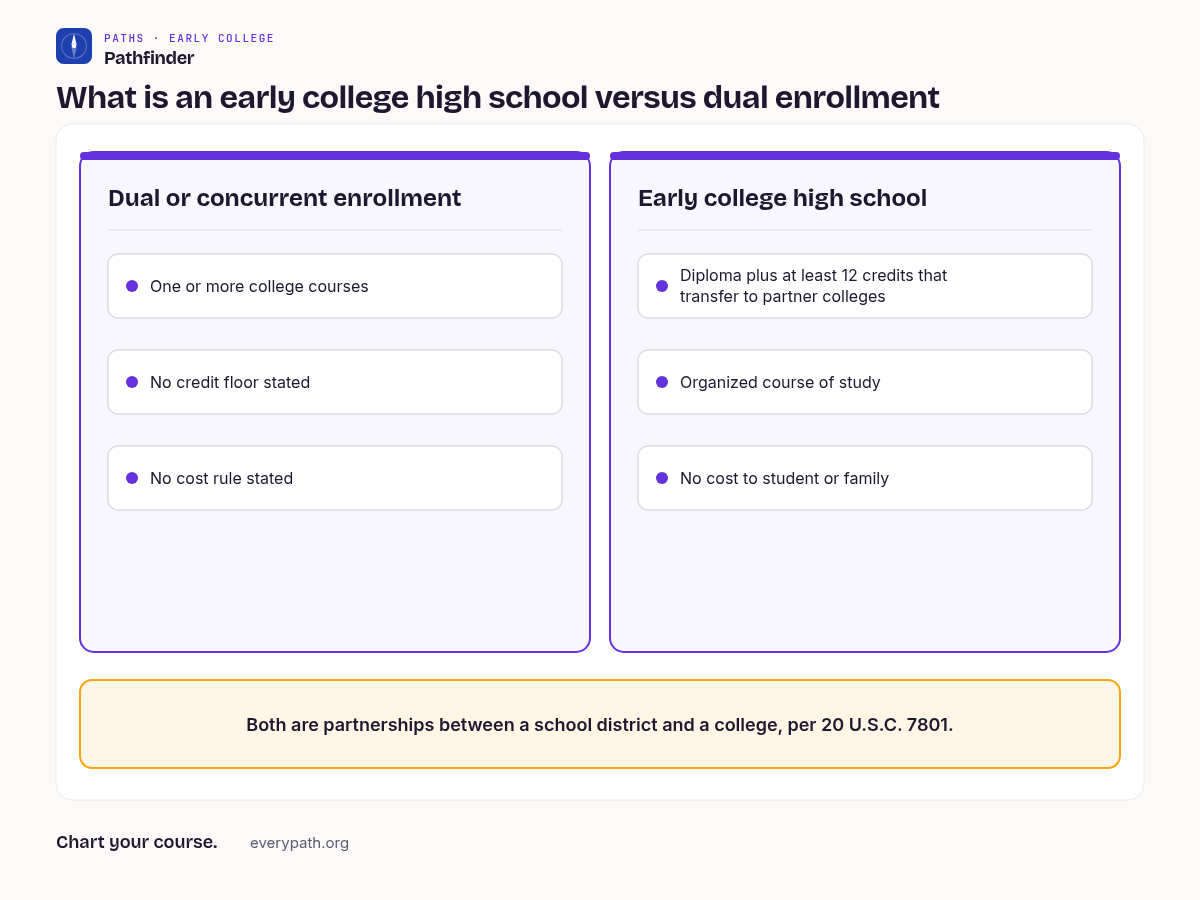
The same section of federal law also defines a "dual or concurrent enrollment program." Reading the two side by side is the clearest way to see the difference.
| Feature | Dual or concurrent enrollment program, 7801(15) | Early college high school, 7801(17) |
|---|---|---|
| Who partners | At least one college and at least one school district | At least one school district and at least one college |
| What a student does | Enrolls in one or more college courses before graduating | Works toward a diploma while earning college credit as part of an organized course of study |
| Minimum credit in the definition | None stated | Not less than 12 credits that transfer to the partner colleges |
| Cost rule in the definition | None stated | No cost to the student or family |
| Credit must apply toward | A degree or recognized credential | A postsecondary degree or credential |
So the answer to the school-model question is this. Dual enrollment describes a course arrangement. Early college describes a school that is organized around that arrangement, with a minimum amount of credit and a promise about cost.
What early colleges look like in practice
The best federal look inside real early colleges comes from a study the What Works Clearinghouse reviewed: "Early College, Early Success," by the American Institutes for Research, published in 2013. It covered 10 early colleges in five states.
The clearinghouse's summary of those schools describes the model in some detail:
- Location. Eight of the 10 early colleges were on college campuses.
- Partners. Seven partnered with a two-year public college, two with a four-year public college, and one with both.
- Governance. Six were district-run schools and four were charter schools.
- Focus. Most had a subject focus beyond college credit: five focused on science, technology, engineering, and math, and two on teacher preparation.
- Supports. All 10 offered tutoring, college preparatory information, and help with college access, including information on scholarships and financial aid. Some also used advisories, summer, evening, or weekend classes, longer school days, or block scheduling.
- Teachers. All but one used college instructors, rather than high school teachers, for the college courses.
- Amount of credit. Seven had course sequences that let students earn at least two years of college credit. Two allowed up to one year, and one allowed at least some.
The review also describes the schools the comparison students went to. They attended 272 different high schools, which were generally much larger than the early colleges. In those schools, Advanced Placement courses were a more common way to earn college credit than dual enrollment.
What the research found
The study used a lottery design: students were randomly assigned to an early college or to a typical high school. The clearinghouse rated it as meeting its standards without reservations. The sample was 2,458 students.
The longer-term follow-up, "Early College, Continued Success," published in 2019, reported these results for the full sample:
| Outcome | Early college students | Comparison students |
|---|---|---|
| Enrolled in college within 1 year of high school graduation | 63.8% | 23.0% |
| Enrolled in a two-year college within 1 year | 48.9% | 11.3% |
| Enrolled in a four-year college within 1 year | 22.3% | 9.1% |
| Enrolled in college within 6 years | 84.2% | 77.0% |
| Earned a postsecondary degree within 6 years after high school | 45.4% | 33.5% |
| Completed an associate degree or certificate within 6 years | 29.3% | 11.1% |
| Completed a bachelor's degree within 6 years | 30.1% | 24.9% |
Enrollment in a four-year college by year six was 57.6 percent for early college students and 56.7 percent for the comparison group, a difference the review did not find statistically significant. The earlier report found a high school graduation rate of 86 percent for early college students against 81 percent for the comparison group.
Two cautions come with these numbers. First, they describe 10 particular schools in North Carolina, Ohio, South Carolina, Texas, and Utah, not every early college. Second, a student who wins a lottery seat is not the same as a student whose district happens to have an early college. Use the figures as evidence that the model can work, not as a promise about any one school.
Is an early college high school right for you?
The model fits some students better than others. Questions worth asking yourself:
- Do you want college credit, or a lighter senior year? An early college is built around a heavy load of college work.
- Are you ready for college classes while still in high school? In most of the studied schools, college instructors taught the college courses.
- Does the subject focus fit you? Several of the studied schools had a science or teacher preparation theme.
- What happens to the credits if you change plans? The definition guarantees transfer to the partner colleges, not to every college.
- Is the school near you? Early colleges are local partnerships, so availability depends on your district.
Early college does not commit you to a degree. You can earn the credits, graduate, and then decide to work, train, or wait. The credits stay on your transcript either way.
How to find an early college high school
Because each early college is a partnership between a district and a college, there is no single national application. Start with your school district or your school counselor and ask whether the district runs or partners with an early college.
When you talk to a school, ask:
- Which college is the partner, and where are the college classes taught?
- How many college credits do students usually finish, and toward which degree or credential?
- Are tuition, fees, and books covered, and is there any cost for transport?
- Who teaches the college courses?
- How are students admitted: by application, lottery, or district assignment?
Common mistakes with early college
- Treating early college and dual enrollment as the same thing. One is a course arrangement; the other is a school model with a 12-credit floor in federal law.
- Assuming the credits transfer everywhere. The definition covers transfer to the colleges in the partnership. Ask other colleges directly.
- Assuming it is only for students who are sure about college. You still leave with a regular diploma and can choose any route.
- Ignoring the subject focus. Many of the studied schools had a theme, which shapes the classes you take.
- Skipping the cost questions. Tuition is covered under the definition, but ask about fees, books, and getting to campus.
What is an early college high school?
Federal education law defines it as a partnership between at least one school district and at least one college that lets students work toward a regular high school diploma while earning at least 12 college credits that transfer to the partner colleges, toward a degree or credential, at no cost to the student or family.
How is early college different from dual enrollment?
Dual enrollment is the general practice of taking college courses for credit in high school, even one course. Early college is a whole school model built on a district and college partnership, with a federal floor of 12 credits that transfer to the partner colleges and no cost to the family.
Do early college students pay tuition for college courses?
Under the federal definition, the college credits come at no cost to the student or the student's family. In the schools reviewed by the What Works Clearinghouse, the early colleges arranged for tuition costs to be covered. Confirm what fees, books, or transport costs apply locally.
Can you earn an associate degree at an early college high school?
Some students do. In a federal review of a study of 10 early colleges, 29.3 percent of early college students had finished an associate degree or certificate within six years after high school, compared with 11.1 percent of students in the comparison group.
Do you have to go to college after an early college high school?
No. You still earn a regular high school diploma, and the college credits stay on your record. Whether you enroll anywhere afterward, start work, or choose another path is your decision. If you do go on, ask each college how it will treat the credits.
Sources
- 20 U.S.C. 7801, Definitions , Elementary and Secondary Education Act section 8101, paragraphs (15) dual or concurrent enrollment program and (17) early college high school, read 14 October 2026
- Early College, Early Success: Early College High School Initiative Impact Study , What Works Clearinghouse study review of the 2013 American Institutes for Research report, read 14 October 2026. School characteristics, comparison schools, and high school graduation figures
- Early College, Continued Success: Longer-Term Impact of Early College High Schools , What Works Clearinghouse single study review of the 2019 American Institutes for Research report, read 14 October 2026. Enrollment and degree figures, study states, and design
Chart your course
Write down the early college you could enter and the plan you would keep if you skipped it. Pathfinder sets the two side by side, with a sourced, estimated, or advisory label beside each claim so the weak spots show.
Frequently asked questions
What is an early college high school?
Federal education law defines it as a partnership between at least one school district and at least one college that lets students work toward a regular high school diploma while earning at least 12 college credits that transfer to the partner colleges, toward a degree or credential, at no cost to the student or family.
How is early college different from dual enrollment?
Dual enrollment is the general practice of taking college courses for credit in high school, even one course. Early college is a whole school model built on a district and college partnership, with a federal floor of 12 credits that transfer to the partner colleges and no cost to the family.
Do early college students pay tuition for college courses?
Under the federal definition, the college credits come at no cost to the student or the student's family. In the schools reviewed by the What Works Clearinghouse, the early colleges arranged for tuition costs to be covered. Confirm what fees, books, or transport costs apply locally.
Can you earn an associate degree at an early college high school?
Some students do. In a federal review of a study of 10 early colleges, 29.3 percent of early college students had finished an associate degree or certificate within six years after high school, compared with 11.1 percent of students in the comparison group.
Do you have to go to college after an early college high school?
No. You still earn a regular high school diploma, and the college credits stay on your record. Whether you enroll anywhere afterward, start work, or choose another path is your decision. If you do go on, ask each college how it will treat the credits.
Sources
- 20 U.S.C. 7801, Definitions (Elementary and Secondary Education Act, section 8101) — Legal Information Institute, Cornell Law School (United States Code text), accessed 2026-10-14
- Early College, Early Success: Early College High School Initiative Impact Study (WWC study review) — U.S. Department of Education, Institute of Education Sciences, What Works Clearinghouse (2013), accessed 2026-10-14
- Early College, Continued Success: Longer-Term Impact of Early College High Schools (WWC study review) — U.S. Department of Education, Institute of Education Sciences, What Works Clearinghouse (2019), accessed 2026-10-14
Chart your course
Pathfinder builds you a plan for whichever path you pick — or for “still deciding” — and labels every claim in it as grounded, modelled or advisory. It will not invent a deadline, a cost, or your chances of getting in.
Start free No credit card required.
Related reading
- What is dual enrollment, and does it lock you into college?
Dual enrollment means taking college courses in high school. About a third of students did it, and it keeps both college and work open for later.
- Can you apply to college and not go? Yes
Yes: you can apply to college and not go. Filing is not enrolling. Early decision can bind you if accepted; early action does not. Check the deposit rule.
- What career and technical education is in high school
Career and technical education is high school coursework, not a ninth path after graduation. Test the program of study before you choose classes.